Tired After Work? A Realistic Guide to Learning a Language
Feel too drained after your full-time job to learn a language? The secret isn't finding more time—it's managing your energy. Here's a realistic system that works.

The key to how to learn a language with a full-time job isn't about finding more hours in the day—it's about managing your mental energy. If you've ever finished work feeling too drained to even think about verb conjugations, you know the feeling. The good news is that you can absolutely make progress and speak confidently without burning out. The secret is to stop fighting your energy levels and start working with them.
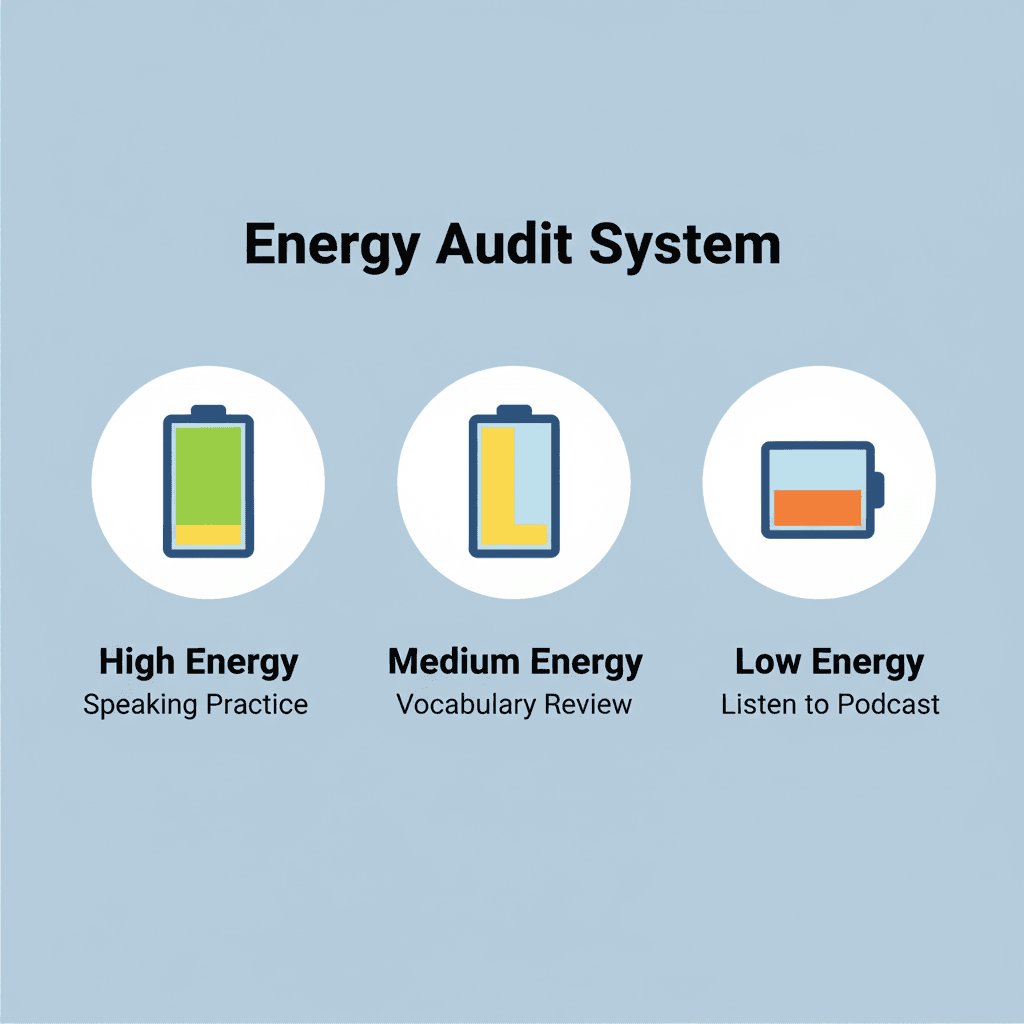
This guide introduces the Energy Audit System, a framework designed for busy professionals. Instead of a one-size-fits-all study plan, you'll learn to match language learning activities to your mental state—whether you're feeling sharp, a bit tired, or completely exhausted. It’s a strategy focused on consistency over intensity, helping you fit language learning into your schedule in a way that feels sustainable, not stressful.
Why It's So Hard (Hint: It’s Not Just About Time)
Let's be honest: juggling a career and language learning is tough. After a long day of meetings, projects, and deadlines, your brain can feel like a depleted battery. This is more than just a time management issue; it's a battle against decision fatigue. The same mental resources you use to excel professionally are the ones needed for the disciplined effort of learning a new language.

When progress feels slow, it’s easy to get discouraged. Many learners quit when they hit the 'intermediate plateau,' a frustrating stage where your effort doesn't seem to translate into noticeable improvement, which drains your motivation. To set realistic expectations from the start, it's helpful to know the scale of the undertaking. According to the US Foreign Service Institute, achieving professional working proficiency in most languages takes between 600 and 1,100 hours of study. This isn't meant to intimidate you, but to empower you to adopt a long-term strategy built on sustainable energy, not just crammed hours.
This is why the old advice to just 'study for an hour every day' often fails. It ignores the reality of a working adult's life. A more effective approach, backed by industry research, is to focus on short, consistent sessions. This shift in thinking is the first step in learning how to learn a language with a full-time job successfully.
The Energy Audit System: Match Your Task to Your Brain
Welcome to the core principle for language learning for busy professionals: Energy Management over Time Management. Instead of forcing yourself into a rigid schedule, the Energy Audit System invites you to check in with yourself. How are you feeling right now? Sharp and focused? A little sluggish? Ready to veg out on the couch? The answer determines your language task for the moment.
Think of your daily mental energy as a finite resource. As research from The Energy Project shows, managing this personal energy is the key to improving focus and resilience—two things you absolutely need for language learning. We'll categorize activities into three levels: High, Medium, and Low Energy. This allows you to make progress every single day, even on the days you feel completely spent.
- •High-Energy Tasks: Activities requiring your full concentration, like speaking practice or learning new grammar. Best for when you feel alert.
- •Medium-Energy Tasks: Activities that involve active review and structured input, like vocabulary drills or interactive exercises. Perfect for a lunch break.
- •Low-Energy Tasks: Passive and enjoyable activities that create immersion without pressure, like listening to music or watching a show. Ideal for your commute or winding down.
High-Energy Tasks (When You're Sharp)
These are the heavy-lifting sessions where you make the biggest leaps. High-energy tasks are for those rare, precious moments when you feel mentally sharp—maybe first thing in the morning, during a quiet weekend hour, or whenever your brain is at its peak. This is when you tackle the most challenging parts of learning.
Active speaking practice is the number one high-energy task. It's the fastest way to build real-world skills and the confidence to use them. You can also use this time to dive into a complex grammar concept or write a few paragraphs in your target language and get them corrected. To put this in perspective, Cambridge University estimates it takes about 350-400 hours of guided learning to reach an intermediate (B1) level. Making your high-energy hours count with focused, active practice is how you get there efficiently.
- •Have a 20-minute conversation with an AI language tutor to practice speaking without scheduling pressure.
- •Work through a new grammar lesson in a textbook and write your own example sentences.
- •Practice pronunciation of difficult words by recording yourself and comparing it to a native speaker.
- •Engage in a language exchange with a partner.
Medium-Energy Tasks (For Your Lunch Break)
You don't need to be at 100% to make meaningful progress. Medium-energy tasks are perfect for those pockets of time where you can focus, but maybe not for a marathon session. Think of your 30-minute lunch break, the 20 minutes before a meeting, or your train ride home. These are ideal moments for what experts call 'microlearning'—short, focused bursts of study that research shows can lead to better retention.
This is the time for intentional review and structured input. You're not just passively consuming content; you're actively engaging with it. This is how you move vocabulary from your short-term to your long-term memory and solidify grammar rules you've already learned. Fitting these sessions into small windows of your day is crucial when chipping away at the 600+ hours the U.S. Foreign Service Institute estimates for proficiency.
- •Use a flashcard app like Anki or Memrise to review vocabulary.
- •Complete a few interactive exercises in a language learning app.
- •Read a short news article or blog post in your target language and look up unknown words.
- •Transcribe a 1-minute audio clip from a podcast.
Low-Energy Tasks (For Your Commute or Winding Down)
This is how you avoid burnout in language learning. On days when you're exhausted, the thought of opening a grammar book can feel impossible. Instead of doing nothing, switch to a low-energy task. These are passive, enjoyable activities that keep you immersed in the language without demanding active brainpower. The goal here isn't to study, but to soak.
Learners in online communities on Reddit and forums frequently credit these low-effort strategies for their consistency. Using 'dead time' like a commute or household chores to listen to a podcast is a classic recommendation for a reason—it works. This approach turns downtime into productive immersion, helping you get familiar with the sounds, rhythms, and culture of the language without the pressure of performance.
- •Listen to a podcast or music in your target language while you commute, cook, or clean.
- •Watch a TV show or movie you enjoy in the target language (with subtitles in that language, if you can!).
- •Follow social media accounts that post in your target language.
- •Flip through a children's book or a graded reader.
How to Build Your 'Work-Integrated' Language Schedule
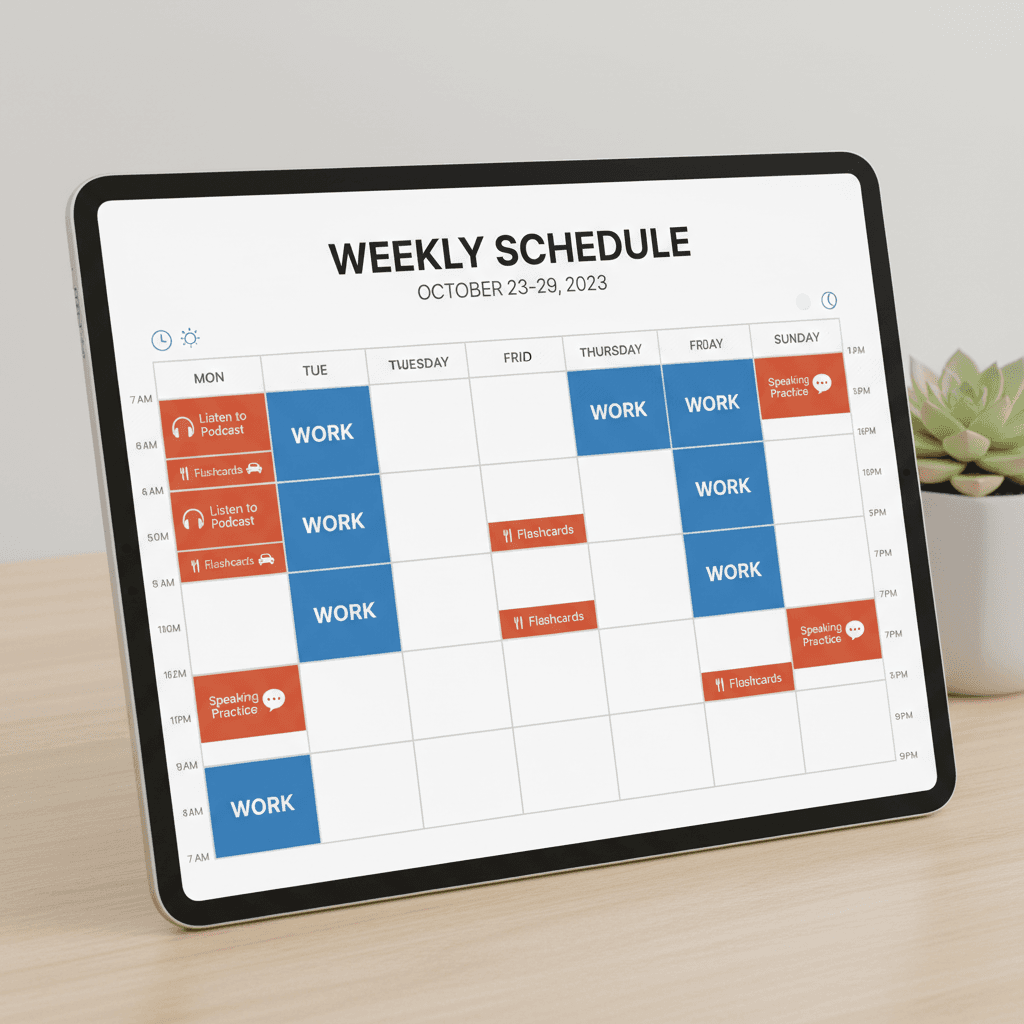
Now let's put the Energy Audit System into practice. The goal is to create a realistic study plan for working adults that weaves into your existing routine. You don't find time; you embed learning into the time you already have. Remember the trend: consistency over intensity. Dedicating just 30 minutes a day can lead to incredible progress. The growth of apps like Duolingo, which reported a 23% year-over-year increase in daily active users in its Q2 2026 report, shows just how many people are embracing this short-session approach.
Example 1: The 9-to-5 Office Schedule
- •Morning Commute (20 mins - Low Energy): Listen to a language learning podcast or music.
- •Lunch Break (25 mins - Medium Energy): Do 15 minutes of vocabulary flashcards, then watch a 10-minute YouTube video in the target language.
- •Post-Work Slump (15 mins - Low Energy): Scroll through social media feeds in your target language as a quick break before starting your evening.
- •Evening (20 mins - High Energy): Dedicate a focused block to speaking practice or a new grammar lesson before you get too tired.
Example 2: The Shift Worker / Unpredictable Schedule
- •Energy Block 1 (High Energy): Whenever you feel most alert (e.g., before your shift), block 20-30 minutes for a core learning activity like a conversation with an AI tutor.
- •Energy Block 2 (Medium Energy): During a scheduled break, use your phone for 15 minutes of app-based exercises or reading.
- •Energy Block 3 (Low Energy): While traveling to/from work or before bed, put on a TV show or podcast for passive listening to stay immersed.
The Best Investment: Flexible Speaking Practice
If there's one activity to prioritize, it's speaking. All the vocabulary and grammar in the world is useless if you can't use it in a conversation. Trends in language learning for 2026 show a massive shift towards systems with an 'early emphasis on speaking and listening.' Yet for busy professionals, this is often the hardest thing to schedule.
Human tutors on platforms like iTalki or Preply are fantastic, but they require booking in advance, which can be a nightmare with an unpredictable work schedule. What happens when your meeting runs late or you need to work overtime? You miss your session. This scheduling friction is a major hurdle. This is where modern technology provides a perfect solution for professionals wondering how to learn a language with a full-time job.
An AI language tutor offers the ultimate flexibility. Tools like SpeaksyAI's AI conversation partner allow you to practice speaking anytime, anywhere, for five minutes or an hour, with no scheduling required. You can have a conversation at 11 PM after a long shift or at 6 AM before anyone else is awake. This 'friction-free' approach gets you speaking early and often, which is the fastest path to fluency.
Getting Your Employer on Board (and Maybe Paying)
Framing your language learning as professional development can be a powerful move, both for your motivation and your wallet. In today's globalized economy, language skills are a significant asset for companies operating in markets like the US, UK, India, Australia, and Canada.
When you approach your manager, don't just ask for support—build a business case. Explain how your new skills will directly benefit the company by improving communication with international clients, partners, or colleagues. To make your case compelling, you can propose it as a 'win-win' opportunity for corporate language training.
- •Cite the Need: Mention that, according to FluentCap Blog's 2026 data, 90% of U.S. employers report that they rely on employees with multilingual skills.
- •Highlight the ROI: Point out that your professional development is an investment for the company. You can even mention that bilingual employees earn 19% more on average, showing it's a valued skill in the marketplace.
- •Present a Plan: Show that you are serious by outlining a plan. You can reference the U.S. Foreign Service Institute's estimate of 600-1,100 hours for proficiency to set realistic expectations for a long-term training goal.
Frequently Asked Questions
Frequently Asked Questions
Ready to speak confidently, on your schedule?
SpeaksyAI is the AI language tutor designed for busy people. Get realistic speaking practice anytime, anywhere, without the pressure.
Join the WaitlistContinue reading

The Best Way to Learn a Language With a Full-Time Job (A System)
Feel too busy to learn a language? It's not about finding more time; it's about managing your energy. Discover a realistic system designed for professionals to finally speak confidently around a 9-to-5.

Learn a Language with a Full-Time Job: A Practical System
Think you're too busy with your full-time job to learn a language? This guide shows you how to integrate effective speaking practice into your work week, without burnout.