Learn a Language with a Full-Time Job: A Practical System
Think you're too busy with your full-time job to learn a language? This guide shows you how to integrate effective speaking practice into your work week, without burnout.

Wondering how to learn a language with a full-time job? The key isn't finding huge, empty blocks of time that don't exist. It's about building a system of small, consistent habits that fit into the life you already have. You don't need to quit your job or sacrifice your sanity; you just need a smarter approach. Instead of feeling like you're falling behind, you can make real, measurable progress by integrating learning into the nooks and crannies of your day. This guide will show you exactly how to do it, turning moments of 'dead time' into powerful opportunities for growth and finally getting you to a place of speaking confidence.
Why Learning a Language Feels Impossible with a Full-Time Job

If you've ever tried to learn a new language while holding down a demanding job, you know the feeling. You start with a burst of motivation, downloading an app and dreaming of ordering coffee in another country. A few weeks later, the app icon is gathering digital dust, and the guilt sets in. This experience is incredibly common, and it’s not a personal failing. The traditional approach to language learning simply wasn’t designed for the realities of modern professional life.
After a long day of meetings and deadlines, the last thing your brain wants is more work. You face decision fatigue, an unpredictable schedule, and the overwhelming sense that you have zero 'free time.' Research from Leyo in 2026 highlights this struggle, showing that fewer than 5% of app users reach conversational fluency, with most quitting in the first three months. The problem isn't your motivation; it's the method. Many learners treat language study as an infrequent, 'all-or-nothing' activity, which is a recipe for burnout when your energy and time are already scarce.
The biggest hurdle for busy professionals is often speaking practice. A 2026 WERC report found that a staggering 97% of learners believe practicing with a real person is crucial for improvement. But how do you schedule a conversation with a tutor or language partner when your own calendar is a chaotic mess of meetings and last-minute tasks? This logistical nightmare leaves many learners stuck in a cycle of passive learning—watching videos and doing flashcards—without ever building the speaking confidence they crave.
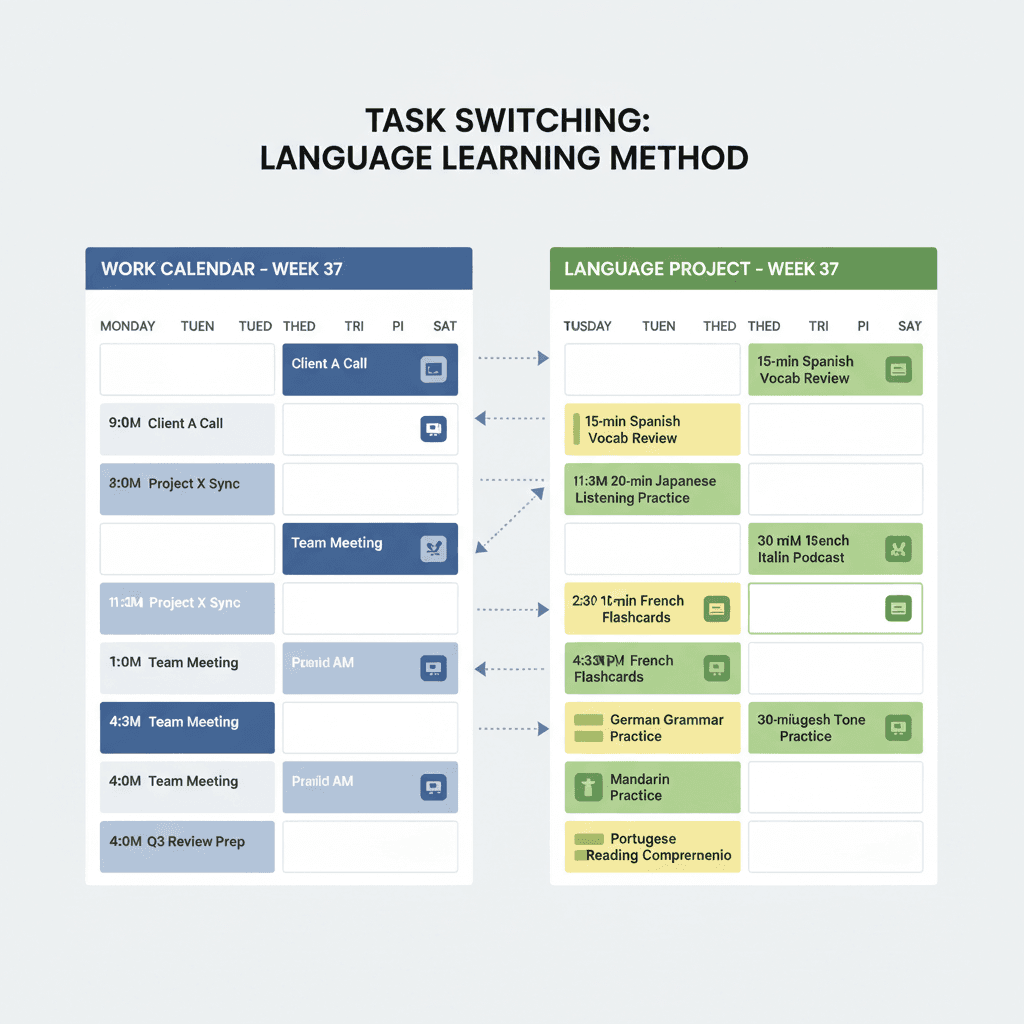
The ‘Task Switching’ Method: Treat Language Learning Like a Project
As a professional, you already have a powerful set of skills: managing projects, breaking down complex goals, and tracking progress. What if you applied that same expertise to language learning? Instead of seeing it as a vague, endless hobby, reframe it as the 'Language Project.' This is the SpeaksyAI System for busy professionals: using the project management principles you live by every day to create a structured, achievable learning plan.
First, you need to scope your project. The Foreign Service Institute (FSI) estimates it takes around 600-750 hours to reach proficiency in a 'Category I' language like Spanish or French. Don't let that number intimidate you; use it to set realistic goals. Instead of 'become fluent,' set a quarterly 'sprint' goal, like 'hold a 5-minute basic conversation about my job' or 'master the past tense.' This agile approach, recommended by industry experts to combat high dropout rates, turns a massive mountain into a series of small, climbable hills.
Next, break your 'sprint' goal into daily tasks. Your project plan isn't about finding a 2-hour block every Saturday. It's about identifying small, consistent actions you can take every day. This is the key to building a long-term habit that avoids burnout. Here’s what your daily 'task list' could look like:
- •Daily Stand-up (5 mins): Review 10 vocabulary flashcards while your coffee brews.
- •Commute Task (20 mins): Listen to one lesson from a language podcast during your commute.
- •Lunch Sprint (15 mins): Complete one grammar lesson on an app or have a short AI-powered conversation.
- •Evening Wind-Down (10 mins): Watch a short YouTube video or listen to music in your target language before bed.
By treating language learning like a project, you shift from feeling overwhelmed to being in control. You have a plan, you have measurable tasks, and you can see your progress every single day. You're not just 'studying'; you're executing a strategy.
Finding Your ‘Hidden Pockets’ of Practice Time
The most successful language learners aren't the ones with the most free time; they're the ones who are best at finding and using 'hidden pockets' of time. This is the 'dead time' scattered throughout your day that often goes to waste scrolling social media. By repurposing these moments, you can rack up hours of practice without ever needing to 'find time' in your schedule. Research from the European Commission confirms that professionals who master this skill reach fluency faster.
Think about your daily routine. Where are the gaps? These 5, 10, or 15-minute intervals are perfect for 'micro-learning.' Here are some specific examples to get you started:
- •The Commute: Whether you're driving, on a train, or on a bus, your commute is a prime opportunity. This is perfect for audio-based learning, like podcasts or audio courses. You can practice your listening and even shadow phrases out loud if you're alone in your car. This is a great way to fit language learning into your schedule.
- •The Coffee Break: While you wait for the kettle to boil or stand in line for your latte, you have a solid 5 minutes. This is ideal for a quick vocabulary review using a flashcard app like Anki or Memrise.
- •Waiting for a Meeting: The 5 minutes before a Zoom call starts? Instead of checking email again, use an AI language tutor to practice introducing yourself or answering a common question. This gets your brain warmed up and uses otherwise dead time.
- •The Lunch Break: Even if you only have 20 minutes, you can dedicate 10 of them to focused practice. This could be a grammar lesson, a short reading exercise, or watching a news clip in your target language.
- •At Your Desk: For desk-based workers, a simple method is to place sticky notes with key phrases on your monitor. This creates passive micro-learning opportunities every time your eyes scan your screen.
- •Household Chores: Folding laundry or doing dishes? Put on a playlist of music in your target language or listen to a slow-paced news broadcast. This is content immersion at its finest.
The goal is to attach a small language habit to an existing part of your routine. When you do X (brew coffee), you also do Y (review 10 words). This automation removes the need for willpower and makes your practice consistent and effortless.
How to Manage Your Energy, Not Just Your Time
For busy professionals, time management is only half the battle. The real secret to sustainable progress is energy management. Pushing yourself to do a difficult grammar lesson after a draining 10-hour workday is a recipe for failure. With a reported 82% of employees at risk of burnout, according to a 2026 analysis by Lifehack.org, fighting against your natural energy levels is a losing game.
The principle of personal energy management, based on research by Dr. Jim Loehr and Tony Schwartz, suggests organizing your learning activities around your energy fluctuations. Instead of a rigid schedule, create a flexible menu of activities and choose one based on how you feel.
- •High-Energy Moments (e.g., morning coffee, mid-day break): This is the time for active, high-effort tasks. Your brain is sharp and ready for a challenge. This is the perfect window for speaking practice. Engage in a conversation with an AI tutor, write a short journal entry, or tackle a complex new grammar concept.
- •Medium-Energy Moments (e.g., early afternoon, right after work): You can still focus, but you're not at your peak. Use this time for structured learning that doesn't require as much creative output. Think of activities like completing lessons in an app, doing interactive exercises, or reading an article and looking up new words.
- •Low-Energy Moments (e.g., late at night, during a tiring commute): Your brain is tired and needs a break. This is where passive immersion shines. Don't try to study. Instead, listen to music, watch a TV show you enjoy, or have a podcast on in the background in your target language. It feels like relaxing, but you're still training your ear to the sounds and rhythms of the language.
By matching the task to your energy level, you make learning feel less like a chore and more like a natural part of your day. This strategy is key to sustaining motivation, a primary challenge for learners juggling work commitments. It's no surprise that tools often used in low-energy moments are surging; Duolingo, for instance, reported a 23% year-over-year growth in daily active users in its Q2 2026 report, showing a huge audience that can benefit from this energy-matching approach.
The Busy Professional’s Secret Weapon: An AI Language Tutor
So, how do you get the crucial speaking practice you need when your schedule is unpredictable? This is where technology provides a powerful solution. While coordinating with a human tutor is a logistical nightmare of time zones and scheduling conflicts, an AI language tutor is always on, ready whenever you have a spare 15 minutes.
For a busy professional, this is a game-changer. You can have a conversation while waiting for your kids at soccer practice, practice a presentation in Spanish before a meeting, or debrief your day in French at 11 PM. This is how you accumulate the hours of speaking practice needed to break through the dreaded 'intermediate plateau,' where many learners quit due to stagnant progress. Experts agree that starting speaking practice early and consistently is the key to building momentum.
An AI conversation partner like SpeaksyAI gives you a patient, non-judgmental space to make mistakes and build confidence. You can get instant feedback on your pronunciation without the fear or embarrassment that often comes with talking to a native speaker for the first time. This allows you to adopt 'micro-learning' habits of just 15 focused minutes of speaking practice daily—a strategy that experts from FluentCap Blog note is far more effective than infrequent, longer sessions. It's the ultimate tool for language learning for busy professionals, turning dead time into productive, confidence-building conversations.
Connecting Your New Language to Your Career
One of the most powerful motivators is seeing a direct link between your efforts and your career goals. Learning a language isn't just a hobby; it's a valuable professional asset that can open doors to new opportunities, promotions, and higher earning potential. Having a concrete career objective is a powerful antidote to the vague goals that cause many learners to drop out.
But how do you leverage this new skill? First, make it visible. Once you reach a conversational level, add it to your resume and LinkedIn profile. Don't just write 'fluent in Spanish'; use a standardized framework to show your proficiency, like 'Spanish - B2 Professional Working Proficiency (CEFR).' This signals to recruiters and hiring managers that you have a tangible, work-ready skill. With 90% of U.S. employers relying on multilingual workers for success, this is a skill that is in high demand.
Next, find ways to use it at work. Seek out Employee Resource Groups (ERGs) for different cultures or propose a language-focused channel on your company's Slack or Teams. Look for multilingual colleagues to practice with during a coffee break. These small interactions not only improve your skills but also build your internal network and signal your capabilities to the company. You can even research if your company offers tuition reimbursement for language courses or certifications, turning your personal development project into a company-sponsored initiative.
Frequently Asked Questions
Frequently Asked Questions
Ready to Speak Confidently on Your Schedule?
SpeaksyAI is the AI language tutor designed for busy professionals. Get unlimited speaking practice anytime, anywhere.
Join the Waitlist