How to Recover From Language Learning Burnout (Without Quitting)
Experiencing language learning burnout feels like hitting a wall. This guide helps you diagnose the root cause and provides a step-by-step plan to recover without losing your progress.

Feeling utterly exhausted by your language studies? If the thought of one more grammar drill makes you want to close the book for good, you’re not alone. The crucial first step in figuring out what to do when you have language learning burnout is to recognize it for what it is: a state of deep exhaustion, not a personal failure. Unlike a temporary slump, language learning burnout is a signal from your mind and body that your current approach is no longer sustainable. This guide will help you diagnose the specific cause of your burnout and give you a clear, actionable plan to not just recover, but to rebuild your confidence and find joy in the language again.
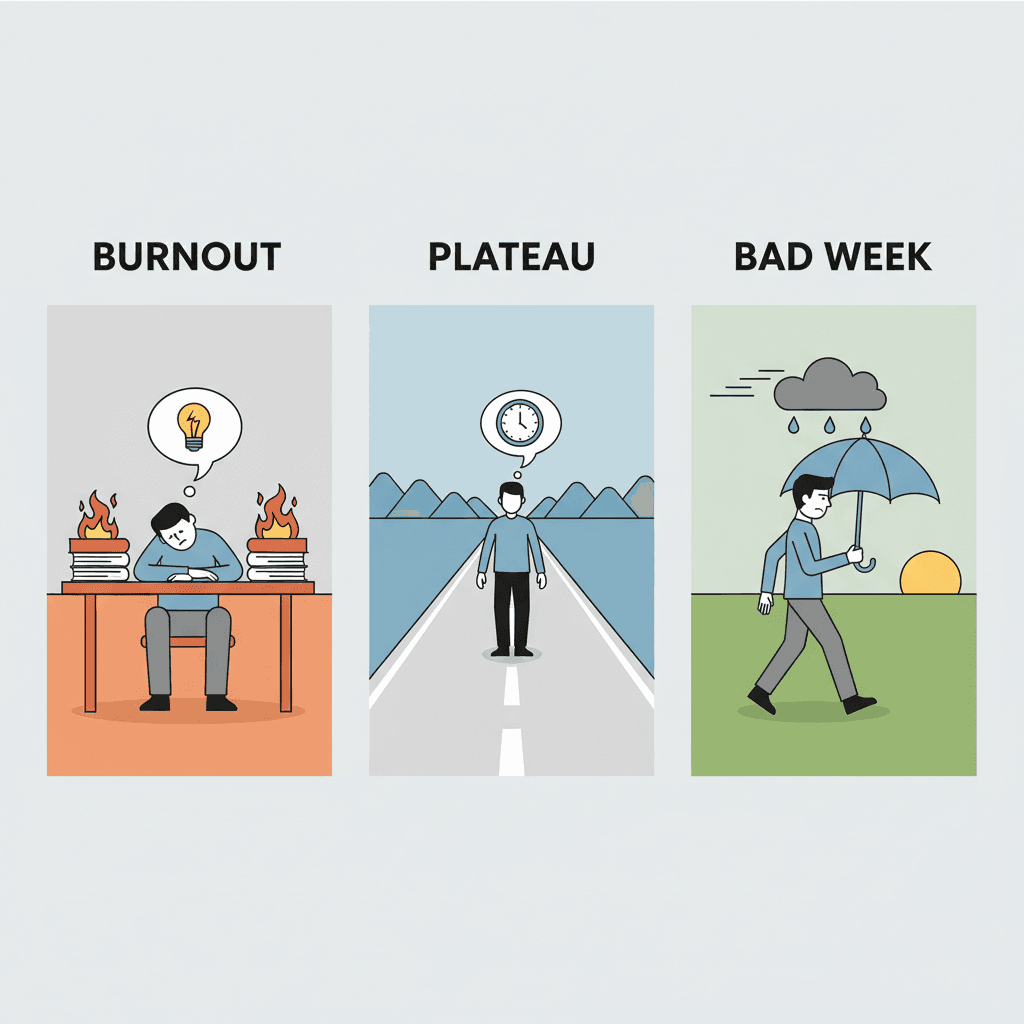
Is It Burnout, a Plateau, or Just a Bad Week?
Before you can create a recovery plan, it's important to know what you're dealing with. Many learners confuse burnout with a learning plateau, but they are very different challenges. A plateau is a normal part of the intermediate stage where your progress slows down despite your efforts. It feels like you’re running in place. Language learning burnout, on the other hand, is a much deeper sense of exhaustion and detachment. It’s when you feel like you can't even bring yourself to try anymore.
The World Health Organization officially recognizes burnout as an 'occupational phenomenon' resulting from chronic workplace stress. While you might not think of language learning as a 'job,' the intense effort it requires makes this definition surprisingly relevant. Applied to your studies, it’s a state of emotional, physical, and mental exhaustion. You might feel cynical about your progress, emotionally distant from the language, and a reduced sense of accomplishment. This isn't just being tired of learning a language for a day; it's a persistent state of depletion.
- •A learning plateau often feels like: 'I'm studying hard, but I'm not getting any better.' Your motivation is still there, but your results have stalled.
- •Language learning burnout feels like: 'I can't even bring myself to open the app. The thought of studying is overwhelming.' It's a crisis of energy and will, not just progress.
Recognizing this distinction is your first small win. If it’s a plateau, you may just need to change your methods. But if it’s burnout, you need to stop pushing and start healing. Pushing through burnout only makes it worse, which is why so many learners quit entirely after the initial 'newbie gains' wear off. Research suggests most people quit within the first 100 hours precisely because they are unprepared for challenges like this.

Diagnose Your Burnout: Find the Root Cause
You wouldn't take medicine without knowing what's wrong, and the same logic applies to language burnout recovery. Generic advice like 'try something fun' often fails because it doesn't address the specific reason you're exhausted. By acting as a diagnostic tool, this guide helps you pinpoint the root cause of your language learning stress so you can apply the right solution. Let's explore the three most common culprits.
Cause #1: Speaking Pressure and Anxiety
Does your heart race when you have to speak? Do you spend conversations rehearsing the 'perfect' sentence in your head, only to miss the moment to say it? This is speaking anxiety, and it's a powerful driver of burnout. Research on language learners has identified a strong link between anxiety, shame, and the emotional exhaustion that defines burnout. The fear of making a mistake or being judged doesn't just feel bad—it actively drains your mental resources.
Psycholinguistic studies show that this fear of negative evaluation actually reduces your brain's working memory capacity. This makes it physically harder to recall vocabulary and form sentences in real-time. The result? You stumble, you freeze up, and your brain logs the experience as 'painful' and 'to be avoided.' Over time, this avoidance becomes a habit, cutting you off from the most rewarding part of learning a language: connection. You end up stuck with passive skills, feeling frustrated and burnt out from a lack of real-world progress.
Cause #2: Grammar & Vocabulary Fatigue
Many language learners fall into the trap of believing that 'more is more.' More flashcards, more grammar rules, more verb conjugation charts. But a routine focused only on these monotonous tasks can lead to what some industry experts call 'Cognitive Language Fatigue.' This is the specific mental exhaustion that comes from endlessly drilling abstract rules and vocabulary without connecting them to meaningful communication.
Your brain isn't a computer that can download infinite lists. Memory consolidation for new words and grammar requires rest, sleep, and context. When you overwhelm it with long, repetitive study hours, you aren't learning more effectively; you're just accelerating your path to burnout.
This type of burnout often feels 'heavy.' You might spend an hour with flashcards only to feel like you've retained nothing, leaving you with a sense of dread about your next study session. The problem isn't your ability to learn; it's that your brain is 'checking out' from the sheer monotony. You're putting in the hours but getting none of the dopamine hit that comes from successfully communicating an idea or understanding a conversation.
Cause #3: The Monotony Trap
Did you fall in love with a language app a year ago, only to now feel a sense of boredom every time you open it? What works for a beginner often stops being effective for an intermediate learner. The 'Monotony Trap' is what happens when your learning routine becomes stale. Humans crave novelty, and if your study methods never change, your motivation will inevitably decline.
Research into language learner boredom confirms this, finding that students quickly disengage from tasks that are too repetitive, such as simple word matching or endless flashcard quizzes. Burnout isn't always caused by stress or overload; sometimes it’s simply a result of profound boredom. If your routine has become predictable and uninspiring, your brain will start to resist it. This is a clear sign that you need to adapt your methods to match your current level and interests, injecting variety back into your learning.
Your Recovery Plan: From Passive Rest to Active Re-Engagement
Now that you've diagnosed the likely cause of your burnout, it's time for a concrete plan. The goal isn't just to stop the bleeding; it's to build resilience for the long haul. Simply stopping your studies with no plan to return can cause your hard-earned skills to fade, making it even more intimidating to start again. Instead, we'll use a structured approach that bridges the gap between total rest and full-on studying.
We'll follow a simple framework: B.A.S.I.C. This stands for Balance rest with light activity, Adapt your methods to your current needs, Simplify your goals to reduce pressure, Inspire yourself by reconnecting with the culture, and Continue with a sustainable pace. Our two-step recovery plan is designed around this principle, moving you from passive rest to active, confident re-engagement.
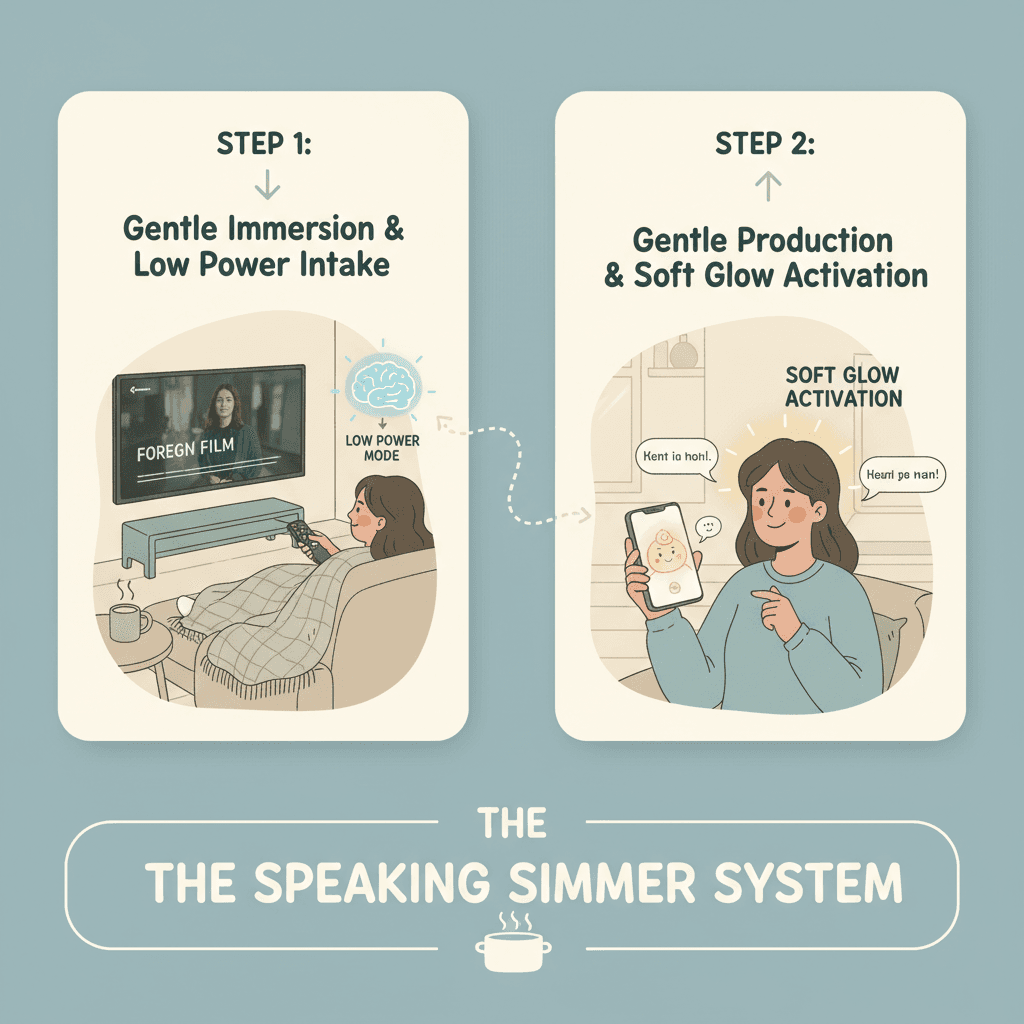
Step 1: The 'Speaking Simmer' System (The Right Way to Take a Break)
If you're truly burnt out, the first step is to take a complete, guilt-free break from active studying. This means no grammar books, no flashcards, no stressful exercises for at least one to two weeks. However, instead of going completely 'cold turkey,' you'll enter the 'Speaking Simmer' phase. The goal is to keep the language ticking over in the background of your mind without any pressure. This maintains your comprehension skills and prevents the 'I've forgotten everything!' panic that can happen after a long break.
- •Listen to music in your target language: Create a playlist and just let it play. Don't try to translate every word; just absorb the sounds and rhythms.
- •Watch familiar TV shows or movies: Re-watch a favorite show from your childhood but with audio dubbed in your target language (with subtitles if you need them). Since you already know the plot, you can relax and absorb the dialogue passively.
- •Follow social media accounts: Find creators, artists, or meme accounts that post in your target language. A quick, visual scroll is a zero-effort way to stay connected.
- •Cook a recipe: Find a simple recipe written in the target language. The context and actions will help you understand the words without a dictionary.
This 'simmer' period leverages the 'spacing effect,' a learning principle where breaking up study sessions over time helps information stick in your long-term memory. It reduces the cognitive load that causes fatigue while still keeping the neural pathways for your new language active. You're resting, but you're also making progress in a different, more sustainable way.
Step 2: Rebuild Confidence with a Judgment-Free Partner
After your 'Speaking Simmer' break, the biggest hurdle is starting to speak again. The fear of being judged, especially after time away, can be paralyzing. This is where you transition from passive recovery to active recovery. Instead of jumping back into a high-pressure classroom or conversation exchange, you need a low-stakes environment to find your voice again. This is where a tool like an AI tutor can be your 'Confidence Rebuilding Partner.'
Research consistently shows that fear of negative evaluation is a primary trigger for speaking anxiety. Creating 'Judgment-Free Zones' where communication is the only goal is a proven strategy for rebuilding confidence. An AI conversation partner provides exactly that. There’s no fear of awkward silences or making a 'stupid' mistake in front of another person. It's just you and the language.
Start with just five minutes a day. Ask the AI simple questions. Describe your room. Talk about your day. With a tool like SpeaksyAI's AI conversation partner, you can have these small, manageable conversations anytime, gradually rebuilding your speaking habit without pressure. It helps you move past the perfectionism that may have contributed to your burnout, reminding you that language is a tool for connection, not a test to be passed. This is how to get motivation back for language learning: by making it feel safe and rewarding again.
Frequently Asked Questions About Language Burnout
Frequently Asked Questions
Ready to Speak Confidently Again?
Join the waitlist for SpeaksyAI and discover your judgment-free AI partner for rebuilding your speaking habit.
Join the WaitlistContinue reading

Feeling Language Learning Burnout? Here's Your Recovery Plan
Feeling drained and unmotivated by your language studies? You're not alone. This is language learning burnout, and it's completely recoverable. Here's how.

How to Avoid Language Learning Burnout: A Recovery System
Feeling drained by language learning? You're not alone, and it's not your fault. Burnout is a sign your methods need a refresh, not a sign of failure. Let's fix your system.