How to Avoid Language Learning Burnout: A Recovery System
Feeling drained by language learning? You're not alone, and it's not your fault. Burnout is a sign your methods need a refresh, not a sign of failure. Let's fix your system.

That feeling of hitting a wall in your language learning journey is incredibly common. You start with excitement, but now every flashcard feels heavy and every grammar rule seems impossible. If you're wondering how to avoid language learning burnout, the first step is to understand that it's not a personal failure—it’s a system failure. Your methods, not your motivation, are likely the problem. The good news is that systems can be fixed. Before you can build a better one, you need to diagnose exactly what you're feeling.
Is It Burnout or Just a Bad Day? A Diagnostic Guide
First, let's validate what you're experiencing. Language learning fatigue is real. It’s the deep mental and emotional exhaustion that happens when the effort you're putting in doesn't match the progress you feel you're making. But is it a temporary slump or the start of chronic burnout? Unlike a bad day, burnout doesn't just disappear after a good night's sleep or a short break. It’s a persistent state of frustration and depletion.
Let's run a quick diagnostic. Ask yourself these questions and be honest about the patterns you see:
Does your study routine feel like a constant, dreaded chore?
Do you feel a growing sense of cynicism or detachment from the language you once loved?
Are you experiencing mental fatigue that makes it hard to concentrate or recall new words?
If you answered 'yes' to these, you're likely dealing with more than just an off day. Tracking your emotional state around your studies can confirm this. According to insights from the Migaku learning community, a consistent pattern of frustration is a key hallmark of burnout. Often, this is because our study systems are built on an unsustainable pace. A recent report on 2026 learning trends highlights that a winning strategy is 'doing more' through frequent, short sessions, not 'studying harder' in long, exhausting bursts. True progress doesn't require studying every day; in fact, studies show that aiming for 3-5 study days per week with scheduled recovery time is far more effective.
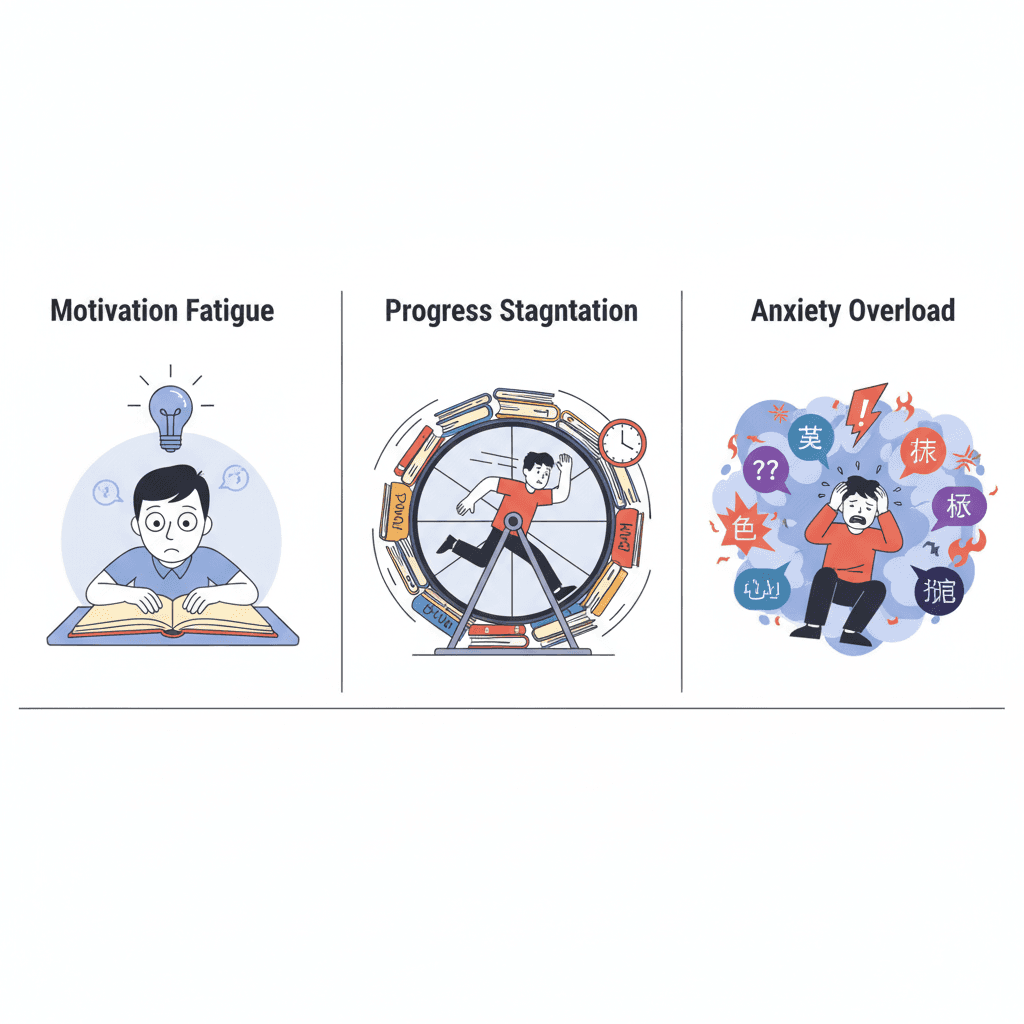
The 3 Types of Language Learning Burnout
Burnout isn't a single, monolithic problem. Experts at Pearson describe it as a state of physical, mental, and emotional exhaustion from prolonged stress or monotony in a learning system. To fix your system, you first need to identify where the breakdown is happening. Most learners experience burnout in one of three key areas.
Understanding this is crucial because neuroscience shows that our brains need downtime. The process of memory consolidation—turning new knowledge into long-term memory—happens during periods of rest. Pushing through exhaustion isn't just unpleasant; it's actively counterproductive to your goals. The key is to find a sustainable rhythm. As one report on smarter learning in 2026 notes, learners thrive when they find autonomy, competence, and connection. Let's explore how a lack of each contributes to burnout.
1. Motivation Fatigue: Your 'Why' Has Faded
This happens when you lose the emotional connection to your learning goals. The initial spark—the dream of ordering coffee in Paris or connecting with family overseas—gets buried under a mountain of flashcards and verb conjugations. Your 'why' has become abstract and distant.
Research shows that motivation based on external pressures, like getting a good grade, is more likely to lead to burnout than a 'why' rooted in personal passion. To combat this, you need to actively seek 'connection.' This doesn't mean more grammar drills. It means reigniting your passion by making the language part of your life in an enjoyable way. A simple change, like swapping a textbook chapter for a movie in your target language, can make a world of difference.
- •Find fun content: Watch a TV series, listen to a new artist, or follow creators on social media in your target language.
- •Connect with the culture: Try cooking a recipe, learning about a holiday, or reading a travel blog about a country where the language is spoken.
- •Plan a future trip: Even if it's just a dream for now, researching destinations can powerfully reconnect you to your ultimate goal.
2. Progress Stagnation: You're Working Hard but Going Nowhere
This is the classic language learning plateau. You're putting in the hours, but your skills feel stuck. The methods that got you from beginner to intermediate suddenly stop working, and the frustration builds. This feeling of incompetence is a major driver of burnout, defined by experts as exhaustion from the prolonged stress of studying without seeing results.
The common impulse is to 'study harder,' but this often backfires, leading to longer, more draining sessions. The solution isn't more intensity; it's a change in strategy. Instead of focusing on one rigid goal, successful learners build flexible systems that prioritize consistency. This means shifting your focus away from what's frustrating you (like complex grammar) and toward low-stress activities that rebuild your sense of competence, like active listening or guided speaking practice.
Pro Tip: According to a 2025 report titled Recharging Your Energy, sustainable progress doesn't mean studying every single day. A system built on 3-5 focused study days per week with scheduled recovery time is more effective for long-term growth and avoiding mental fatigue.
3. Anxiety Overload: The Fear of Speaking Is Draining You
This form of burnout is driven by speaking anxiety. The fear of making mistakes, being judged, or sounding foolish can be so paralyzing that you start avoiding speaking practice altogether. When you stop speaking, your progress stalls, creating a vicious cycle of anxiety and stagnation.
You're not alone in this. A December 2025 study from Cambridge University Press confirmed that fear of social evaluation is a key component of this anxiety. Even more telling, a June 2026 review on PubMed identified interactions with teachers and peers as significant drivers of language learner anxiety. This intense fear isn't just a case of 'nerves'; it's a form of 'debilitating anxiety' that directly harms your confidence and sabotages your journey.
When the fear of judgment leads to avoiding the very practice you need to improve, burnout is almost inevitable. It's not a lack of courage; it's a natural response to a high-pressure environment.
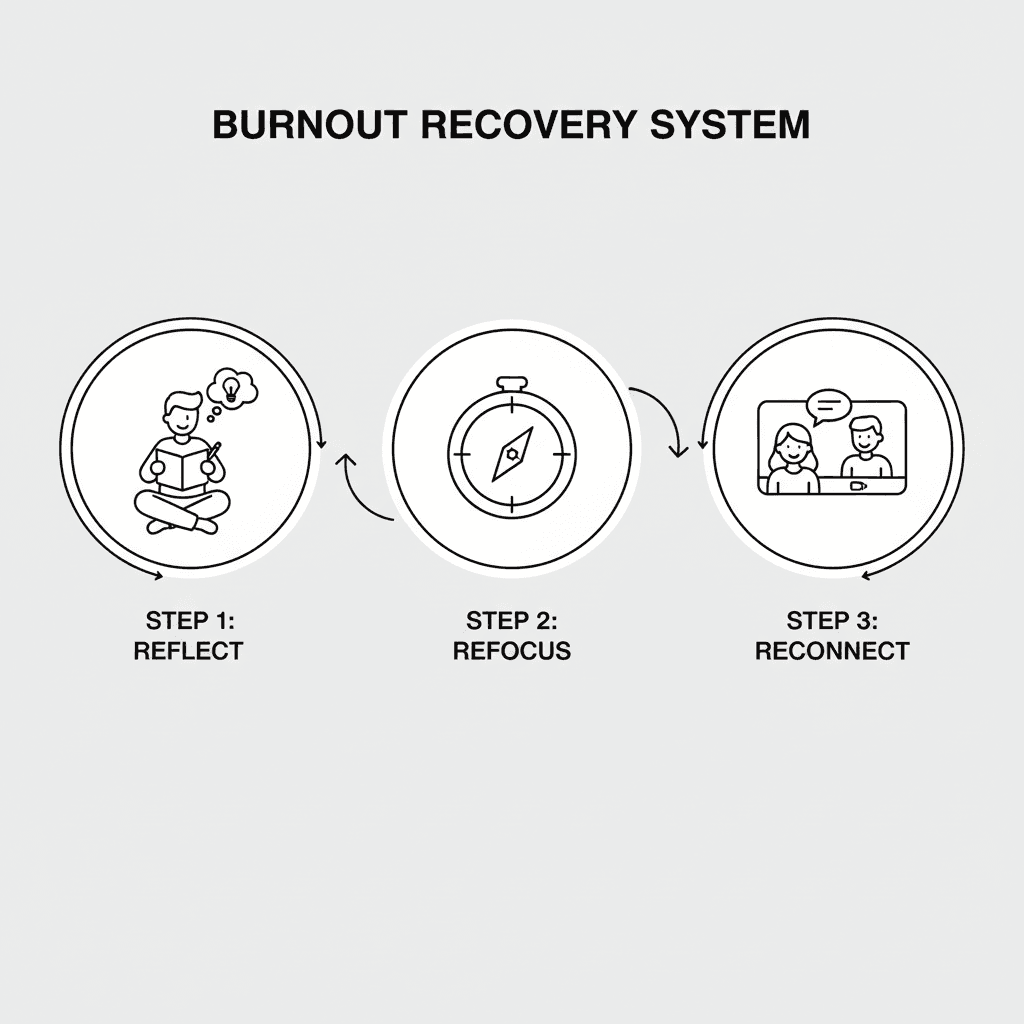
The Burnout Recovery System: Reflect, Refocus, Reconnect
Feeling burnt out is a signal that your current system is broken. Instead of pushing through, it’s time to pause and rebuild with a structured approach. We call this the 'Burnout Recovery System,' a simple three-step framework to get you back on track.
- 1.Reflect: Give Yourself Grace. The first step is to let go of the 'perfect learner' ideal. According to Pearson's experts on burnout-free learning, you must understand your personal energy levels and set healthier boundaries. Acknowledge that you're exhausted and that it's okay to take a step back. Use the diagnostic questions from earlier to pinpoint what type of burnout you're facing.
- 2.Refocus: Build a Sustainable System. Your new language study routine shouldn't be about 'studying harder.' A winning strategy for 2026 is to build a system around frequent, consistent, and short sessions. Aim for 3-5 study days per week, not seven. Schedule your language learning like you would a workout, including rest days. Your goal is consistency, not intensity.
- 3.Reconnect: Find the Joy Again. This is about returning to your 'why.' As learning expert Clara Kinken from the University of Delaware suggests, reexamine the initial excitement you felt. What made you want to learn this language in the first place? Shift your activities toward things you genuinely enjoy, whether it's watching a comedy special, listening to a podcast, or having a low-stakes chat about your favorite hobby.
How to Build a Proactive, Burnout-Proof Language Study Routine
The best way to deal with burnout is to prevent it from happening in the first place. This means shifting from a reactive mindset to designing a proactive, sustainable language study routine. A well-designed system makes consistency feel effortless.
- •Schedule Short, Frequent Sessions: Ditch the two-hour marathon study sessions. Your brain learns better in focused 20-30 minute sprints. Schedule 3-5 of these sessions throughout your week.
- •Prioritize Consistency Over Intensity: The goal is to make language learning a regular habit, not an occasional heroic effort. Showing up for 20 minutes three times a week is infinitely better than cramming for three hours once a month.
- •Incorporate Variety: Don't just do flashcards every day. Mix it up! Dedicate different days to different skills: a listening day (podcasts), a speaking day (chatting with a tutor), a reading day (news articles), and a fun day (movies or music).
- •Integrate into Daily Habits: Find small pockets of time to engage with the language. Change your phone's language setting, listen to a podcast during your commute, or watch a short YouTube video in your target language instead of scrolling social media.
- •Set Systems, Not Just Goals: A goal is 'I want to be fluent.' A system is 'I will practice speaking for 15 minutes every Monday, Wednesday, and Friday.' As author James Clear says, you don't rise to the level of your goals; you fall to the level of your systems.
Smarter Learning in 2026: According to a report on recent language learning lessons, the most successful learners prioritize consistency over intensity and build systems that give them autonomy (choice in what they study), competence (a sense of progress), and connection (a link to the culture and other speakers).
Why an AI Tutor Is Your Best Ally Against Burnout
When you're facing Progress Stagnation or Anxiety Overload, the thought of speaking with a human tutor can be daunting. This is where an AI language tutor becomes your most powerful tool—a true antidote to burnout. It provides a safe, effective space to rebuild your skills and confidence without the pressure.
For learners stuck on a plateau, the impact is measurable. A 2025 meta-analysis of 46 studies found that AI integration has a significant positive effect on language learning outcomes. But for those with speaking anxiety, the benefit is even more profound. An AI tutor offers a 'zero-judgment, zero-anxiety' environment. Platforms like SpeaksyAI provide a safe space to make mistakes, get instant pronunciation feedback, and practice conversations 24/7. There's no fear of negative evaluation, just patient, constructive guidance. This allows you to regain a sense of competence and speak confidently again, on your own terms and on your own schedule.
Frequently Asked Questions about Language Learning Burnout
Frequently Asked Questions
Ready to Rebuild Your Confidence?
Practice speaking in a judgment-free zone. SpeaksyAI offers the infinite patience you need to overcome burnout and find your fluency.
Join the Waitlist