Know a Word But Can't Say It? How to Activate Passive Vocabulary
It's a frustrating feeling: you understand a word perfectly but can't use it in conversation. This guide gives you a step-by-step system to finally activate your passive vocabulary and speak confidently.

Ever felt that frustrating 'tip-of-the-tongue' feeling where you know the perfect word, but it just won’t come out? You're not alone. This gap between understanding a word and using it is one of the biggest hurdles in language learning. The good news is that you can bridge this gap. This guide will show you exactly how to activate passive vocabulary using a simple, systematic approach, so you can stop hesitating and start speaking with confidence. We’ll focus on practical exercises you can do, especially with an AI practice partner, to turn the words you know into the words you use.

That 'Tip-of-the-Tongue' Feeling (And Why It Happens)
That moment a word feels 'locked away, just out of reach' has a name: the tip-of-the-tongue phenomenon. It perfectly illustrates the difference between your two mental dictionaries. Your passive vocabulary includes all the words you recognize when you read or listen. It’s your 'book knowledge.' Your active vocabulary, on the other hand, contains all the words you can retrieve and use correctly when you speak or write. For most learners, the passive dictionary is much, much larger than the active one.
Why does this happen? Research confirms that passive and active vocabularies develop along separate paths and require different kinds of practice. Recognizing a word is a less demanding cognitive task than spontaneously retrieving it to form a sentence. According to insights from HearSay Learn, many learners 'freeze when speaking' not from a lack of knowledge, but because activating passive vocabulary under pressure is a completely separate skill—one that needs its own dedicated training.
There's also a powerful psychological barrier at play. The fear of being judged can cause you to hesitate, preventing you from trying out a new word. This hesitation reinforces the gap, as you fall back on simpler, safer words you already know. It becomes a cycle where the fear of making a mistake prevents you from getting the very practice you need. If this sounds familiar, you might find our article on Feeling Judged When Speaking helpful.
Introducing the 4R Cycle: Your System for Vocabulary Activation
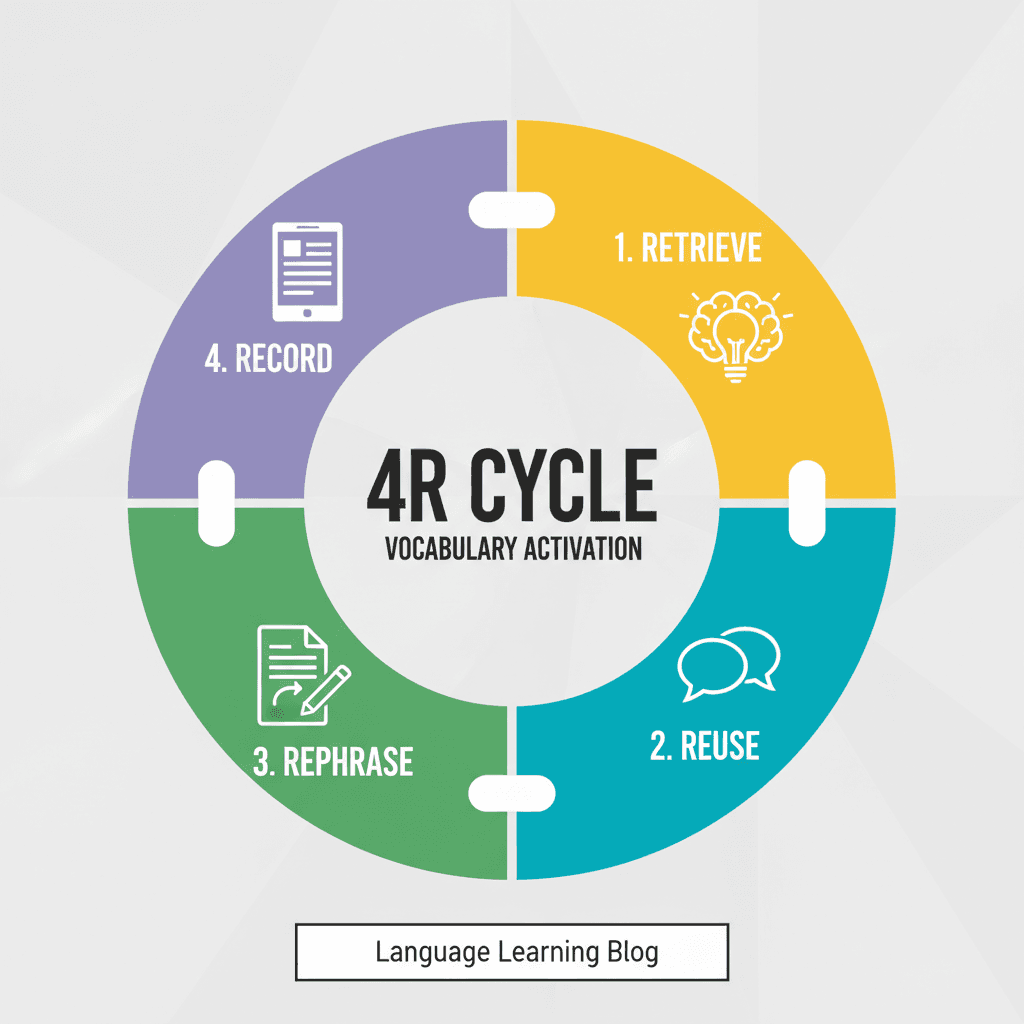
Instead of just hoping words will magically appear when you need them, you need a system. We call it the 4R Cycle, a framework for vocabulary activation based on proven pedagogical methods. It’s a simple, four-step process to systematically move words from your passive understanding to your active use:
- 1.Retrieve: Actively pull the word from your memory into a low-pressure format.
- 2.Rephrase: Use the word in different ways to understand its nuances.
- 3.Reuse: Practice using the word repeatedly in different contexts and conversations.
- 4.Record: Track your new active words to solidify your progress and build momentum.
This system is necessary because, as language teaching expert Dr. Gianfranco Conti notes, our receptive (passive) vocabulary tends to develop about 1.5 times faster than our productive (active) vocabulary. This creates a natural backlog of words you know but can't yet use. The 4R Cycle is your tool for clearing that backlog and closing the gap.
To successfully activate a word and move it into long-term, accessible memory, research suggests a learner needs to encounter and use it 15–20 times in varied, meaningful contexts.
Modern learning strategies increasingly emphasize this kind of structured, repeated practice. A 2025 pedagogical study published in WOS Journals found that interactive, contextualized learning environments—like the kind you can simulate with an AI language tutor—lead to significantly better vocabulary retrieval and use than simple memorization.
Step 1: Retrieve — From Your Mind to the Page
The first step is the simplest and lowest-pressure way to begin: writing. Writing slows you down and gives your brain the time it needs to search for and retrieve a specific word without the pressure of a live conversation. This is a crucial first move in strengthening the neural pathways for that word.
Your task: Pick 3-5 words from your passive vocabulary that you’d love to start using. These could be words you recently learned in an app, read in a book, or heard in a movie. Now, write a short paragraph or at least one unique sentence for each word. The goal is not to be perfect, but to force your brain to produce the word in a meaningful context.
Step 2 & 3: Reuse & Rephrase — The AI Tutor Practice Ground
Once you have your sentences, it's time to bring them to life. This is where you move from the page to production, and it’s where an AI conversation partner becomes your most valuable tool. Unlike a human partner, an AI tutor offers a judgment-free zone where you can experiment, make mistakes, and practice an unlimited number of times.
This is where SpeaksyAI's AI conversation partner can transform your practice. Take the words and sentences you wrote in Step 1 and use them to start a conversation. You can give the AI a direct prompt to guide the practice. Try this:
“Hi! Can we have a conversation about [your topic, e.g., 'travel']? I want to practice using the words [word 1], [word 2], and [word 3]. Please ask me questions that will help me use them.”
As you talk, ask the AI to rephrase your sentences or suggest other ways to use your target words. This Reuse and Rephrase loop is the core of vocabulary activation. For an extra challenge, try timed drills. Set a 60-second timer and try to use your target word in as many different sentences as you can. This trains your brain for faster recall under pressure, making you more prepared for real-world conversations.
Step 4: Record — How to Track Your Activated Words
If you don't track it, you can't measure it. Recording your newly activated words is a critical step that solidifies your progress and provides a huge motivational boost. Seeing your 'active' list grow is proof that your hard work is paying off. Here are a few simple methods for tracking your progress:
- •The Sentence Log: Instead of just a word list, keep a dedicated notebook or digital document where you write down the full sentence you successfully used in your AI practice. A 2025 guide from abblino.com suggests recording 5 full sentences with context tags after each session to solidify new patterns.
- •The Audio Diary: At the end of the day, record yourself talking for 1-2 minutes about your day, a movie you watched, or your thoughts on a topic. As suggested by the ENGin program, you can listen back to identify which new words you used, where you hesitated, and where you reverted to simpler vocabulary.
- •The Digital Deck: Use a flashcard app like Anki with two decks: 'Passive' and 'Active'. When you successfully use a word from your 'Passive' deck multiple times in conversation, proudly move it to the 'Active' deck. This creates a tangible sense of achievement.
The best method is the one you'll stick with. The goal is to create a record of your wins, which will encourage you to keep practicing and tackling even more ambitious vocabulary.
Putting It All Together: A Sample Weekly Activation Routine
Consistency is more important than intensity. You don't need to spend hours a day to see results. A short, focused routine can make a huge difference. Here is a sample weekly plan to put the 4R Cycle into action:
- 1.Day 1 (Retrieve): Spend 15 minutes selecting 3-5 target words. Look them up, understand their meaning, and write at least one original sentence for each.
- 2.Day 2 (Reuse & Rephrase): Spend 15 minutes with an AI tutor. Use your prompt from Step 2 to start a conversation around your target words. Ask for corrections and alternative phrasing.
- 3.Day 3 (Record & Review): Spend 10 minutes updating your sentence log or digital deck with the words you practiced. Review the sentences you created.
- 4.Day 4 (Reuse & Rephrase Again): Spend another 15 minutes with the AI tutor. This time, try a new context or a timed drill to challenge your recall speed.
- 5.Day 5 (Record & Active Use): Update your log. Today, make a conscious effort to use at least one of your target words in a real-world situation—a text to a friend, a short journal entry, or even just saying it aloud to yourself.
- 6.Days 6 & 7 (Rest & Review): Give your brain a break! You can do a light 5-minute review of your sentence log, but the key is to rest and let the new knowledge sink in.
This routine is a template—adjust it to fit your schedule and goals. By making it a habit, you create a system for continuous improvement, helping you avoid the dreaded 'intermediate plateau' where so many learners get stuck.
From Casual Chat to Professional Email: Adapting Your Practice
The beauty of the 4R cycle is its flexibility. You can adapt it to any learning goal, whether you want to sound more eloquent in casual conversation or more professional at work. The key is to make your practice context-specific.
For professional language: Let’s say you want to activate words like 'leverage,' 'stakeholder,' and 'milestone.' Your 'Retrieve' step might involve writing a mock project update email. Your 'Reuse' step with an AI tutor could be role-playing a business meeting. As many learners report in language forums, writing an email gives you time to find the right words, but speaking practice is what reveals your true active vocabulary gaps.
For casual conversation: Perhaps you want to sound more descriptive when telling stories, using words like 'breathtaking,' 'bustling,' or 'serene.' Your 'Retrieve' step could be journaling about a recent trip. Then, you can practice 'Reusing' these words by telling your AI tutor a story about your vacation. This helps you practice using new words in natural, complete chunks, which is essential for fluent speech.
FAQ: Activating Your Passive Vocabulary
Frequently Asked Questions
Ready to Turn Passive Words into Active Speech?
Practice using your new vocabulary in countless scenarios with SpeaksyAI, your personal AI language tutor. Get instant feedback and speak confidently.
Join the WaitlistContinue reading

How to Activate Passive Vocabulary for Speaking: A 4-Step Plan
Do you ever feel like you know thousands of words but can only use a handful when you speak? This guide provides a practical system to bridge that gap.

How to Practice Speaking a Language By Yourself (7 Methods)
Nervous about speaking? Practicing a language by yourself is a powerful way to build confidence. This guide shows you effective methods to find your voice, alone.

Why Speaking Practice Matters More Than You Think
The gap between knowing a language and speaking it is wider than most people realise.