How to Activate Passive Vocabulary for Speaking: A 4-Step Plan
Do you ever feel like you know thousands of words but can only use a handful when you speak? This guide provides a practical system to bridge that gap.

Why You Can't Use Words You Already Know (And How to Fix It)
It’s one of the most frustrating feelings for a language learner. You’ve spent hours studying, you can understand a movie, you can read an article, but when you open your mouth to speak… nothing. The perfect word is on the tip of your tongue, a ghost in your mind that you recognize but can't grab. This experience of 'freezing' is incredibly common and isn't a sign of failure. It's a sign that you're ready for the next step: learning how to activate passive vocabulary for speaking. This isn't just about learning more words; it's about learning how to use the words you already have.
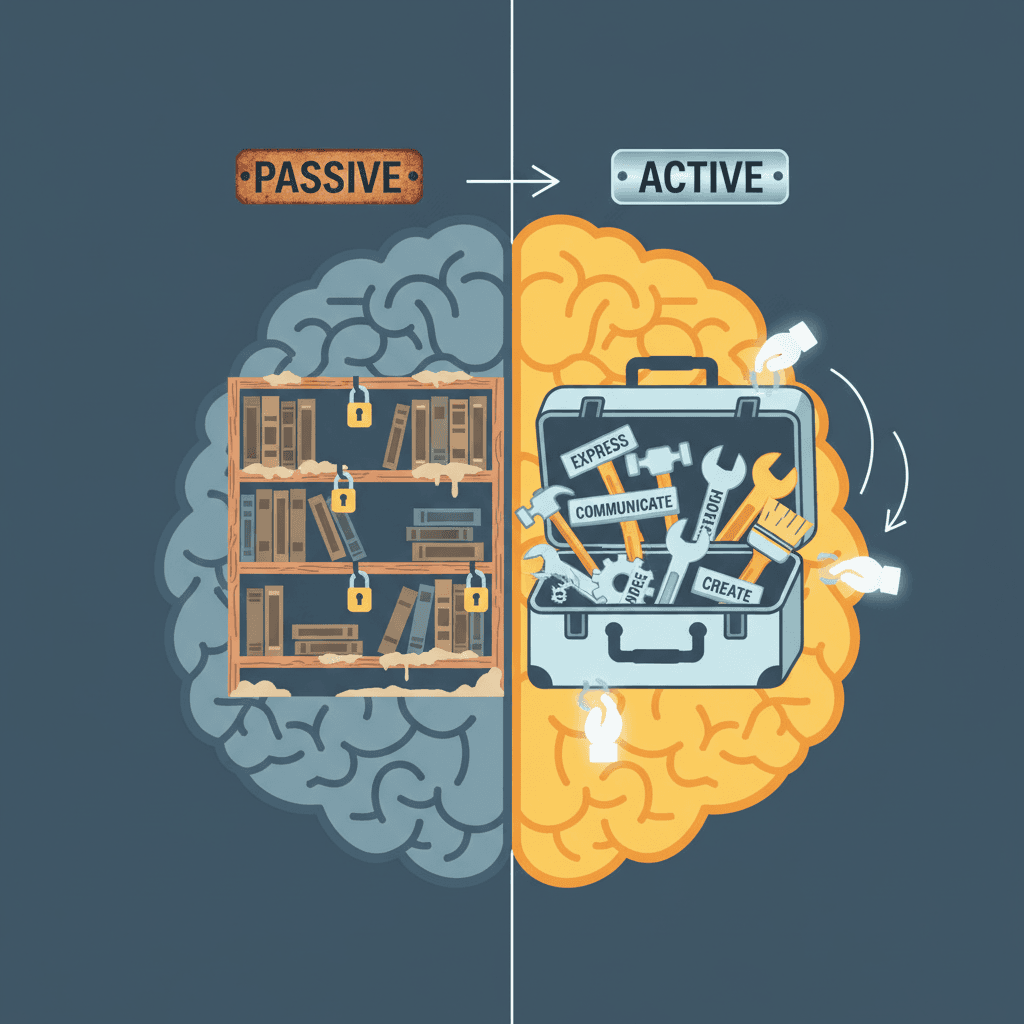
The issue lies in the difference between your active vs passive vocabulary. Think of your vocabulary as a massive library. Your passive vocabulary includes every book on every shelf—all the words you recognize when you read or hear them. Your active vocabulary, however, is the small stack of books you've checked out and are currently using. The gap between these two is a normal function of human memory. According to research, recognition (seeing a word and knowing it) and recall (producing a word on your own) are fundamentally different cognitive tasks. Your brain has separate, independent pathways for each one.
Many traditional language learning methods, from textbooks to popular apps, primarily train your 'recognition' muscle. They help you build an impressive library of passive words, which is a great foundation. However, as noted in From Passive to Active Vocabulary, these methods often don't sufficiently train for active production. This explains why so many learners can achieve a high level of comprehension but struggle to speak with confidence. The brain's working memory becomes overloaded when trying to speak, even when you understand the language perfectly. The solution isn't just more flashcards; it's about building consistent, small habits that strengthen the brain's 'recall' muscle, turning that passive knowledge into an active, automatic skill.
The 4R Cycle: A Simple System to Activate Vocabulary
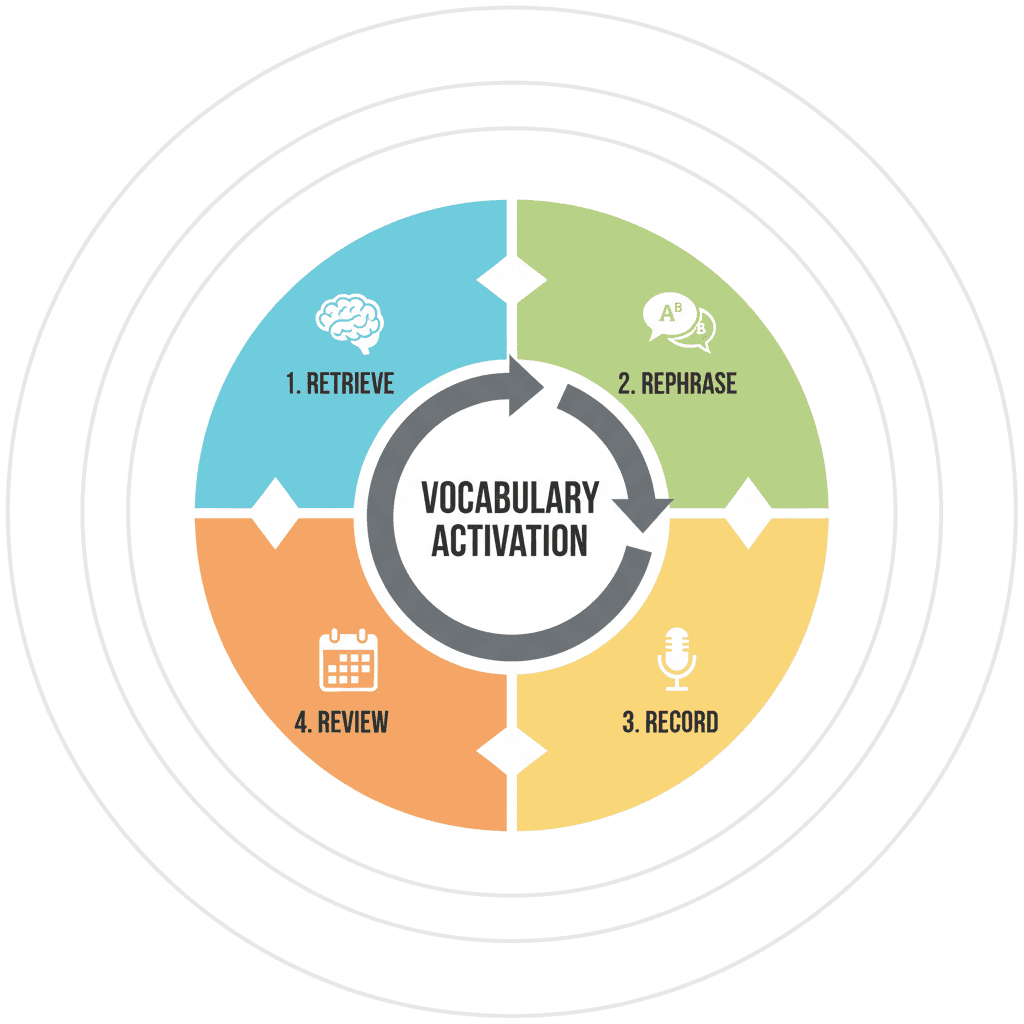
So, how do you build that 'recall' muscle? Instead of random practice, you need a system. We call it the 4R Cycle, a simple framework designed to systematically move words from your passive library into your active toolkit. It's a trainable skill, not an innate talent, and this cycle provides the drills you need for each stage of activation. It acknowledges a crucial finding from academic research: that while online tools are great for building passive vocabulary, they often show little improvement in active use without a production-focused strategy.
- •Retrieve: You must actively force your brain to pull the word from memory, rather than just recognizing it.
- •Rephrase: You need to place the word in a personal context, connecting it to your own thoughts and experiences in a full sentence.
- •Reuse: You have to deploy the word in a low-pressure conversational setting to begin building automaticity.
- •Record: You should save the new sentence (with its context) for structured, spaced review to strengthen the memory.
This cycle isn't just a theory; it aligns with core principles of effective vocabulary instruction, which demands 'active and deep processing' through multiple exposures and ongoing review. Even on forums like Reddit, you'll find successful learners recommending strategies that mirror the 4R cycle: keeping a journal (Record, Reuse) and practicing building new sentences with target words (Rephrase, Reuse). Now, let's break down how you can put this powerful cycle into practice.
Step 1: Prioritize & Retrieve with Forced Production
Before you can activate words, you need to decide which ones are worth the effort. Your passive vocabulary is vast, so trying to activate everything at once is a recipe for burnout. The key is to prioritize. Start with words that are either high-frequency in the language or personally relevant to you. Think about your job, your hobbies, your daily life. What words do you wish you could use? Make a short, manageable list of 10-15 target words to focus on.
Once you have your list, it's time for the first and most crucial step of the 4R cycle: Retrieve. This is where you engage in a technique called forced production language learning. It's exactly what it sounds like: you deliberately create situations that force your brain to retrieve a word, not just recognize it. This active retrieval process is the foundational step for moving vocabulary from passive to active memory. Practicing this under slight, managed time pressure is a powerful way to build automaticity, making it much easier to recall those words during a real conversation.
- •L1→L2 Flashcards: Instead of seeing the foreign word and guessing the meaning (recognition), show yourself the word in your native language (L1) and force yourself to produce the foreign word (L2).
- •Fill-in-the-Blank Exercises: Take a sentence and remove your target word. Your task is to fill in the blank, forcing recall within a specific context.
- •'Gap Retell' Drills: Read a short paragraph, then try to retell the main points, making sure to use 3-4 of your target vocabulary words. The original text provides a 'scaffold' to support your production.
Step 2: Rephrase & Reuse in a Low-Pressure Environment
A word learned in isolation is a word easily forgotten. The next steps in the cycle, Rephrase and Reuse, are about weaving your target vocabulary into the fabric of real communication. Rephrasing means taking a target word and building a sentence around it that is personal and true for you. If your word is 'exhilarating', don't just memorize 'the roller coaster was exhilarating'. Think of a real experience and say, 'Hiking to the top of that mountain was an exhilarating feeling.' This personal connection acts like memory glue.
Next comes the scary part: Reusing the word in a conversation. The fear of making a mistake, of sounding unnatural, or of pausing too long can be paralyzing. This is why practicing in a 'low-pressure environment' is non-negotiable. You need a space where you can experiment, make mistakes, and build confidence without judgment. This is a core part of the vocabulary activation technique known as 'forced production with scaffolding,' where you're prompted to use new words within a supportive framework that reduces speaking anxiety.
This focus on safe, purposeful practice reflects a major strategic shift in the language learning industry. Experts are recognizing that active use is critical for fluency, and there's a move to make speaking practice a core, integrated part of the learning journey from day one. Engaging in 'Thematic Speaking Drills' or 'Conversations with a Purpose' creates the perfect context to activate dormant words by connecting them to meaningful scenarios, which is exactly how you bridge the gap from understanding to using.
Step 3: Record & Review with Smart Spaced Retrieval
You've retrieved a word and used it in a sentence. Amazing! But if you don't review it, the memory will fade. The final step of the cycle is to Record and review. To be effective, don't just write down isolated words. As experts recommend, you should save the full sentences you created during the 'Rephrase' step. The brain is far better at retaining patterns embedded in context than it is at retaining single words. A simple notebook or a note-taking app works well for this.
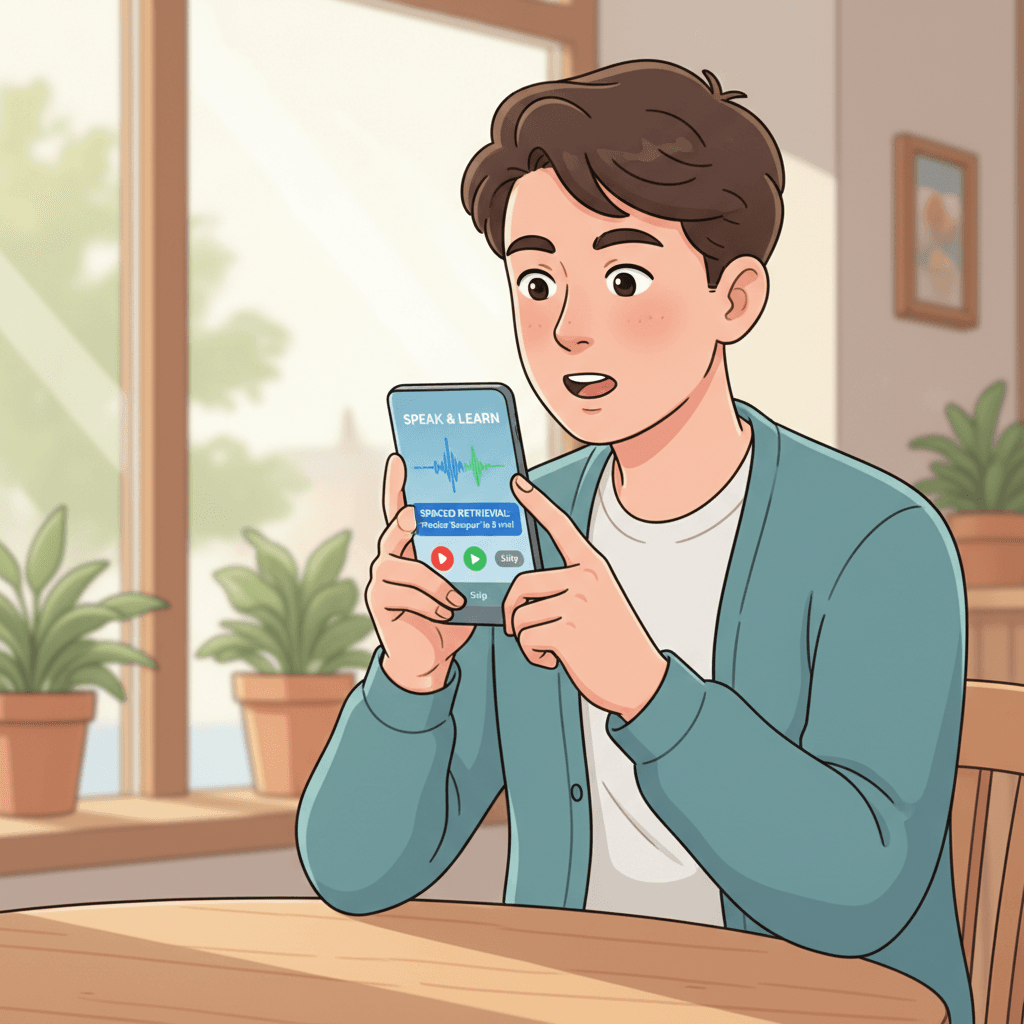
To make your review process truly effective, you should employ an evidence-based memory technique called spaced retrieval for vocabulary. Unlike simple repetition, spaced retrieval involves trying to recall information at progressively longer intervals (e.g., after 10 seconds, then 30 seconds, then 2 minutes). This process of repeatedly and successfully recalling information strengthens the neural pathways, moving the word into your long-term active memory. It’s the difference between cramming for a test and truly learning a concept.
This is where traditional methods often fall short. Manual flashcard apps using spaced repetition are great for securing words in your passive memory, but they don't provide the active usage practice needed to move words into your active vocabulary for spontaneous speech. The missing piece is the 'Reuse' component. This is where modern technology can provide a huge advantage. Smart platforms like SpeaksyAI can automate the entire spaced retrieval process in a conversational context. By tracking the words you struggle with during your practice chats, the AI can strategically re-introduce them in future conversations, creating a personalized, automated review system without the manual work of managing flashcard decks. It's review and reuse, all in one.
Your 30-Day Vocabulary Activation Challenge
Theory is great, but action is what creates progress. Knowing the 4R cycle is one thing; implementing it is another. To help you get started, here is a simple, structured 30-day challenge. Remember, successful vocabulary activation is a trainable skill built on incorporating easy, daily habits. The goal isn't perfection; it's consistency.
- 1.Week 1: Prioritize & Retrieve. Choose 10 high-value words from your passive vocabulary. Spend 5-10 minutes each day on 'forced production' drills. Use L1→L2 flashcards or write out fill-in-the-blank sentences to force your brain to retrieve these 10 words from scratch.
- 2.Week 2: Rephrase & Reuse. Take your 10 words. For each one, write 2-3 personal sentences ('Rephrase'). Then, your mission is to use each word at least once in a low-pressure conversation ('Reuse'). This can be with a language partner or an AI tutor. The goal is simply to deploy them.
- 3.Week 3: Expand & Review. Choose 10 new words and repeat the 'Prioritize & Retrieve' process from Week 1. At the same time, continue to 'Reuse' your original 10 words from Week 2 in conversations to keep them fresh. This is a form of personalized spaced repetition.
- 4.Week 4: Consolidate & Automate. This week, focus on consolidating all 20 words. Engage in thematic speaking drills or role-plays that require you to use as many of the words as possible. The goal is to mix them up and use them more flexibly, helping turn theoretical knowledge into a practical, automatic skill.
At the end of 30 days, you won't just have learned 20 words. You'll have built a complete system for how to move vocabulary from passive to active. This is a skill that will serve you for your entire language learning journey. Celebrate that win!
Frequently Asked Questions
Frequently Asked Questions
Ready to Speak Confidently?
Stop just recognizing words. Start using them. Practice with our AI language tutor in a judgment-free space to build real fluency.
Join the Waitlist