How to Practice Speaking a Language By Yourself (7 Methods)
Nervous about speaking? Practicing a language by yourself is a powerful way to build confidence. This guide shows you effective methods to find your voice, alone.

Why Practice Speaking Alone? (And How to Overcome the Awkwardness)
Let's be honest: the thought of speaking a new language can be terrifying. What if you make a mistake? What if no one understands you? This fear is the single biggest barrier for many learners. But what if you could build confidence and find your flow in a completely judgment-free zone? Learning how to practice speaking a language by yourself is the secret to doing just that. It's your private space to experiment, make mistakes, and improve, long before you have your first conversation with a native speaker.
When you talk to yourself in a foreign language, you're doing more than just making noise. You're actively building what linguists call 'retrieval pathways.' Think of it like creating well-worn paths in your brain. The more you practice pulling out vocabulary and grammar on your own, the more automatically they'll come to you under the pressure of a real conversation. Structured solo speaking practice isn't just a warm-up; it's essential training for your brain to make your knowledge accessible when you need it most.
- •Reduces Speaking Anxiety: Practicing alone removes the fear of being judged, creating a low-stakes environment to build confidence.
- •Improves Speaking Speed: Focused repetition helps you form sentences more quickly and naturally.
- •Builds Active Vocabulary: It forces you to actively use words, moving them from your passive understanding to your active vocabulary.
- •Ingrains Grammar Patterns: Saying sentences out loud helps solidify correct grammar structures in your mind.
The best part? You already have everything you need to start. A classic method is to simply record yourself speaking and play it back—a powerful way to self-correct in private. And with the growth of AI-powered language apps, a new kind of 'judgment-free zone' has emerged, allowing you to get conversational practice without another person even being there. Let’s explore how you can turn this idea into a powerful daily habit.
Level 1: Foundational Solo Practice Techniques
Ready to get started? These foundational solo speaking practice techniques are simple, accessible, and incredibly effective. Think of them as the building blocks for fluency. You don't need fancy software or a conversation partner—just a few minutes and a willingness to talk to yourself. You can even use the material you're already studying from a textbook or app; the goal is to transform that passive knowledge into active sentence production.
The two most powerful starting methods are narrating your life and shadowing. One helps you produce your own original sentences, and the other helps you mimic the natural sound of the language. Some learners also find it helpful to speak to their reflection in a mirror, as it can make self-talk feel more like a real conversation and allows you to observe your mouth movements. Let's break down the first two techniques.
Narrate Your Daily Life
This might be the simplest way to talk to yourself in a foreign language. The idea is to become the narrator of your own life. As you go about your day, describe what you're doing, thinking, or seeing—out loud. “I am walking to the kitchen. I am opening the fridge. I see the milk.” A 2026 study identified this 'instructional self-talk' as a key strategy learners use to improve fluency and increase self-confidence. It makes the language a part of your daily world and forces you to actively recall everyday vocabulary.
The psychological benefits are huge. A 2025 study found that language learners who received 'Positive Self-Talk' training significantly outperformed others in speaking skills and learner autonomy. By creating your own 'free context' for practice, you remove the fear of judgment that often holds you back in a classroom. This freedom gives you the confidence to try new words and sentence structures, which is crucial for making progress.
Using self-talk enhances a learner's 'desire to experiment with language,' which is crucial for building active vocabulary and improving overall fluency and expression.
The Shadowing Technique Explained
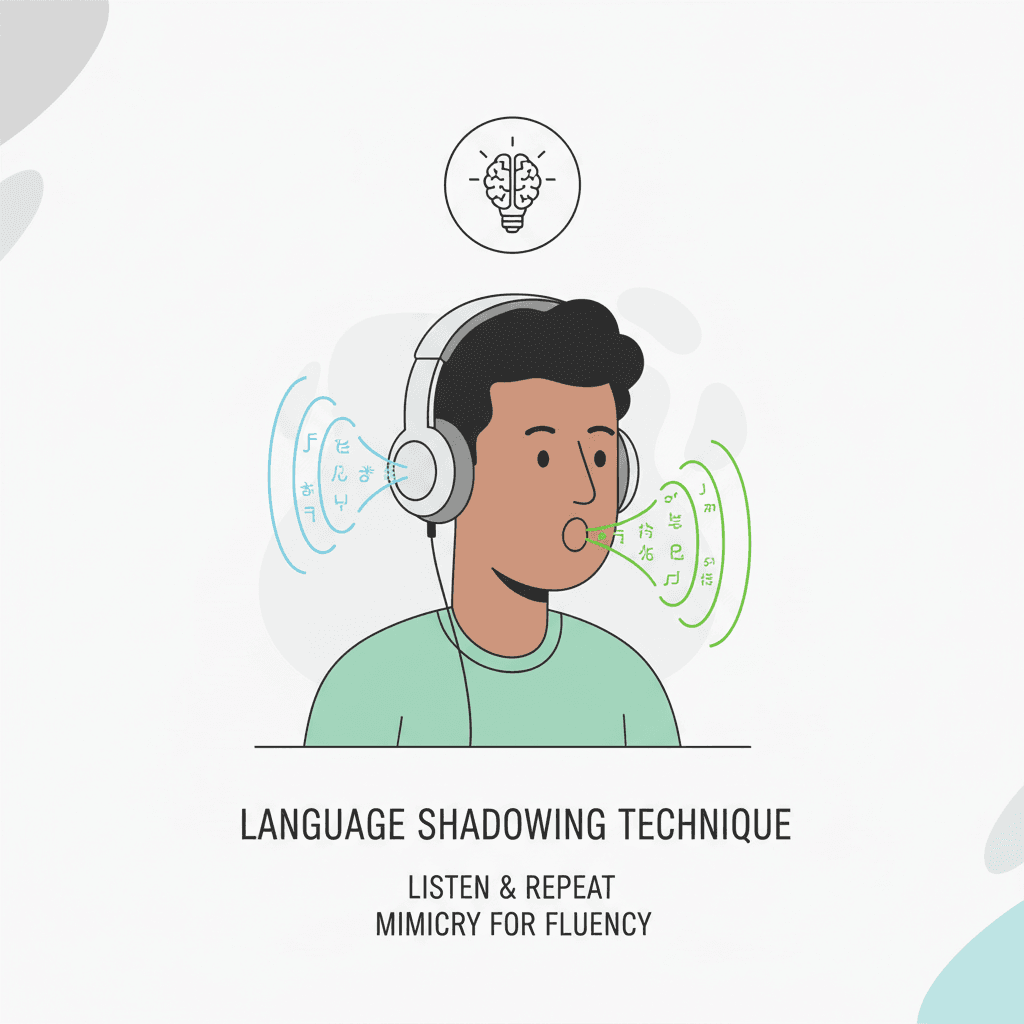
If narrating feels a bit daunting, try the shadowing technique. Shadowing is a powerful method where you listen to a native speaker and repeat what they say in real-time, just a split-second behind them. The goal isn't to understand every single word, but to mimic the speaker's rhythm, pitch, and intonation—what linguists call 'prosody'. This is the key to sounding more natural and less robotic when you speak.
By focusing on the music of the language, the shadowing technique language learning method helps improve four things at once: your listening skills, pronunciation, speaking fluency, and your ability to handle the speed of natural conversation. It connects your ears and your mouth, training them to work together seamlessly. Start with slowly spoken audio, like a podcast for learners or an audiobook, and make sure you have a transcript to follow along if needed.
Level 2: Getting Real Pronunciation Feedback, By Yourself
Talking to yourself is a fantastic start, but it has one major drawback: how do you get pronunciation feedback alone? How can you be sure you're not just practicing the same mistakes over and over? This is the most common challenge with solo practice. Without correction, bad habits can become 'fossilized,' making them much harder to fix later. Fortunately, technology provides a powerful solution.
A major trend in language learning is the rise of AI-powered apps designed specifically for conversational practice. Unlike a mirror or a voice recorder, these tools can listen, understand, and react. This has created a new kind of 'judgment-free' environment where you can speak freely *and* get the guidance you need to improve. The language app market is seeing a clear shift away from simple gamification and toward structured, conversation-focused lessons created by linguists, addressing the need for truly effective practice.
Using Free Tools for a Quick Check
You can get a basic level of feedback using tools you already have. The simplest is your phone's voice recorder. Record yourself saying a few sentences, then listen to a native speaker say the same thing. Can you spot the differences? This simple comparison can reveal a lot about your rhythm and intonation.
For a more advanced check, use a speech-to-text tool. Open Google Translate's voice input, set it to your target language, and start speaking. Does it write out what you intended to say? You can also ask your phone's assistant (like Siri or Google Assistant) questions in your target language. If the technology understands you, it’s a great sign that your pronunciation is clear enough to be understood. It’s a quick and easy way to get a baseline for your clarity.
However, these free tools have a limit. They can tell you *that* you were misunderstood, but they can't tell you *why*. Was it a single vowel sound? The wrong word stress? That’s where a dedicated tool becomes essential.
The Ultimate Solution: An AI Language Tutor
While free tools are a good start, an AI language tutor is a complete game-changer for solo speaking practice. Tools like SpeaksyAI are not just add-ons; they are built from the ground up to solve the feedback problem. They act as your personal conversation partner and pronunciation coach, available 24/7.
The critical element missing from traditional methods is instant, actionable pronunciation feedback. An advanced AI tutor provides exactly that. It doesn't just tell you if you're right or wrong; it analyzes your speech on a granular level. It can pinpoint specific phonemes you're struggling with, show you where your intonation should rise or fall, and highlight incorrect word stress. This is the key to correcting mistakes before they become habits and learning to speak confidently.
This technology represents a major shift in language learning, moving beyond simple games to offer structured, conversation-focused lessons designed by linguists. It’s a serious tool for developing real conversational skills. While some comprehensive language platforms like Busuu offer premium plans starting around €9.99 per month, a dedicated AI conversation tutor provides focused, unparalleled value for improving the one skill that matters most: speaking.
Level 3: Advanced Practice with AI Role-Playing
Once you're comfortable with the basics of self-talk, it's time to level up. To truly become conversational, you need to practice using the language in realistic contexts. This is where AI conversation practice shines, especially for intermediate and advanced learners. An AI tutor can act as a dynamic role-playing partner, helping you prepare for real-world situations.
The industry is rapidly moving in this direction. Language tech companies are shifting away from pure gamification and toward AI tools that offer structured, conversation-focused lessons. These tools act as dynamic speaking partners, creating the 'judgment-free' practice environment that learners need to thrive. Even major tech companies like Google are investing heavily in integrating advanced AI into their language tools, validating this as a powerful and legitimate way to learn.
Simulating Real-World Scenarios
The real magic of an AI tutor is its ability to simulate any conversation on demand. Instead of just having a generic chat, you can direct the AI to role-play specific scenarios. This makes your practice targeted, practical, and directly applicable to your life. Learners are increasingly using these AI chat-partners to build confidence before engaging in real-life interactions.
- •"Let's role-play ordering food at a restaurant in French. You be the waiter, I'll be the customer."
- •"Pretend you are a hotel receptionist in Germany. I need to check into my room and ask for a Wi-Fi password."
- •"Let's simulate a job interview in Spanish. Ask me about my strengths and weaknesses."
- •"You are a shopkeeper in Italy, and I want to return an item. Explain the store policy to me."
Why is this so effective? Engaging with language in authentic, meaningful contexts helps you remember it better. One study found that practicing with real-world contexts led to a 12% boost in speaking fluency and a 20% increase in vocabulary usage. By practicing how to navigate a doctor's office or an immigration interview ahead of time, you build the confidence and vocabulary to handle those situations with ease when they happen for real.
Research found that using simulations to reproduce communicative situations contributed to a 10.1% increase in the high level of foreign language communicative competence in learners.
Your 7-Day Solo Speaking Challenge
Theory is great, but consistency is what brings results. To help you get started, here is a simple, actionable 7-day challenge to turn solo practice into a powerful habit. The goal is just 10-15 minutes a day. You can do this!
- 1.Day 1: The Narrator (10 mins) - As you make your breakfast or coffee, narrate your actions out loud in your target language. Don't worry about perfection, just speak.
- 2.Day 2: Shadowing (10 mins) - Find a 2-minute audio or video clip of a native speaker. Listen once, then play it again and repeat what they say in real-time. Do this five times.
- 3.Day 3: Photo Description (5 mins) - Open your phone's photo gallery, pick a recent picture, and describe everything you see in it for five minutes straight.
- 4.Day 4: AI Conversation (15 mins) - Use an AI tutor to have a simple conversation. The topic: your hobbies or your job. Focus on asking and answering basic questions.
- 5.Day 5: The Critic (15 mins) - Record yourself answering the question, “What did you do yesterday?” Listen back to the recording and try to identify one specific thing you could improve.
- 6.Day 6: AI Role-Play (15 mins) - Practice a real-world scenario with an AI tutor. Try ordering a coffee, buying a train ticket, or asking for directions.
- 7.Day 7: Review & Repeat (10 mins) - Pick your favorite exercise from the week and do it again. Notice how it feels a little bit easier this time? That’s progress!
Completing this challenge isn't about becoming fluent in a week. It's about building the muscle of speaking and proving to yourself that you can do it. Celebrate this small win and keep the momentum going!
Frequently Asked Questions
- Narrate your current actions: "I am typing on my keyboard."
- Describe objects around you: "This is a blue lamp with a white shade."
- Summarize a book, TV show, or movie you recently enjoyed.
- Prepare and rehearse answers to common questions like, "Tell me about yourself," or "What did you do today?" This directly prepares you for real conversations.
Ready for Real-Time Conversation Practice?
Get instant pronunciation feedback and speak confidently with your own AI language tutor.
Join the Waitlist