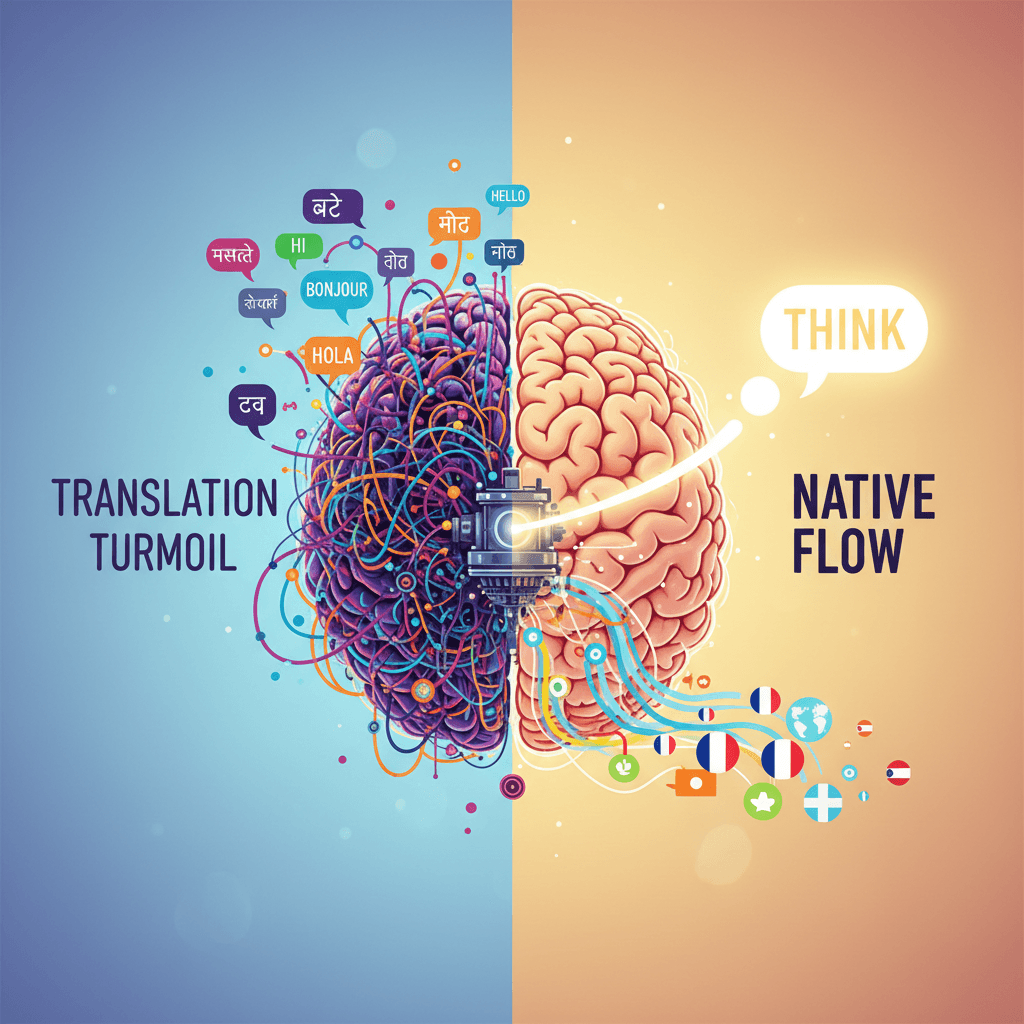
Think in a New Language: The Internal Monologue System
Tired of mentally translating every word? It's the biggest hurdle to fluency. This guide isn't just tips; it's a complete system to build your internal monologue.
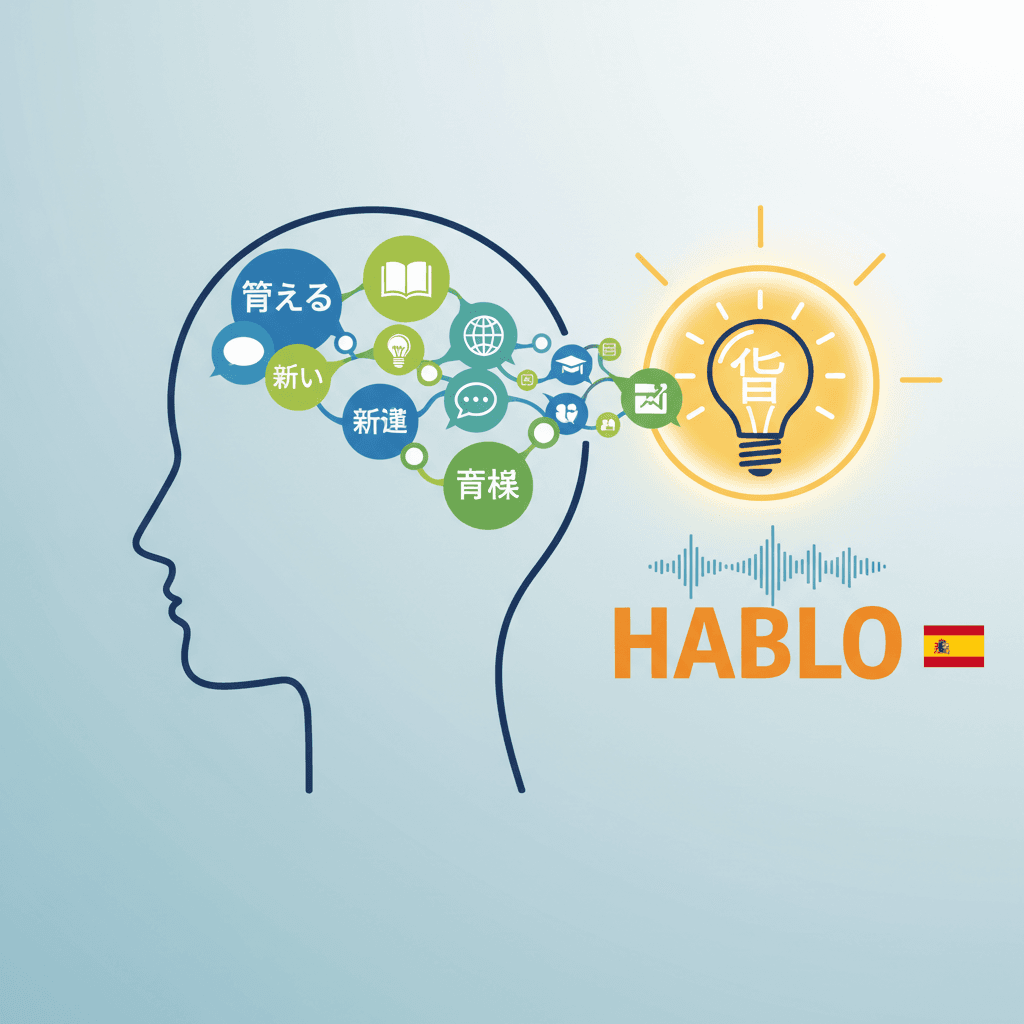
Are you stuck in the frustrating cycle of hearing a question in a new language, translating it to your native tongue, thinking of your answer, translating it back, and finally speaking? If you’re nodding along, you’re not alone. This mental gymnastics is one of the biggest barriers to fluent, confident conversation. But what if there was a way to bypass that translation step entirely? Learning how to think in a foreign language without translating is the single most important skill to unlock natural, effortless speech. It’s the journey from speaking like a learner to speaking with the ease of a native.
Why Translating in Your Head Is Slowing You Down
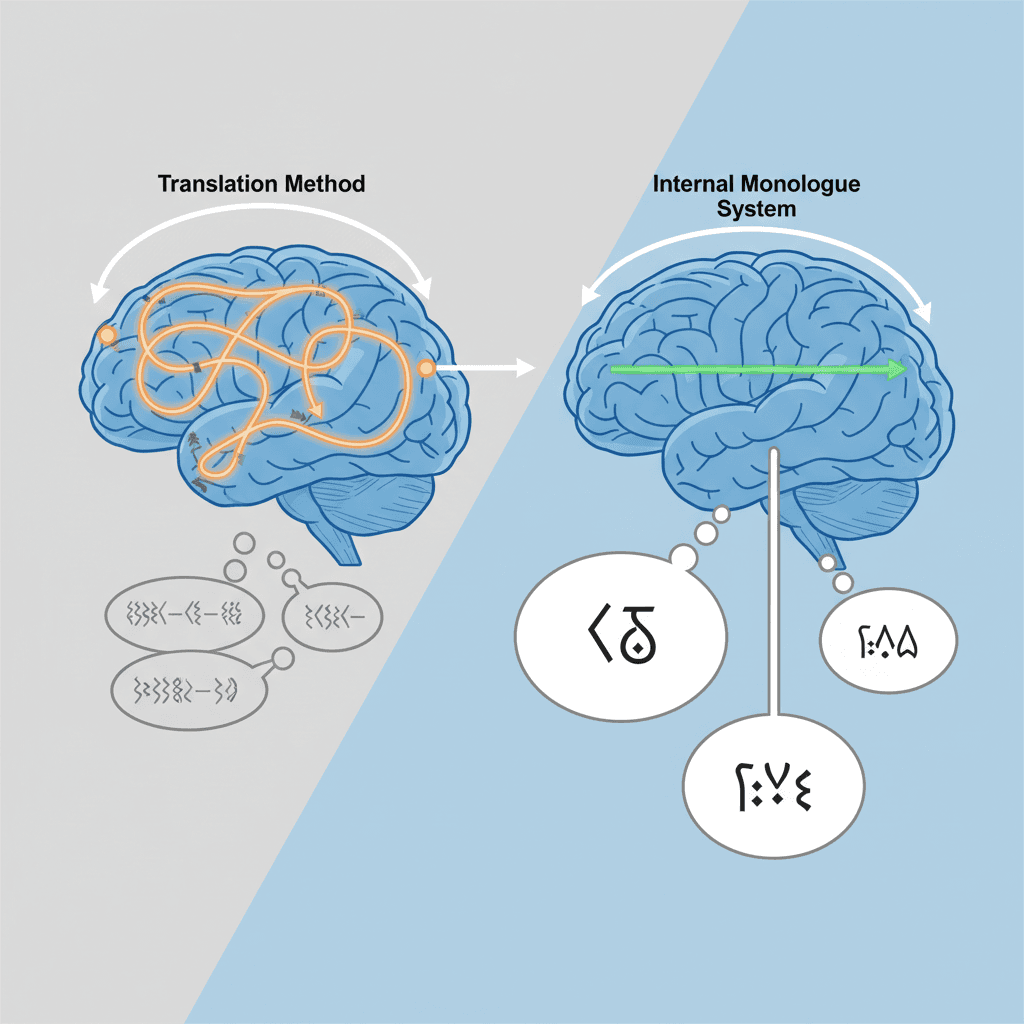
Every time you translate in your head, you’re adding a mental 'middleman' that disrupts the flow of communication. According to a 2025 analysis by abblino, this process makes you “work twice as hard for half the fluency,” leading to speech that feels slow, exhausting, and unnatural. This isn't just a feeling; it’s a measurable cognitive load. Research from Talaera in 2026 indicates that an individual's working memory capacity can predict their ability to produce and comprehend a second language, especially under the stress of real-time translation.
This is why learning to stop translating in your head is the key differentiator between an intermediate learner and an advanced, confident speaker. As highlighted by Effortless English in 2026, thinking directly in your target language is what leads to natural, fluid communication. It removes the hesitation that comes from searching for words and allows you to participate in conversations in real-time. It’s about building the reflexes to respond instantly, which is the cornerstone of speaking confidence.
Relying on mental translation can create an 'illusion of learning' because it tends to store information only in short-term memory, which hinders long-term automatic recall.
Essentially, when you depend on translation, you're not building a direct pathway in your brain from a concept (like a dog) to the new word (like 'perro'). You're building a roundabout, three-step path: concept -> 'dog' -> 'perro'. The goal is to train your brain to forge a direct, two-step connection: concept -> 'perro'. This is the foundation for true fluency and the core of what we'll build together.
The Internal Monologue System: An Overview
So, how do you actually make this shift? It can feel like a monumental task, but it’s not about flipping a switch overnight. It’s about building a new habit, one thought at a time. That’s why we’ve developed The Internal Monologue System. This isn’t just a list of disconnected ideas; it’s an actionable, step-by-step framework designed to gently rewire your brain and build the habit of direct thinking.
- 1.Start Small with 'Situational Thinking': Anchor your thoughts to specific, everyday routines to make the process manageable and build early wins.
- 2.Build Your Direct Vocabulary: Use powerful word association techniques to create direct links between concepts and new words, bypassing your native language entirely.
- 3.Activate Your Inner Voice: Practice thinking out loud to bridge the vital gap between internal monologue and external, spoken speech.
- 4.Practice Spontaneity with an AI Tutor: Use targeted exercises to train your brain for the exciting unpredictability of real-world conversations.
This system is designed to build momentum. A 2025 study in Bilingualism: Language and Cognition found that the ease of activating concepts—what they call 'cognitive fluency'—was most influential during monologic tasks, which is very similar to practicing your internal monologue. By strengthening this inner voice, you’re directly building the foundation for more confident dialogues with others.
The best part? This internal monologue language learning is a trainable skill, not a hidden talent. Language learning experts confirmed in 2026 that shifting your inner monologue is a habit you can develop by starting small—even just five minutes a day—and focusing on learning 'chunks' or phrases instead of single, isolated words. This system will show you exactly how.
Step 1: Start Small with 'Situational Thinking'
The thought of running your entire inner world in a new language is intimidating. So, let’s not do that. Instead, we'll start small. The first step is to choose one specific, recurring situation in your day and make it your 'language lab.' This could be making your morning coffee, your commute to work, or your evening walk.
This is the 'Situations Over Lists' approach, a technique language experts championed in 2025. Instead of trying to memorize a random list of vocabulary, you learn the specific phrases tied to a real-life context. For example, while making coffee, your internal monologue might be: 'I need coffee. I am pouring the water. The coffee smells good. This mug is blue.' These simple observations build direct, useful connections without any translation.
This method naturally encourages 'chunking'—learning whole phrases and connecting them to feelings or moments. A 2025 analysis of language learning trends emphasized that focusing on these chunks is far more effective than word-for-word translation. You’re not just learning words; you're learning the patterns and rhythms of the language in a way that’s immediately applicable.
Step 2: Build Your Direct Vocabulary with Word Association
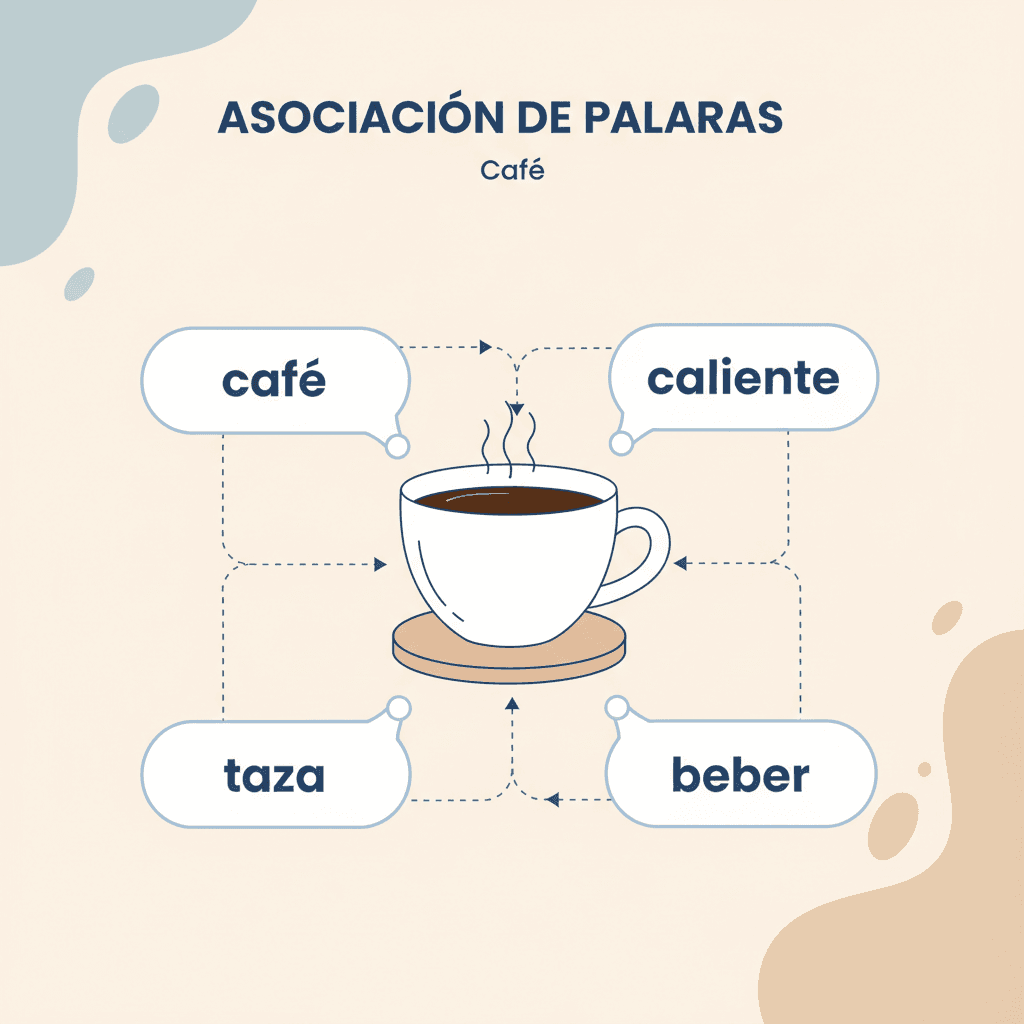
To think in a new language, you need a mental library of words that are directly linked to their meaning. The mistake many learners make is creating a library where every book is cross-referenced with their native language. Word association language learning helps you build a direct library from scratch.
Here’s how it works: instead of using flashcards that say 'dog' on one side and 'perro' on the other, use flashcards with a picture of a dog on one side and 'perro' on the other. A July 2026 guide on language learning highlights this 'picture-first' method to forge direct word-to-meaning links. As you look at the image, think the new word. You are training your brain to see the object and immediately access the foreign word, completely bypassing the English word.
This technique is backed by science. A 2026 language research summary explains that as your word recognition becomes more automatic, your brain naturally shifts to 'top-down, meaning-driven processes,' which is just a scientific way of saying it stops translating. A key technique highlighted in a March 2026 guide is to consciously replace the 'word equals word' habit with a 'word equals meaning' approach, directly linking new vocabulary to the world around you.
Step 3: Activate Your Inner Voice by Thinking Out Loud
Your internal monologue is a great starting point, but to build real speaking confidence, you need to bridge the gap between thought and speech. This is where thinking out loud comes in. It might feel strange at first, but experts agree it's one of the most powerful language immersion techniques you can do by yourself. A July 2026 analysis confirmed that thinking aloud is a more potent tool than silent thinking for connecting internal cognition with external speech.
You can structure this practice. As recommended by multiple 2026 guides, dedicate specific, short periods of your day to narrate your actions aloud. While cooking, say what you’re doing: 'Now I am cutting the onion. I am adding salt.' While walking outside, describe what you see: 'The sky is cloudy. Many people are walking their dogs.' This simple act makes the process of direct thinking more automatic and less abstract.
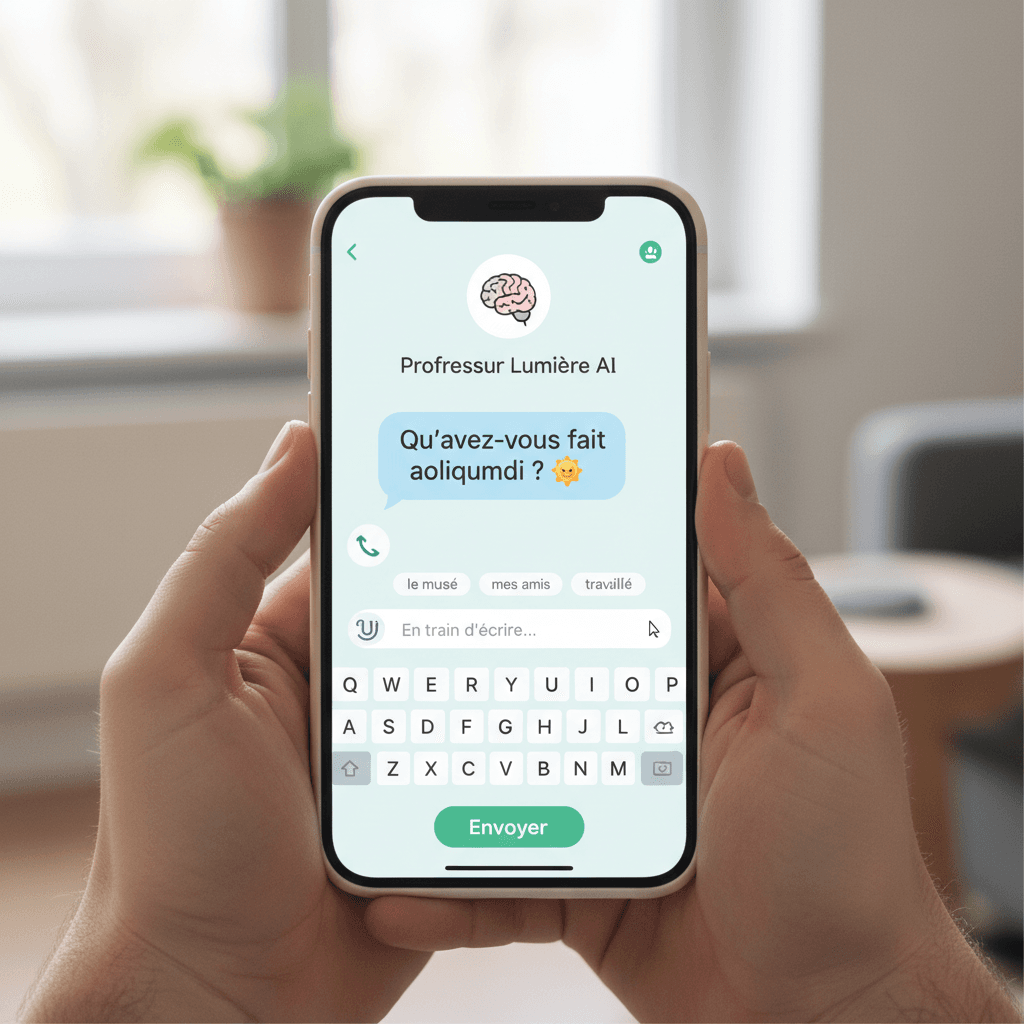
This low-stakes practice builds the 'muscle' for real-world conversations. It helps reduce the hesitation that plagues so many learners who are busy translating in their heads. By getting used to the sound of your own voice producing the language spontaneously, you’re preparing yourself for the pressure of a real dialogue. This is where you can start leveraging modern tools to amplify your progress. For instance, AI-powered platforms like SpeaksyAI (speaksyai.com) let you practice this narration and get instant feedback in a pressure-free environment, directly supporting this crucial habit.
Step 4: Use Your AI Tutor to Practice Spontaneous Thought
The final step in the Internal Monologue System is to train for spontaneity. Real conversations don’t follow a script. They’re unpredictable. According to Test Prep Insight in 2026, AI conversation partners are incredibly valuable for replicating this spontaneity, forcing you to think on your feet in your target language in a way that traditional, rigid apps often can't.
This is where you turn practice into a fun, dynamic game. Use your AI language tutor to create scenarios that demand immediate, untranslated responses. Here are a few prompts to try:
- •"Give me a random object, and I will describe it for 30 seconds without pausing."
- •"Let's roleplay. You are a shopkeeper, and I want to return an item I bought yesterday. Start the conversation."
- •"Show me a picture of a busy street, and I will describe everything that is happening."
- •"Ask me about my opinion on a current event, and I will try to explain my viewpoint."
An August 2026 guide from Future Factors AI highlights that these AI tutors provide a 'judgment-free' zone for this kind of open-ended practice, helping you build confidence. Educators at the 2026 Global English Education China Assembly stressed that AI chatbots enable spontaneous communication practice that moves learners beyond rote memorization and toward authentic fluency.
A 2025 meta-analysis covering 46 separate studies confirmed that AI has a medium-to-large positive effect on language learning outcomes, validating its use as an effective tool for production skills.
From Concrete to Abstract: Expanding Your Inner World
Once you're comfortable narrating the world around you, it’s time to move to the next level: thinking about abstract concepts. This means expressing opinions, making plans, discussing feelings, and summarizing ideas. This is the path to how to be fluent without translating in any situation, not just descriptive ones.
A fantastic activity is the 'silent summary,' a technique recommended by MosaLingua. After reading a news article or watching a short video in your target language, spend two minutes silently summarizing the key points and your personal reaction to it. Don't write anything down; perform the entire exercise in your head. Another powerful exercise is 'emotional narration.' Pause once or twice a day to identify how you’re feeling and then, in your internal monologue, explain why you feel that way in the target language, as if talking to a friend.
This is another area where AI can accelerate your growth. The Internal Monologue System framework suggests using targeted prompts with an AI tutor to practice these skills. For instance, you could ask your SpeaksyAI tutor, "Ask me about my goals for next year" or "Show me a complex painting and ask for my interpretation." This guided practice on abstract topics is exactly what you need to expand your inner world and achieve a deeper level of fluency.
Frequently Asked Questions (FAQ)
Frequently Asked Questions
Stop Translating. Start Speaking.
SpeaksyAI is the AI language tutor that gives you unlimited practice to build fluency and speak confidently.
Join the Waitlist