Stop Translating in Your Head & Find Your Voice When Speaking
Constantly translating in your head is a common roadblock to fluency that makes you sound slow and robotic. This guide explains why you do it and how to stop.

You want to know how to stop translating in your head when speaking a new language. The solution is to train your brain to think directly in your target language, bypassing your native tongue completely. It’s a skill that feels like a superpower, and it’s the true secret to speaking fluently and naturally. While it sounds challenging, it’s a habit you can build with consistent practice and the right methods. This guide will walk you through exactly why this happens and provide a clear, step-by-step system to break the habit for good.
Why You Translate in Your Head (It’s Not Your Fault)
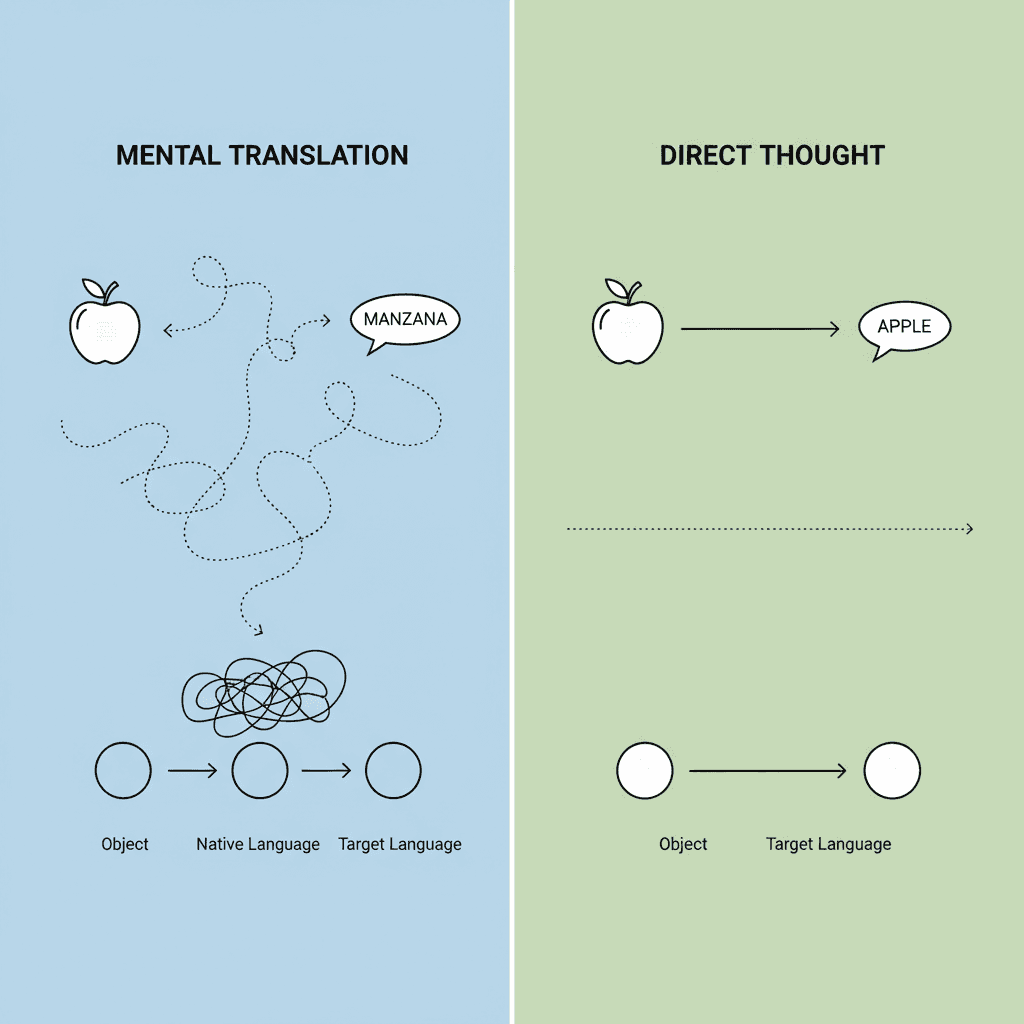
If you find yourself mentally translating every sentence, you're not alone. In fact, this habit is an incredibly common—and predictable—part of the language learning journey. It’s not a sign of failure; it’s often a direct result of how we were taught.
Many of us learned languages in school through the 'grammar-translation method.' This approach, originally designed for studying ancient texts like Latin, focuses on dissecting grammar and translating words one by one. According to experts at Effortless English, this creates a 'translation trap' where your brain is trained to see your native language as the necessary bridge to your target language. This isn't an effective way to communicate in a living, breathing conversation.
Another major driver is the fear of making mistakes. When you’re worried about getting the grammar wrong or using the wrong word, your brain defaults to what it knows best: your native language. You build the sentence carefully in your head, translate it, and only then do you speak. This creates a mental 'traffic jam' that overloads your brain, making you sound slower, more hesitant, and less confident. It's a defense mechanism, but it’s one that holds you back from achieving true fluency.
The Real Cost of Mental Translation

While a natural stage, staying stuck in the translation phase carries a heavy cost that can stall your progress. It’s the hidden reason behind many of the most common language learning frustrations.
- •It slows you down. Your brain is doing double the work—processing the thought, translating it, and then speaking. This creates a noticeable delay that makes real-time conversation difficult and stressful.
- •It makes you sound unnatural. Word-for-word translation often results in awkward phrasing that doesn't capture the natural rhythm and structure of the target language. This is a primary reason learners often feel they sound robotic and struggle to find their unique voice.
- •It increases cognitive load. The constant mental juggling act is exhausting. This is why you might find your mind going blank or suddenly forgetting words you actually know, especially under the pressure of a live conversation.
- •It undermines your confidence. The hesitation and slow response times can make you feel inadequate, contributing to the frustrating 'intermediate plateau' where you feel stuck. As experts on learner motivation point out, this feeling of stagnation is a major reason why many people quit.
Ultimately, by constantly reverting to your native language, you prevent the 'target language' part of your brain from getting stronger. To break free, you need to intentionally build new pathways that connect ideas directly to your new language.
The Direct-Thought Method: A 3-Level System to Break the Habit
Breaking a deep-seated mental habit requires a system. We call it the Direct-Thought Method—a progressive, three-level approach designed to gently rewire your brain to stop mental translation and start thinking directly in your new language. Instead of trying to do everything at once, you’ll build the skill one small, manageable step at a time. This isn't a quick fix, but a sustainable process of habit formation.
Level 1: From Single Words to Direct Concepts
The first step is to break the link between a foreign word and its English translation. Instead, you need to connect that new word directly to the object or concept it represents. Don't just learn that 'maçã' means 'apple'; learn to see an apple and have your brain immediately think 'maçã'.
- •Label your world: Look at an object in your room, like a chair. Think the word for it in your target language—for example, 'la silla'. Don't say 'chair' in your head first. Connect the image of the chair directly to 'la silla'.
- •Use a monolingual dictionary: When you look up a new word, use a dictionary that defines it in the target language. This forces you to stay within the language, creating more connections.
- •Describe your surroundings: Sit in a park or cafe and simply name what you see. 'Tree.' 'Dog.' 'Coffee.' 'Book.' Say each word in your target language without translating first. This is a core strategy recommended by the iLiLi Club to build direct links between concepts and words.
Level 2: Narrating Your World with Simple Actions
Once you're comfortable with single concepts, it's time to move on to simple sentences. The goal here is to connect actions to language in real time. You’ll become the narrator of your own life, using a simple internal monologue.
As you go about your day, describe what you are doing in short, simple sentences. When you make breakfast, think: 'I am walking to the kitchen. I open the fridge. I take out the milk.' Say these sentences in your target language. Don't worry about perfect grammar; the focus is on creating a direct link between the action and the phrase. This practical technique of narrating daily actions helps forge a direct connection between your thoughts and speech.
This moves your focus from individual words to simple patterns, like verb-object combinations. According to a 5-step strategy from StoryLearning, this shift is a critical step to overcome the habit of in-head translation.
Level 3: Thinking in Chunks and Patterns
Fluent speakers don’t think in single words; they think in 'chunks'—groups of words that naturally go together. For example, a native English speaker thinks of 'a cup of coffee' as one unit, not four separate words. Learning to think in chunks is how you’ll unlock conversational speed.
- •Learn phrases, not just words: When you learn a new noun, learn it with its common verbs. Instead of just 'decision', learn 'make a decision'. Instead of 'appointment', learn 'book an appointment'.
- •Use flashcards for full sentences: Create flashcards with common, useful phrases. On one side, have 'I need to...' and on the other, have the target language equivalent. Practice recalling the entire chunk.
- •Listen for patterns: When watching shows or listening to podcasts, pay attention to repeated phrases and collocations. As experts from Effortless English suggest, this 'deep listening' with repetition helps you absorb language patterns naturally, bypassing grammar rules and translation.
One of the most effective strategies to stop translating in your head is to learn phrases instead of single words and use target language definitions to build associations directly within the language.
Your Training Ground: How to Practice Thinking Directly
Practicing the Direct-Thought Method in your head is the first step, but the real progress happens when you start using it in conversation. This is often the most intimidating part. You need a safe space where you can practice speaking on the spot, make mistakes, and build the confidence to trust your direct-thinking brain.
This is where modern technology can be a game-changer. An AI conversation partner, like the one offered by SpeaksyAI, provides the perfect, judgment-free training ground. You can have open-ended conversations about any topic, forcing you to respond in real time without the chance to pre-translate everything. You can stumble, correct yourself, and try again without the social pressure of talking to a person. This safe practice is essential for anyone serious about how to stop translating in your head when speaking.
According to industry research, providing a 'safe space to fail' is a key reason AI is being integrated into language tools. It helps learners overcome the 'intermediate plateau'—a common stage where fear of mistakes halts progress—by creating a judgment-free environment to practice speaking on the spot.
How to Manage the Frustration of Feeling 'Slow'
As you start practicing the Direct-Thought Method, you might feel... slow. Your responses may not be as quick as they are when you translate. This is normal. In fact, it’s a sign that you're doing it right. You are forging new neural pathways, and that takes effort. Think of it like building a new muscle; it feels weak at first, but it gets stronger with every repetition.
Research on why learners quit shows that 'unrealistic speed expectations' are a primary cause of burnout. Don't fall into this trap. Instead of judging yourself for not being faster, celebrate the small win: you are actively choosing to think in a new language. That feeling of 'slowness' is the feeling of growth.
Feeling Stuck? It Might Be a Good Sign. Many learners quit because of the 'intermediate plateau,' where progress feels slow. But hitting this stage isn't failure—it's proof you've moved beyond the basics and are now building the complex pathways needed for fluency. A key trend in language learning is to focus on consistency over intensity. Small, daily habits are far more effective for preventing burnout and achieving long-term goals.
Frequently Asked Questions
Frequently Asked Questions
Ready to Practice Thinking on Your Feet?
SpeaksyAI provides a judgment-free space to practice speaking, helping you break the translation habit and build the fluency to speak confidently.
Join the Waitlist