How to Overcome Fear of Speaking a New Language With an AI
The fear of speaking a new language is real, but so is the solution. Forget 'just start speaking'—discover how an AI language tutor provides a safe, judgment-free space to practice.
You’ve spent hours memorizing verb conjugations and vocabulary lists. You can read an article or follow a movie in your new language. But when it’s time to actually speak? A wave of panic hits. Your mind goes blank, your heart races, and the words just won’t come out. If you’ve ever wondered how to overcome the fear of speaking a new language, you are not alone. This is one of the most common and frustrating hurdles learners face, but it’s one you can absolutely conquer.
Why 'Just Start Speaking' Is Scary (And Often Ineffective)
Well-meaning friends and teachers often give the same advice: “Just get out there and speak!” But this advice ignores the very real psychology of language speaking anxiety. This fear has a name: xenoglossophobia. It’s a specific type of anxiety rooted in a deep-seated fear of negative evaluation. You worry about being judged for your accent, making a grammatical error, or simply being misunderstood. Your brain perceives the situation as a social threat.
Speaking a new language is incredibly demanding. As one 2025 analysis noted, it requires the simultaneous processing of word choice, grammar, pronunciation, and sentence structure. When you add anxiety to this cognitive load, your brain can feel overwhelmed and simply 'freeze up' in what is essentially a biological safety response. It's not a personal failing; it's your body trying to protect you from what it perceives as an unsafe situation.
This isn't just a feeling. Research backs it up. A 2025 study from Cambridge University Press & Assessment involving 262 language students found that the difficulty of retrieving vocabulary was a primary trigger for their speaking anxiety. When you're put on the spot, the pressure to find the right word can be enough to trigger a full-blown anxiety response. This is why simply 'starting to speak' in a high-pressure environment can often do more harm than good, reinforcing the fear instead of diminishing it.
Your Judgment-Free Practice Zone: The AI Language Tutor
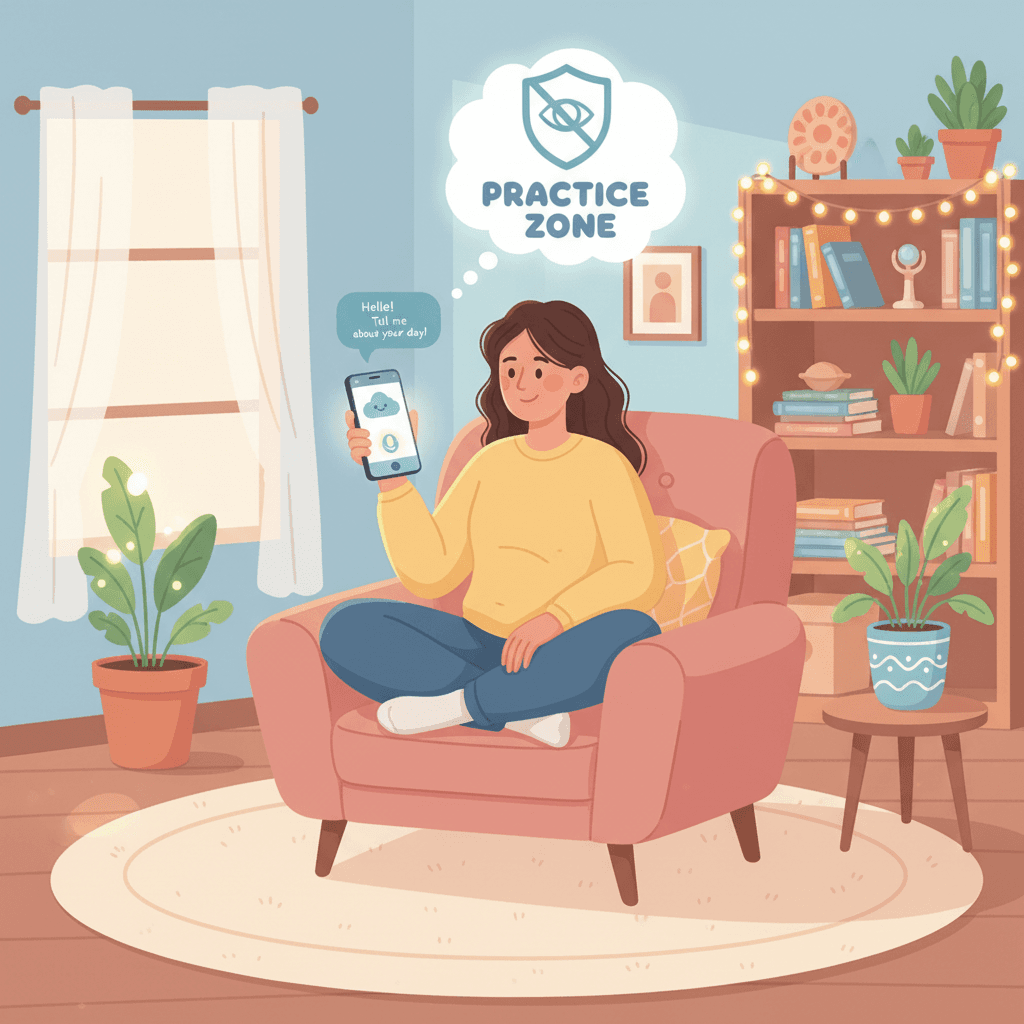
So, if jumping into conversations isn't the answer, what is? Imagine a practice partner who is infinitely patient, available 24/7, and will never, ever judge you. This is the power of an AI language tutor. It's a revolutionary tool that creates a safe, encouraging, low-stakes environment—what many are calling a 'judgment-free practice zone'—to help you build real speaking skills without the social pressure.
The fear of making mistakes in language learning is a major barrier. An AI partner removes this barrier completely. You can stumble over words, try out new phrases, and get your pronunciation wrong a hundred times, all without an ounce of embarrassment. This private practice space is designed to help you tackle the exact issues, like vocabulary recall, that trigger anxiety in the first place. You can practice speaking a language alone until you feel ready for the real world.
Platforms like SpeaksyAI are built on this principle. They provide the crucial scaffolding to take you from passive knowledge (understanding the language) to active skill (speaking it). Instead of just offering abstract advice, an AI tutor gives you a concrete way to take action, build speaking confidence, and prepare for real-world interactions at your own pace. The goal isn't to replace human connection, but to build you up so you can embrace it confidently.
A 5-Step Plan to Build Confidence with Your AI Partner
Ready to move past the fear? Here is a concrete, actionable plan to use an AI language partner to build sustainable speaking confidence. Think of it as your personal training program for learning how to speak confidently.
Step 1: Start with 'Micro-Conversations'
The biggest hurdle is often the first one. To overcome it, you need to make it as small as possible. Don't try to have a 30-minute debate. Start with a one-minute 'micro-conversation' with your AI tutor. The goal is simply to open your mouth and produce sounds in your target language, no matter how simple. This approach is a form of gradual exposure, a proven method for conquering fear by incrementally building comfort and confidence.
- •Describe what you see out your window.
- •Talk about what you had for breakfast.
- •Explain your plans for the weekend in one or two sentences.
- •Name five objects in the room around you.
Starting with simple topics directly addresses the anxiety trigger of vocabulary retrieval. You're using words you likely already know in a context that has zero stakes. This builds a positive feedback loop and trains your brain to associate speaking with success, not fear.
Step 2: Use Instant Feedback to Improve Privately
One of the biggest sources of language speaking anxiety is the fear of being corrected publicly. AI tutors eliminate this entirely by providing immediate, private feedback on your pronunciation, grammar, and word choice. This transforms correction from a source of shame into a powerful tool for improvement.
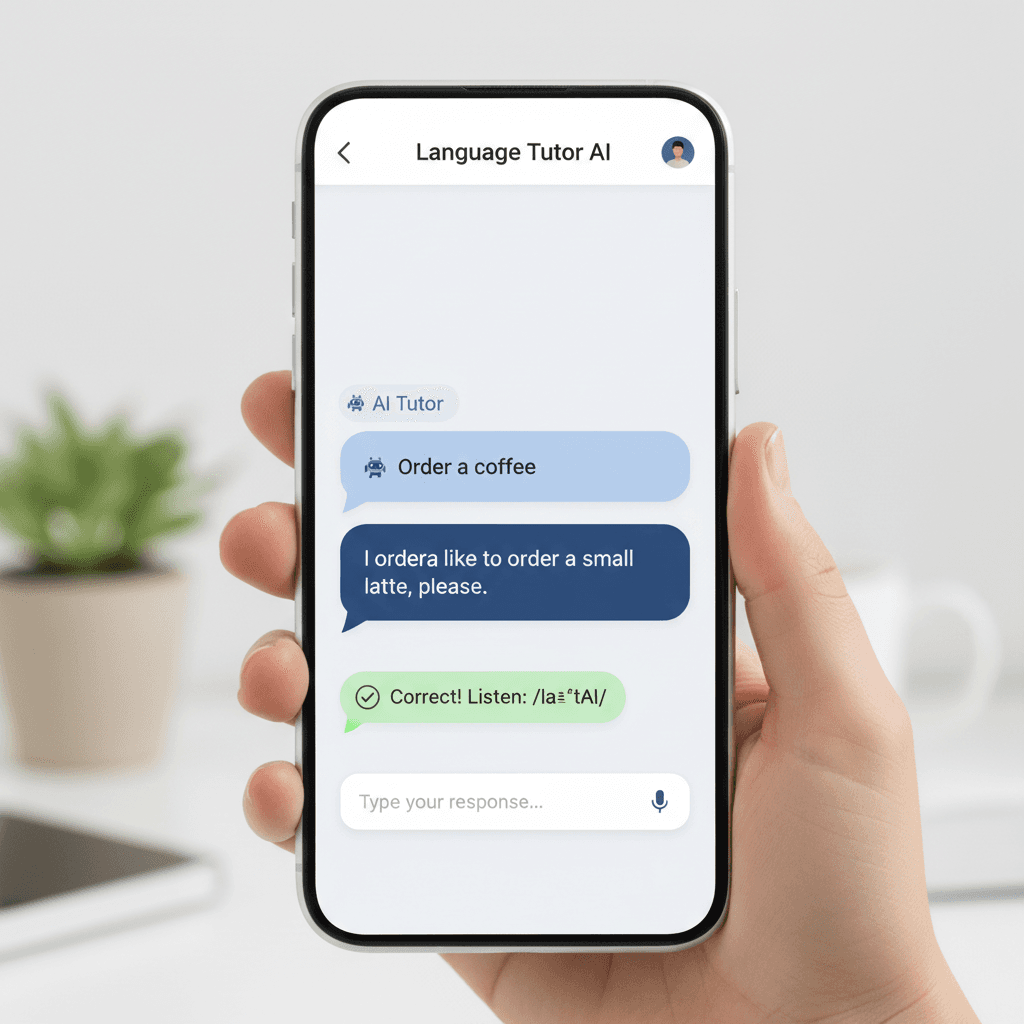
Think of it as a private sandbox. You can experiment, make mistakes, and get clear, actionable feedback on how to improve. Did you mispronounce a word? The AI will show you how to say it correctly. Was your sentence structure awkward? It can suggest a more natural phrasing. According to Berlitz, this real-time feedback loop allows learners to build skills privately without the fear of failure that often comes with human interaction.
This process is incredibly empowering. Each time you use the feedback to correct a mistake, you're not just fixing an error—you're building a stronger foundation and proving to yourself that you can improve. This is how you build genuine, unshakable speaking confidence.
Step 3: Apply Mindful Speaking Techniques
Overcoming fear isn't just about what you do; it's also about how you think. Integrating psychological strategies while you practice with your AI partner can dramatically accelerate your progress. These techniques help you manage anxiety in the moment and reframe your entire relationship with speaking.
- •Cognitive Reframing: A 2024 study identified the 'fear of making mistakes' as a key driver of speaking anxiety. The solution is to reframe mistakes. They are not failures; they are data. Each error you make is a signpost showing you exactly what you need to work on. Celebrate them as proof that you are challenging yourself.
- •Focus on Connection, Not Perfection: Shift your goal. Instead of aiming for flawless grammar, aim for simple connection. Can you make your AI partner (and eventually, a human) understand your basic idea? This lowers the stakes and makes speaking feel less like a test and more like a game.
- •Breathing and Grounding: If you feel anxiety rising, use a simple 4-7-8 breathing technique: inhale for 4 seconds, hold for 7, and exhale for 8. This simple act sends a signal to your nervous system that you are safe, helping to counteract the 'freeze' response.
Step 4: Create a Gradual Exposure Ladder
Your AI tutor is the perfect first step, but the ultimate goal is to talk to people. The 'Bridge the Gap' method uses the concept of an 'Exposure Ladder,' a psychological tool for systematic desensitization. You start at the bottom with the least scary activity and slowly work your way up as your confidence grows.
- 1.Have 5-minute 'micro-conversations' with your AI tutor daily.
- 2.Role-play a specific scenario with your AI, like ordering coffee or asking for directions.
- 3.Record yourself speaking a short paragraph and listen to it back without judgment.
- 4.Find a language exchange partner online and start with text-based chats.
- 5.Schedule a 10-minute voice call with your exchange partner.
- 6.Attempt a very low-stakes real-world interaction, like saying 'hello' and 'thank you' to a cashier.
Each step builds upon the last. The confidence you gain from mastering conversations with an AI makes you brave enough to try texting a human. The success of that text chat gives you the courage for a voice call. The AI practice isn't the destination; it's the essential scaffolding that makes climbing this ladder possible.
Step 5: Set Realistic Goals & Track Your Wins
Setting unrealistic goals like “become fluent in three months” is a recipe for anxiety and burnout. Instead, focus on small, consistent, and achievable process goals. Your goal isn't 'fluency'; it's 'practice for five minutes today'.
Most importantly, celebrate every single win. Did you have a one-minute conversation with your AI tutor? That's a huge victory. Did you try a new word, even if you weren't sure it was right? Amazing. Keep a simple log of your practice sessions. Seeing a week's worth of completed 5-minute sessions is far more motivating than staring at a distant, intimidating goal. This positive reinforcement is key to rewiring your brain and building a lasting habit of confident speaking.
FAQ: Overcoming the Fear of Speaking a New Language
Frequently Asked Questions
Ready to Start Speaking Without Fear?
SpeaksyAI is your private, judgment-free AI tutor. Get instant feedback and build the confidence to speak for real.
Join the Waitlist