A Structured Plan to Practice Speaking a Language Alone
You know the advice: talk to yourself, shadow speakers. But how do you create a real routine? This guide provides a structured plan for how to practice speaking a language alone, using AI tools to get feedback and build confidence.
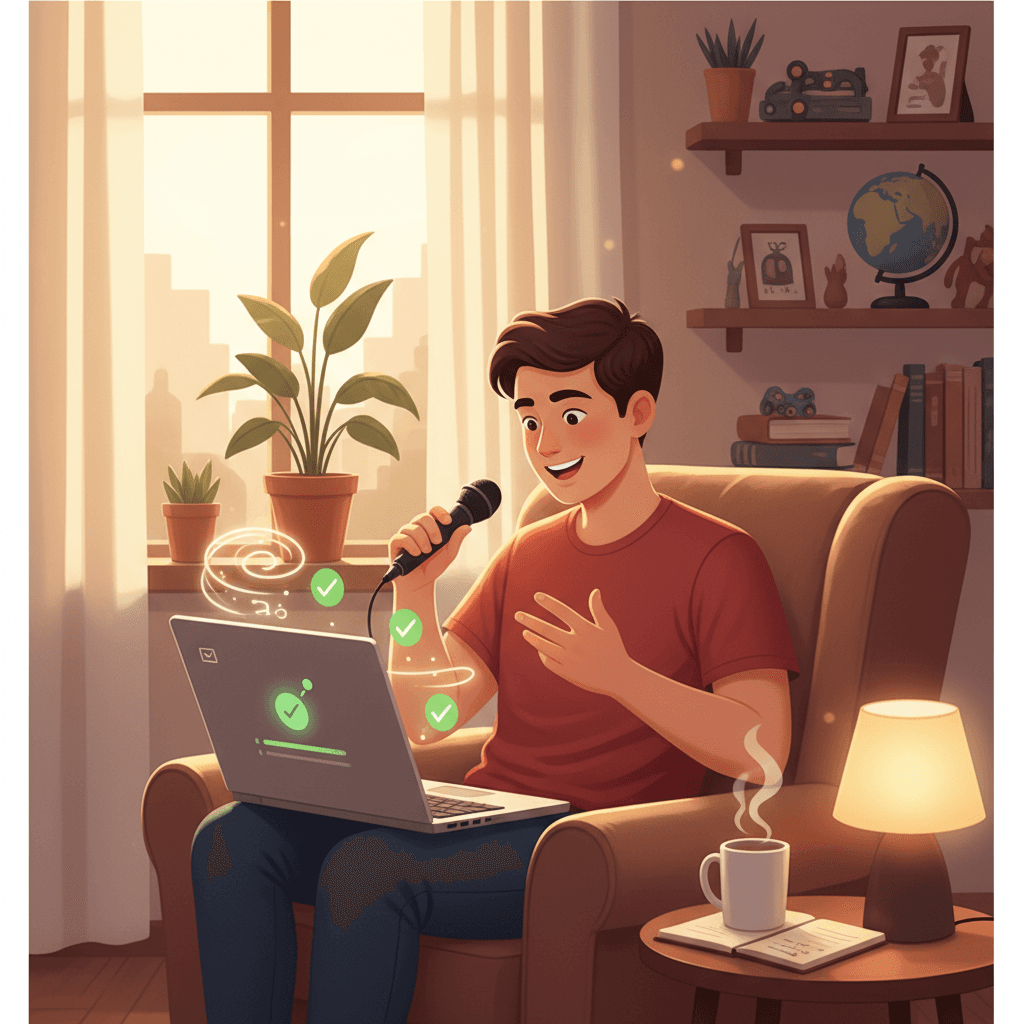
You’ve searched “how to practice speaking a language alone,” scrolled through endless lists of tips, and are still left wondering: how do I actually do it? The problem isn’t a lack of ideas, but a lack of a clear, actionable plan. A 2025 analysis on language learning found that this kind of “fragmented learning” often leads to overwhelm and a lack of clear progress. Instead of just another list, you need a structured routine—a daily system that transforms abstract advice into an achievable habit, which is the real secret to building speaking confidence.
This isn't about finding more time; it's about making your practice time more effective. We're going to build a simple, repeatable workout plan for your speaking muscles. A plan that gives you a safe space to make mistakes, get better, and finally start sounding like the fluent speaker you want to become.
Why a Structured Routine Beats a Random List of Tactics
If you've ever felt stuck in a loop of downloading apps, reading blog posts, and then doing nothing, you're not alone. The challenge for motivated learners like you isn't finding information; it's implementing it consistently. A structured language speaking routine is the bridge between knowing what to do and actually doing it.
According to research, it takes an average of 66 days for a new behavior to become automatic. By following a set plan, you reduce the mental effort of deciding what to do each day. This preserves your cognitive resources for the actual task of learning. Instead of feeling overwhelmed by options, you can focus your energy on what matters: speaking. As language experts emphasized in 2026, fluency is a “daily system” built on these consistent habits, not just occasional bursts of study.
Fragmented learning leads to a lack of clear progress as learners become overwhelmed by too many options without a clear plan.
A structured approach also makes your progress measurable. When you randomly try different things, it's hard to know what's working. But when you follow a consistent workout, you can start to notice real changes in your ability to form sentences, use vocabulary, and speak more smoothly. This is why consistent practice in shorter, regular intervals is proven to be more effective than occasional, marathon study sessions.
The Core Components of Your Solo Speaking Workout
An effective solo speaking practice isn't just one activity; it's a combination of exercises that train different aspects of your speech. Think of it like a full-body workout at the gym. You wouldn't just do bicep curls every day and expect balanced strength. Similarly, your mouth, brain, and ears need a varied routine to develop well-rounded speaking skills. As noted by one expert in late 2025, a great solo practice breaks down oral proficiency into smaller skills, much like a pianist rehearsing scales to prepare for a symphony.
Your weekly workout will be built from these four core components:
- •Structured Self-Talk: This is the foundation. You'll practice producing original sentences by narrating your activities, describing objects, and simulating simple conversations. This builds the habit of thinking in your target language.
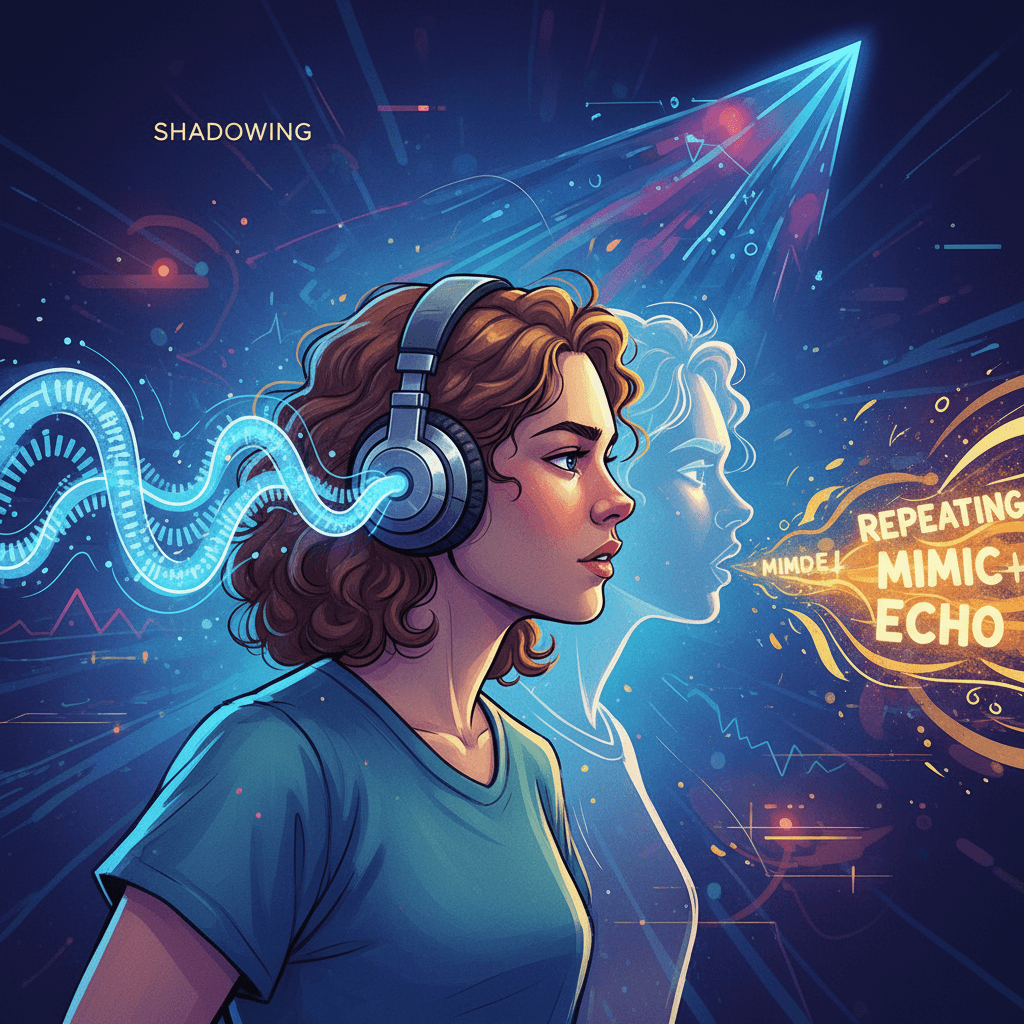
- •Mimicry & Flow (Shadowing): This exercise trains your mouth and ears. By listening to a native speaker and repeating what they say in near real-time, you master the rhythm, intonation, and natural flow of the language.
- •Reading Aloud: A simple but powerful way to improve your pronunciation and the physical 'muscle memory' of forming new sounds. It helps you get comfortable with the physical act of speaking.
- •AI Conversation & Feedback: This is your sparring partner. Using an AI language tutor gives you a chance to apply what you've learned in a simulated conversation and, crucially, get instant pronunciation feedback online—something impossible with other solo methods.
Your Weekly Solo Speaking Workout Plan [Template]
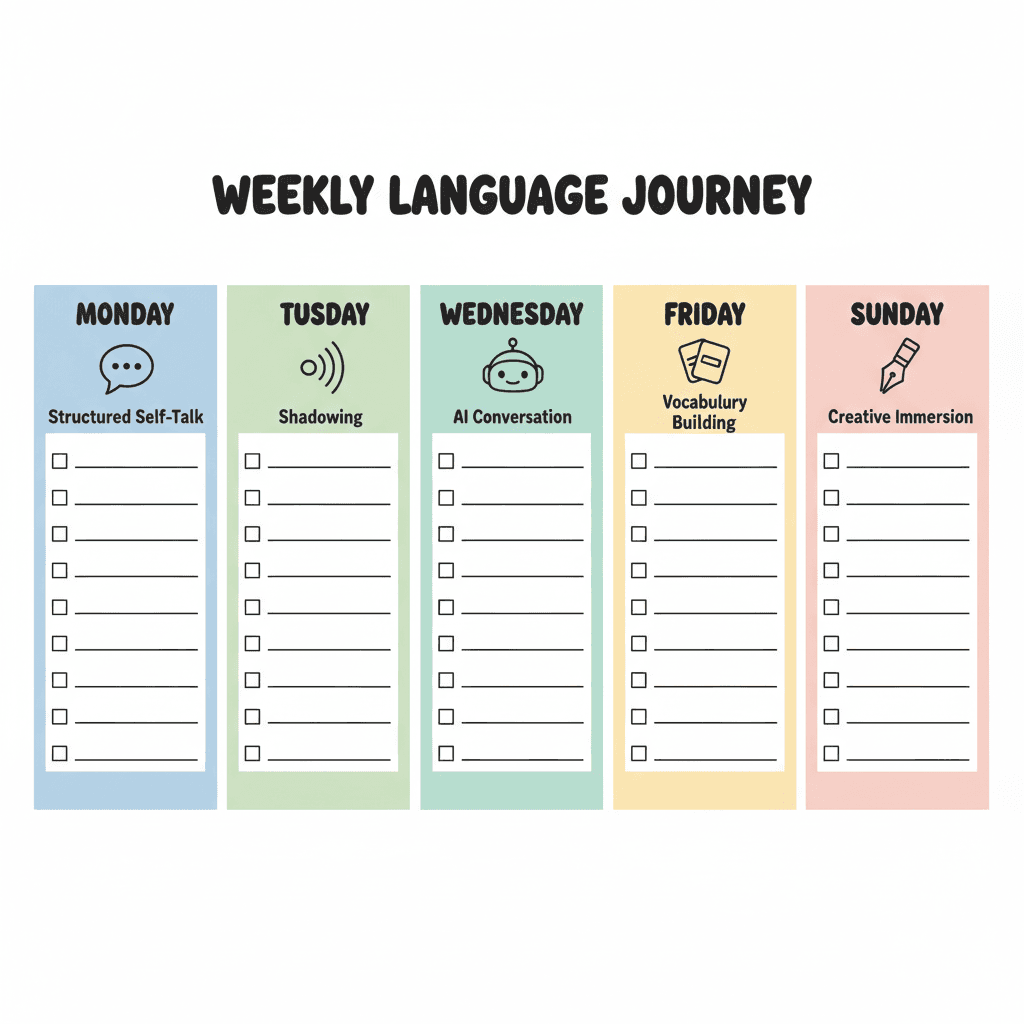
Here is a clear, repeatable 5-day schedule. The goal is consistency, not intensity. Just 15-20 minutes a day is enough to build incredible momentum. The weekend is for rest and passive listening (like music or podcasts). This structure is backed by evidence; a 2022 study in Language Learning & Technology found that learners using structured self-talk and voice recording improved their oral fluency at rates similar to those getting feedback from a human.
This routine gives you a safe environment to practice and make mistakes without judgment—a key factor for building the confidence you need to speak with others. Let's dive into the daily breakdown.
Day 1 & 3: Active Production (Structured Self-Talk)
On these days, your goal is active sentence production. This isn't about memorizing scripts; it's about training your brain to build sentences on the fly. Research from 2026 confirmed that students view this kind of self-talk as a highly effective strategy for boosting fluency and motivation. It’s a natural behavior—one study found people talk to themselves about 61% of the time—so let's put it to good use!
Spend 15 minutes on one of the following prompts. Speak out loud. Don't worry about perfection. If you don't know a word, try to describe it or look it up and use it immediately. The goal is to keep talking.
- •Narrate your current activity: Describe what you are doing, step-by-step, as if you're hosting a cooking show or a tutorial. “Now, I am opening the refrigerator. I am looking for the milk.”
- •Describe your surroundings: Pick five objects in the room and describe them in detail—their color, shape, size, and what they're used for.
- •Summarize your day: Talk about what you did today or what you plan to do tomorrow in 5-10 sentences.
- •Explain a concept: Explain how to do something you know well, like making your favorite meal, playing a simple song on an instrument, or your basic job function.
- •Argue for/against a simple topic: “Cats are better pets than dogs.” Argue one side for two minutes, then switch to the other.
Day 2 & 4: Mimicry & Flow (Shadowing & Reading Aloud)
Today is about focusing on the music of the language—the rhythm, stress, and intonation. This is how to improve speaking fluency alone by training your mouth to move in new ways. In fact, a 2020 study showed that just four weeks of training that included shadowing and reading aloud improved working memory performance.
First, spend 10 minutes shadowing. Find a short audio or video clip (1-2 minutes) with a clear, relatively slow speaker. Play the audio and try to repeat what the speaker is saying almost at the same time. Don't wait for them to finish the sentence. The goal is to mimic their sounds and rhythm precisely. It will feel awkward at first, but stick with it!
After shadowing, spend 5 minutes reading something aloud. This could be a short news article, a children's book, or the transcript from your shadowing exercise. Research shows that daily repeated reading aloud improves key fluency metrics like speech rate and reduces pauses. You are literally building muscle memory in your tongue and lips.
Day 5: AI Conversation & Feedback Loop
This is your day to put everything into practice in a simulated conversation. Using an AI language practice tool is like having a tireless, non-judgmental tutor available 24/7. This is the perfect, low-stakes environment to test your skills and build confidence before speaking with native speakers in the US, UK, Australia, or anywhere else.
Engage in a conversation with your AI language tutor for 15 minutes. You can talk about your week, ask it questions, or role-play a scenario like ordering coffee or booking a hotel. The real power here is the feedback loop. As you speak, the AI can provide instant, specific pronunciation feedback on your words and sentences. It might highlight words you’re mispronouncing or give you a score on your clarity. This kind of personalized, real-time feedback is what accelerates your progress and helps you self-regulate your learning, a benefit highlighted by 2026 research on AI's role in education.
The AI Advantage: How to Get Feedback When You're Alone
For decades, the biggest challenge with practicing speaking alone has been the lack of feedback. You can record yourself, but can you really hear your own mistakes? It's incredibly difficult to judge your own accent and pronunciation accurately. This is the gap where modern technology changes everything.
AI-powered tools offer what was previously impossible: immediate, objective feedback. A May 2026 study confirmed that AI tools significantly reduce foreign language anxiety by creating a judgment-free practice zone. When you aren't afraid of making a mistake in front of someone, you speak more freely, experiment more, and learn faster. The true value of AI is giving you more opportunities to speak with focused feedback, helping you bridge the gap between knowing a language and using it confidently.
This isn't a niche trend; it's the future of language education. Major platforms like Google Translate are rolling out AI-powered experiments for customized speaking practice. Language learning companies are shifting to an 'AI-first' strategy because it works. You now have the power to access a sophisticated feedback tool right from your phone or computer, ensuring your solo speaking practice is as effective as possible.
Measuring What Matters: How to Track Your Solo Progress
Feeling like you're making progress is crucial for staying motivated. But when you practice alone, how do you know if you're actually getting better? Here are four actionable ways to measure your solo progress and see tangible results from your efforts.
- 1.The Day 1 vs. Day 30 Recording: This is the simplest and most powerful method. Choose one of the self-talk prompts from your routine. On Day 1, record yourself answering it for 2-3 minutes. Don't listen to it yet. Follow your workout plan for 30 days. Then, record yourself answering the exact same prompt. Now, listen to both recordings back-to-back. The improvement in your fluency, confidence, and vocabulary will be undeniable.
- 2.The AI-Transcription Test: This is an objective way to measure your clarity. Use your phone’s voice-to-text feature or an AI transcription tool. Speak a few sentences in your target language. How accurately does the tool transcribe what you said? The fewer errors the AI makes, the clearer your pronunciation is becoming. Track the accuracy rate week over week.
- 3.Use In-App Analytics: Many AI language tutors provide data-driven feedback. They might give you a clarity score, track your words per minute, or count the number of new vocabulary words you used in a conversation. These 'Output Analytics' provide a consistent benchmark to track your improvement over time.
- 4.Keep a “Can-Do” Journal: At the end of each week, write down one new thing you can now do. For example: “I can describe my morning routine without pausing,” or “I can confidently order a coffee.” This focuses on functional ability and celebrates small wins, which is a huge motivator.
By actively monitoring your progress, you turn practice into a rewarding journey. This is how you build the confidence needed to move from solo practice to real-world conversations.
Frequently Asked Questions (FAQ)
You have questions, and we have answers. Here are some of the most common queries about how to practice speaking a language alone.
Frequently Asked Questions
Ready to Practice with Your AI Language Tutor?
Get instant feedback and practice real conversations in 54+ languages. Stop guessing and start speaking confidently.
Join the Waitlist