How to Learn a Language with ADHD: A Speaking-First Guide
Struggling to focus on grammar charts or stay motivated with language apps? You're not alone. This guide shows how to learn a language with ADHD by embracing how your brain works.
If you've ever tried to learn a new language, you know it takes focus, consistency, and a solid plan—three things that can feel like a constant battle when you have ADHD. So if you're wondering how to learn a language with ADHD without feeling like you're fighting your own brain, you're in the right place. The good news is that not only is it possible, but the unique wiring of your ADHD brain can actually become your greatest asset. It’s not about forcing yourself into rigid study routines; it's about finding strategies that work with your neurotype, not against it.
Why Learning a Language with ADHD Can Feel Impossible (It's Not You)
Let's be honest: the traditional way of learning a language often feels designed to frustrate the ADHD brain. Long grammar lessons, repetitive verb conjugation drills, and the pressure to study for an hour every day can be a recipe for burnout. Many learners with ADHD report struggling with:
- •Executive Function Hurdles: The mental energy it takes to plan a study schedule, organize resources, and stick with it long-term can feel overwhelming.
- •Intense Boredom: Monotonous tasks like memorizing vocabulary lists fail to provide the novelty and stimulation your brain craves, making it nearly impossible to stay engaged.
- •Time Blindness: The thought of a 60-minute study session can feel endless and intimidating, making it hard to even start.
- •Analysis Paralysis: With thousands of apps, books, and courses available, the sheer volume of choices can be paralyzing, a challenge noted by industry analysis to be particularly acute for those struggling with decision-making.
These challenges often lead to a crisis of confidence. A recent review mentioned by Medical News Today found that while adults with ADHD often report lower confidence in their language skills, their actual grammar, speaking, and reading abilities showed no significant differences compared to their neurotypical peers. The barrier isn't your aptitude; it's the approach. The feeling that success is out of reach is common, but it's not the reality.
Feeling discouraged is understandable, but the data tells a different story. In a study of 68 college students with ADHD referenced by HealthcareOnTime, 100% of them successfully passed their foreign language requirement. Even more encouraging? Two-thirds of them did it without any special accommodations. This proves that with the right strategies, success isn't just possible—it's probable.
Turning Your ADHD Brain into a Language Learning Superpower
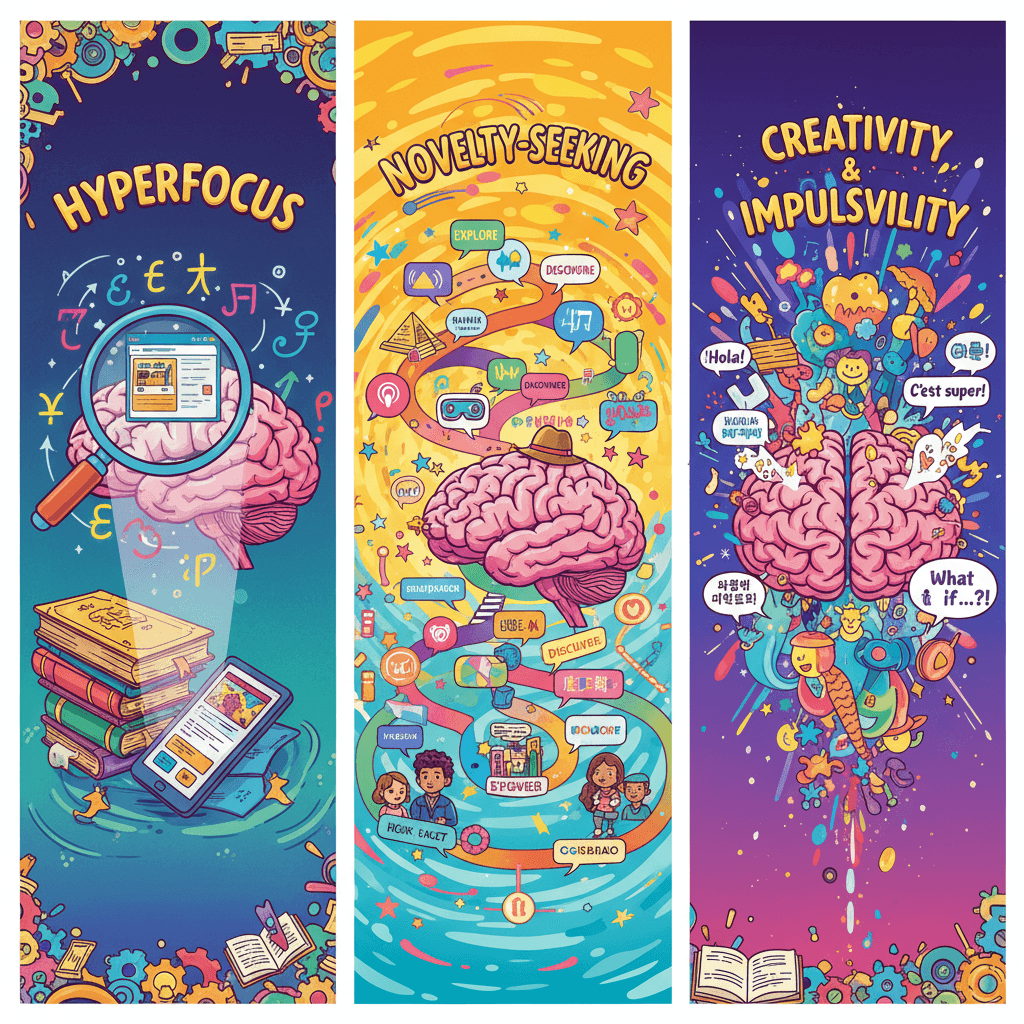
Instead of viewing ADHD as a disadvantage, it's time to reframe the narrative. Your brain isn't broken; it's just different. By understanding your unique cognitive traits, you can turn them from challenges into powerful tools for language acquisition. Recent research even supports this 'ADHD-as-a-superpower' framework. A study in *Studies in Second Language Acquisition* found that the hyperactivity/impulsivity component of ADHD may actually have a positive impact on learning an additional language. Let’s explore how to harness these traits.
Hyperfocus: Your Deep-Dive Immersion Tool
Hyperfocus is the ability to concentrate intensely on something you find genuinely interesting, often for hours at a time. While it can be a challenge when you're supposed to be doing laundry, it's a massive advantage for language learning. When you direct this intense attention toward a movie, a video game, or a YouTube channel in your target language, you can achieve a level of immersion that others can't easily replicate. A recent study highlighted by Medical News Today found that when learners with ADHD were personally interested in a topic, they experienced periods of hyperfocus that resulted in 'intense productivity.' These deep-dive sessions are where, as expert Corbin Vermeulen notes, the 'biggest leaps in learning' are made.
Novelty-Seeking: The Ultimate Cure for Boredom
The ADHD brain is wired for novelty. It craves new experiences and stimuli, which is why repetitive grammar drills feel like torture. This neurobiological drive is linked to the brain's dopamine system, which provides a rewarding surge from new experiences. You can leverage this by constantly changing *how* you learn. Instead of sticking to one app or textbook, embrace variety:
- •Listen to music in your target language on Monday.
- •Watch a new episode of a TV show on Tuesday.
- •Read a few pages of a comic or graded reader on Wednesday.
- •Have a low-stakes conversation with an AI tutor on Thursday.
This strategy of 'varied repetition' exposes you to the same vocabulary and grammar in different contexts, making it stick without the monotony. Experts suggest that rotating the type of input content weekly and using short 8-12 minute study sessions is an effective way to maintain novelty and prevent the burnout associated with monotonous methods.
Creativity & Impulsivity: The Keys to Fearless Speaking
Creativity and impulsivity are two sides of the same ADHD coin. Research from Drexel University revealed that individuals with strong ADHD symptoms often rely on intuitive thinking, leading to superior creative problem-solving and more 'Aha!' moments. This is perfect for making unique, funny, or weird associations to remember new words. At the same time, impulsivity can be harnessed to become a fearless speaker. While others hesitate, worried about making a mistake, your brain might encourage you to just jump in and try. This aligns with findings from a study in *Studies in Second Language Acquisition*, which suggested the hyperactivity/impulsivity component of ADHD may positively impact language learning by encouraging learners to speak without overthinking.
The Speaking-First System for the ADHD Brain
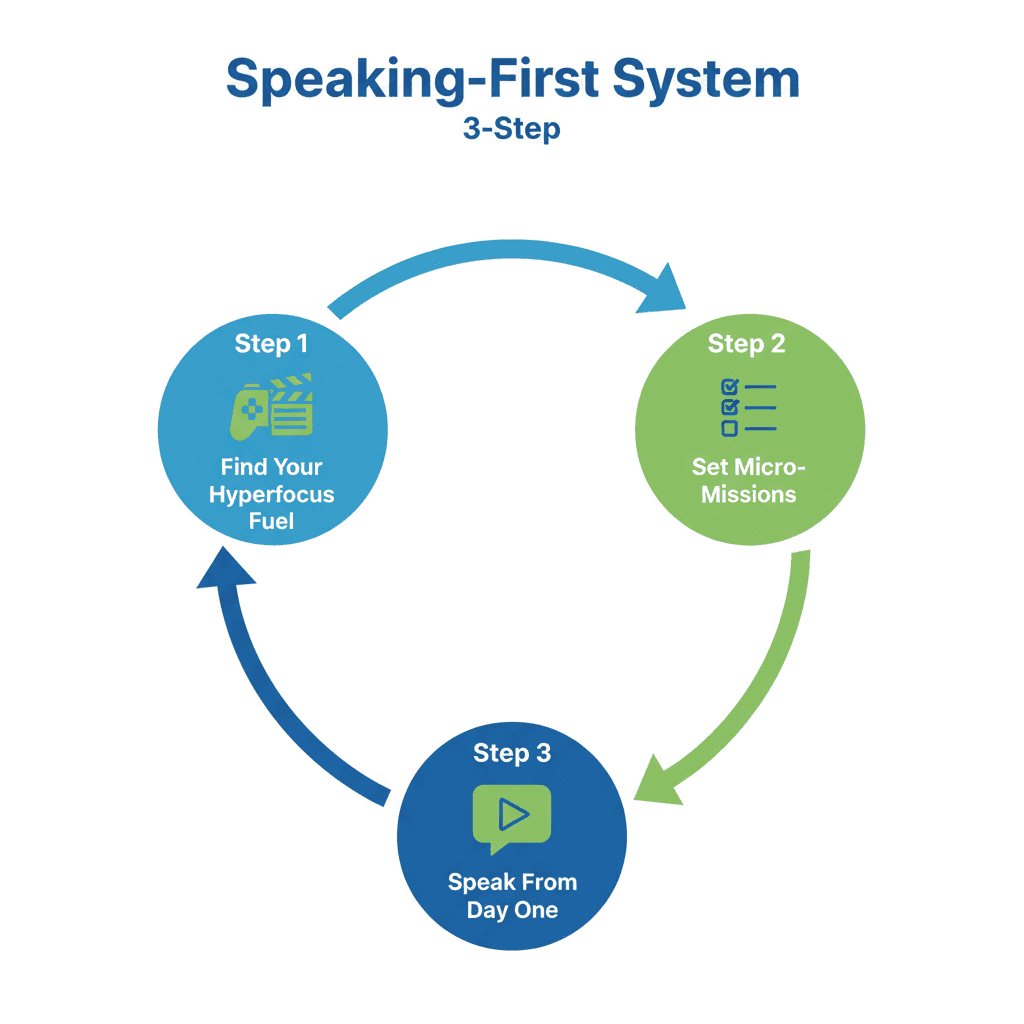
Feeling overwhelmed? A clear framework helps. Traditional 'sit-and-study' routines fail because they don't provide the dopamine hits your brain needs to stay engaged. This system is different. It’s built on active production (speaking) to maximize engagement and provide the immediate feedback you crave. A review in Medical News Today even noted that people with ADHD self-reported that a focus on speaking more would help them learn more effectively. Let's break it down.
Step 1: Find Your 'Hyperfocus Fuel'
Your biggest motivator is your own interest. Don't just pick a language because it's popular or seems 'useful.' Choose one that connects to something you're genuinely passionate about. This is your 'hyperfocus fuel.' A study found that learners with ADHD reported 'intense productivity' when they had strong personal goals for learning. Your fuel could be:
- •Learning Spanish to finally watch La Casa de Papel without subtitles.
- •Learning Japanese to understand your favorite anime and manga.
- •Learning Italian to connect with your heritage and family history.
- •Learning French to follow Parisian bakers on Instagram.
When your learning is tied to a passion, it stops feeling like a chore and becomes a gateway to something you love. This natural inspiration is what allows you to pursue learning energetically.
Step 2: Set 'Micro-Missions', Not Goals
The vague goal of 'become fluent' is a motivation killer. It’s too big and too distant. Instead, break your learning into tiny, achievable 'micro-missions.' These are short, defined tasks that give you a quick win and a satisfying dopamine hit. According to HealthcareOnTime, short 8-12 minute sessions are proven to improve follow-through. Think 'sprints, not marathons.'
- •Instead of: 'Study for an hour.'
- •Try: 'Have a 10-minute conversation about my weekend.'
- •Instead of: 'Learn vocabulary.'
- •Try: 'Learn 5 phrases to order coffee.'
- •Instead of: 'Practice grammar.'
- •Try: 'Write 3 sentences describing my pet using past tense.'
Completing these missions gives you a tangible sense of accomplishment that builds momentum, a strategy echoed by learners who advise setting small, concrete goals to counter the tendency to get overwhelmed.
Step 3: Speak From Day One for Instant Feedback
For the ADHD brain, speaking is the ultimate learning tool. The active back-and-forth of conversation holds your attention and provides the instant feedback it needs to stay engaged. You don't have to wait until you're 'ready.' The very act of trying to speak forces your brain to process grammar and retrieve vocabulary, a concept known as the 'Output Hypothesis.' Every mistake becomes an immediate learning opportunity. This is where AI language tutors can be a game-changer, offering a judgment-free space for conversation with the kind of immediate, personalized feedback that is so beneficial for dopamine learning.
The spontaneity of speaking leverages impulsivity as a strength, turning the urge to 'speak before you think' into a powerful engine for progress.
Choosing the Right Tools (That Won't Bore You)
The sheer number of language learning apps can trigger 'analysis paralysis.' To avoid this, be selective. The goal isn't to collect apps; it's to find one or two core tools that align with the principles of ADHD-friendly learning: novelty, engagement, and low 'starting friction.' According to experts like Corbin Vermeulen, committing to just a few resources is more effective than spreading your attention thin. The best tools are those that make it easy to jump in for a short 8-12 minute session and feel a sense of accomplishment.
For Immersion & Novelty: Lingopie, YouTube & Graded Readers
Your 'interest-based nervous system' thrives when you learn through things you already enjoy. Immersive tools that align with your passions are far more effective than generic study materials. Watching TV shows on a platform like Lingopie, which turns entertainment into active study with interactive subtitles, directly counters the boredom many learners with ADHD experience. Similarly, finding YouTubers who discuss your hobbies (whether that's gaming, makeup, or history) in your target language provides a stream of engaging, multi-sensory content. This interest-driven approach is crucial for pushing through the dreaded 'intermediate plateau,' where progress often feels slow.
For Speaking Practice: Why an AI Tutor Beats a Human (for ADHD)
While human tutors are great, they aren't always ideal for the specific needs of an ADHD learner. An AI tutor offers a unique set of advantages that cater directly to your brain's wiring. For many, an AI-powered speaking partner creates a judgment-free zone for practice, which is critical for learners who may experience social anxiety or Rejection Sensitive Dysphoria (RSD). This is a key advantage for building confidence.
Furthermore, an AI tutor is available 24/7. This perfectly accommodates the sudden bursts of motivation and hyperfocus sessions that are common with ADHD. You can practice at 3 AM if that's when inspiration strikes. Tools like SpeaksyAI's AI conversation partner offer the core features your brain thrives on: short bursts of practice, endless novelty through conversation on any topic, and immediate feedback. Because the ADHD mind excels with what one writer calls the 'improvisational nature of real communication,' the endless variety an AI tutor provides can turn speaking practice from a chore into a strength.
How to Stay Motivated When Your Brain Says 'No'
Even with the best system, there will be days when your executive functions are low and motivation is nowhere to be found. This is normal. The key is to have strategies ready for these moments. Research shows that while feelings of 'chaotic' learning are common for language learners with ADHD, they are not a barrier to achieving high fluency. Remember that consistency over time matters more than a perfect streak. Here are some ADHD-friendly ways to stay on track.
Feeling like you're the only one struggling? Far from it. In fact, some ADHD traits may be an advantage. Recent research found that the hyperactivity/impulsivity component of ADHD may have a positive impact on learning an additional language. Your energetic and spontaneous nature could be your secret weapon for speaking practice.
Use 'Body-Doubling' for Accountability
Body doubling is a popular productivity strategy in the ADHD community. It involves working on a task alongside another person, either in person or virtually. Their quiet presence creates a sense of passive accountability that can help you initiate tasks and stay focused. You can find a language learning partner online or simply have a friend or family member sit in the room while you complete a 'micro-mission.' While formal research on the topic is still nascent, community reports and some experts suggest it is a safe and often effective strategy for externalizing executive functions and improving follow-through.
Schedule Your Dopamine: Link a 'Want' with a 'Should'
This strategy, sometimes called 'temptation bundling,' is about creating an immediate reward for your efforts. Because the ADHD brain often has reduced dopamine activity (the 'motivation fuel'), it responds well to clear, instant rewards. The idea is to link something you should do (your language practice) with something you want to do.
- •"I can watch the next episode of my favorite show after I complete one 10-minute speaking session."
- •"I can play my video game for 30 minutes after I learn 5 new vocabulary words related to gaming."
- •"I can scroll through social media after I listen to one song in my target language."
This system provides the immediate gratification your brain craves, making it easier to form and maintain the habit of learning. It helps bridge the gap between effort and reward, which is often a major hurdle in long-term projects like language learning.
Frequently Asked Questions
Frequently Asked Questions
Ready for Non-Judgmental Speaking Practice?
SpeaksyAI is the AI language tutor that's always available, endlessly patient, and ready to talk about whatever interests you. Practice speaking confidently.
Join the Waitlist