Bridging the Gap: Your 12-Week System for B2 to C1 Speaking
Feeling fluent but not truly advanced? This guide details the specific system for how to get from B2 to C1 speaking, focusing on precision, nuance, and effectiveness.


Wondering how to get from b2 to c1 speaking? You're not just looking to learn more English; you're looking to master it. The leap from B2 (fluent and independent) to C1 (proficient and effective) is less about memorizing new grammar rules and more about a strategic shift in how you use the language. It’s about moving from simply being understood to expressing yourself with precision, nuance, and confidence on any topic. This guide presents a complete system to help you break through the notorious B2 plateau and achieve that next level of spoken mastery.
From Fluent to Effective: The Real Meaning of the B2 to C1 Leap
First, let's celebrate where you are. Reaching the B2 level is a huge accomplishment! You can communicate freely, understand the main ideas of complex texts, and navigate most situations while traveling. But now, you might feel stuck on what many learners call the 'B2 plateau.' You're comfortable, but you're not growing. You might find yourself recycling the same vocabulary and struggling to talk about unfamiliar subjects with authority.
This is a pivotal moment in your journey. The good news is, the way forward isn't about studying harder, but studying differently. According to educational experts at OISE, the transition requires a strategic shift from passive learning to an immersive, output-focused approach. The jump to C1 is about adding depth and sophistication. It’s the difference between saying 'The movie was good' (B2) and 'The film's cinematography was compelling, though the plot felt somewhat derivative' (C1). You're not just acquiring language; you're learning to command it.
A key benchmark for this transition, as noted in expert study plans, is expanding your active vocabulary to over 8,000 word families. This isn't about flashcards; it's about building the spontaneous fluency you need to command a conversation, not just participate in it. You're moving from managing the language to truly owning your expression within it.
A C1-Readiness Check: Where Are Your Current Gaps?
Before you can build a bridge to C1, you need to know exactly where you're starting from. The B2-C1 gap is unique for every learner. For some, it's a lack of specific vocabulary; for others, it's difficulty structuring complex thoughts on the spot. Take a moment for an honest self-assessment. The goal isn't to feel discouraged—it's to gather the data you need to create a targeted, effective plan. If you find yourself nodding 'yes' to several of these, you might benefit from our guide on how to Break the Intermediate Language Plateau: A Diagnostic System.
- •When discussing a topic, do you often feel like you know the 'idea' but can't find the precise words to express it?
- •Can you confidently argue for or against a complex point (e.g., in a work meeting or a debate) for more than a minute?
- •Do you find yourself using the same handful of adjectives (good, bad, interesting, nice) to describe most things?
- •Can you understand humor, sarcasm, or irony in a podcast or TV show, and could you use it yourself in a conversation?
- •When you tell a story, do you struggle to connect your ideas smoothly and logically without pausing frequently to search for words?
Answering 'yes' to these questions is a sign you're ready for the C1 challenge. This jump is one of the most significant hurdles in language learning. In fact, one 2026 study on CEFR progression found that only about 8% of English learners worldwide successfully reach the C1 level. This isn't because it's impossible, but because it requires a dedicated and strategic approach to close these specific skill gaps.
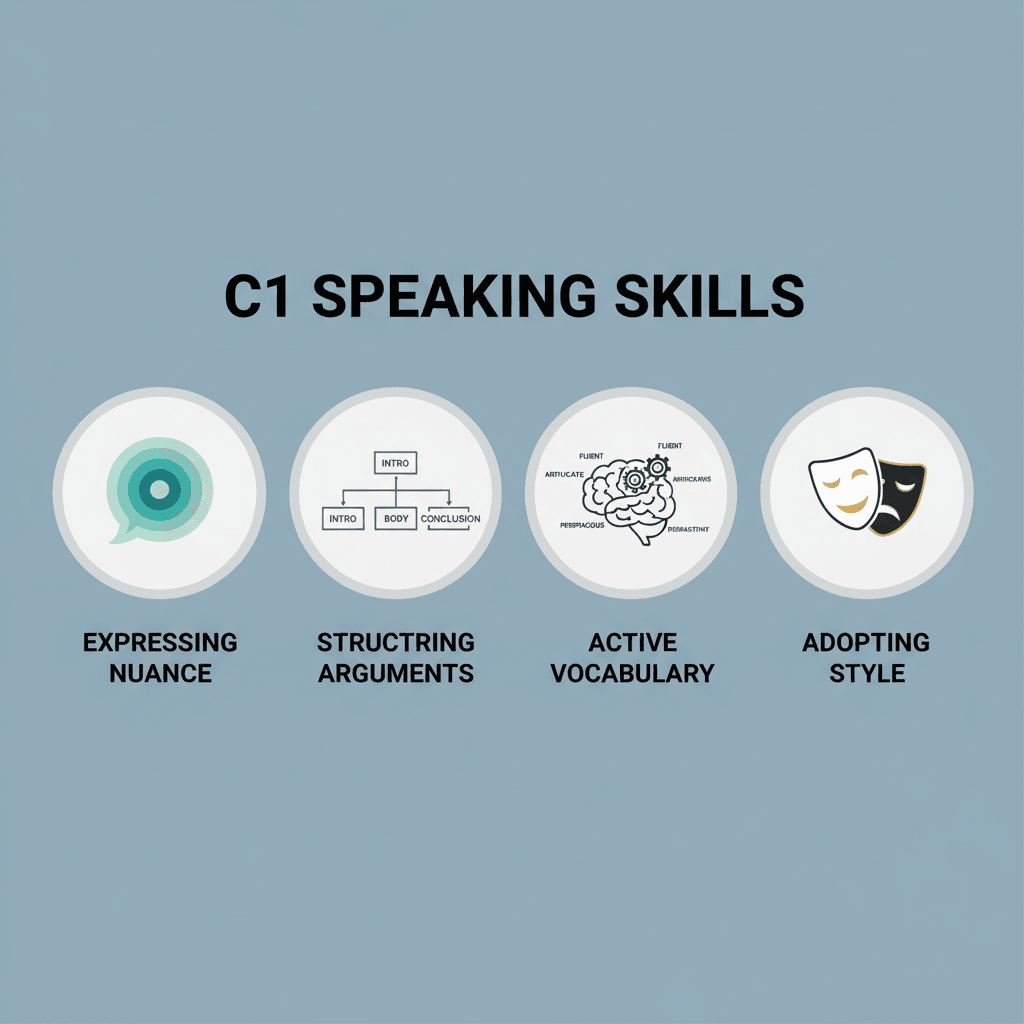
Deconstructing C1: The 4 Core Skills to Master
The CEFR framework describes C1 speakers as being able to 'express ideas fluently and spontaneously without much obvious searching for expressions.' But what does that actually mean in practice? Instead of thinking of C1 as a vague, monolithic goal, let's break it down into four concrete, trainable skills. Community discussions among successful learners often highlight that mastery comes not from learning new grammar, but from achieving greater depth and quality with the language they already know. Mastering these four areas is your path to doing just that.
Skill 1: Expressing Subtle Shades of Meaning
This is the core of the B2-C1 shift. It's about moving from broad statements to precise, nuanced expressions. A B2 speaker can say a project was successful. A C1 speaker can articulate how and why it was successful with greater detail and sophistication. This skill relies on a deep awareness of tone and style, allowing you to choose the perfect word for the context.
Think of it as upgrading your linguistic toolkit. For example:B2 Statement: 'I think this is a good idea.'C1 Expressions:• 'I believe this could be a particularly effective solution.' (More formal, emphasizes effectiveness)• 'From my perspective, this seems like a very promising approach.' (Adds personal viewpoint, highlights potential)• 'I'm inclined to agree; it's a remarkably straightforward way to tackle the problem.' (Expresses agreement, praises simplicity)
To develop this skill, you must actively practice using these richer expressions. Many language learners find that a new word or phrase must be used 15-20 times in a real context before it becomes part of their active vocabulary. Focus on adverbs (remarkably, surprisingly, deeply), modal verbs (could, might, should have), and qualifying phrases ('from my perspective,' 'it appears to be') to add layers to your speech.
Skill 2: Structuring Complex Arguments
At the B2 level, you can share your opinion. At the C1 level, you can build a case. This means structuring your thoughts logically for longer speaking turns, whether you're presenting in a meeting, participating in a debate, or telling a detailed story. A 2025 study, The Road to Mastery, identified the command of discourse markers as essential for the spontaneous and flexible expression required in professional settings.
To sound like a C1 speaker, you need to guide your listener through your thought process. You can do this by mastering signposting language. Practice incorporating these into your speaking:
- •Introducing your point: 'The main issue we need to consider is...', 'I'd like to begin by highlighting...'
- •Adding another idea: 'Furthermore...', 'On top of that...', 'Another crucial point is...'
- •Contrasting ideas: 'On the other hand...', 'Having said that...', 'While that may be true, we also need to consider...'
- •Concluding: 'To sum up...', 'In conclusion, my position is that...', 'Ultimately, it all comes down to...'
A great way to practice, as suggested by language acquisition guides, is to give yourself impromptu speeches. Pick a random topic—'Should all employees have a four-day work week?'—and give yourself one minute to structure an argument using the signposting language above. Research also shows that practicing structured writing is a highly transferable skill for improving spoken delivery, as it trains your brain to organize thoughts logically.
Skill 3: Expanding Your Active Vocabulary
Many B2 learners have a large passive vocabulary—words they recognize when reading or listening. The C1 challenge is to convert this passive knowledge into an active, usable vocabulary that you can deploy spontaneously in conversation. It's not just about knowing more words; it's about using a wider range of them with precision and flexibility. The goal, as suggested by experts at Practice Me, is to roughly double your active vocabulary and master natural-sounding collocations (words that often go together, like 'make an effort' instead of 'do an effort').
The transition to C1 is characterized not by simply learning more words, but by using them with greater flexibility and precision in increasingly complex situations.
How do you activate your vocabulary? Focus on output. When you learn a new word or phrase, don't just put it on a list. Follow this process:1. Notice it: Hear or read the word 'ubiquitous' in context.2. Understand it: Look up its meaning ('present, appearing, or found everywhere').3. Analyze it: See how it's used. 'Smartphones have become ubiquitous in modern society.'4. Create with it: Form your own sentences. 'In major cities, coffee shops are ubiquitous.'5. Use it: Make it a goal to use the word in a conversation 3-5 times over the next week. As community discussions suggest, a word often needs 15-20 active uses to stick.
Skill 4: Adopting an Appropriate Tone and Style
This is perhaps the most sophisticated C1 skill. It’s the ability to adapt your language to the social context. This means knowing when to be formal or informal, how to express enthusiasm or polite disagreement, and how to use humor or irony effectively. A C1 speaker can chat casually with friends and then seamlessly switch to a more formal register for a business presentation. This advanced social and linguistic awareness is a key differentiator from the more functional B2 level.
Mastering this skill is a major reason why only about 8% of learners reach C1, as it requires understanding subtle cultural references and nuances. The best way to learn is through immersion and active practice. Listen carefully to how native speakers in a variety of settings (e.g., in the US, UK, or Australia) adjust their language. Pay attention to:• Formality: 'Would it be possible for you to...' vs. 'Can you...?'• Enthusiasm: 'That's absolutely brilliant!' vs. 'That's a good idea.'• Understatement (a very British trait!): 'I'm a bit concerned' meaning 'This is a major problem.'AI-powered tools can be invaluable here, as they can simulate varied social scenarios and provide instant feedback on whether your tone was appropriate for the situation.
The 12-Week System for B2 to C1 Speaking Practice
Knowing the skills is one thing; building them is another. This requires consistent, focused effort. As mentioned, experts and institutions like Cambridge estimate you'll need between 200-400 hours of focused study to get from B2 to C1. Don't let that number intimidate you. Instead, let it motivate you to create a structured plan. A 12-week system, dedicating around 15-20 hours per week, can make this mountain climbable.
Remember the C1 mindset: This isn't about studying harder, but studying differently. Each week of this plan is designed to be an immersive, output-focused experience that pushes you beyond your comfort zone. Consistency is more important than intensity.
Weeks 1-4: Vocabulary Activation & Precision
Your focus this month is to break out of your vocabulary rut. The goal is to activate passive words and master the collocations needed for natural, fluent speech. A 2025 study in TESL-EJ confirmed that targeted vocabulary activation strategies are highly effective for boosting speaking proficiency.
- 1.Choose a 'Topic of the Week': Pick one complex subject outside your comfort zone (e.g., renewable energy policy, the ethics of AI, urban planning).
- 2.Input & Harvest: Spend two days consuming C1-level content on this topic. Read articles from sources like The Economist or The Guardian, and listen to podcasts like NPR's Planet Money. Create a list of 15-20 new words, phrases, and collocations.
- 3.Activate & Produce: For the rest of the week, your mission is to use this new language. Write a short summary of an article. Record yourself giving a one-minute opinion on the topic. Explain the key concepts to a friend or an AI language tutor. The goal is active use.
Weeks 5-8: Argumentation & Abstract Topics
This month is all about building your ability to discuss abstract topics and structure your thoughts on the fly. This is a common stumbling block, as it requires both linguistic skill and confidence. This aligns with the industry trend of 'doing more beats studying harder'—you'll build this skill through active practice, not by studying lists.
- 1.Daily Debates: Use an AI conversation partner for structured practice. Start a conversation with a prompt like, 'Let's debate the pros and cons of universal basic income.' Don't just state your opinion; practice using the signposting language from Skill 2 to build a coherent argument.
- 2.The 'For and Against' Drill: Pick a controversial statement. Spend two minutes arguing *for* it, then immediately spend two minutes arguing *against* it. This forces mental flexibility and stops you from relying on pre-prepared opinions.
- 3.Explain a Concept: Choose a complex concept you understand well (from your job, a hobby, etc.) and explain it to someone who knows nothing about it. This tests your ability to simplify, use analogies, and structure information logically. Recording yourself can be very insightful.
Using a tool like the SpeaksyAI language tutor is perfect for this stage, as its AI can simulate these debates and provide a safe space to practice constructing arguments on complex subjects without the pressure of a live audience.
Weeks 9-12: Spontaneity & Stylistic Flexibility
The final month focuses on polishing your delivery to sound more natural, spontaneous, and stylistically aware. This is where you connect all the pieces: vocabulary, structure, and tone. Reaching this level of stylistic flexibility is a significant achievement, putting you in the small percentage of learners who reach C1 proficiency.
- 1.News Retelling with a Twist: Read a news article. Then, close the page and record yourself retelling the story in your own words. The 'twist' is to adopt a specific tone: retell it as if you're excited, concerned, skeptical, or formal. This practices both summary and stylistic control.
- 2.Shadowing C1 Content: Choose a 1-2 minute clip from a C1-level source, like a TED Talk. Listen once, then play it again and speak along with the speaker, trying to mimic their rhythm, intonation, and stress patterns exactly. This helps internalize the 'music' of the language.
- 3.Pronunciation Polish: Use a tool that provides real-time pronunciation feedback. Focus on specific sounds you struggle with, as well as sentence-level intonation. A small improvement in pronunciation can make a huge difference in how natural and confident you sound.
Measuring What Matters: How to Track Your C1 Progress
The move from B2 to C1 feels less linear than earlier stages, which can make progress difficult to see. You're no longer just learning tenses; you're refining nuance and flexibility. That's why you need concrete methods to track your improvement and stay motivated. Relying on a 'feeling' of progress isn't enough.
Many learners get stuck at the B2 plateau because they aren't actively tracking their output. To avoid this, integrate these measurement habits into your routine:
- 1.The Weekly Recording Benchmark: At the start of your 12-week plan, choose a complex question (e.g., 'What is the most significant challenge your generation will face?'). Record yourself answering it for 2 minutes. Every Sunday, record yourself answering the exact same question. After a month, listen to Week 1 and Week 4 back-to-back. The progress in vocabulary, structure, and fluency will be undeniable.
- 2.Keep a 'Newly Activated Words' Journal: Don't just list new words. Create a journal specifically for words and phrases you have successfully used in a real conversation. The goal isn't just to grow the list, but to see how often you can move a word from your 'learning' list to your 'activated' list. This directly tracks your progress in converting passive to active vocabulary.
- 3.Analyze Your Feedback: If you're using an AI tool like SpeaksyAI, don't just glance at the feedback. Look for patterns. Is the AI consistently flagging your use of prepositions? Do you often use 'very' instead of a stronger adjective? Use this data to set a specific micro-goal for the following week, such as 'use five strong adjectives instead of 'very'.'
FAQ: Your B2 to C1 Questions Answered
Frequently Asked Questions
Ready to Practice C1-Level Speaking?
Get personalized feedback on nuance, tone, and complex topics with SpeaksyAI's AI language tutor.
Join the Waitlist