Stuck at B1? How to Break the Intermediate Language Plateau
Are your language skills stuck at 'good enough'? It's a common stage called the intermediate plateau. This guide provides actionable steps to break through to fluency.


You can order coffee, ask for directions, and even handle a simple chat about your weekend. You’ve passed the beginner stage, but now… you feel stuck. Progress has slowed to a crawl, and fluency feels further away than ever. If this sounds familiar, you’re likely facing the intermediate plateau. It’s a frustrating but completely normal part of the journey. The good news is that with the right strategies, you can break through it. This guide will show you how to get past the intermediate plateau in language learning by shifting your mindset, upgrading your methods, and building the confidence to speak freely.
You're Not Alone: Understanding the Intermediate Plateau
First, let's normalize this feeling. The intermediate language plateau isn't a sign of failure; it's a sign that your learning needs are evolving. In the beginning stages (like A1/A2 on the CEFR scale), progress is rapid and easy to measure. You learn your first 100, then 1,000 words. But at the intermediate B1 to B2 level, the game changes. You're no longer just learning foundational rules; you're trying to master the nuance, speed, and cultural context of authentic, native-level communication.
Progress feels slower because it is slower, mathematically. Moving from 1,000 to 2,000 words doubles your vocabulary. Moving from 5,000 to 6,000 words is a much smaller percentage gain, yet it requires just as much, if not more, effort. This is what a 2024 report by education platform abblino calls the 'trap of no metrics.' In the beginner phase, you have clear wins. At the B1 level, improvements are more subtle—like using a preposition more naturally or understanding a fast joke. It's crucial to find new ways to track these small victories to maintain your language learning motivation.
Why Your Beginner Study Habits No Longer Work
The tools that got you here won't get you there. Methods designed for beginners—like basic vocabulary flashcards and simple grammar drills on apps—start to show diminishing returns. Why? Because they are designed for passive recognition, not active production. You can probably understand far more words than you can use spontaneously in conversation. This gap between your passive and active vocabulary is the very definition of the intermediate plateau.
As a popular 2023 guide for students points out, to progress, intermediate learners need targeted, challenging input combined with active production (speaking and writing). Simply consuming more basic content won't work because you likely already know most of the common words. You need to push your brain to retrieve and use more complex language. The primary challenge is no longer about acquiring 'low-hanging fruit' vocabulary; it's about turning the thousands of words you recognize into words you can use to express your own thoughts confidently.
- •Basic flashcards often reinforce words you already know passively.
- •Beginner app drills lack the context for complex, spontaneous conversation.
- •Passive listening to easy content doesn't force you to produce new structures.
- •Memorizing grammar rules without applying them in speech fails to build fluency.
Step 1: Diagnose Your Specific Weak Points
Before you can overcome the learning plateau, you need to know exactly what's holding you back. Is it a lack of specific vocabulary? Awkward grammar? Hesitation and filler words? It's time for a quick self-audit. The most effective way to do this is to force yourself into a situation that requires active output.
- 1.Pick a complex topic. Choose something you know well in your native language, like your job, a favorite hobby, or the plot of a recent movie.
- 2.Record yourself. Open a voice memo app on your phone and speak for 2-3 minutes on that topic in your target language. Don't stop to look up words. Just talk.
- 3.Listen back critically. Play the recording and listen carefully. Where do you hesitate? What words do you overuse? Do you notice recurring grammar mistakes?
- 4.Identify the patterns. Note your specific weaknesses. Maybe you struggle with past-tense conjugations, can't find descriptive adjectives, or rely too heavily on simple sentence structures. This is your diagnosis.
At the intermediate stage, learners often find that bad habits or mistakes start to become more ingrained. This makes self-assessment critical for identifying specific weaknesses before they fossilize.
This exercise is powerful because it forces you to practice active recall, directly addressing what linguists call the 'output hypothesis.' By trying to produce language, you become acutely aware of the gaps in your knowledge. This targeted awareness is the first step toward progress.
Step 2: Set 'Micro-Missions,' Not Vague Goals
A goal like 'get better at Spanish' is a recipe for frustration because it's impossible to measure. To break the plateau, you need to replace these vague ambitions with specific, achievable 'micro-missions.' These are small, project-based tasks with a clear finish line. Completing them provides a tangible sense of accomplishment and builds momentum.
According to a 2022 study in the Journal of Educational Management Research, setting small goals is a crucial technique for stimulating enthusiasm and overcoming psychological barriers. Each completed mission provides a small dopamine hit, which reinforces your habit and builds self-efficacy. You start proving to yourself that you are still making progress.
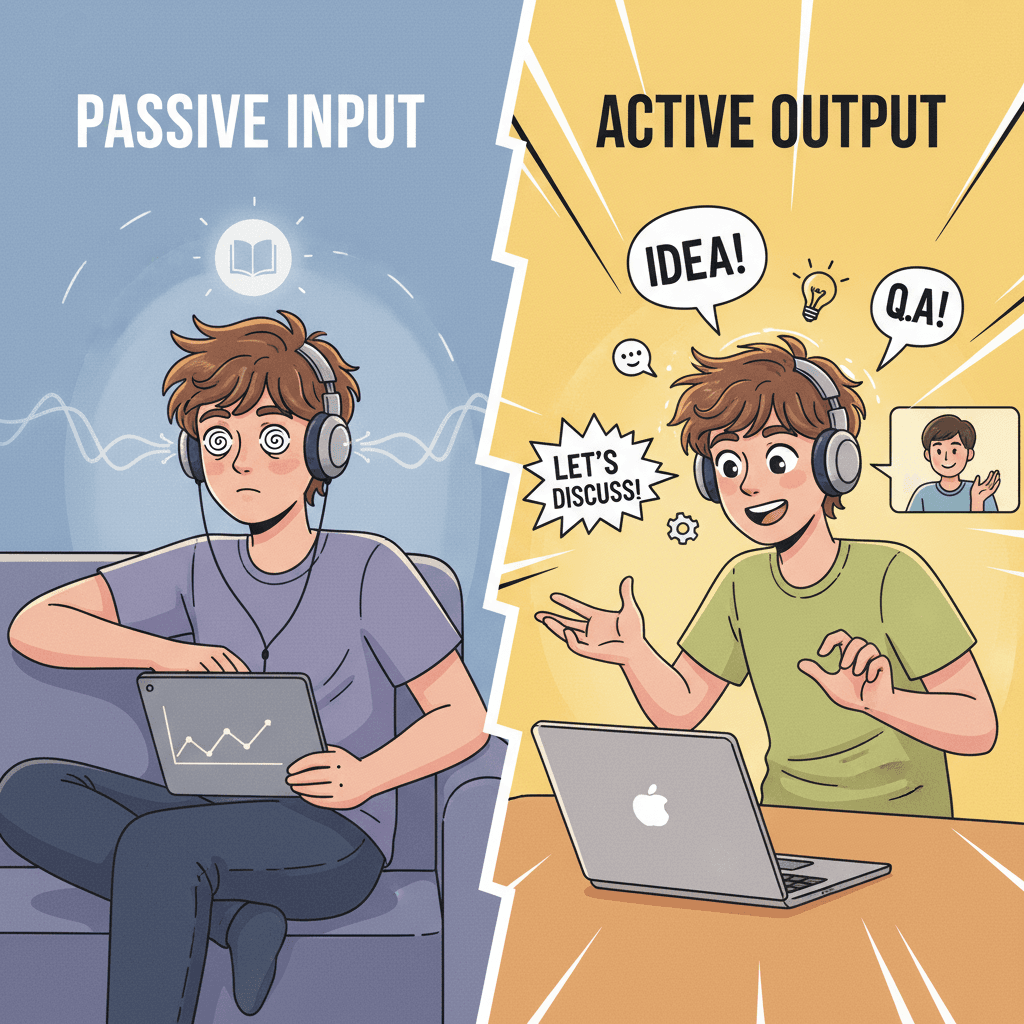
Step 3: Move from Passive Input to Active Output
This is the most critical shift you can make. To overcome the intermediate plateau, you must prioritize producing language, not just consuming it. Many experts suggest flipping the typical learning ratio from 80% input/20% output to at least a 50/50 balance. This focus on active vocabulary building forces you to grapple with grammar and word choice in a way that passive listening does not.
A powerful technique is to apply 'strategic constraints.' For example, try to tell a story without using the 50 most common verbs, or describe a picture using at least five new adjectives you learned this week. This forces you out of your comfort zone and helps you build a more flexible, active vocabulary. The goal is to make output a daily habit, even if it's just for 10-15 minutes.
This is where an AI tutor can be a game-changer. Practicing your 'micro-missions' with a conversation partner is essential, but it’s not always easy to find someone. An AI-powered tool like SpeaksyAI provides a safe, on-demand space to practice these complex, output-focused tasks. You can try explaining a difficult topic, get instant feedback on your pronunciation, and practice speaking without the fear of judgment, directly targeting the skills needed to bridge the B1 to B2 gap.
Step 4: Upgrade Your Immersion Strategy
Immersion is still vital, but your approach needs an upgrade. Instead of passively watching movies with subtitles, you need to engage with them actively. The goal is to find content that is challenging but not overwhelming—a sweet spot where you understand about 70-80% of what's being said. This is known as 'comprehensible input.'
Once you've found the right content (YouTube videos from native creators, podcasts on topics you love, books written for native speakers), turn it into an active task. Don't just consume—interact. This shift from passive to active immersion is one of the most effective language fluency strategies for intermediate learners.
- •Shadowing: Listen to a sentence and repeat it immediately, trying to mimic the speaker's intonation and rhythm. This is fantastic for pronunciation and fluency.
- •Summarizing: Watch a 5-minute video or read a short article, then pause and summarize the main points out loud in your own words.
- •Responding: Pause a podcast or video and respond to the speaker's question or statement as if you were part of the conversation.
Your Action Plan to Speak Confidently
Knowing the strategies is one thing; implementing them is another. To help you get started, here is a sample one-week action plan that integrates all these steps. Remember, consistency is more important than intensity. A little bit every day goes a long way.
- •Monday (Diagnosis): Record yourself for 3 minutes explaining your weekend. Listen back and identify one specific grammar point to work on this week.
- •Tuesday (Micro-Mission): Complete a small, defined speaking task. Your mission: Describe your favorite food in detail for 2 minutes, focusing on using descriptive adjectives.
- •Wednesday (Active Output): Practice your micro-mission with your AI tutor, SpeaksyAI. Ask it to have a conversation with you about food and try to use your target grammar point correctly.
- •Thursday (Active Immersion): Find a 10-minute YouTube video in your target language on a topic you enjoy. Watch it once, then watch it again, pausing every minute to summarize what was said out loud.
- •Friday (Review & Repeat): Redo Tuesday's micro-mission, but this time try to do it more fluently or with more complex vocabulary. Compare it to your first attempt.
- •Saturday (Fun Immersion): Watch a movie or TV show episode in your target language. Just enjoy it, but keep a notebook handy to jot down 3-5 interesting new phrases you hear.
- •Sunday (Rest & Reflect): Rest is part of learning! Briefly review the new phrases from Saturday and reflect on the progress you made this week.
The intermediate plateau can feel like a wall, but it's really a launchpad. It's the point where you transition from being a 'student' of the language to a 'user' of the language. By focusing on active output, setting measurable goals, and practicing consistently, you'll build the skills and—just as importantly—the confidence to navigate more complex conversations. You've got this!
Frequently Asked Questions
Frequently Asked Questions
Ready to Break Your Plateau and Speak Confidently?
Get targeted speaking practice and instant feedback with an AI language tutor designed for learners just like you.
Join the Waitlist