How to Choose Vocabulary to Learn for Speaking: A System
Tired of learning words you never use? This guide provides a step-by-step system for how to choose vocabulary to learn for speaking that truly matters for your goals.

Why 'More Words' Isn't the Answer for Speaking Fluently
If you've ever felt like your brain is a library full of words you can't check out when you need them, you're not alone. Many language learners focus on growing their vocabulary list, but the real key to confident speaking isn't just knowing more words—it's about activating the ones you already know. This guide will show you how to choose vocabulary to learn for speaking not by memorizing endless lists, but by building a strategic, personal, and powerful set of words you can use instantly. We’ll be moving beyond brute-force memorization to a smarter, more effective approach.
The difference between knowing a word and using it is the gap between a passive vocabulary (words you recognize when you read or hear them) and an active vocabulary (words you can recall and use correctly in conversation). Speaking fluently depends almost entirely on the second category. In fact, a 2025 study found that 'automatized vocabulary knowledge'—your ability to access words quickly without thinking—is a much stronger predictor of speaking fluency than simply knowing a word’s definition. The goal isn't to have the biggest vocabulary; it's to have the fastest, most accessible one.
This is why simply cramming flashcards often fails to produce real speaking skills. True vocabulary acquisition is about deep learning, not just memorization. Experts like Dr. Gianfranco Conti have highlighted that learners may need to encounter a word 15 to 20 times in different, meaningful contexts before it becomes a stable part of their active vocabulary. Other analyses agree, suggesting that to truly own a word, you need 8–12 meaningful encounters plus dozens of spaced repetitions. This proves that a strategic method is far more critical for speaking skills than just trying to learn a massive quantity of words.
So, how do you bridge the gap between passive recognition and active use? You need a system. A repeatable process that helps you select the right words for your specific goals and then deliberately practice them until they become second nature. Let's build that system together.
Introducing the 3-Step Vocabulary Activation System
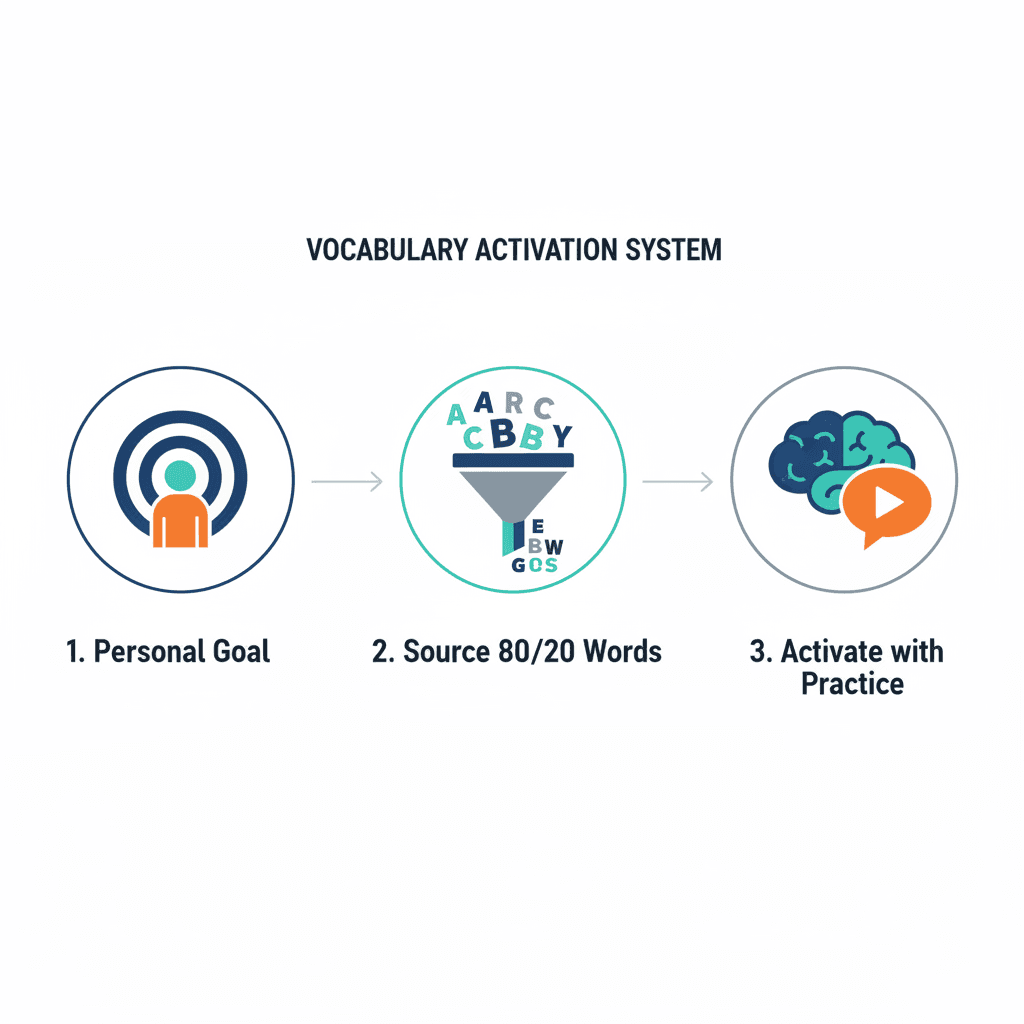
Forget the overwhelming feeling of not knowing where to start. We've distilled the science of vocabulary acquisition into a clear, actionable framework: the SpeaksyAI 3-Step Vocabulary Activation System. This isn't about learning every word in the dictionary; it's about making the words that matter to you instantly available for conversation. Research validates that a structured, multi-step process like this one helps you develop a deeper understanding by exposing you to words in different contexts.
- 1.Pinpoint Your Personal Vocabulary Goal: First, you’ll define why you're learning new words. This personal connection is the foundation for motivation and retention.
- 2.Source High-Impact Words: Next, you'll learn how to find the essential 'Tier 2' words—high-utility vocabulary that gives you the most mileage across many different situations.
- 3.Activate with Practice: Finally, you’ll turn passive knowledge into active skill through structured, deliberate practice, solidifying the words in your long-term memory for spontaneous use.
This system helps you build a strong foundation, moving you from simply recognizing words to using them with confidence. The final step, 'Vocabulary Activation,' is where the magic happens. A growing trend shows learners using specialized AI conversation apps for judgment-free speaking practice, which is the perfect way to test out your new words and make them stick.
Step 1: Pinpoint Your Personal Vocabulary Goal
Before you learn a single new word, you need to ask yourself a crucial question: “Why?” Are you trying to impress in a job interview? Make friends on your trip to Sydney? Or finally understand your favorite British TV show without subtitles? Setting specific, measurable goals—like learning vocabulary for your job—is the key to making tangible progress. Your personal 'why' is the most powerful motivator you have.
Your goal also shapes your strategy. For example, recent comparisons between popular language apps show that learners who prioritize speaking confidence as their primary goal often see faster improvement in that specific area. While some platforms excel at building recognition-based vocabulary, others are better suited for developing conversational skills. By defining your objective first, you can choose the right path for your learning journey.
Think of it this way: if your goal is to build a house, you don't start by collecting random pieces of wood. You start with a blueprint. Your vocabulary goal is your blueprint. It guides every word you choose to learn, ensuring that your efforts are always aligned with what you want to achieve, whether it's facilitating meaningful social interactions or acing a professional presentation.
Identify Your Key Speaking Scenarios
Let's get specific. What real-world situations do you want to be ready for? Language learning trends for 2026 show a major shift away from academic levels and towards measuring progress by your ability to communicate in practical scenarios. This is great news for you! It means you can focus your energy on what truly matters.
- •For Work: Participating in team meetings, negotiating a contract, writing professional emails, presenting data, or making small talk with colleagues from the US or UK.
- •For Social Life: Discussing hobbies like movies or gaming, ordering food, making new friends, or understanding slang and internet culture terms like 'delulu' or 'rage bait'.
- •For Travel: Asking for directions in a new city, booking a hotel, navigating an airport, or understanding a tour guide in places like Canada or Australia.
- •For Hobbies: Discussing your passion for gardening, learning the terms for different cooking techniques, or talking about your favorite sports team.
Make a list of 3-5 scenarios that are most important to you right now. As you encounter new words through immersion, you can prioritize learning the ones that are directly relevant to these situations. Instead of a generic, disorganized word list, you'll be building a powerful, personalized toolkit for the conversations you actually want to have. Experts recommend organizing this personal vocabulary list by theme or priority to make it even more effective.
Source Your Words from What You Love
The most effective way to select vocabulary is to pull it from content that you genuinely find interesting. When you're engaged in a story from a TV show, a fascinating podcast, or a captivating book, you're not just 'studying'—you're learning naturally. Research from 2025 confirms that vocabulary is retained much better when learned in a meaningful context compared to studying isolated word lists. Your brain is wired to remember stories, not spreadsheets.
This approach also keeps your vocabulary current and relevant. If you want to talk about modern life, learn from modern media. Exploring topics you're passionate about, whether it's AI technology, sustainable fashion, or online gaming, naturally exposes you to the exact words you need. A 2026 analysis of vocabulary development highlights storytelling from media as a perfect way to encounter rich vocabulary and understand new words in a natural, memorable context.
To understand about 85% of general media like TV shows and podcasts, a learner needs to know the 2,000 to 3,000 most common word families, which are best acquired by engaging with this type of content.
Step 2: Source High-Impact Words (The 80/20 Rule)
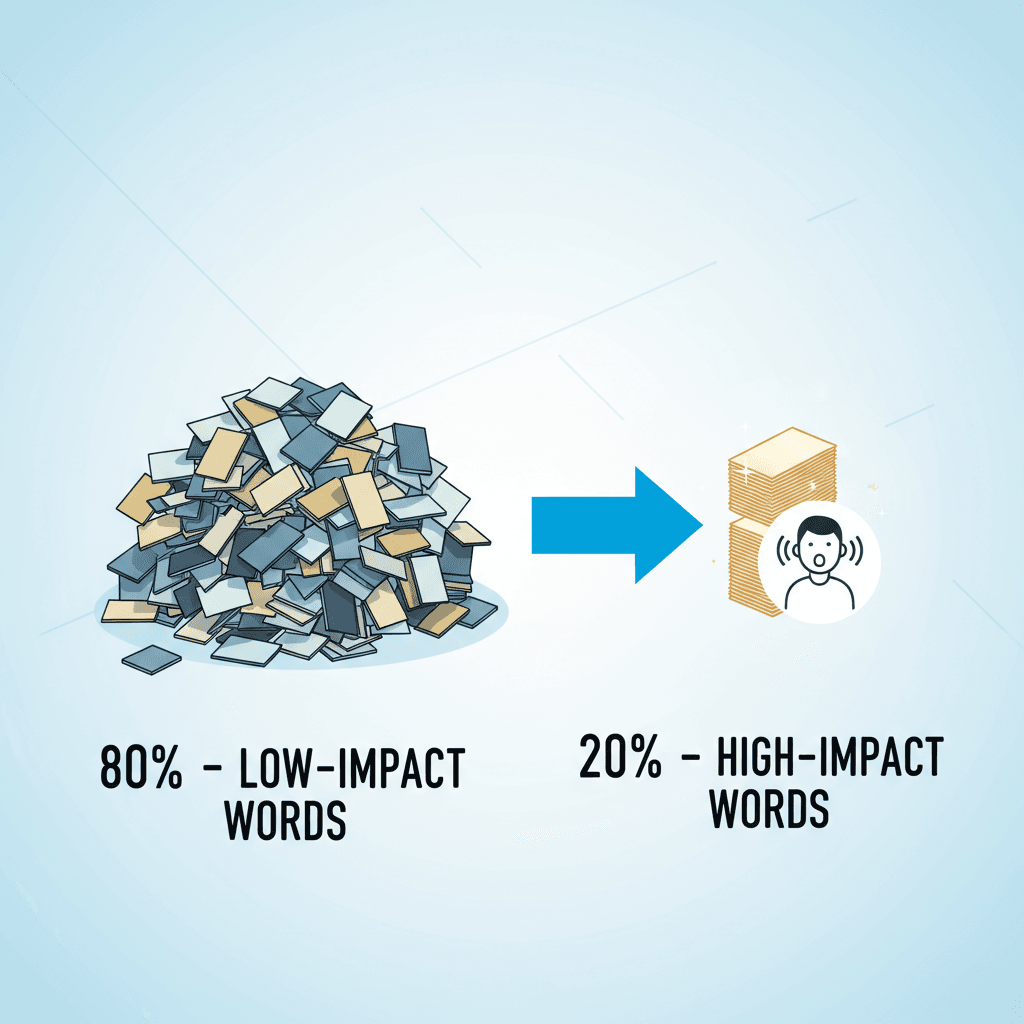
Welcome to the 80/20 rule of vocabulary, also known as the Pareto Principle. In language, it means that about 80% of what you say and understand comes from just 20% of your vocabulary. This is a game-changer. By focusing your efforts on mastering a core set of high-impact words, you can accelerate your communication skills much faster than if you tried to learn everything at once.
This isn't just a theory; it's backed by data. Research shows that the first 1,000 most common English word families cover roughly 70-80% of everyday texts, and a core set of around 2,000 lemmas (the base form of a word) accounts for the vast majority of normal speech. Your mission is to identify and master this high-impact 20%. While frequency lists are a great shortcut, learners have noted that the most impactful effort comes from cognitively demanding tasks—like active speaking practice with a tutor—which truly cement these core words in your memory.
Go Beyond Basic Frequency Lists
High-frequency word lists are a fantastic starting point, but they are not the destination. To sound natural and speak fluently, you need to understand how words work together in context. Recent research emphasizes that building 'rich semantic networks'—understanding the connections between words—is more effective for spontaneous speech than just memorizing definitions from a list.
This means prioritizing the diversity of contexts in which you encounter a word. Instead of just seeing 'implement' on a flashcard, you should find it in an article about business strategy, hear it in a podcast about software development, and then try to use it when talking about a new plan you have. This process builds a robust mental map around the word, making it easier to recall.
A huge part of this is focusing on collocations (words that naturally go together) and phrasal verbs. Native speakers don't say 'do a mistake,' they 'make a mistake.' They 'run into trouble' or 'come up with an idea.' Learning these phrases as single chunks is a powerful strategy. This focus on using words in communicative tasks is what experts call 'vocabulary activation,' and it directly improves your ability to produce speech.
Build a Professional Vocabulary List
For those of you learning English for your career, the 80/20 rule is especially powerful. You can quickly become effective in a professional environment by targeting the specific language of your industry. A great starting point is to combine the General Service List (GSL) with the Academic Word List (AWL), which together cover a huge portion of professional and academic language.
To make your personal vocabulary list truly relevant for the modern digital workplace, source words directly from your professional life. Pay close attention to the language used in:
- •Company-wide emails and Slack channels.
- •Meeting agendas and transcripts.
- •Industry-specific reports and case studies.
- •Presentations from senior leadership or clients.
Once you have your list of professional terms, the next step is activation. A key trend is the use of AI tutors for 'vocabulary activation,' which allow you to practice new terms in realistic but judgment-free conversations. For instance, you could role-play a negotiation or a project update to practice your new words before using them in a high-stakes meeting. This hybrid model of self-study combined with active practice is becoming a new standard for professional language development.
Step 3: Activate Your Vocabulary with Deliberate Practice
This is where we turn knowledge into action. Knowing a word is one thing; using it smoothly in the middle of a sentence is another. 'Vocabulary activation' is the process of building a bridge between your passive and active vocabularies through deliberate, focused practice. Every time you successfully use a new word in conversation, you strengthen that bridge.
One effective technique is to build 'oral muscle memory.' This involves saying the new word and its various forms out loud. Practice using it in different sentences. This simple act of vocalization makes the word feel more familiar and easier to retrieve under pressure. You have to deliberately try to use a new word in conversation to truly solidify your understanding and make its use automatic.
Remember the 15-20 encounters rule? Practice is how you create those encounters. Research emphasizes that learners need multiple opportunities to use new words. This can be done through brief, daily activities like reviewing with a partner, writing example sentences that are personal to you, or—most powerfully—engaging in real conversation. This is where a safe, supportive practice environment becomes essential.
Practice in a Judgment-Free Zone with an AI Tutor
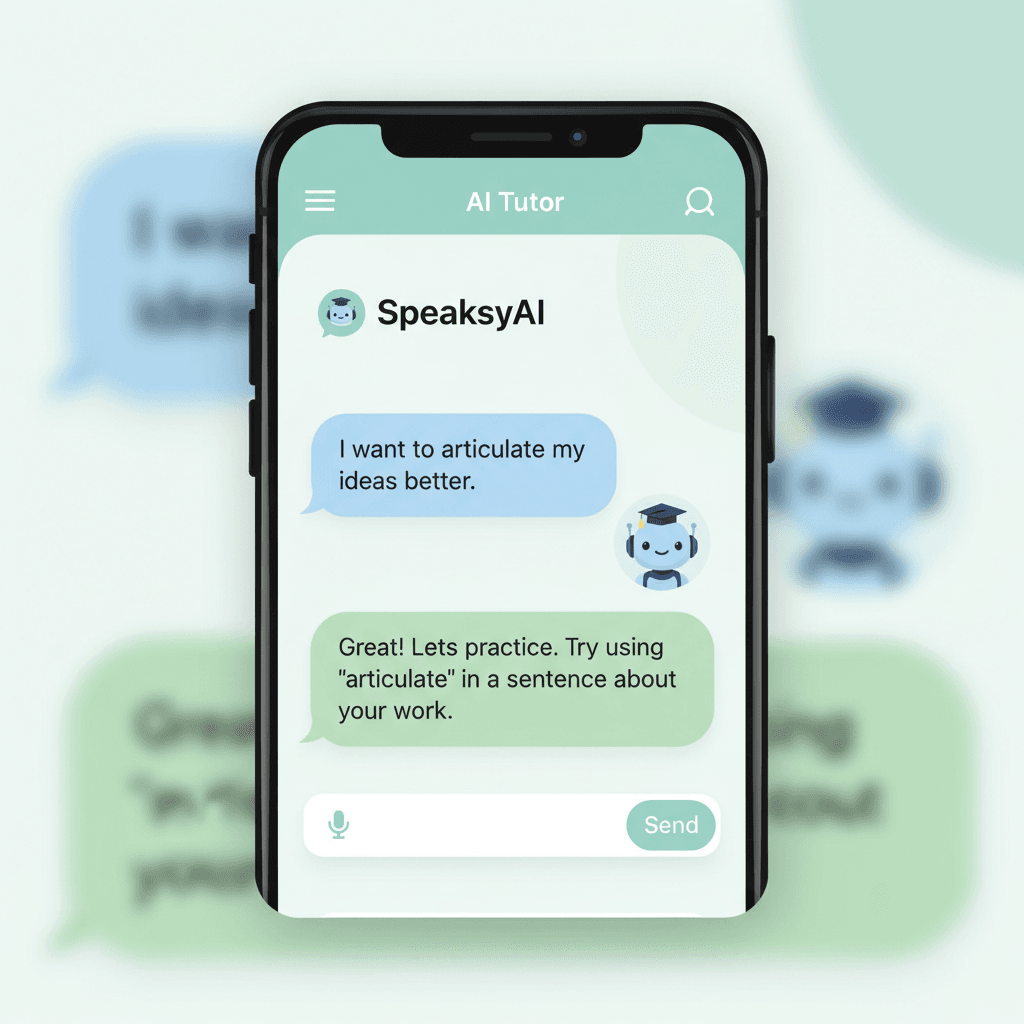
The biggest barrier to activating vocabulary is often the fear of making mistakes. What if you mispronounce the word? What if you use it in the wrong context? This is why a major industry development is the rise of AI language tutors that provide a 'judgment-free' environment for conversational practice. You get all the benefits of a real conversation without any of the pressure.
These tools allow you to build confidence privately. You can try out your new professional vocabulary, practice your pronunciation, and get immediate feedback without worrying about how you sound. Platforms like SpeaksyAI (speaksyai.com) are designed for this exact purpose, providing a safe space to activate the personal vocabulary list you've just built. The technology has even evolved to 'Agentic AI' that can remember your past mistakes and adapt its teaching style to you, creating a truly personalized practice experience.
Use a Spaced Repetition System (SRS) for Speaking
Spaced Repetition Systems (SRS) are one of the most effective tools for memory. Apps like Anki and Quizlet use an algorithm to show you information just before you're about to forget it. This method of 'spaced retrieval practice' is incredibly powerful—a landmark study found it results in 150% better long-term recall compared to cramming.
But you can use SRS for more than just passive recognition. To supercharge your vocabulary activation, create flashcards that prompt you to produce language, not just recognize it. Instead of a card that asks 'What does versatile mean?', create a prompt like: 'Use the word versatile in a sentence to describe a skill you have.' This forces you to actively retrieve and use the word in context.
The ultimate workflow combines these powerful tools. Use an SRS to schedule your reviews, but when a card comes up, don't just answer it in your head. Say the sentence out loud, or better yet, jump into a conversation with an AI tutor and try to use your word of the day. This powerful combination of spaced repetition and active, conversational practice is the fastest way to move words from your passive list to your active speaking toolkit.
FAQ: How to Choose Vocabulary to Learn
Frequently Asked Questions
Ready to Activate Your Vocabulary?
Stop memorizing words you'll never use. Get personalized practice with an AI language tutor and start speaking confidently. Join the SpeaksyAI waitlist today.
Join the Waitlist