Can't Speak After Duolingo? A 3-Step System to Start Talking
You've spent months on Duolingo, but the words won't come out in a real conversation. You're not alone. This guide explains why and gives you a clear system to start speaking.
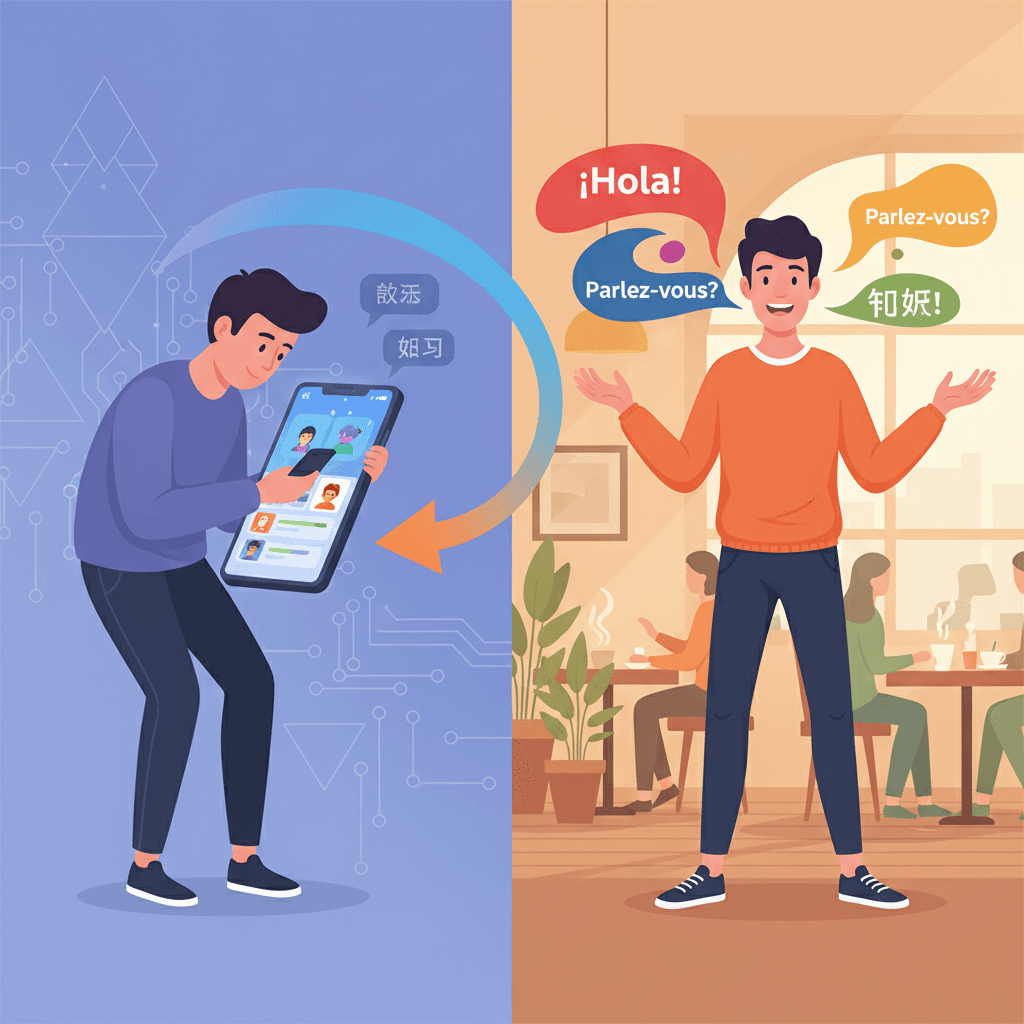
You’ve done everything right. You’ve earned a triple-digit streak on Duolingo, unlocked every level, and collected a treasure trove of gems. You can read menus in your target language and understand snippets of TV shows. But when it comes to actually speaking, you freeze. If you’ve ever thought, “I can't speak after Duolingo, what to do next?” you’ve hit a very common, and very frustrating, wall. The good news is, it's not your fault. You’ve just arrived at what we call the 'Post-Duolingo Plateau,' and it's a completely normal part of the language learning journey.
Welcome to the 'Post-Duolingo Plateau': It's Not Your Fault
The feeling that your speaking skills don't match your reading or listening skills is incredibly common. The reason is simple: language learning involves two distinct types of knowledge. Duolingo is a master at building input-based knowledge. It fills your brain with vocabulary, grammar patterns, and sentence structures through tapping, matching, and fill-in-the-blank exercises. You get very good at recognizing the right answer when it's presented to you. However, as language learning experts at Tandem explained in 2026, speaking is an output-based skill. It requires you to produce language spontaneously, from scratch, without multiple-choice options. Duolingo builds a fantastic foundation, but it doesn’t build the house.
This gap between recognition and production is so widely experienced it’s been called the 'language learning plateau.' A May 2026 guide on Duolingo's own progress reports noted they can be misleading because speaking skills aren't actively tracked, causing many US users to 'hit a wall' despite high scores. You might have a massive passive vocabulary (words you recognize) but a much smaller active vocabulary (words you can actually use in a sentence). As one learner shared in a July 2026 note after five years of daily use, Duolingo alone doesn't build conversational skills; those are only developed through the habit of speaking aloud. This isn't a personal failure—it's a limitation of the method, and one you can absolutely overcome.
The Speaking Activation Diagnostic: Find Your Bottleneck
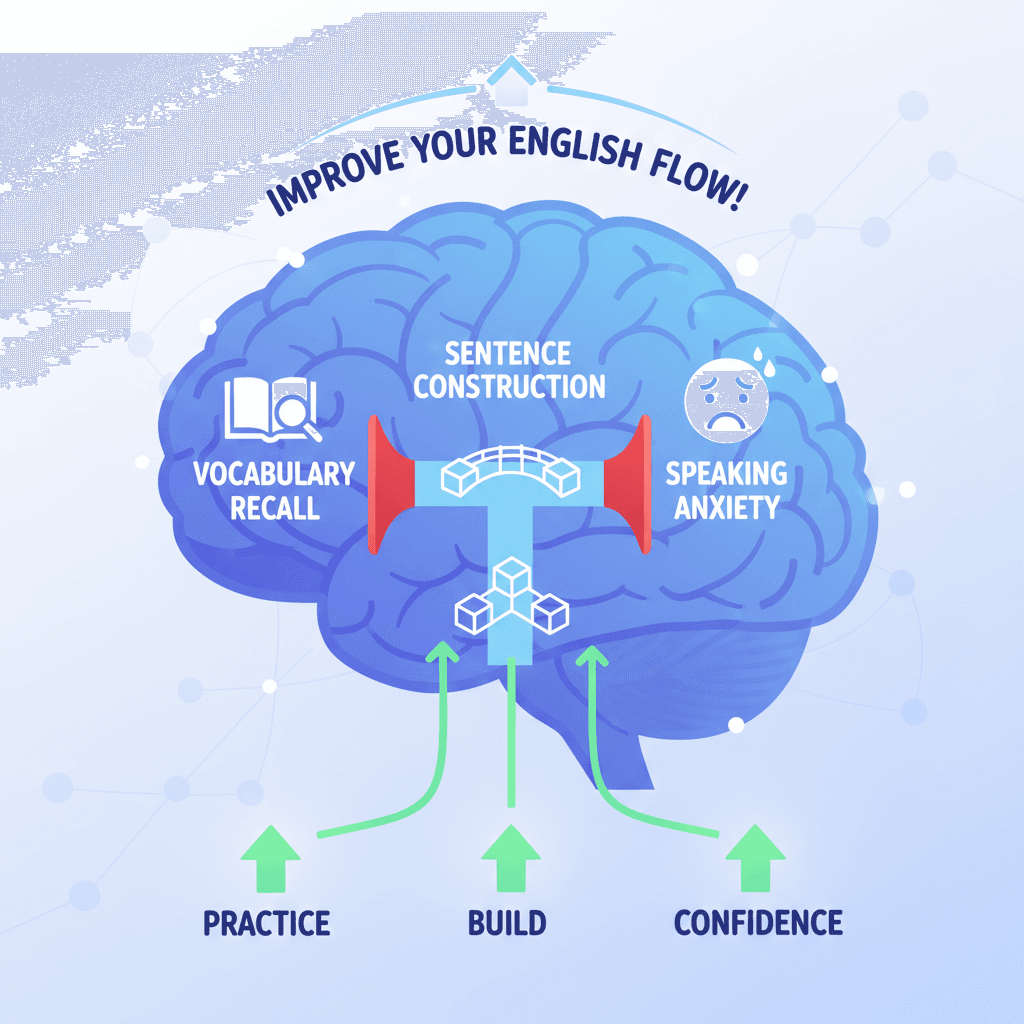
Before you can break through the plateau, you need to know exactly what’s holding you back. Just as a doctor diagnoses an illness before prescribing a treatment, you need to identify your specific language learning bottleneck. Are you struggling to remember words, form sentences, or just overcome the fear of speaking? Each issue has a different solution. An honest 2026 review noted that it's common for speaking ability to improve 'minimally or not at all' with Duolingo alone, highlighting this need for targeted practice. This is because the app doesn't prepare you for the complex, multi-layered skill of real-time conversation.
Use the simple checklist below to pinpoint your primary challenge. Be honest with yourself—identifying the root cause is the first and most important step toward speaking confidently. Research from March 2025 identifies common speaking bottlenecks as psychological barriers, like a fear of making mistakes, and limited active vocabulary recall. Let's find yours.
Is it Vocabulary Recall?
This is the most common issue for post-Duolingo learners. You likely recognize thousands of words when you read them in the app, but when you try to speak, your mind goes blank. Does this sound familiar? You're having a conversation in your head, but the specific words you need are just out of reach. According to a May 2026 report, most Duolingo courses are designed to bring a learner to the A2 (upper-beginner) level. At this stage, your vocabulary is often recognizable but not yet automated for spontaneous use. A January 2026 analysis confirms this, arguing that Duolingo primarily teaches vocabulary and grammar recognition, not the spontaneous production required for conversation.
Is it Sentence Construction?
Perhaps you know the individual words, but stringing them together into a coherent, grammatically correct sentence feels like a monumental task. You might find yourself mentally translating from your native language, resulting in awkward phrasing and long pauses. This happens because, as LinguaLive noted in 2026, Duolingo functions as a recognition app, testing your ability to identify correct grammar rather than produce it from scratch. A 2025 study in the Journal of English Language and Education found that while Duolingo is effective, it lacks the 'authentic communication' needed to develop the skill of actively constructing sentences in a live conversation. You've learned the ingredients, but you haven't practiced the recipe.
Is it Speaking Anxiety?
Maybe you know the words and grammar, and you can even form sentences perfectly in your head. But the moment an opportunity to speak arises, you freeze. Your heart races, you get flustered, and you worry about sounding foolish. This is speaking anxiety, and it’s a powerful barrier. A June 2026 study confirmed that students enjoy Duolingo because it provides a 'fun, non-threatening, and interactive learning environment'—the exact opposite of a high-pressure, real-world conversation. As Duolingo's own blog explained in September 2024, real-world conversations require spontaneous thought and processing unfamiliar accents, skills that aren't fully developed in the app's controlled environment. This anxiety is a sign that you need a safe space to build confidence.
The 3-Step System to Activate Your Duolingo Knowledge
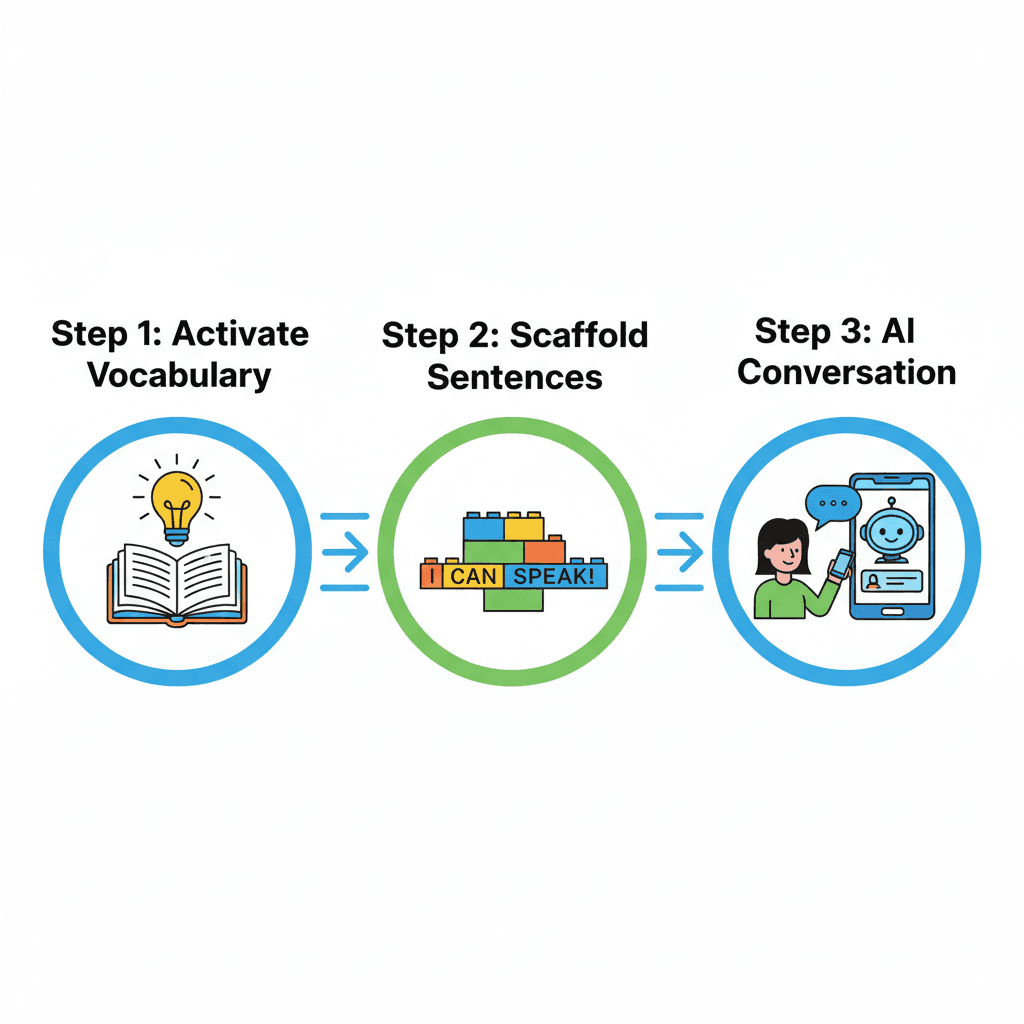
Now that you've identified your bottleneck, it's time for a clear, actionable plan. We've designed a simple 3-step system to help you activate the knowledge you already have and turn your passive understanding into active, confident speaking. This isn't about learning more vocabulary lists; it's about making the vocabulary you already know usable in the real world. This 'activation' phase is what bridges the gap between the app and the real world.
The language learning market is already shifting to address this gap. In 2026, leading apps like Babbel are recognized for a method built around real native speaker conversations, and platforms like Busuu offer 'Live Lessons' to supplement their courses. This hybrid approach acknowledges a crucial truth: passive knowledge requires active practice to become a real skill. This system will give you that active practice in a structured, low-stress way.
Step 1: Turn Passive Vocabulary into Active Knowledge
If your issue is vocabulary recall, your goal is to break free from the 'Recognition Trap.' This is where you only practice recognizing words, not producing them. To make words 'active,' you have to force your brain to retrieve them without any clues. Here are a few powerful techniques:
- •Narrate Your Day: As you go about your daily routine—making coffee, commuting, cooking dinner—describe what you're doing out loud in your target language. A 2026 discussion on Reddit's r/languagehub highlighted this as a top strategy for forcing active recall in a low-pressure context.
- •Use Sentence Mining: Instead of memorizing isolated words, find sentences in TV shows or articles that contain one new word you want to learn. As recommended by FluentU in 2023, this teaches you vocabulary in context and helps you internalize natural sentence structures.
- •Describe a Photo or Scene: Open a random photo on your phone and describe everything you see in detail. This forces you to retrieve nouns, adjectives, and prepositions to build a description from scratch, activating your passive knowledge.
Step 2: Build Sentences with Low-Pressure 'Scaffolding'
If you struggle with sentence construction, you need 'scaffolding'—support structures that help you build correct sentence habits without the pressure of a live conversation. According to a 2026 analysis from The Language Gym, fluency is built through 'carefully sequenced processing and retrieval,' which is exactly what these exercises do. They reduce cognitive overload so you can focus on one skill at a time.
Scaffolding strategies significantly improve a learner's comprehension, fluency, and confidence primarily by creating a space to practice without the fear of failure, which is crucial for speaking development.
Here are two highly effective scaffolding techniques:
- 1.Shadowing: Find a podcast or YouTube video with a native speaker and a transcript. Play the audio and speak along with the speaker, trying to match their pronunciation, rhythm, and intonation exactly. This builds muscle memory for sentence flow and natural cadence.
- 2.Scripting: Write out short scripts for common conversations you expect to have, such as ordering a coffee, introducing yourself, or asking for directions. Practice them out loud until they feel automatic. This gives you pre-built conversational 'chunks' you can deploy without having to construct every sentence from zero.
Step 3: Bridge to Conversation with an AI Language Tutor
If speaking anxiety is your main hurdle, you need a bridge. You need a way to get the experience of a real conversation without the fear of judgment. Traditional apps excel at structured lessons but, as Test Prep Insight noted in May 2026, they lack the spontaneity required for real conversation. This is where AI-powered tools have become a game-changer for learners across the US, UK, and Australia.
This is where an AI language tutor becomes your most powerful tool. Platforms like SpeaksyAI (speaksyai.com) are designed specifically to act as this low-pressure 'bridge' between solo study and the real world, letting you practice unlimited conversations in a judgment-free zone before you speak with a person. According to a March 2026 report from Vertech Academy, learners are increasingly using AI chatbots to access a 24/7 environment where they can build speaking confidence at their own pace. You can make mistakes, ask for translations, get instant pronunciation feedback, and slowly build the confidence you need to take the next step.
Your First-Week Speaking Plan After Duolingo
Feeling motivated? Let's put it all together into a concrete, 7-day plan to get you speaking. This structured approach helps you build momentum and see real progress quickly. The need for speaking practice is so clear that Duolingo itself announced plans to introduce scenario-based 'Speaking Adventures' by mid-2026. You can get a head start right now.
- •Days 1-2: Diagnose & Activate. Start by using the diagnostic checklist in this article to identify your main bottleneck. Then, begin your first activation exercise. Spend 15 minutes each day narrating your daily tasks out loud in your target language. Don't worry about perfection; just focus on retrieving words.
- •Days 3-4: Scaffold & Shadow. Find a 5-minute podcast or video clip with a transcript. Spend 15 minutes each day 'shadowing' the speaker. You'll feel awkward at first, but this is one of the best ways to improve your flow and pronunciation. Also, write out one short 'script' for a simple interaction, like buying a train ticket.
- •Days 5-7: Your First AI Conversations. It's time to talk! Start with just 10-15 minutes a day in a low-pressure conversation with an AI language tutor. A 2025 Duolingo study found that using generative AI features significantly increased a learner's belief in their ability to use a language. Tell the AI about your day, practice your script, or ask it questions. The goal is simply to get comfortable producing spontaneous sentences in a safe environment.
FAQ: Moving from Duolingo to Speaking
Frequently Asked Questions
Ready to Finally Start Speaking?
Stop feeling stuck. SpeaksyAI is the low-pressure AI language tutor that gets you speaking from day one. Get instant pronunciation feedback and build real confidence.
Join the Waitlist