How to Supplement Duolingo for Speaking Practice: A System
Love your Duolingo streak but struggle to speak confidently? You're not alone. This guide gives you an actionable system to turn your Duolingo vocabulary into real conversation.

You’ve built an incredible streak on Duolingo, maybe even hundreds of days long. You know the words for 'apple' and 'the cat is under the table' in your target language. But when you try to ask for directions or make small talk, you freeze. If you've ever felt that frustrating gap between knowing words and actually speaking, you are not alone. This is the single most common hurdle for Duolingo users, but the good news is that it's completely solvable. The key isn't to ditch the owl, but to learn how to supplement Duolingo for speaking practice with the right tools and techniques. This guide will give you a clear, three-step system to turn your passive vocabulary into confident, real-world conversation.
Why Your Duolingo Streak Isn't Making You Fluent (And That's Okay!)
First, let's celebrate your consistency. A long Duolingo streak shows dedication, which is the foundation of language learning. Duolingo is fantastic at what it does: building a base of vocabulary and grammar through gamified repetition. It trains your brain for passive recognition—seeing a word and knowing what it means. However, speaking is an active skill. It requires spontaneous recall, muscle memory in your mouth and tongue, and the confidence to form sentences on the fly. This is a completely different skill set, and it's one Duolingo wasn't primarily designed to build on its own.
This feeling of being 'stuck' is incredibly common. A poll from Android Authority revealed that while nearly half of users were annoyed by recent app changes, most stuck with it. Why? Because we know it provides value, even if it's not the complete solution. Think of Duolingo as your recipe book. It gives you all the ingredients (words) and instructions (grammar), but it doesn't offer the kitchen (conversation practice) where you actually learn to cook.
The most effective learners don't rely on a single tool. They build a system. Duolingo is a powerful piece of that system, but it needs partners. The goal isn't to replace it, but to enhance it with targeted exercises that build the active, conversational skills you're aiming for. Let's explore how to build that bridge from the app to confident speaking.
The 3-Step System: From Duolingo Knowledge to Confident Speaking
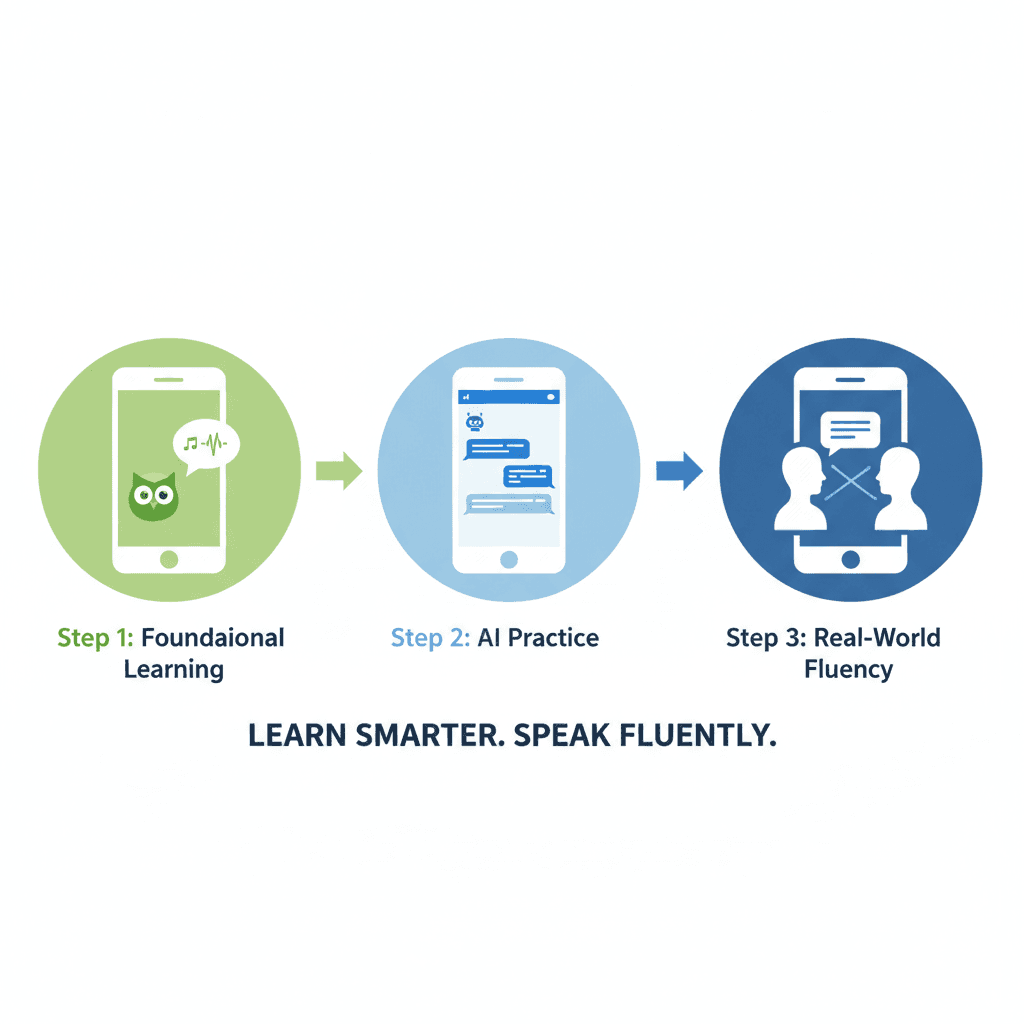
Instead of randomly trying different apps and methods, you need a clear path that builds on your existing Duolingo habit. This simple, three-step system is designed to do just that. It layers new skills on top of the foundation you've already built, systematically moving you from passive knowledge to active communication. Each step addresses a different part of the learning process, creating a well-rounded routine for real progress.
The path to speaking involves three core stages: maximizing your current tools, activating your knowledge in a safe environment, and reinforcing your skills in real-world scenarios.
- 1.Squeeze More Speaking Out of Duolingo: Before adding anything new, we’ll start by using simple techniques to turn every Duolingo lesson into active speaking practice.
- 2.Activate Your Vocabulary with an AI Tutor: Next, you'll take the words you've learned and use them in realistic, low-pressure conversations with a dedicated AI language tutor.
- 3.Reinforce Your Skills with Human Interaction: Finally, you’ll build on that confidence by engaging with native speakers through language exchanges or structured tutoring sessions.
This structured approach is proven to be more effective than just spending more time on vocabulary drills. In fact, independent linguists suggest that adding just one 30-minute tutoring session per week can accelerate your progress more than tripling your time on Duolingo alone, according to a 2024 analysis by Leyo - AI. By combining these methods, you create a powerful learning loop that leads to genuine fluency.
Step 1: Squeeze More Speaking Out of Duolingo Itself
Your first step doesn't require downloading any new apps or spending any money. It's about changing how you use the tool you already open every day. With a few small adjustments, you can transform Duolingo from a passive reading game into an active speaking workout. The app has built-in speaking exercises, but you can go even further by making every question a chance to practice.
A key technique is 'shadowing.' It's simple: whenever the app speaks a sentence, repeat it out loud. Mimic the pronunciation, the rhythm, and the intonation as closely as you can. This builds muscle memory and connects the written words to their spoken form. Research from 2024 has confirmed that Duolingo's model can significantly contribute to speaking proficiency when used actively, and this is one of the best ways to do it.
- •Speak every answer aloud. Before you tap the correct word or type a translation, say the full sentence out loud.
- •Use the dedicated speaking exercises. Don't skip them! They use voice recognition to give you immediate feedback.
- •Talk back to the characters. When a character says something, respond to it. If Duo says, 'I am eating bread,' you can say, 'Oh, is the bread good?' It feels silly, but it trains your brain to think in the language.
- •Master the Dictation Method. This next technique is so powerful it gets its own section. It's the ultimate way to turn Duolingo into speaking practice.
The Dictation Method: Turn Every Exercise into Speaking Practice
This single change can revolutionize your Duolingo sessions. The dictation method uses your phone's built-in voice-to-text feature to force you to speak your answers instead of typing them. For any exercise that requires you to type a response—whether it’s a translation or a fill-in-the-blank—tap the little microphone icon on your keyboard and say the answer instead.
Why is this so effective? It forces active recall. You can't just recognize the words; you must produce them correctly from memory. It also provides instant pronunciation feedback. If your phone's voice recognition doesn't understand you, it's a sign that your pronunciation needs work. Duolingo's own blog encourages this, as it creates a direct link between sound and meaning, building the mental reflexes you need for real conversation. A December 2025 case study published on ResearchGate concluded that Duolingo is a highly beneficial supplementary tool specifically for this kind of pronunciation practice and vocabulary reinforcement.
Step 2: Activate Your Vocabulary with an AI Language Tutor
You’ve learned the words on Duolingo and started saying them out loud. Now, it's time to use them in a real conversation. This is where most learners get stuck, because jumping from drills to talking with a native speaker feels terrifying. What if you make a mistake? What if you're too slow? This is the problem an AI language tutor is perfectly designed to solve.
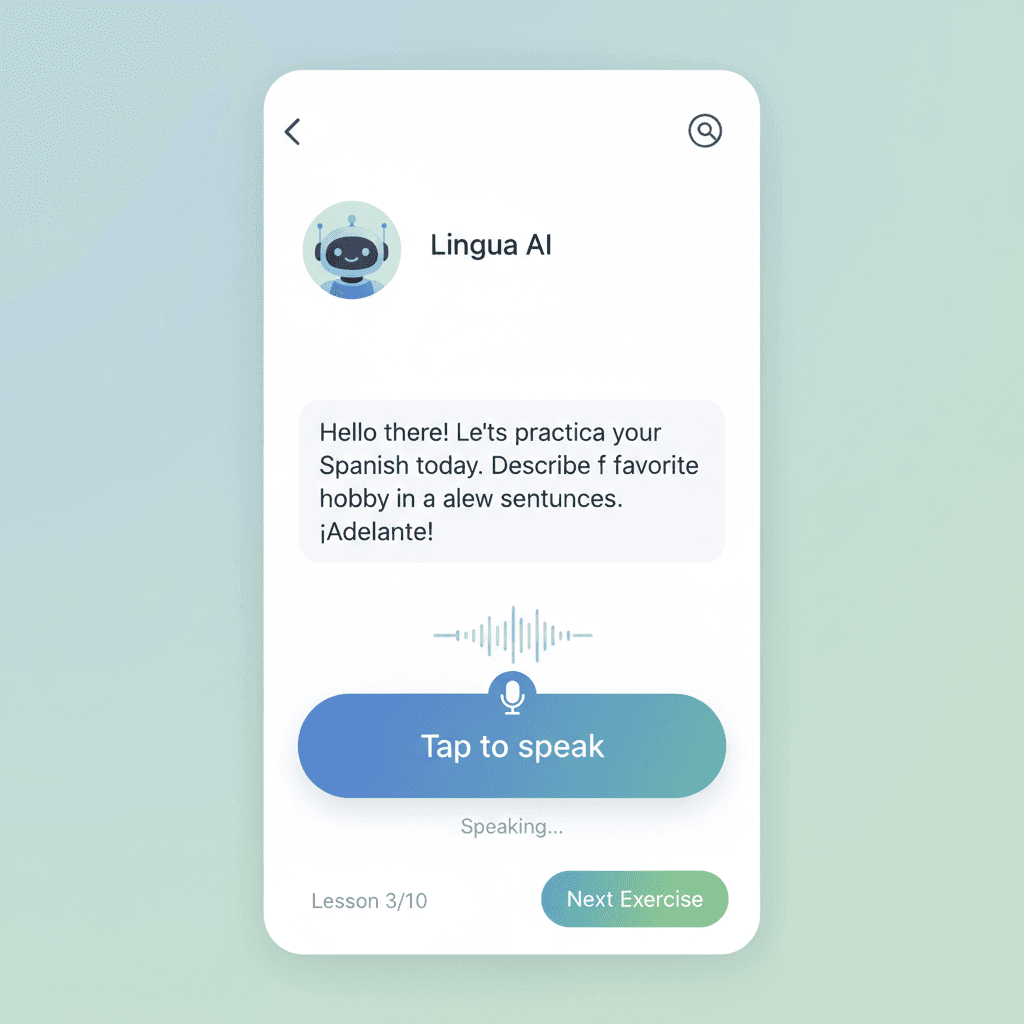
Think of an AI tutor as your personal speaking gym. It’s a safe, judgment-free space where you can practice speaking about any topic, anytime. Unlike the scripted exercises in Duolingo, an AI can hold open-ended conversations, ask you follow-up questions, and gently correct your mistakes in real time. This is the missing link for Duolingo conversation practice, moving you beyond simple drills into the world of dynamic communication, a trend noted by Vertech Academy in March 2024.
This is exactly why platforms like SpeaksyAI are so powerful. They act as the perfect partner to your Duolingo routine, giving you a dedicated space to turn passive vocabulary into active, confident conversation. You can take the exact words you learned in your lesson and immediately try using them in a realistic dialogue. This immediate application is critical for moving knowledge from your short-term to your long-term memory.
Ready to finally use all those words you've learned on your streak? The fastest way to build confidence is to start having low-stakes conversations. An AI tutor provides unlimited opportunities to practice speaking a language without the fear of judgment. It’s the essential next step to activate your knowledge and start speaking.
The 15-Minute Post-Duolingo Routine
Habits are built through small, consistent actions. To make speaking practice a natural part of your routine, tack it directly onto your Duolingo habit. The moment you finish your daily lesson, your mind is already warmed up in your target language. Use that momentum.
- 1.Finish your Duolingo lesson for the day. Pay attention to 3-5 new words or phrases you encountered.
- 2.Immediately open your AI language tutor. Don't check email or social media. Make this the very next step.
- 3.Start a conversation. Say something like, 'Let's talk about travel. I want to try using the words...' and list the new words you learned.
- 4.Talk for 15 minutes. Focus on communication, not perfection. The goal is to use the language. The AI will guide you and help with corrections.
This simple routine bridges the gap between the two apps and creates a powerful learning cycle. A 2025 study on Duolingo Max noted that using AI for practice helped learners develop more positive beliefs about their own language abilities after just one month. This boost in confidence is exactly what you need to keep progressing. For more ideas, you can also explore other great AI language tutors that can fit into this routine.
Step 3: Reinforce Your Skills with Human Interaction
After building a solid foundation with Duolingo and gaining confidence with an AI tutor, you're ready for the final step: talking to real people. An AI is an incredible training partner, but the ultimate goal is to communicate with humans. This is where you test your skills and learn the cultural nuances and slang that apps can't always teach you. There are two main paths for this.
- •Language Tutors (italki, Preply): This is the most structured option. A human tutor provides personalized feedback, corrects your specific errors, and can design lessons around your goals. While it's a paid option, its efficiency is unmatched. That 2024 Leyo - AI analysis found a single 30-minute session can be more impactful than hours of solo app study.
- •Language Exchanges (Tandem, HelloTalk): This is a free or low-cost way to practice with native speakers. You find a partner who is learning your native language, and you split your time talking in each language. It’s less structured but offers authentic, casual Duolingo conversation practice. It’s the perfect way to make friends and learn how people *really* talk.
Don't feel pressured to jump into this step too early. Use an AI language tutor like SpeaksyAI to build your confidence first. When you stop worrying about basic grammar and can recall words more easily, you'll be able to get much more value out of your conversations with human partners. View this as the 'graduation' step of your Duolingo speaking practice plan.
Putting It All Together: Your Weekly Speaking Practice Plan
Now, let's combine these three steps into a simple, sustainable weekly schedule. The key isn't to spend hours every day, but to be consistent with a balanced routine. A blended approach is the most effective way to improve. Here is a sample plan you can adapt to your own lifestyle.
Your Sample Weekly Plan: Mon / Wed / Fri: 20 min Duolingo + 15 min AI Tutor conversation. Tue / Thu: 20 min Duolingo + 15 min shadowing a podcast or TV show. Saturday: 30-minute language exchange (e.g., Tandem) or session with a human tutor (e.g., italki). Sunday: Rest day or review your notes from the week.
This schedule ensures you're maintaining your vocabulary base with Duolingo, actively using it with an AI, and reinforcing it with real-world listening and speaking. This is the kind of supplementary routine that separates casual learners from those who achieve fluency. It's not about more hours; it's about smarter hours. For a deeper dive, check out our complete Duolingo review and how it fits into a larger learning strategy.