Why You Forget Words When Speaking & How to Fix It (A System)
It's the most frustrating moment for any learner: a word you *know* is on the tip of your tongue but won't come out. This guide explains why and gives you a system.

It’s Not Just You: The 'Tip-of-the-Tongue' Frustration
You’re mid-sentence, the conversation is flowing, and then… nothing. The perfect word is right there, hovering just out of reach, a ghost on the tip of your tongue. You know the word, you’ve studied it, but your brain refuses to produce it. If you’ve ever wondered, why do I forget words when speaking a foreign language?, please know this: you are not alone, and your memory isn’t broken. This frustrating experience is a universal part of the language learning journey, and more importantly, it's a problem you can solve.
This feeling isn't a sign of failure, but a well-documented cognitive event that scientists call the 'tip-of-the-tongue' (TOT) phenomenon. A 2026 review in PMC confirms it’s a 'transient lexical block'—a temporary glitch in your brain's retrieval system, not its storage system. The word is safely filed away in your memory; you just can't access the file at that moment. In fact, this happens even more frequently to bilingual and multilingual individuals. Why? Because your brain is working hard to manage multiple language systems that sometimes 'compete' for attention, leading to these temporary retrieval blocks.
Speaking a foreign language requires a 'higher item processing effort,' according to a 2026 study in Frontiers. Because the sounds and connections for these words are less familiar, your brain has to work harder to pull them up. It’s like trying to find a book in a library you’ve only visited a few times versus the one you grew up in. The frustration is real, but understanding the cause is the first step toward building a better retrieval system.
The Real Reasons Your Brain 'Loses' Words
Think of your brain's working memory like a computer's RAM—it has limited capacity. Speaking a foreign language is a cognitively demanding task that uses a lot of that RAM. When you add the stress of a real-life conversation or performance anxiety, your system can overload. This overload acts like a circuit breaker, temporarily cutting off access to the very words you’re trying to find. This isn't just a feeling; a 2025 article on language memory explains that stress can genuinely block access to known words.
Furthermore, not all words are created equal in your brain. A fascinating December 2025 study found that the 'age of acquisition' is the single most significant predictor of a retrieval failure. This means words you learned recently are on much shakier ground than those you learned years ago. They haven't had time to build strong, durable pathways in your long-term memory, making them the first to disappear when you’re under pressure.
Your Brain's Filing System: Passive vs. Active Vocabulary
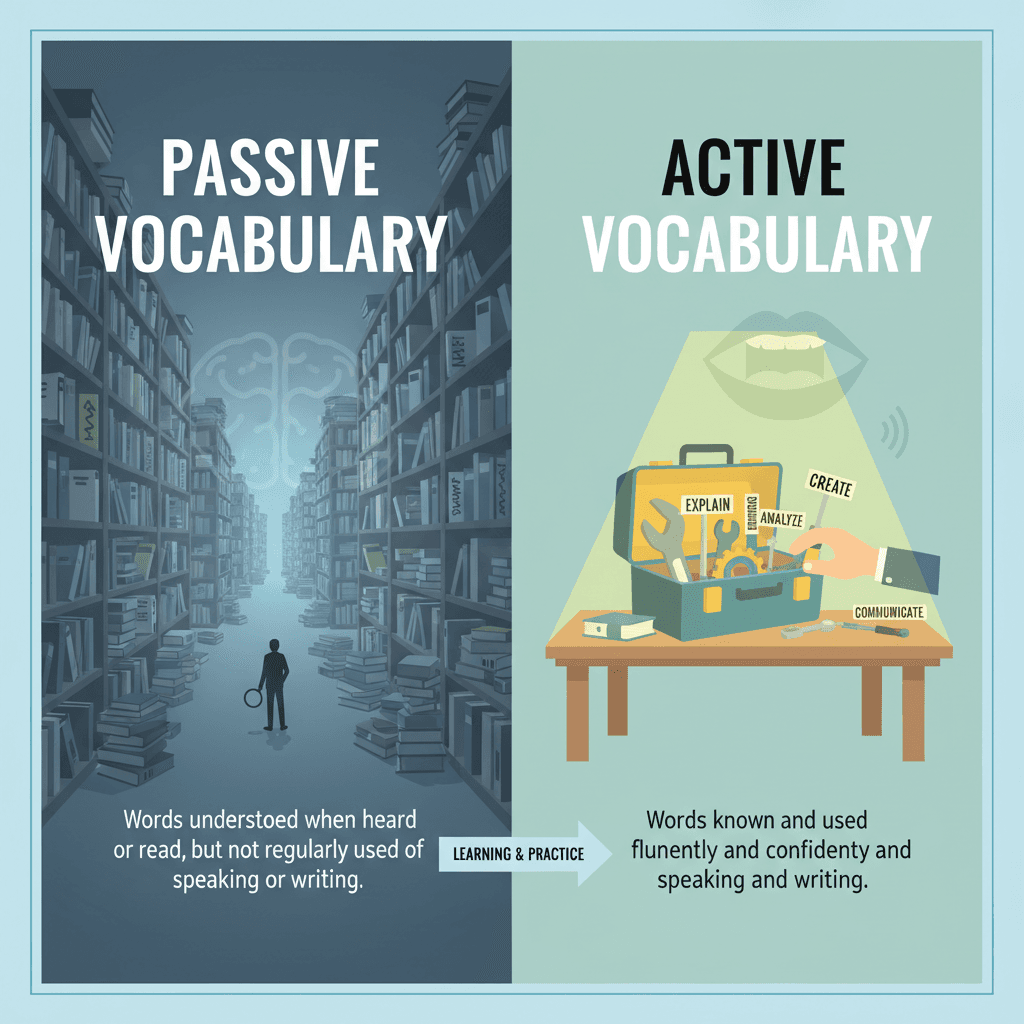
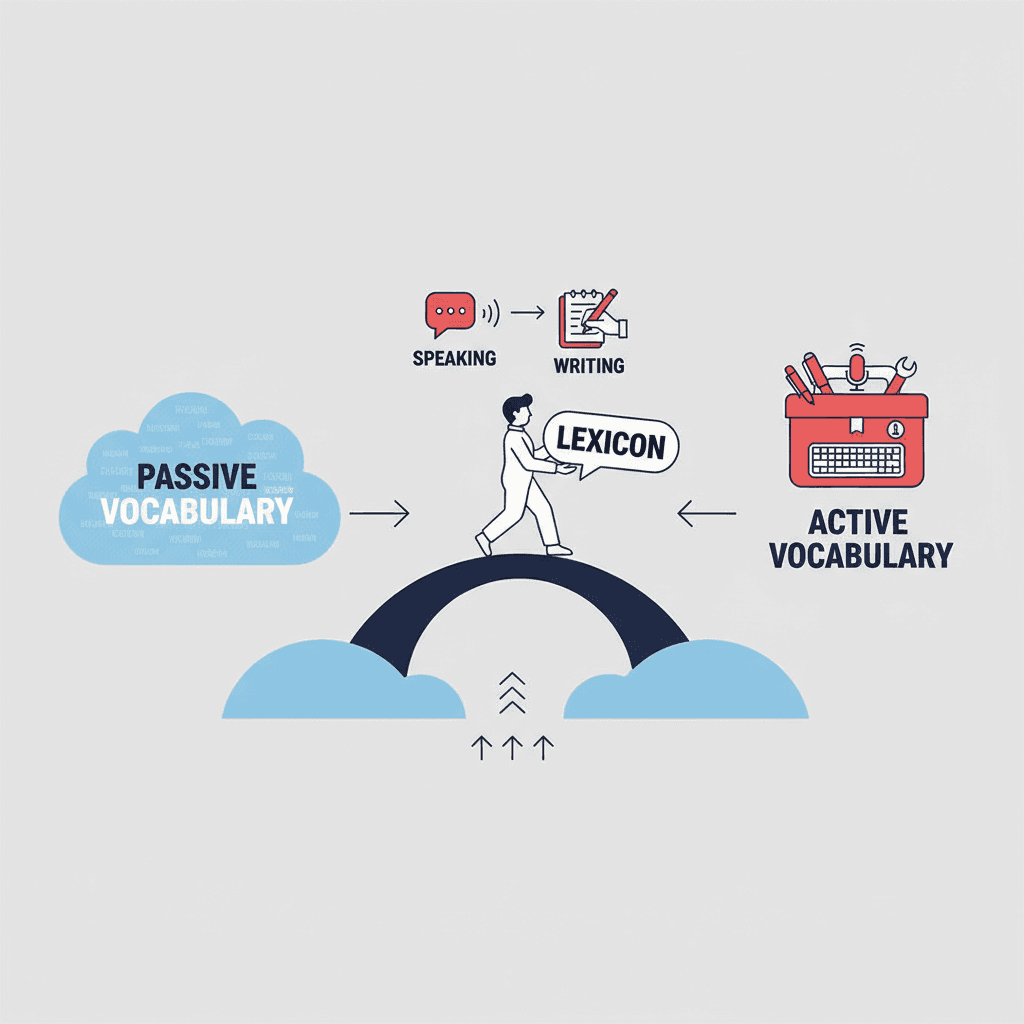
One of the biggest reasons for the tip-of-the-tongue phenomenon is the difference between your passive and active vocabulary. Think of your passive vocabulary as a massive filing cabinet. It contains all the words you can recognize when you read or hear them. Your active vocabulary, on the other hand, is like the set of files sitting right on your desk—words you can grab and use effortlessly in speech and writing. The problem is often not that you've forgotten a word, but that it's stuck in the filing cabinet instead of being on your desk, ready to use.
How does a word move from the cabinet to the desk? Through conscious, repeated usage. A 2025 article on Medium highlights that simple exposure isn't enough; you need to actively retrieve and use a word to strengthen its 'retrieval path.' Every time you successfully pull a word from memory and say it out loud, you’re paving that path, making it smoother and faster for the next time. Infrequent use causes that path to become overgrown and difficult to travel.
Speaking Anxiety: How Stress Shuts Down Recall
The emotional component of speaking a new language cannot be overstated. That feeling of panic when you’re put on the spot? It’s not just in your head; it’s a physiological response that sabotages your recall. This foreign language speaking anxiety, sometimes called xenoglossophobia, triggers your brain's 'fight or flight' response. Your brain perceives the situation as a threat and diverts its resources away from complex cognitive tasks (like language production) toward survival.
Research from Cambridge University Press (2025) shows that this performance anxiety consumes your finite working memory, leading to a 'freeze mode' where you struggle to access material you've already learned. Your brain isn't focused on finding the right word; it's focused on the perceived danger of making a mistake. This creates a vicious cycle: you get anxious about forgetting words, which makes you more likely to forget them, which in turn increases your anxiety.
'Crosstalk': How Your Languages Compete for Attention
If you speak more than one foreign language, you may have noticed another strange phenomenon: learning a new language can sometimes make you forget words in one you already know. This isn't your imagination. It's a process called 'interference' or 'crosstalk.' Because your brain uses the same neural pathways to process all languages, words from different languages can become active simultaneously and compete for selection. Your brain must then work to inhibit the word you don't want to say, and sometimes, that process goes awry.
This mental juggling act is actually a fantastic workout for your brain and is linked to slower cognitive aging. However, as research from the FENS Forum 2026 highlights, the skill of switching between languages requires actively selecting one vocabulary while suppressing another. This constant effort of managing attention is a primary cause of those temporary blocks or accidentally blurting out a word from the wrong language.
The Word Retrieval System: From Passive to Active Recall
So, how do we fix this? The answer isn’t to study harder, but to practice smarter. Instead of just cramming more words into your brain's 'filing cabinet' (passive memory), you need a system to build strong, reliable bridges to your 'on-demand' vocabulary (active memory). We call this The Word Retrieval System. It’s a three-step approach designed to strengthen your recall pathways and build unshakable speaking confidence.
The core principle is simple: prioritize word retrieval practice. The most effective way to improve your recall for speaking is to focus on pulling words from your memory, not just putting them in. Every time you successfully retrieve a word during conversation, you make that connection stronger. The goal of this system is to create low-pressure opportunities to do exactly that, turning moments of forgetting into moments of reinforcement.
Step 1: Low-Stakes Retrieval Practice in Your 'Confidence Sandbox'
The biggest enemy of word recall is stress. As we've seen, anxiety releases cortisol, a hormone that directly impairs your brain's memory functions. To practice retrieval effectively, you need to do it in a low-stakes environment where the fear of judgment is completely removed. You need a 'Confidence Sandbox.'
This is where modern technology offers a brilliant solution. Practicing with a non-judgmental partner, like an AI tutor from a platform such as SpeaksyAI, removes social pressure. It creates a private space where you can talk, pause, make mistakes, and try again without any fear of embarrassment. This allows your brain to focus 100% on the task of retrieval. You can simulate real conversations, practice describing things, and get instant feedback on pronunciation, all of which moves words from your passive to active vocabulary.
Step 2: Master In-the-Moment Rescue Strategies
Practicing is essential, but you also need a plan for when your mind goes blank in a real conversation. Having 'if-then' rescue strategies reduces panic and empowers you to keep the conversation moving. Instead of freezing, you'll have a tool ready to go.
- •If you forget a noun: Use circumlocution techniques. Describe the word you're looking for. Instead of freezing for 'corkscrew,' you can say, 'the tool you use to open a bottle of wine.' The other person will likely supply the word, and the act of describing it helps solidify its meaning in your mind.
- •If you need a moment: Use a filler phrase to buy yourself a few seconds of thinking time. Simple phrases like, 'Let me see...' or 'How do you say it in English?' or 'It's on the tip of my tongue...' signal to your partner that you're just searching for a word, which is a normal part of any conversation.
- •If you are truly stuck: Just ask! Turn it into a learning opportunity. Saying, 'Sorry, I've blanked on the word for...' is not a failure. A 2025 article confirms that this process of actively retrieving a forgotten word with help actually strengthens its connection in your memory for the future.
Step 3: Create 'Recall Triggers' with Context
Are you learning new words from isolated flashcards or vocabulary lists? This is one of the biggest culprits behind weak recall. Learning a word like 'appointment' on its own gives your brain only one path to retrieve it. When that path is blocked by stress, the word is gone. Forgetting is often a symptom of poor memory encoding from the start.
The solution is to learn words within rich, full sentences and stories. This creates multiple 'recall triggers.' When you learn the sentence, 'I have a doctor's appointment at 3 PM tomorrow,' you link the new word to 'doctor,' '3 PM,' and 'tomorrow.' These related concepts act as contextual hooks. If you can't remember the word 'appointment' directly, thinking of 'doctor' might trigger it. This method also helps protect words from the 'interference' effect, where new vocabulary crowds out old.
Frequently Asked Questions
Frequently Asked Questions
Ready to Find Your Words and Speak Confidently?
Turn frustrating silences into fluent sentences. Practice retrieving words in realistic conversations with SpeaksyAI, your personal AI language tutor.
Join the Waitlist