Beyond 'How Are You?': What to Talk About With a Language Partner
You've found a language partner—congratulations! But now comes the hard part: what do you actually talk about? Go beyond basic lists and learn a framework for confident conversations.

Why 'What Should We Talk About?' is the Wrong Question

The fear is universal: you sit down for a language exchange, introductions are made, and then... silence. The pressure to find the perfect thing to say is immense, and your mind goes blank. Many learners believe the key is finding a list of what to talk about with a language partner, but this misses the point. Recent linguistic research frames language learning as 'experience-dependent plasticity,' which means the quality of your practice—not just the topic—is what truly builds fluency (Language & Literacy, 2025). The real issue isn't a lack of topics; it's the lack of a plan and the confidence to execute it.
Thinking you just need more 'language exchange topics' is like thinking a chef just needs more ingredients. A great meal requires a recipe, technique, and practice. Similarly, a great conversation practice session needs structure. Even major platforms like Tandem emphasize conversational technique, such as asking open-ended questions, over simply providing topic lists (Tandem, 2024). The goal isn't just to fill the silence but to create meaningful, structured interactions that actively rewire your brain for your new language. This anxiety around unstructured conversation is precisely why AI language partners have become essential preparation tools for learners worldwide.
Instead of scrambling for ideas mid-conversation, you need a strategy. This shift in mindset moves you from being a passive participant to an active architect of your learning journey. By preparing conversational frameworks and practicing them beforehand, you can walk into every language exchange feeling prepared, confident, and ready to make real progress. This structured approach ensures your live conversations are more effective, turning potential moments of panic into powerful learning opportunities.
The Conversation Scaffolding Method: A 3-Stage Plan for Better Chats
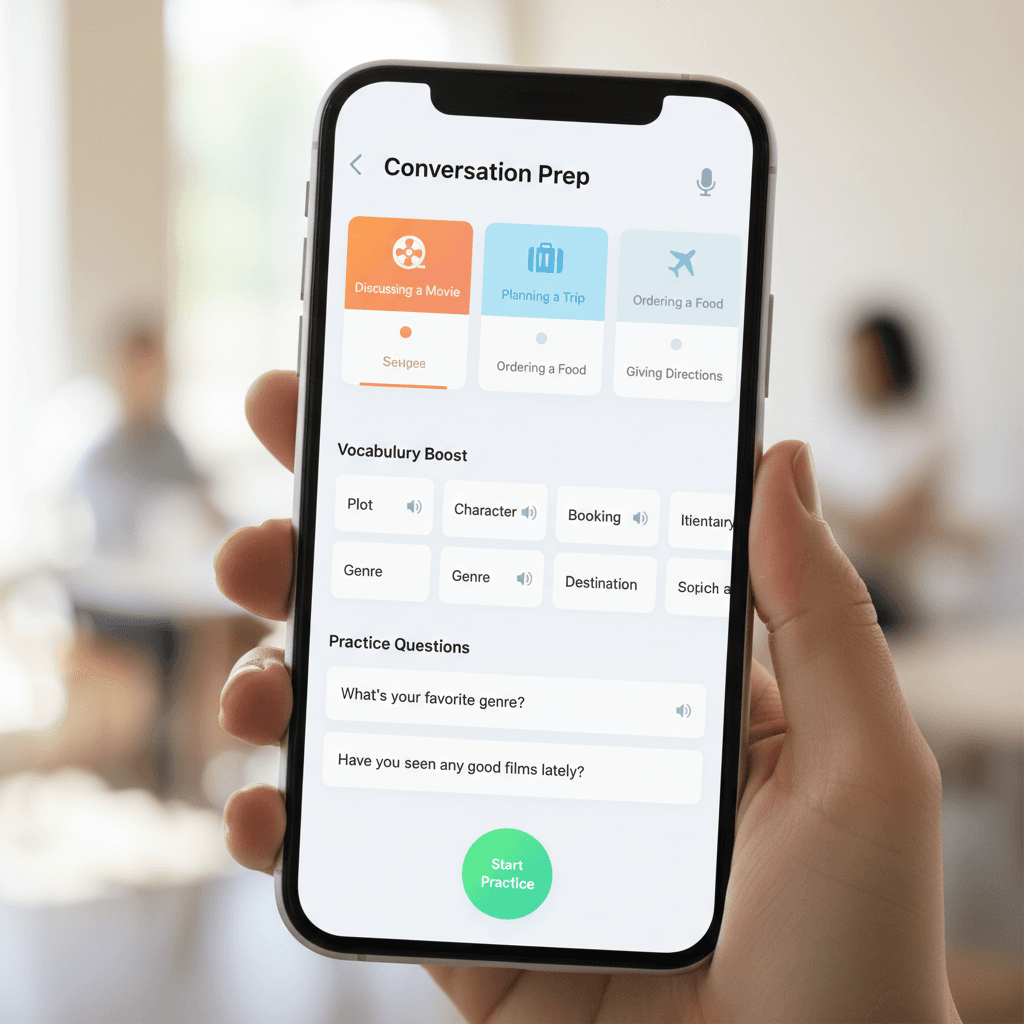
Great conversations, like sturdy houses, are built with good structure. You don't start with the roof; you start with a solid foundation. We call this the Conversation Scaffolding Method. It’s a simple, three-stage plan designed to help you build conversational complexity and confidence at a pace that feels right for you. Instead of worrying about what to say, you'll have a clear framework to guide you.
This approach is validated by proven educational models, such as the Collaborative Scaffolding Model of Teaching Speaking (CSMTS), which moves learners from simple initiation to more complex extension activities. It mirrors the natural way we learn to talk. Think about how parents help children speak; they instinctively use scaffolding by clarifying, asking questions, and easing production difficulties to build conversational ability (Parent-Child Conversation Study, 2025). This method empowers you to do the same for yourself. The three stages are:
- •Stage 1: Building Your Foundation — Simple, structured exchanges about everyday topics to build core confidence.
- •Stage 2: Deeper Connections — Moving from facts to feelings, opinions, and stories to create richer conversations.
- •Stage 3: Advanced Scenarios — Engaging in dynamic, real-world situations like debates, role-playing, and collaborative storytelling.
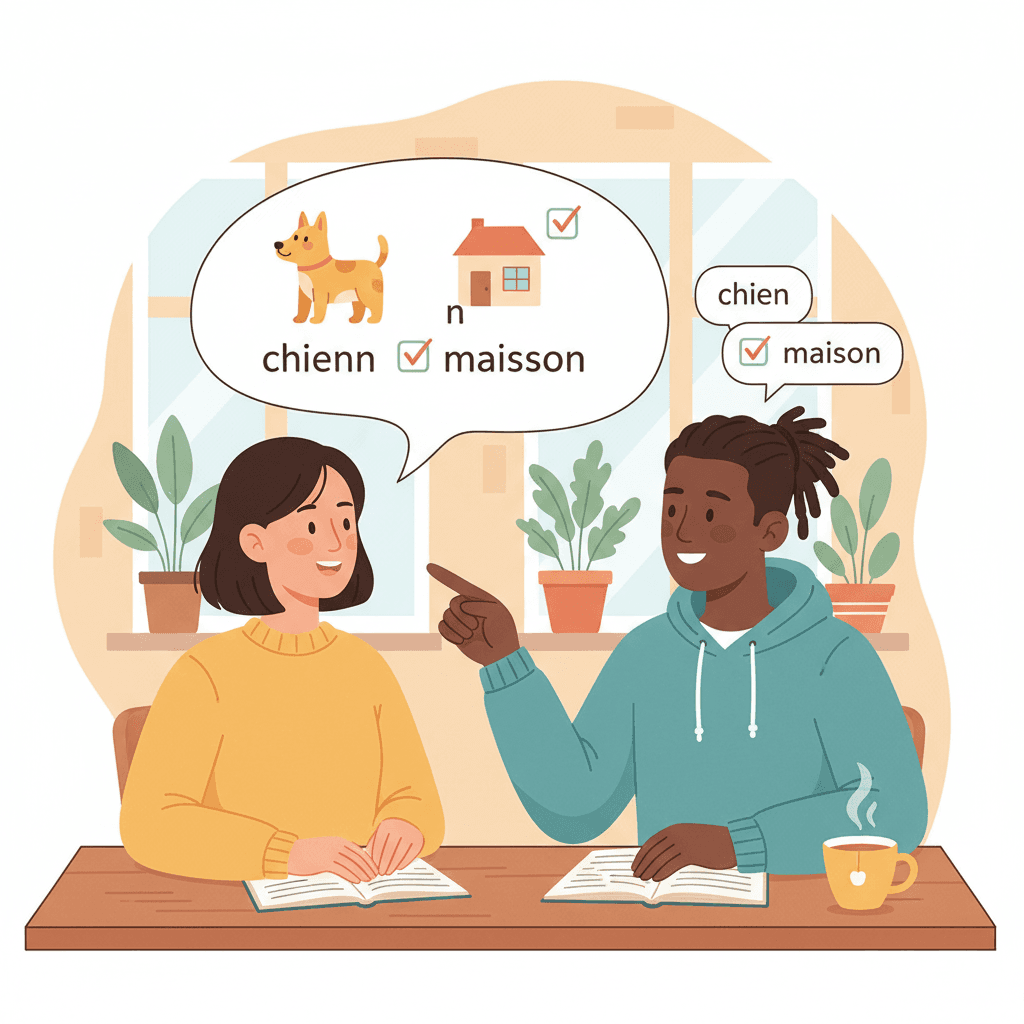
By using this method, you’ll not only have endless conversation starters for language exchange, but you'll also develop the underlying skills to navigate any conversational turn. A 2023 study found this type of scaffolding fosters cooperation and boosts learner confidence, which is exactly what you need to succeed.
Stage 1: Building Your Foundation (Beginner-Level Scaffolds)
In the beginning, the goal is simple: get talking and build momentum. This stage is all about using simple, repeatable structures—or scaffolds—to discuss familiar topics. This isn't just about listing your hobbies; it's about practicing a complete conversational turn. Speech language pathologists use this exact technique, building on what a learner can already say by adding descriptive words or actions.
Here are a few foundational scaffolds you can use for your next conversation practice. Instead of just picking a topic like 'Food,' use this recipe to structure your exchange:
- 1.State a simple fact or preference: 'My favorite food is tacos.'
- 2.Give one reason or detail: 'I love them because you can customize the fillings.'
- 3.Ask your partner an open-ended question: 'What's a popular dish in your city and why do people love it?'
This simple three-step process turns a one-word answer into a multi-turn exchange. You can apply this scaffold to countless beginner topics. Try it with these:
- •Daily Routine: What time do you wake up? What do you do first? What does your morning look like?
- •Family & Friends: Tell me about one of your family members. What do you enjoy doing together?
- •Language Goals: Why did you start learning this language? What is your biggest goal?
- •Your Hometown: What is one thing a tourist should do in your city? Why is it special?
Stage 2: Deeper Connections (Intermediate Scaffolds)
Once you feel comfortable with the basics, it’s time to move beyond facts and start sharing your personality. This is where you build genuine connections. Stage 2 focuses on expressing opinions, sharing experiences, and comparing perspectives. This is critical for your progress, as research highlights that language acquisition is rooted in 'experience-dependent plasticity' (Language & Literacy, 2025). Creating richer, more varied conversational experiences literally strengthens the neural pathways for fluency.
The key here is to practice scaffolds that invite more complex answers. Instead of just talking about movies, you can use a scaffold for expressing an opinion and defending it. This kind of structured interaction is proven to enhance communication and problem-solving skills (Frontiers, 2025).
Practice scenarios, not just topics. Instead of 'talking about movies,' practice the scenario of 'politely disagreeing about a movie.' This small shift prepares you for the dynamic nature of real-world conversations.
Try this scaffold for discussing a movie, book, or song:
- 1.State your opinion: 'I recently watched the new sci-fi movie and I thought it was a bit disappointing.'
- 2.Provide two supporting reasons: 'The plot felt predictable, and I didn't connect with the main character's motivations.'
- 3.Compare it to something else: 'I think the prequel was much more original.'
- 4.Ask your partner for their detailed opinion: 'What did you think about the special effects? Did the ending surprise you?'
This structure encourages you to use more complex sentences and provides your partner with multiple points to respond to. Other Stage 2 topics include comparing cultural traditions (e.g., holidays in the US vs. India), telling a story about your week, or discussing personal goals and dreams.
Stage 3: Advanced Scenarios (Mastering Complex Conversation)
Ready to take your skills to the next level? Stage 3 is about moving away from prepared topics and into dynamic, interactive scenarios. This is how you prepare for the spontaneity of real life. By 2026, language learning progress is increasingly being measured by the ability to have a 'real communication,' which prioritizes speaking over simply completing app levels (Language Learning Trends for 2026). This stage gets you there.
Instead of a simple Q&A, you and your partner will collaborate, negotiate, and problem-solve in the target language. These advanced scenarios directly address what many learners miss: the ability to react and build on what someone else says in real time. Here are a few advanced scenarios to try:
- •Friendly Debate: Pick a low-stakes, fun topic like 'Is pineapple on pizza delicious or a crime?' or 'Are cats better pets than dogs?'. Your goal is to practice disagreeing politely, providing counter-arguments, and finding common ground.
- •Collaborative Storytelling: One person starts a story with a single sentence (e.g., 'A man walked into a cafe and ordered a mysterious glowing drink.'). The next person adds a sentence, and you go back and forth, building a story together.
- •Role-Playing Real-Life Situations: This is incredibly practical. Take turns playing roles like a customer and a waiter ordering food, a tourist asking for directions, or two friends planning a weekend trip together. This is a key trend, with VR/AR tech now being used to simulate these exact scenarios (ILC English Blog, 2025).
While human interaction is crucial for mastering these nuances, don't be afraid to prepare. Practicing the vocabulary and phrasing for a debate or role-play beforehand can make all the difference. This is where an AI partner becomes an invaluable tool.
Your Secret Weapon: Building Topic-Specific Confidence with AI
The single biggest barrier to great conversation is confidence. You might know the words, but you're afraid of misspeaking, awkward pauses, or judgment. This is where you need a secret weapon: an AI language tutor. The entire purpose of platforms like SpeaksyAI is to provide a private, judgment-free space to build topic-specific confidence before you talk to your human partner.
Think of it as your personal rehearsal studio. Before you discuss travel plans with your partner from Australia, you can practice the 'planning a trip' scenario with your AI tutor. You can try out vocabulary, get instant feedback on your pronunciation, and run through the conversation scaffold as many times as you need. A May 2025 study confirmed that using chatbots as speaking partners significantly improves student self-confidence for oral assessments.
This approach is directly supported by the 'experience-dependent plasticity' model of language learning. Every practice conversation you have with an AI tutor is another repetition that strengthens those neural pathways. When you finally talk to your human partner, you're not speaking from memory—you're speaking from experience. Tools like the AI tutor at speaksyai.com allow you to get that crucial experience on-demand, turning anxiety into confident, fluent conversation.
How to Handle Awkward Silences and Give Corrections
Even with the best plan, you'll face tricky moments. Two of the biggest hurdles are awkward silences and giving corrections. Knowing how to talk to your language partner through these moments is key to a successful exchange. The fear of silence is very real; it's a core component of social anxiety, which affects a significant portion of adults in places like the US (Science of People, 2025).
Defeating Awkward Silences
When a conversation stalls, don't panic. The best defense is a good offense. Have a few 'emergency questions' ready to go. These should be open-ended 'story-generating questions' designed to get more than a 'yes' or 'no' answer.
- •What's something that made you smile this week?
- •If you could travel anywhere in the world right now, where would you go and why?
- •What's a skill you'd love to learn, besides this language?
Giving and Receiving Corrections
Corrections can feel personal, but they're essential for growth. The key is to establish a clear system with your partner before you start. Agree on a style that works for both of you. Some popular methods include:
- •Correcting in the moment: Best for glaring errors that impede understanding.
- •Saving corrections for the end: Writing down mistakes and discussing them in the last 5-10 minutes.
- •Using the 'ask, don't tell' method: Instead of saying 'That's wrong,' ask, 'In English, how might we say that another way?' This is less direct and encourages self-correction.
Setting these respectful boundaries upfront is a key strategy for navigating difficult moments and ensuring a positive, productive partnership (Tandem, 2026).
Frequently Asked Questions
Frequently Asked Questions
Ready to Speak Confidently in Every Conversation?
Practice conversation scenarios, build topic-specific vocabulary, and get instant feedback with your personal AI language tutor. Prepare with SpeaksyAI so you never run out of things to say.
Join the Waitlist