Awkward Silence? What to Say in a Language Exchange
That moment of panic when a conversation dies in a language exchange is all too common. Here’s a simple system to prepare and react so you never run out of things to say.

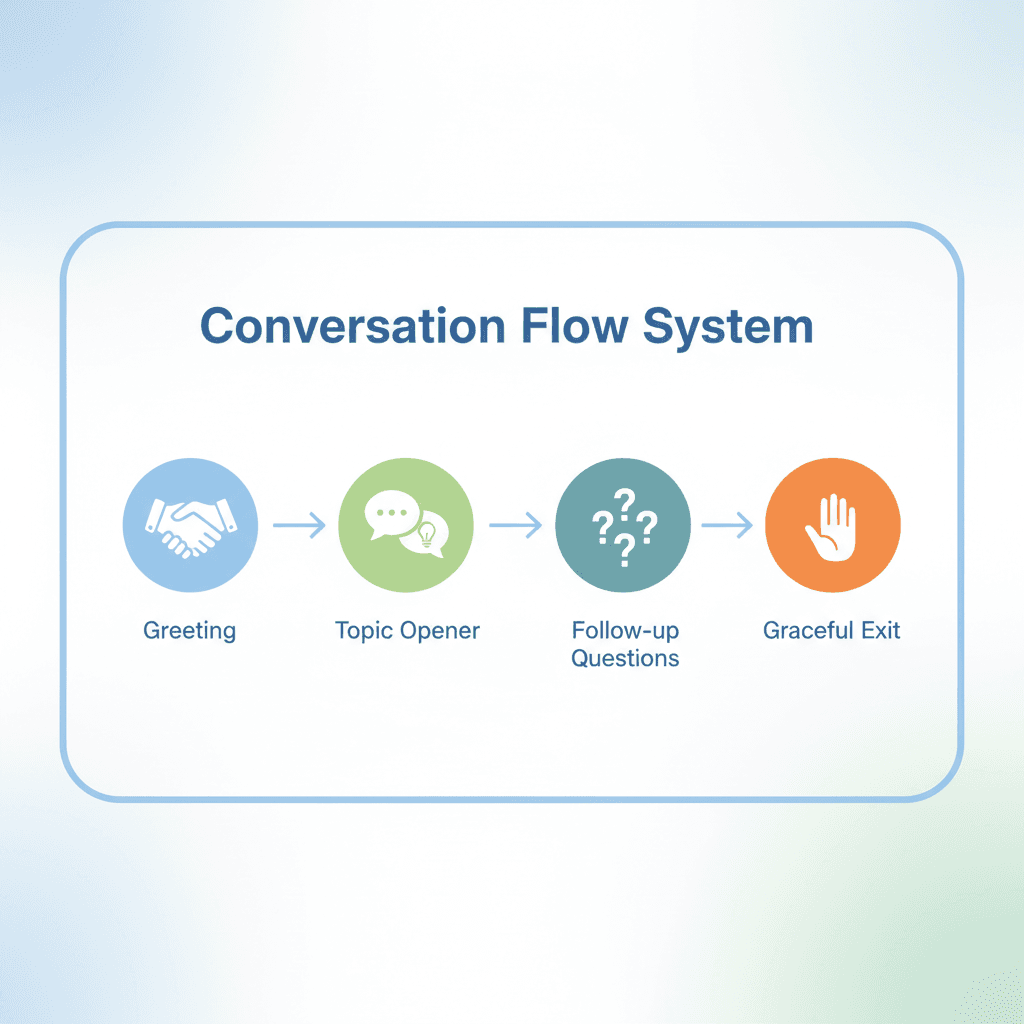
That sinking feeling when the conversation dies is familiar to almost every language learner. So, what to do when you run out of things to say in a language exchange? The most effective approach is to use The Conversation Flow System, a simple two-part framework. It combines Proactive Prep (preparing topics before you talk) with Reactive Rescue (using specific phrases to revive a conversation in the moment). This turns a moment of potential panic into a powerful, confidence-building learning opportunity.
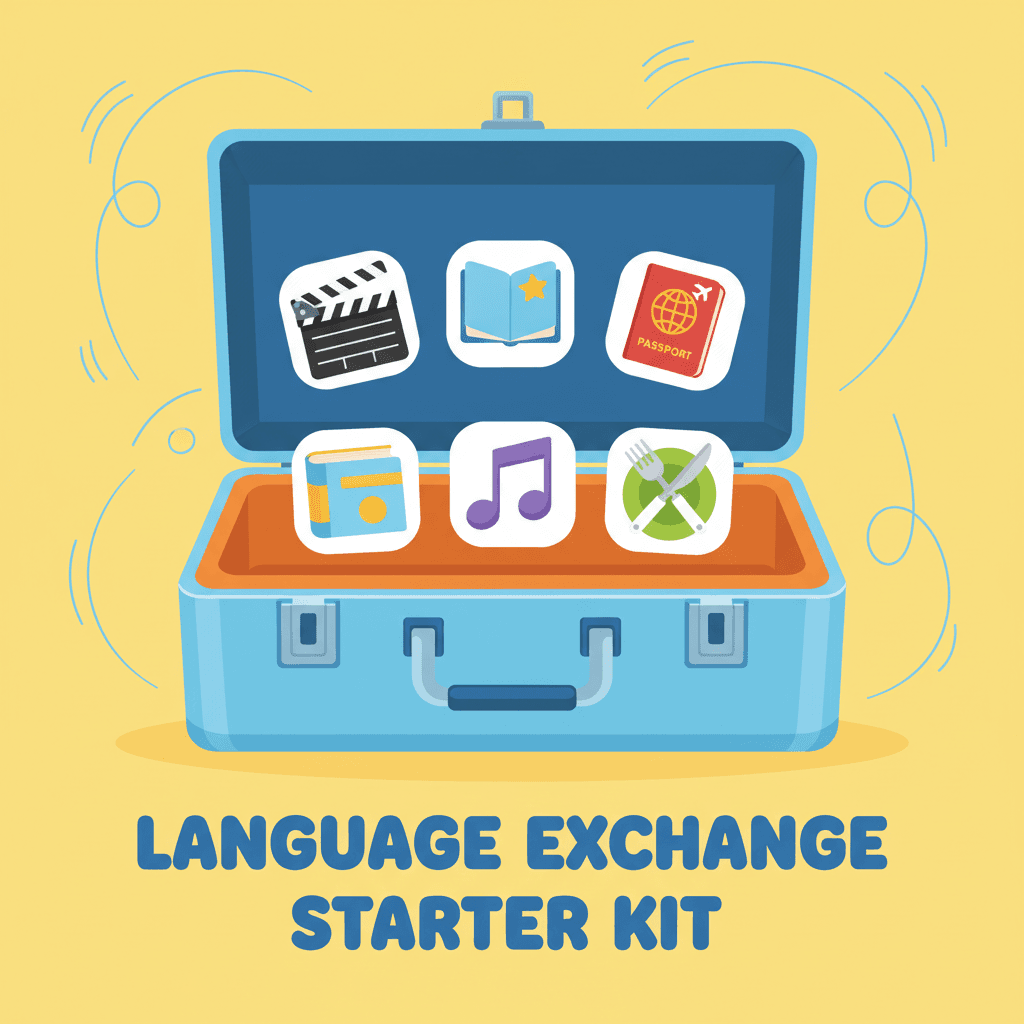
Let's be honest: that awkward silence in a language exchange can feel like a failure. Your mind goes blank, your palms get sweaty, and you start questioning why you even started. But this experience is completely normal. It’s not a sign of your inability to learn; it’s a sign that you’re pushing your boundaries—and that’s where real growth happens. This guide will walk you through the entire system, giving you the tools to not only prevent stalls but to handle them with grace when they happen.
Your Direct Answer: The Conversation Flow System
The Conversation Flow System is your blueprint for navigating language exchanges with confidence. Instead of hoping for the best, you enter every conversation with a clear plan. It’s built on two core pillars:
- •Proactive Prep: This is what you do before your exchange. It involves gathering a few conversation starters for your tandem partner, preparing a short story, or finding a piece of media to discuss. This front-loading work dramatically reduces in-the-moment pressure.
- •Reactive Rescue: This is your toolkit for when a conversation stalls during the exchange. It includes simple, powerful techniques like narrating your thoughts or asking smart follow-up questions to get things moving again.
Why is this system so effective? Because it addresses the root cause of the problem: uncertainty. Research from HelloTalk's blog in 2026 suggests viewing these stalls not as failures, but as a 'diagnostic tool' to pinpoint specific gaps in your vocabulary and grammar. Each time you get stuck, you learn exactly what you need to study next. This reframes the entire experience from a performance into a productive practice session.
Community discussions among experienced language learners often highlight the value of 'Proactive Prep.' Many suggest preparing activities like discussing song lyrics or talking about current events to avoid lulls. This is backed by social science; a landmark 2026 Harvard study published via NerdSip found that people who ask more follow-up questions are seen as more likable and are more likely to secure a second interaction. Both pillars of the system—preparation and recovery—are designed to make you a more engaging conversation partner.
Proactive Prep: Build Your Conversation Toolkit Before You Talk
The best way to handle an awkward silence is to prevent it from ever happening. Spending just 10-15 minutes preparing before your language exchange can transform your anxiety into anticipation. It’s not about scripting the entire conversation; it’s about having a safety net of language exchange conversation topics so you never feel completely lost.
Start by building a 'Conversation Bank' in a notebook or digital document. Throughout the week, jot down ideas as they come to you. Did you try a new recipe? Watch a great movie? Have an interesting day at work? These are all potential topics. Language learning resource Migaku advised in 2026 that keeping a running list of ideas is a key habit for successful learners. Experts at Tandem also suggest that the physical act of handwriting can reinforce learning, so a dedicated notebook is a powerful tool. Your goal is to have two or three fallback options ready for every call.
This preparation directly addresses two of the biggest hurdles in language learning: anxiety and the feeling of not making progress. When you have topics ready, you can focus on expressing yourself instead of scrambling for something to say. As the HelloTalk Blog noted in 2026, this lets you use the conversation as a 'diagnostic tool'—you’re intentionally testing your ability to talk about specific subjects, and you can review any new vocabulary you needed afterward.
The 'Story of the Week' Method
One of the most powerful proactive strategies is the 'Story of the Week'. Instead of a vague list of topics, you prepare one small, personal story. It doesn’t need to be dramatic—in fact, simple is better. This method, recommended by learning sites like Migaku and TandemPartners in 2024, provides a concrete anchor for your conversation.
For example, instead of just saying 'I went shopping,' you could prepare a mini-story: 'This weekend, I went to a new farmers' market in my city. I wanted to buy fresh tomatoes. I found a stall run by an old man who grew everything himself. I tried to ask him about the different kinds of tomatoes in [target language], and he was very patient. I ended up buying some heirlooms that I’m excited to cook with.'
This simple narrative does several things at once. First, it’s authentic to your life, which, as the HelloTalk Blog (2026) points out, helps you diagnose vocabulary gaps that are actually relevant to you. Second, it combats boredom and the dreaded 'intermediate plateau'—two of the top five reasons people quit language learning, according to 2026 data from Noun Town—by making your conversations personal and unique. Finally, a personal story naturally invites follow-up questions from your partner, creating an easy, flowing dialogue.
Use Shared Media as a Launchpad
Another excellent proactive method is to create instant shared context. Before your call, agree with your language partner to watch the same short YouTube video, listen to a podcast episode, or read a brief article. This gives you an immediate, rich topic to dive into, completely eliminating the 'so... what do you want to talk about?' problem.
This strategy is frequently suggested in language learning communities, with members of Reddit's r/languagelearning often recommending discussing song lyrics or news events. You could pick:
- •A 5-minute news report from a source in your target language.
- •A short documentary on a topic you're both interested in (like cooking or travel).
- •A popular song and its lyrics.
- •An interesting discussion thread from a forum like Reddit.
Resources like Tandem and Migaku have long advocated for preparing topics in advance, and using shared media is the easiest way to do it collaboratively. It ensures both you and your partner have something to say, along with opinions to share and new vocabulary to explore together. This transforms the exchange from a test of your memory into a fun, collaborative activity.
Reactive Rescue: 3 Ways to Revive a Stalled Conversation
Even with the best preparation, you will eventually hit a wall. Your mind will go blank, and an awkward silence will descend. This is the moment to deploy your Reactive Rescue toolkit. The key is to see this not as a crisis, but as an opportunity to practice a different skill. Instead of panicking, take a breath and choose one of these three simple strategies.
The power of these techniques is rooted in social psychology. Research has shown that how you handle these small moments of friction can actually strengthen your connection with your partner. A 2026 study published in Psychological Science found that people who ask more questions are consistently perceived as more likable. By using a stall as a cue to ask a question, you turn a potential negative into a social positive. This is how you learn to keep your language exchange going even when you feel stuck.
A lull in conversation is an opportunity to shift from small talk to more meaningful questions, which fosters a closer connection.
Narrate the Silence
One of the most effective and confidence-boosting rescue techniques is to use your target language to talk about the fact that you’re stuck. Instead of letting the silence grow, you vocalize your thought process. This immediately lowers the pressure and invites your partner to help you.
Try memorizing a few of these phrases in your target language:
- •"Wait, I'm thinking of the word..."
- •"How do you say [word in your native language]?"
- •"I'm sorry, I lost my train of thought. What were we saying?"
- •"Let me think how to phrase this properly..."
- •"That's a good question. I need a moment to think."
This strategy transforms a moment of panic into a learning opportunity. As noted by the HelloTalk Blog (2026), this serves as a real-time 'diagnostic tool'—you're getting immediate help on the exact vocabulary you need. It's also a powerful way to push through the 'intermediate plateau,' which Noun Town (2026) identifies as a major reason learners quit. By learning to navigate these moments of difficulty, you build the resilience needed for fluency.
Pivot with Follow-Up Questions
When you run out of things to say about yourself, the simplest solution is to turn the spotlight back on your partner. This is more than just asking random questions; it's about active listening. Pay close attention to what your partner says, and then 'pull on a thread' by asking a follow-up question about a specific detail they mentioned.
This isn't just a polite strategy—it's scientifically proven to make you a more engaging conversationalist. The 2026 Harvard speed-dating study found that people who asked more follow-up questions were consistently rated as more likable and were more likely to get a second date. You can think of it as a 'Refuel Loop': they speak, you listen for a detail, you ask about that detail, and the conversation is refueled. This is especially helpful for learners in markets like the US, where a 2025 study found that conversational silence can begin to feel awkward after just 6.3 seconds.
Fill the Gaps with Language Games
Sometimes the pressure of 'having a conversation' is the problem itself. A fantastic way to break an awkward silence in a language exchange is to switch gears entirely and propose a simple game. This lowers the stakes, removes the pressure to tell personal stories, and injects a dose of fun into the session.
Introducing games is also a powerful tool against boredom, which a 2026 report from Noun Town cited as one of the top five reasons people give up on language learning. Here are a few low-prep games you can suggest:
- •Two Truths and a Lie: A classic icebreaker mentioned by tandem.net. Each person makes three statements about themselves—two true, one false. The other person has to guess the lie.
- •20 Questions: One person thinks of a person, place, or thing. The other has 20 yes/no questions to guess what it is.
- •Would You Rather?: Ask fun or silly hypothetical questions like, 'Would you rather have the ability to fly or be invisible?'
- •Describe and Draw: This is a type of 'information gap activity' recommended by the U.S. Department of State's language resources. One person describes an object or a simple image, and the other tries to draw it without looking.
- •Role-Playing: As suggested by languagepartnersbc.ca, you can act out simple scenarios like ordering at a restaurant, booking a hotel room, or conducting a job interview.
These games provide structure and a clear goal, which can be a huge relief when you're feeling conversational fatigue. They naturally encourage the use of new vocabulary in a low-pressure, enjoyable context.
What If There's a Big Proficiency Gap?
A significant difference in skill level between partners is a common source of conversational stalls. It can be intimidating for the less advanced speaker and frustrating for the more advanced one. The key is for both partners to adapt their approach.
For the more advanced speaker: Your role is to be a guide. Simplify your language, speak a bit slower, and avoid complex idioms. Your most powerful tool is asking thoughtful, open-ended questions. As the 2026 Harvard study showed, being inquisitive makes you a more effective and likable communication partner. Your goal is to create a safe space for your partner to practice, not to show off your own skills. As Bubblic noted in 2026, it's the advanced partner's job to choose topics that challenge without breaking the conversation.
For the lower-level speaker: Embrace your role as the learner. Use stalls as the 'diagnostic tool' the HelloTalk Blog (2026) describes to identify what you need to learn. Don't be afraid to ask for help. According to Migaku (2026), using phrases like, 'Can you explain that more simply?' or 'What does that word mean?' is crucial. If free-form conversation is too difficult, suggest a structured activity. Experts at TandemPartners (2026) recommend role-play scenarios like ordering coffee, which provide a predictable context and reduce language exchange anxiety.
Practice Your Rescue Plan Without the Pressure
Knowing these strategies is one thing, but applying them in the heat of the moment—when your heart is racing and your mind is blank—is another. The gap between passive knowledge and active skill is where many learners get stuck. This is where practicing in a low-stakes environment becomes invaluable.
This is the perfect use case for an AI tutor. Using SpeaksyAI's AI conversation partner is like having a flight simulator for your language skills. You can practice your 'Reactive Rescue' techniques—narrating the silence, asking follow-up questions, pivoting the topic—without the fear of judgment or making a real person wait. You can intentionally let the conversation stall just to rehearse how you'll recover.
This type of practice provides the diagnostic data that the HelloTalk Blog (2026) mentions, but without the live-performance anxiety. You can rehearse asking the kinds of engaging follow-up questions highlighted in the Harvard study until it becomes second nature. As the language learning industry increasingly integrates AI to simulate real-world practice (Upstream Research, 2026), using these tools is a smart way to build the muscle memory you need to handle any awkward silence with a human partner.
Your 5-Minute Post-Exchange Follow-Up
Your learning doesn't stop when the call ends. A quick, 5-minute follow-up routine can dramatically increase how much you retain from each session. It solidifies new vocabulary, strengthens your relationship with your partner, and sets you up for success next time.
- 1.Consolidate New Vocabulary: Immediately after the call, write down 3-5 new words or phrases you learned. As resources like Storylearning and FluentU advise, writing them down and creating an example sentence is crucial for memory retention.
- 2.Reinforce the Connection: Send your partner a short thank-you message. You can mention something you enjoyed about the conversation or even try to use one of the new words you learned. This simple act reinforces the social bond, which is key to long-term exchange success.
- 3.Plan for Next Time: While the conversation is fresh in your mind, jot down a potential topic for your next meeting. You could even propose it in your thank-you message: 'Thanks for the chat! It was great hearing about your trip. Maybe next time we can talk about our favorite movies?'
This routine directly applies the 'diagnostic tool' principle from the HelloTalk Blog. You're taking the 'data' from your conversation and immediately putting it into a structured plan for improvement. This turns every exchange into a measurable step forward on your learning journey.
Frequently Asked Questions
Frequently Asked Questions
Stop Practicing, Start Speaking
Get unlimited, judgment-free conversation practice with SpeaksyAI, your personal AI language tutor. Build confidence for your next language exchange.
Join the Waitlist