Natives Switch to English? The Switch-Back System to Use
It's a common frustration for learners: you start a conversation and the native speaker immediately switches to English. This guide provides a step-by-step system to handle it with confidence.

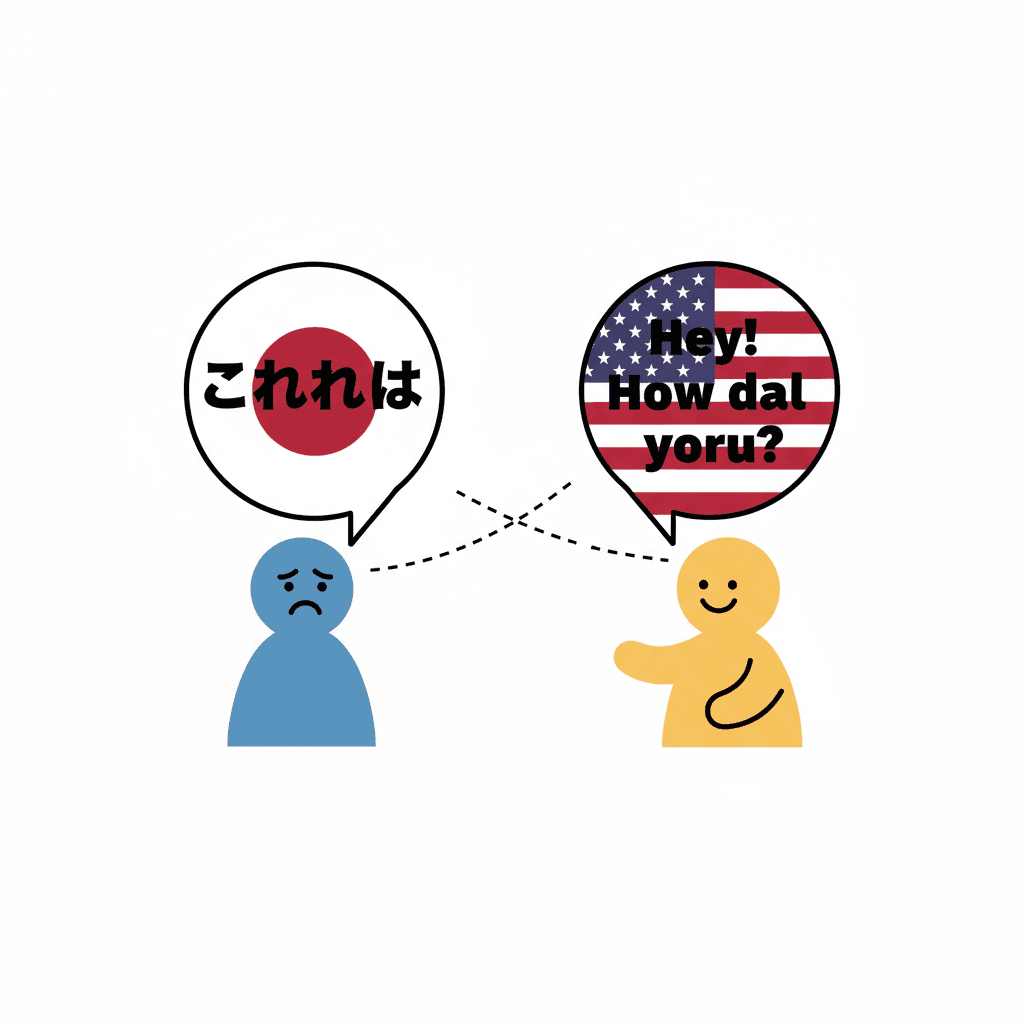
It’s a moment every language learner dreads. You take a deep breath, start a conversation in your target language, and then it happens: the person you’re speaking with replies in English. It can feel like a punch to the gut, a clear sign that your skills just aren’t good enough. But here’s the thing: knowing what to do when native speakers switch to english isn’t about fixing a flaw in your language ability. It’s about understanding the hidden psychology of the conversation and having a system to confidently steer it back on track. This isn't a failure; it’s a milestone. It’s your chance to build the conversational resilience you need for real-world fluency, and we’re going to show you exactly how.
Why You Shouldn't Feel Discouraged When They Switch
First, let's get one thing straight: your feelings of frustration are completely valid. When someone switches to English, it's easy to internalize it as a negative judgment on your accent, grammar, or vocabulary. You might think, "They must think I’m terrible at this," or "I'll never be good enough to have a real conversation." This feeling of rejection can be a major blow to your language learning confidence. But more often than not, the switch has very little to do with you and everything to do with the other person's instincts.
Most native speakers aren't trying to be rude or dismissive. Their switch to English is usually driven by one of three things: politeness, efficiency, or their own self-interest. Many see it as a kind gesture to make the conversation easier for you. They might perceive your slight hesitation or search for a word as a struggle and switch to English to 'help out.' In other cases, especially in busy environments in places like the US or UK, it’s about efficiency. They want to get to the point of the conversation quickly, and defaulting to a shared language is the fastest way to do that. And sometimes, they might simply see an opportunity to practice their own English skills.
This change in perspective is backed by a growing trend in language education. The goal is shifting away from the old-school 'native speaker ideal'—the idea that you must sound perfect—towards a more realistic and effective goal: mutual intelligibility. A May 2026 study highlighted this shift towards an 'accommodative mindset,' where the primary aim is simply to understand and be understood. Furthermore, research from January 2026 found that students actually have a positive view of code-switching (alternating between languages), seeing it as an effective communication strategy. So, when a native speaker switches, don't see it as a verdict on your skills. See it as a communication puzzle you now have the tools to solve.
The Switch-Back System: A 3-Step Plan for Confidence
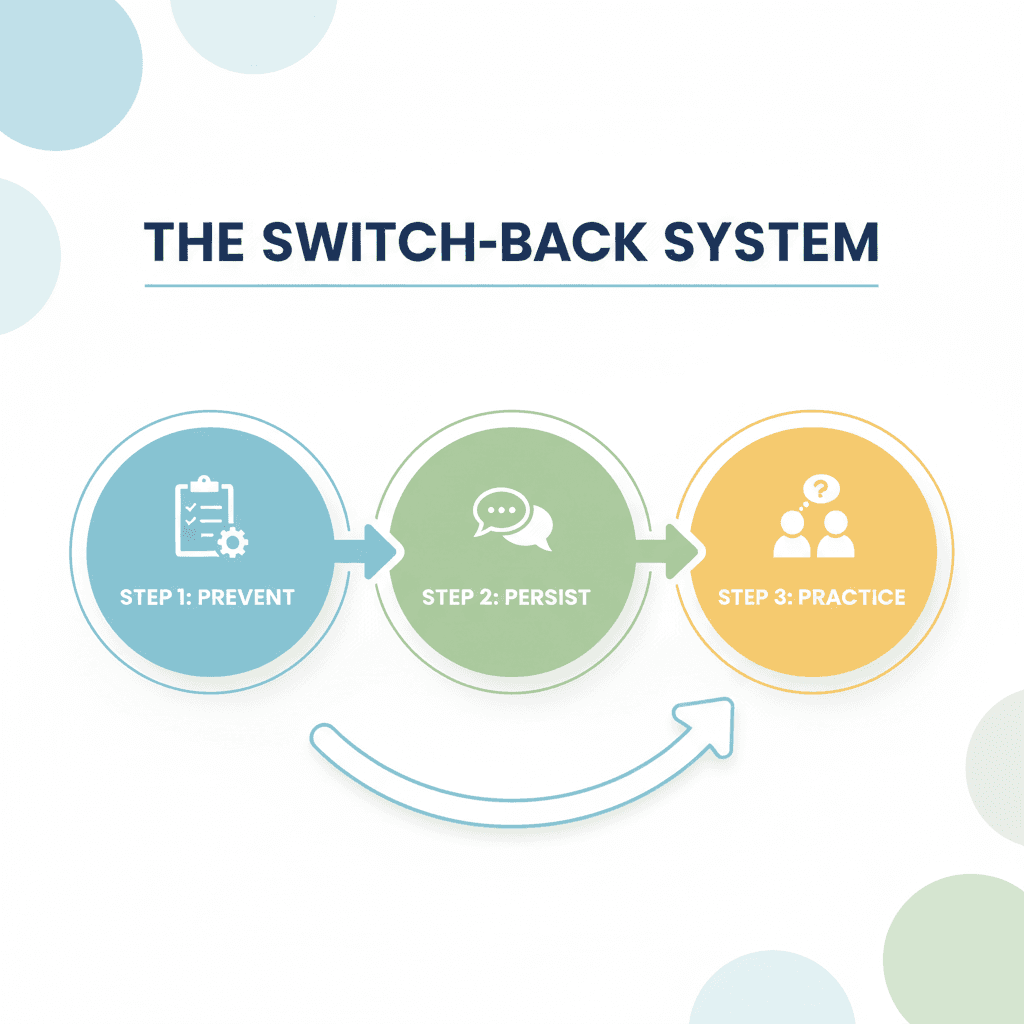
Feeling better? Good. Now, let’s move from psychology to strategy. Instead of leaving these interactions to chance, you need a clear, repeatable plan. That's why we developed The Switch-Back System. It’s a simple, three-step framework designed to give you control and confidence when you practice speaking a new language. It turns a moment of potential anxiety into a predictable process you can manage every single time.
- 1.Prevent: Set the stage for success before the conversation even begins by framing the interaction and managing expectations.
- 2.Persist: Use polite, confident scripts and tactics in the moment to keep the conversation in your target language.
- 3.Practice: Build conversational muscle memory and resilience by role-playing these scenarios in a pressure-free environment.
This system helps you build confidence strategically. A 2025 study on language learners found that they successfully move from silence to confidence by adopting specific practices, including rehearsing for social contexts. It’s not about magic; it’s about preparation. Modern language learning is all about this kind of real-world application. As the industry evolves, with major platforms like Duolingo aiming for 100 million daily users by 2028 by enhancing their AI and speaking exercises, the focus is clearly on practical communication, not just passive study. This system is your bridge from the classroom to the real world.
Step 1 (Prevent): How to Set the Stage for Success
The best way to handle the switch is to prevent it from happening in the first place. This starts with your mindset. Before you even open your mouth, remind yourself of the 'accommodative mindset' we talked about. Your goal isn't perfection; it's connection. This simple mental shift, supported by the May 2026 study, can dramatically lower the stakes and reduce the language practice anxiety that might make you seem hesitant.
Next, frame the conversation from the very beginning. Don't just launch into your target language and hope for the best. Politely state your intentions. A strong, friendly opening can work wonders. You are essentially giving the other person context for the conversation, turning them from a passive participant into an active helper in your learning journey.
This works because it taps into their desire to be helpful, which we know is a primary reason people switch. The January 2026 research showed that students see code-switching as a positive teaching strategy; by stating your goal, you're inviting them to 'teach' you by staying in the language. The environment also matters. A relaxed language exchange meetup in Toronto is a far better setting for this than a noisy, crowded market in Delhi where speed is essential. Choose moments where the other person has the time and context to engage with you on your terms. The demand for practice is why the market is booming—Duolingo's Q1 2026 revenue jumped 26.5% as they focus more on features that simulate these real conversations.
Step 2 (Persist): What to Say and Do in the Moment
Even with the best preparation, the switch will still happen sometimes. This is where Step 2 comes in. This is your action plan for the moment it happens. Your goal is to persist gently but firmly, guiding the conversation back to your target language without creating an awkward confrontation. You have two main tactics at your disposal: The Gentle Nudge and The Confident Continue. Choosing the right one depends on the situation and your comfort level.
The Gentle Nudge: Polite Scripts to Use
The Gentle Nudge is exactly what it sounds like: a polite, direct request to continue in the target language. It acknowledges their switch to English but re-establishes your goal. The key is to be friendly and appreciative. You're not demanding anything; you're asking for help. This tactic works beautifully because it validates their impulse to be helpful while redirecting it to your actual need—practice.
- •English: "Thanks, I appreciate that! Would you mind if we stick with [Language]? I really need the practice."
- •Spanish: "¡Gracias! ¿Te importaría si seguimos en español? Es que de verdad necesito practicar."
- •French: "Merci beaucoup ! Ça vous dérangerait de continuer en français ? J'ai vraiment besoin de m'exercer."
The Confident Continue: Staying in the Target Language
This tactic is more subtle but can be incredibly effective. When the native speaker replies to you in English, you simply… continue speaking in the target language. For example, if you ask "¿Dónde está la estación de tren?" and they reply, "It's two blocks down on the left," you can smile and say, "Ah, a la izquierda. ¡Gracias!" By doing this, you're confidently demonstrating that you understood them and that you are capable and determined to how to stay in the target language. This is a powerful, non-verbal cue.
This approach aligns with research from a 2024 paper in *Applied Linguistics*, which reframes the goal of language learning as achieving 'nativelikeness' through adaptation, rather than an impossible 'native speaker' status. You are adapting to the situation by showing, not just telling, that you can handle the conversation. Many times, the native speaker will pick up on your confidence and switch back without you ever having to ask. It's a smooth, effective way to assert your learning needs.
Step 3 (Practice): Role-Play and Build Resilience
Knowing the scripts is one thing; having the confidence to use them under pressure is another. This is where practice becomes your superpower. To overcome language practice anxiety, you need to build muscle memory. You need to make the words and tactics of Step 2 feel so natural that you can deploy them without panicking.
This is where an AI language tutor can be a game-changer. With a tool like the AI tutor from SpeaksyAI (speaksyai.com), you can role-play this exact scenario in a safe, non-judgmental space. You can literally tell the AI, "Let's practice a conversation, and I want you to switch to English on me so I can practice asking you to switch back." You can run this drill ten, twenty, or fifty times until the 'Gentle Nudge' feels like second nature.
A 2025 study found that university students view role-playing simulations as highly beneficial for improving their speaking skills. Practicing with an AI allows you to get instant feedback on your pronunciation—a key factor that can cause native speakers to switch—and build the resilience needed for real-world interactions. This is crucial, as a 2026 guide noted that 46% of immigrants in the U.S. face language barriers in high-stress situations. By practicing beforehand, you are preparing yourself to handle that stress with confidence.
When Is It Okay to Let Them Switch?
While the Switch-Back System is powerful, it's not a rule you must follow 100% of the time. The goal is effective communication, not winning a linguistic battle. Sometimes, the most strategic choice is to let the switch happen. This is known as strategic code switching language learning, and it’s a smart tool, not a sign of failure.
Research increasingly supports this nuanced view. A January 2026 study found that students see code-switching as a helpful teaching strategy. Think of it as a scaffolding tool that supports comprehension when things get tricky. It's okay to switch to English in certain situations.
- •When time is short: If you're asking for quick directions to catch a train in Sydney or ordering in a packed Melbourne café, it's about efficiency. Get the information you need in the easiest way possible.
- •When the topic is complex: Discussing medical issues, technical problems, or deep philosophical concepts might be too difficult. Switching can ensure clarity and avoid dangerous misunderstandings.
- •When you're mentally exhausted: Speaking a new language is tiring! If your brain feels like mush, it's perfectly fine to take a break and switch to a language that feels easier.
- •When the other person insists: If you've tried the Gentle Nudge and they keep switching back, it's often best to just go with the flow. The social harmony of the conversation is also important.
Remember the 'accommodative mindset' from the May 2026 study. The goal is mutual intelligibility. If switching to English achieves that best in a given moment, then it’s the right move. Far from being a weakness, linguistic research from 2025 suggests that the ability to expertly switch between languages is a feature of a highly advanced, cognitively flexible multilingual brain. You're not failing at one language; you're succeeding at two.
FAQ: Your Questions on "The Switch," Answered
Frequently Asked Questions
Ready to Practice Without Pressure?
Build the confidence to handle any conversation. Use the SpeaksyAI tutor to role-play this exact scenario, master the scripts, and get instant feedback.
Join the Waitlist