Can't Understand Fast Speakers? A 3-Step System to Tune Your Ear
Feeling lost when native speakers talk fast? It's a common frustration, but it’s not a sign you’re a bad learner. Here's why it happens and how you can fix it.

Feeling lost the moment a native speaker starts talking? It’s a near-universal frustration among language learners, and if you’re asking yourself, “why can't I understand native speakers when they talk fast?”, you're certainly not alone. For a moment, it can feel like all your hard work studying grammar and vocabulary has vanished. But here’s the crucial truth: this struggle is not a reflection of your intelligence or dedication. The problem isn’t you; it’s the massive, often undiscussed gap between how you learned to listen and how people speak in the real world.
First, Let's Validate: Why This is So Hard (and Not Your Fault)
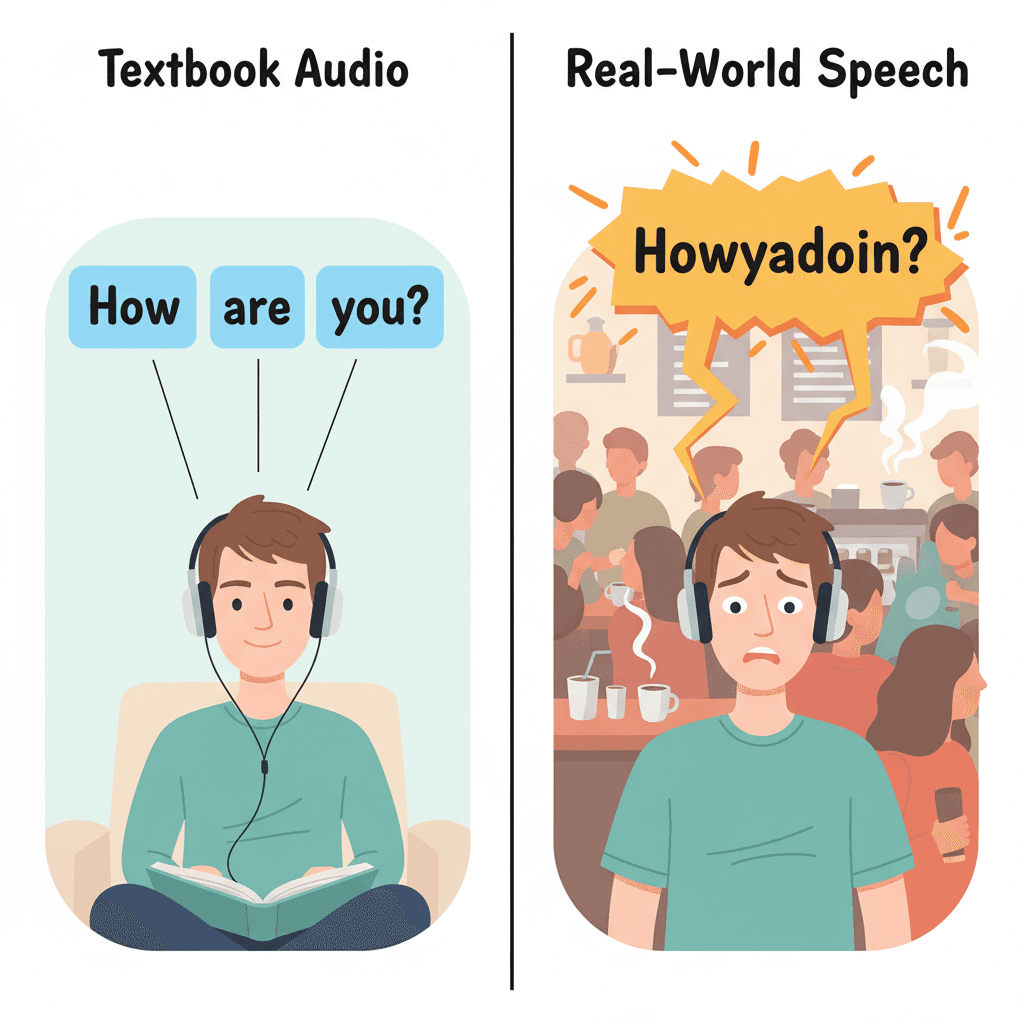
That feeling of being completely overwhelmed when faced with fast spoken English is very real. It’s not just in your head. A 2026 study from AIP Publishing confirmed that fast speech rates significantly decrease a listener's ability to recognize key words and dramatically increase comprehension errors. Researchers pointed to a genuine 'cognitive impairment' under these conditions. Your brain is working so hard to keep up that it simply can’t process everything.
A major reason for this is that you were likely trained with artificially slow audio. While typical language courses use audio recorded at a manageable 80-100 words per minute, native speakers in countries like the US, UK, or Australia converse at a much faster rate of 150-180 words per minute (Erla, 2026). You've been training for a slow-pitch softball game, and suddenly you're facing a professional fastball pitcher. The rules are the same, but the speed changes everything.
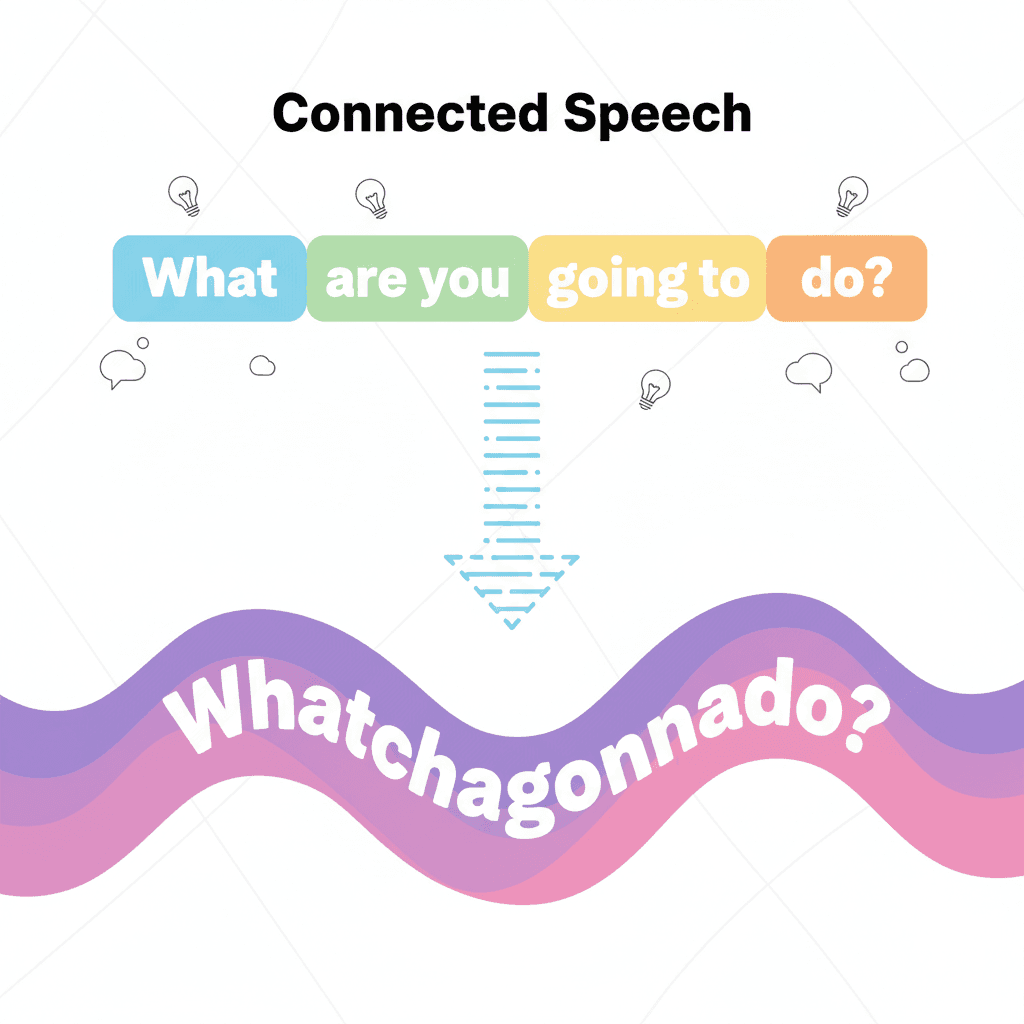
Furthermore, it’s not just about speed but how the sounds themselves are physically altered. In real-world conversation, native speakers use 'connected speech,' where sounds are linked, changed, or even omitted entirely. They naturally 'crush' unstressed words, making them sound completely different from the crisp, clear examples in your textbook (Langclub, 2026). This is why a simple phrase you know on paper becomes an unrecognizable stream of sound.
Finally, the common learner strategy of translating word-by-word in your head is a primary source of this cognitive overload. Fluent listening isn't about processing individual words in a sequence; it’s about recognizing internalized 'chunks' and patterns of speech almost instantly (Lingtuitive, 2026). When you try to translate each word, you’re performing a two-step process while the speaker is already three words ahead. It’s a race you can't win.
The Real Culprit: Textbook Audio vs. Real-World Speech
The most significant hurdle you face is the 'speed gap.' As you’ve just seen, the comfortable 80-100 words per minute of your learning materials is a world away from the rapid-fire 150-180 words per minute of natural, fast spoken English. This isn't a small difference; it's nearly double the speed, and your ear simply hasn't been trained for it.
Beyond pure speed, native speakers use 'connected speech,' where words are linked, weakened, and sometimes seem to disappear entirely. This is why a sentence doesn't sound like a string of individual words, but rather a continuous, flowing melody. This mismatch is a common frustration voiced by learners, who often report they can understand their teachers or educational podcasts perfectly but feel completely lost in actual conversations with native speakers.
Traditional textbooks offer static, slow audio that fails to prepare you for this reality. However, the good news is that modern AI tools are now specifically designed to bridge this gap. They can simulate real-world scenarios and, most importantly, allow you to practice with adjustable-speed audio, helping you gradually train your ear for language at its natural pace.
What is 'Connected Speech'?
Connected speech is the collection of 'shortcuts' native speakers use to talk faster and more efficiently. Instead of pronouncing every single sound in every single word, sounds are blended, changed, or dropped. This is why 'what do you want to do' often sounds like 'whaddaya wanna do' in a casual conversation in Canada or the US (lingtuitive.com, 2026). Here are a few key features:
- •Assimilation: A sound changes to become more like a neighboring sound. For example, 'don't you' frequently sounds like 'don-chu' because the 't' and 'y' sounds merge.
- •Vowel Reduction: Unstressed vowels often get reduced to a weak, neutral 'schwa' sound (ə). This is why 'I'm going to the store' can sound like 'I'm gonna go tə thə store'.
- •Linking: The last sound of one word attaches to the first sound of the next word, especially if it starts with a vowel. For instance, 'turn off' is pronounced smoothly as 'tur-noff'.
- •Elision: Sounds are dropped or disappear entirely, especially 't' and 'd' sounds. 'Next door' often becomes 'nex door'.
Reductions and 'Crushed' Sounds
English is a stress-timed language. This means the rhythm of a sentence is determined by the stressed syllables, which occur at relatively regular intervals. To maintain this rhythm, all the unstressed words and syllables in between the main 'beats' get compressed, rushed, or 'crushed'. Think of 'fish and chips'. We don't say 'fish-AND-chips'; we say 'fish n' chips', crushing the word 'and' into a single, quick sound.
This phenomenon, known as phonetic reduction, is a major barrier for learners. A February 2025 study on the topic confirmed that non-native listeners recognize unreduced words far more accurately and quickly than their reduced, 'crushed' counterparts. Your brain is looking for the full sound it learned in a textbook, but in fast speech, that full sound may not even be there. It's no wonder it's confusing—even for native speakers! A 2026 study found that for young, normal-hearing native listeners, their accuracy in recognizing key words still decreased under fast speech conditions.
Find Your Bottleneck: A Quick Self-Diagnosis
To start improving, you need to know exactly what's holding you back. Is it the raw speed? The strange sounds of connected speech? Or something else? Dr. Esther Gutierrez Eugenio, a PhD in Language Education, recommends a form of 'Plateau Diagnosis' to pinpoint your specific weak points. Ask yourself the following questions to find your bottleneck:
- 1.The Transcript Test: When you listen to a fast speaker and then read the transcript, is your reaction “Oh, I know all those words!”? If so, your bottleneck is likely sound recognition and connected speech, not vocabulary.
- 2.The Slow-Down Test: If you play the same audio at 0.75x speed and can suddenly understand it perfectly, your primary bottleneck is likely the raw speed itself. Your ear isn't yet calibrated to the 150-180 words per minute of native speech.
- 3.The Dictionary Test: If you read the transcript and still have to look up several key words to understand the meaning, your bottleneck might be vocabulary. You can't recognize words you don't know, no matter the speed.
- 4.The 'Huh?' Test: Do you understand the words but not the meaning? This points to a bottleneck with idioms, slang, or cultural context. You're hearing 'he's pulling my leg' but thinking about literal anatomy, not a joke.
Identifying your main challenge is the first step toward targeted, effective listening comprehension practice. For many adult learners, the bottleneck is sound recognition, partly due to how our brains are shaped by early language exposure, making it a common, neurologically-based challenge (Neuroscience video, 2025).
The 3-Step System to Tune Your Ear for Fast Speech
Once you know your bottleneck, you can stop feeling overwhelmed and start training strategically. Forget passive listening that goes in one ear and out the other. It's time to actively tune your ear to the frequency of real-world conversation. We call this The SpeaksyAI Fast Speech System, a structured method that moves from decoding individual sounds to practicing in real-time, directly connecting the passive skill of listening to your active goal of speaking confidently.
This system is designed to systematically close the 'speed gap' between slow course audio and fast native speech. It trains your brain to recognize the patterns of connected speech and reductions, turning them from confusing noise into understandable language. The key is moving from analysis to practice with tools that can adapt to your level, a feature that static media like TV shows or podcasts simply can't offer.
Step 1: Decode - Break Down Short Clips with Transcripts
The first step is to become a detective of sound. Your goal is to train your brain to notice the differences between written words and spoken sounds. Effortful listening consumes crucial cognitive resources, which is why it feels so tiring (2025 study on oral language skills). This exercise targets that effort in a focused way.
- 1.Find a 15-30 second audio or video clip of a native speaker talking naturally (movie scenes, interviews, or podcasts are great).
- 2.Listen to the clip once or twice without subtitles or a transcript. Write down, word-for-word, exactly what you think you hear.
- 3.Now, find the transcript or turn on the subtitles. Compare your version to the official text.
- 4.Circle every single difference. Did 'going to' become 'gonna'? Did 'and' become 'n''? Did they link 'an apple' to sound like 'anapple'? These differences are your clues. This is how you learn what connected speech actually sounds like.
This process trains your brain to make the 'best guesses' needed for fluent comprehension, a skill that varies significantly among individuals (Individual Differences in Language Comprehension, 2025). Thanks to 2026 advancements in AI transcription tools, getting accurate text for audio content is easier than ever.
Step 2: Calibrate - Use an AI Tutor to Control the Speed
After decoding what fast speech sounds like, it's time to practice understanding it at different speeds. This is where an AI language tutor becomes your most powerful tool. Unlike a static YouTube video, an AI tutor like the one on SpeaksyAI allows you to control the conversation's pace, bridging the gap between slow textbook audio and the 150-180 wpm of native speakers.
Here’s how to perform the 'AI Speed-Up Drill':
- •Start a conversation with your AI tutor on any topic you're interested in.
- •Set the speaking speed to a comfortable level, like 0.8x. Focus on understanding everything without stress.
- •Once you feel confident, increase the speed to 1.0x (normal speed). Your ear will already be warmed up, making this jump feel less jarring.
- •Ready for a challenge? Push the speed to 1.2x. This will feel very fast, but the goal is to expose your brain to a pace even faster than normal. After a few minutes of this, returning to 1.0x will feel surprisingly manageable.
This method of calibrated exposure is incredibly effective. A 2025 meta-analysis of 87 studies found that students using AI learning tools outperformed their peers by an average of 12.4% (Upstream Research, 2025). Another experimental study showed that learners using AI-enabled virtual tutors achieved significantly enhanced listening comprehension scores (Upstream Research, 2025).
Step 3: Simulate - Practice Responding in Real-Time
The ultimate goal of listening isn't just passive understanding; it's active participation. You need to understand well enough to respond. The final step is to use your AI tutor to simulate a real, back-and-forth conversation. A 2026 study confirmed that language simulations are highly effective for improving speaking skills because they force you to understand and respond in real-time, just like in the real world.
Choose a topic and have a conversation with your AI tutor set at normal (1.0x) speed. Your task is not just to listen, but to formulate and deliver a reply. This forces your brain to stop translating word-by-word and start internalizing common word combinations and phrases to keep up (Lingtuitive, 2026). It's the closest you can get to a real-world conversation in a safe, judgment-free practice environment. This active simulation is what turns your listening practice into confident speaking ability.
Beyond Speed: Acknowledging Slang, Idioms, and Accents
While speed and connected speech are the biggest hurdles, they aren't the only ones. Real-world conversation is messy. It's filled with slang, regional expressions, and cultural references that are rarely found in formal learning materials (Erla, 2026). An English speaker from India might use different expressions than one from Texas, and both will sound different from someone in London.
Furthermore, a listener's own biases can impact comprehension. Research on 'reverse linguistic stereotyping' shows that if a listener holds a negative bias about a particular accent, their ability to understand that speaker can actually decrease (NAU research, 2018). It’s important to acknowledge these factors. Don't feel discouraged if you don't understand a niche idiom or a thick regional accent. It's a long-term part of the journey. For now, focus on your chosen accent (e.g., American or British English) and use resources that explain common slang to gradually build your knowledge.
Your Weekly Fast-Speech Workout Plan
Consistency is more important than intensity. Instead of one long, frustrating listening session, integrate short, focused 'workouts' into your week using our 3-step system. This helps you build momentum and celebrate small wins. Here’s a sample plan to help you train your ear for language in just 15-20 minutes a day:
- •Monday (Decode): 15 minutes. Find a short podcast clip. Transcribe it, compare it to the text, and identify 3-5 examples of connected speech.
- •Tuesday (Calibrate): 15 minutes. Use an AI tutor for an 'AI Speed-Up Drill'. Spend 5 minutes at 0.8x, 5 minutes at 1.0x, and 5 minutes at 1.2x.
- •Wednesday (Simulate): 15 minutes. Have a real-time conversation with an AI tutor at 1.0x speed about your day. Focus on understanding and responding smoothly.
- •Thursday (Decode): 15 minutes. Analyze a scene from a movie or TV show you like. Pay attention to how actors use emotion and intonation.
- •Friday (Simulate): 20 minutes. Challenge yourself with a longer AI conversation on a new topic. Try to use a new phrase you learned this week.
- •Weekend (Relaxed Exposure): Watch a movie or listen to music in your target language, but with no pressure. Just let the sounds wash over you.
Frequently Asked Questions
Frequently Asked Questions
Ready to Understand Real-World Conversations?
Get personalized practice and finally keep up with fast native speakers. Try the AI language tutor built for real-world fluency.
Join the Waitlist