Stop Making Grammar Mistakes When Speaking: A 3-Step System
Feel like grammar rules vanish the moment you open your mouth? You're not alone. This guide offers a simple system to stop making grammar mistakes when speaking.
Ever had that frustrating moment where you know the grammar rule, but when you open your mouth to speak a new language, it all disappears? You're not alone. The real question for so many learners is how to stop making grammar mistakes when speaking a foreign language and finally speak with confidence. It's a common hurdle, but one you can absolutely overcome. The key isn't to chase perfection, but to build a smart system for improvement that turns errors into your greatest learning asset.
Many learners feel like they're failing when they make a mistake, but the opposite is true. A March 2025 study on language acquisition found that making mistakes is essential for progress, helping form stronger neural connections that improve memory of correct patterns (Source: Embracing Mistakes, 2025). This article will reframe your entire approach. We'll show you how to move past the fear and use a simple, three-step system to improve your spoken grammar, achieve clear communication, and finally enjoy the conversation.
Why Your Brain Forgets Grammar When You Speak (It's Not You!)
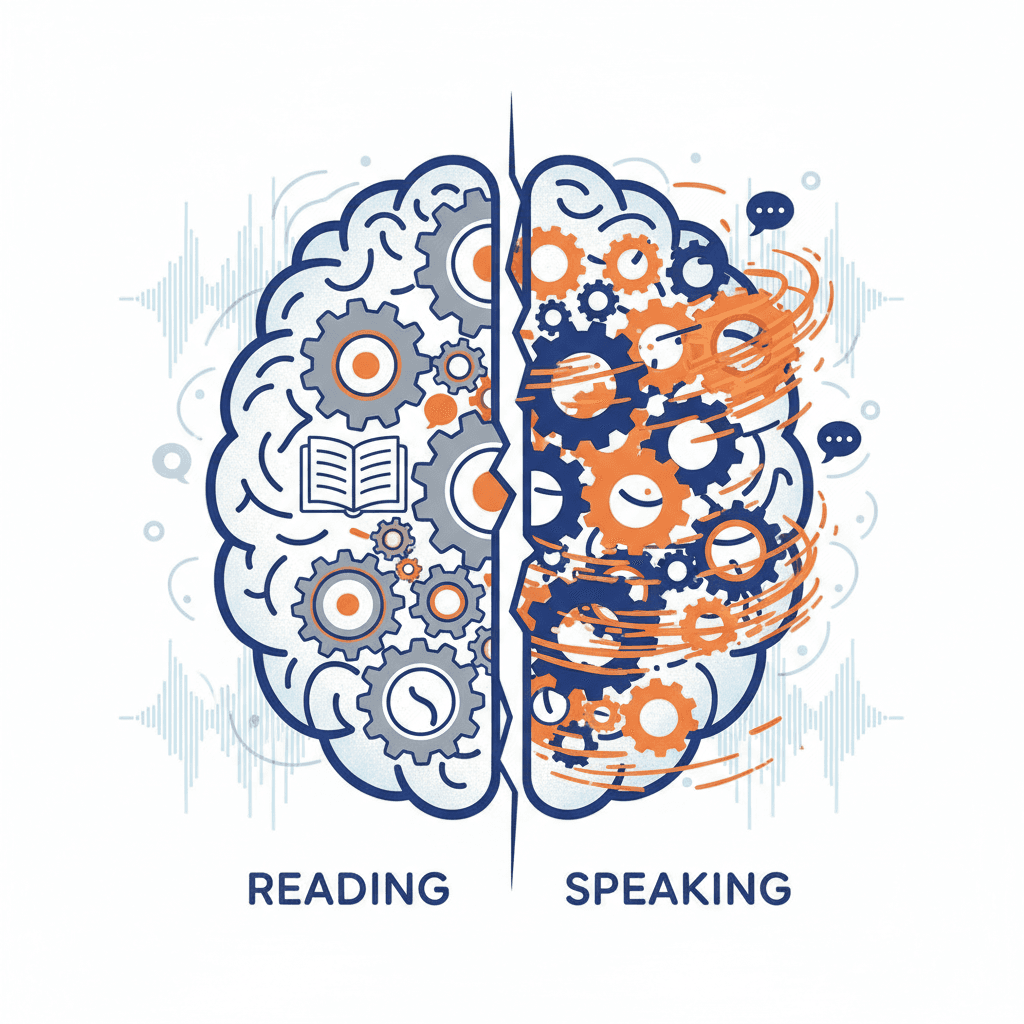
Let's get one thing straight: the gap between your written grammar knowledge and your spoken ability is not a personal failing. It's a cognitive traffic jam. Writing is a slow, deliberate process where you have time to edit and reflect. Speaking is a high-speed, automatic-fire activity that demands you pull vocabulary, form sentences, and manage pronunciation all at once. Your brain is juggling multiple tasks, and it prioritizes getting the message across over perfect syntax.
This pressure can trigger what experts call 'perfectionism paralysis'—the fear of being judged for making mistakes becomes so strong that you stop speaking altogether. This fear is a major roadblock to fluency. The goal should always be communication, culture, and connection over flawless grammar. After all, real-world conversation is about being understood, not passing an exam.
The fear of making mistakes is one of the biggest hindrances to fluency. Your brain acquires grammar in a fixed, predictable sequence... not based on a learner's desire for perfection.
The good news is that receiving feedback on errors can be incredibly effective when it feels like helpful assistance rather than judgment. Research confirms that when correction is psychologically comfortable, it accelerates learning (Source: ResearchGate, 2026). This is why a systematic, low-pressure approach is the secret to making real progress.
Introducing the 3-Step System to Fix Spoken Grammar
Instead of feeling frustrated by errors, it's time for a mindset shift: think of your mistakes as data. Every time you miss an article or use the wrong tense, you're not failing; you're gathering crucial information about where your weak spots are. This 'data' is the foundation of our simple, repeatable system for improving your spoken grammar.
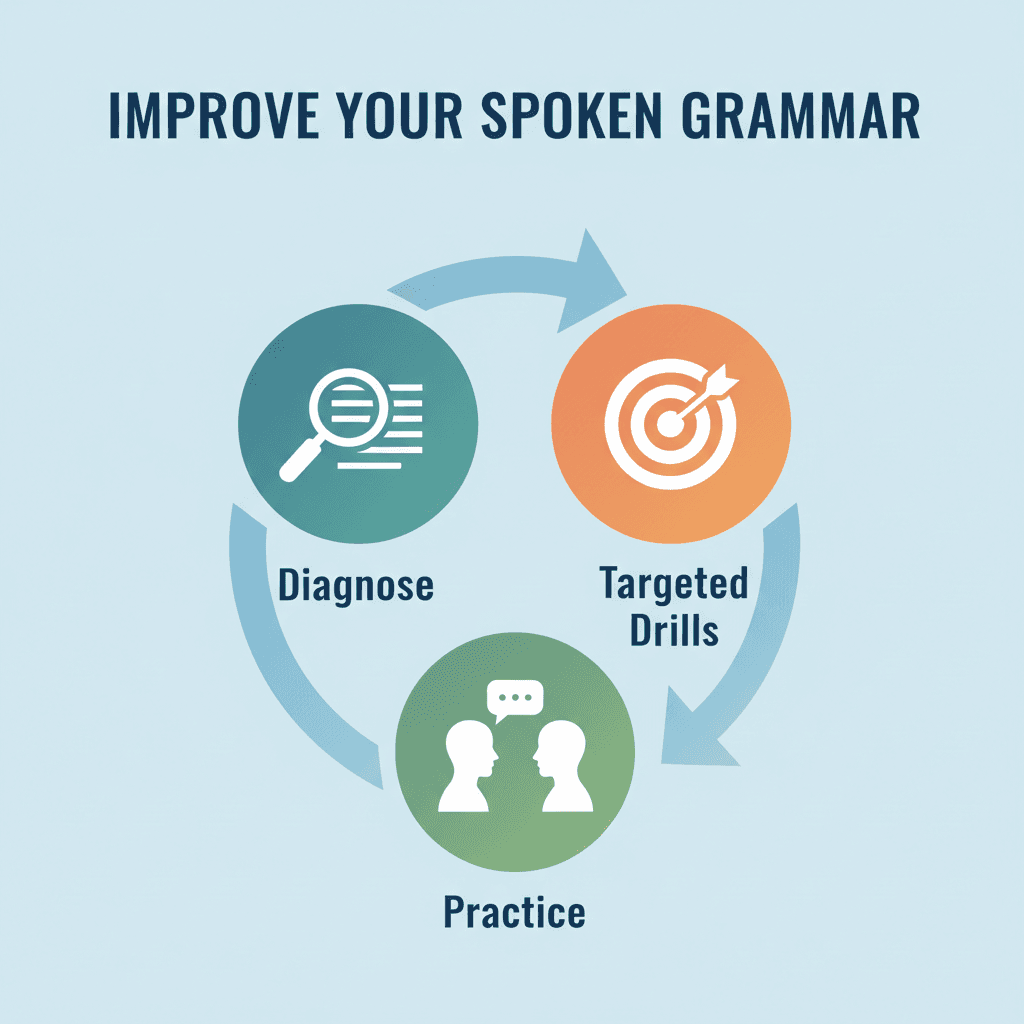
This system isn't about cramming more rules. It's a cycle designed to build habits and automate correct grammar, so you can speak fluently without mistakes becoming a source of anxiety. It works in three clear phases: Diagnose your personal error patterns, Target one mistake at a time with focused practice, and Automate the correct form through low-stakes conversation. Let's break it down.
Step 1: Diagnose Your Personal Error Patterns
You can't fix a problem you can't see. The first step toward better spoken grammar is to become a detective and identify your specific, repeated errors. Many learners have a few recurring 'bad mistakes' that pop up constantly, while 'good mistakes' happen when you're stretching your abilities and trying new things. Your goal here is to collect data on the 'bad' ones.
How do you collect this data without a teacher following you around? You can use technology and a bit of self-reflection. Here are a few practical methods to start diagnosing your grammar errors in speaking:
- •Record Yourself: Use your phone's voice memo app to record yourself speaking for 1-2 minutes about your day. Listen back and write down every grammatical mistake you hear. Do you consistently drop the 's' in the third person? Forget the correct gender for nouns? This is your raw data.
- •Use AI-Powered Tools: Modern language apps and platforms can provide instant analysis of your speech. An AI grammar checker for speaking can highlight recurring issues, giving you a clear list of what to work on.
- •Keep a 'Mistake Journal': As recommended in a March 2025 study, logging your mistakes turns moments of embarrassment into a tangible source of growth (Source: Embracing Mistakes, 2025). When you're corrected by a language partner or notice an error, jot it down. After a week, you'll see clear patterns emerge.
Step 2: Target One Mistake at a Time with Focused Drills
Once you have your data, it's tempting to try and fix everything at once. This is a recipe for overwhelm. The key to lasting improvement is to target one—and only one—of your recurring mistakes at a time. This is especially crucial for tackling what linguists call fossilized mistakes. These are errors that have become so ingrained through repeated use that they feel natural, often because of influence from your native language. You say them without thinking, and they are notoriously hard to unlearn.
To break a fossilized habit, you need focused, intentional practice. For example, if you consistently mix up 'for' and 'since,' dedicate an entire week to mastering just that. This approach, known as 'targeted grammar instruction,' leads to statistically significant improvements in accuracy (Source: Enhancing English Grammar..., 2025). You are consciously turning an automatic error into a manual thought, and then rebuilding it as a correct automatic habit.
Step 3: Automate Correct Grammar with Low-Stakes Practice
Knowing the rule isn't enough; you need to make it a habit. The final step is to move from conscious drilling to automatic use through extensive, low-pressure spoken grammar practice. This is how you 'proceduralize' a rule, turning it from something you know into something you do without thinking. Passive listening won't get you there—you have to actively produce sentences and get corrected (Source: r/languagelearning).
This is where the fear of judgment can creep back in. Who wants to practice their biggest mistake in front of a native speaker? This is why low-stakes environments are so powerful. The goal is to get as many 'reps' as possible without the anxiety of a real-world conversation. You can do this by talking to yourself, re-recording your audio memos until they're correct, or, most effectively, by using an AI language tutor.
Platforms like SpeaksyAI are designed for exactly this purpose. You can have open-ended conversations with an AI that provides instant, private, and non-judgmental feedback on your grammar. It acts as a patient language partner that's available 24/7, allowing you to practice a specific grammar point until it becomes second nature. This process is crucial for overcoming the psychological barriers associated with making mistakes (Source: ResearchGate, June 2026).
The Best Tools for Spoken Grammar Feedback
The language learning landscape is rapidly changing, moving away from simple flashcard apps and toward more sophisticated tools that tackle the hardest part of learning a language: speaking. While apps are popular—Duolingo, for example, reported 23% year-over-year growth in daily active users (Source: Duolingo, 2026)—many learners realize they create an 'app illusion' of competence without building real conversational skill.
The most exciting trend is the rise of AI tutors that can provide real-time, contextual feedback on spoken grammar. This has long been a major challenge, but new advancements are making it a reality. Here are some of the tools leading the way:
- •AI Language Tutors (SpeaksyAI, Speak): These platforms focus on conversation as the core of the learning experience. They use AI to simulate conversations and provide immediate feedback on grammar, vocabulary, and pronunciation, creating the ideal low-stakes environment for practice.
- •Busuu: Known for its community feedback feature, Busuu recently launched an AI-powered 'Speaking Practice' feature that gives personalized feedback within video scenarios, reflecting the industry's shift toward AI-driven instruction.
- •Tandem/HelloTalk: These language exchange apps connect you with native speakers. While feedback isn't guaranteed to be systematic, they offer invaluable practice in a real communicative context. Use them after you've drilled a grammar point to see if you can apply it under pressure.
Shifting Your Mindset: From 'Mistakes' to 'Data'
If you take away only one thing from this guide, let it be this: the way you think about your errors will determine how quickly you achieve your language goals. Every fluent speaker you admire has made thousands more mistakes than the beginner who is too afraid to start. They simply learned to see those mistakes not as failures, but as data.
Reframing errors as data in an 'error-positive environment' is a key strategy to overcome foreign language anxiety and turn discomfort into motivation.
Each error is a signpost pointing you toward what you need to learn next. It’s a gift of feedback that helps your brain remember the correct information more effectively (Source: Embracing Mistakes article, 2025). By embracing this process, you remove the emotional weight of 'being wrong' and replace it with the logical, empowering process of 'getting better.' You stop chasing an impossible standard of perfection and start building real, measurable confidence. So go ahead, make mistakes. Your future fluent self will thank you for the data.
Frequently Asked Questions
Frequently Asked Questions
Ready to Practice Grammar Without Judgment?
Get instant, private feedback on your spoken grammar with SpeaksyAI, your personal AI language tutor. Speak confidently from day one.
Join the Waitlist