Speaking vs. Grammar: Your Action Plan for Learning a Language
Debating when to start speaking a language vs studying grammar? This guide ends the debate with a practical system to help you speak confidently from the start.

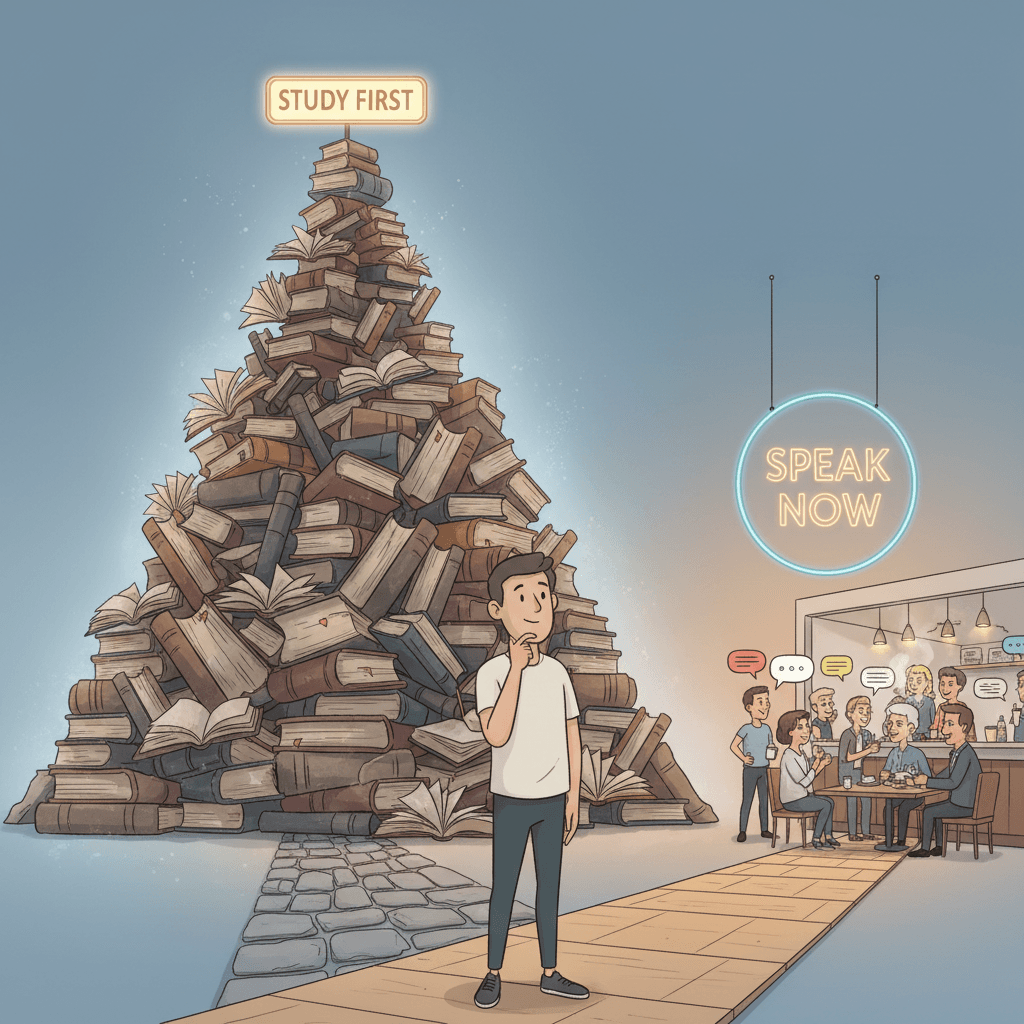
It’s the question every language learner faces: When to start speaking a language vs studying grammar? For years, the debate has raged between two camps: the 'speak from day one' advocates and the 'master the grammar first' purists. The truth is, you don’t have to choose. The most effective path isn't about picking a side; it's about having a system. This guide turns that abstract debate into a clear action plan, showing you exactly how to balance grammar and speaking to build real-world confidence and make steady, motivating progress.
Many learners, perhaps in places like the US or Australia where foreign language exposure can be limited, feel they need a solid grammar foundation before they dare to speak. They worry about making mistakes or sounding foolish. But this 'wait until you're ready' approach is often a trap. In fact, a major shift is happening in language learning. A 2026 report on language learning trends highlights a move away from rigid, grammar-first methods toward adaptive systems that get you speaking and listening from the very beginning. The goal has changed from academic perfection to practical communication.
The Big Question: Speak Now or Study Grammar First?
So, what does this mean for you? It means letting go of the pressure to be perfect. The fear of making mistakes is one of the biggest hurdles in language learning. But as research from March 2025 points out, focusing too much on grammar rules early on can actually backfire, leading to hesitation and anxiety in real conversations. Starting to speak early, even with simple phrases, does the opposite. It normalizes making mistakes, builds your confidence, and shifts your focus from a silent fear of error to the joy of actual communication. It’s about building a new habit, one conversation at a time.
Why 'Waiting to Speak' Can Slow Your Progress
The idea of mastering grammar before speaking sounds logical, but it often works against our brain's natural learning process and, more importantly, our motivation. The 'grammar-first' approach turns language into an academic subject to be studied, rather than a living tool to be used. This can create a cycle of endless study without the rewarding feedback of a real conversation, leading to burnout. This isn't just a feeling; a 2025 report on Medium found that a staggering number of learners quit within the first 100 hours, frequently citing doubt and fatigue as the primary reasons.
When you delay speaking, you train your brain to analyze and translate in your head, which is the enemy of fluency. Instead of responding naturally, you get stuck overthinking verb conjugations and noun genders. A 2026 analysis of learning methods noted that this can seriously damage confidence, as the learner never develops a natural feel for the language's rhythm and flow. As many experts observe, waiting until you feel 'ready' often means you never start, leading to a critical loss of the initial excitement that drove you to learn in the first place.
An excessive early focus on grammar can actively hinder fluency by causing hesitation and anxiety during real-world conversations.
Ultimately, the purpose of learning a language is to connect with others. By putting up a wall of grammar rules between you and your first conversation, you delay the very experience you're working toward. The risk isn't making a few mistakes; it's giving up entirely before you ever get there.
Your 'Minimum Viable Grammar' Checklist for Speaking
So, if you shouldn't wait for perfect grammar, what's the alternative? The answer is focusing on Minimum Viable Grammar (MVG). This is the absolute essential toolkit you need to have your very first simple conversation. It’s not about being grammatically perfect; it’s about being understood. Instead of asking 'how much grammar to learn?', ask 'what's the least I need to start?' You’ll be surprised by how little it is.
- •The Present Tense: Just focus on how to say things like 'I am,' 'you have,' and 'they go.'
- •Core Vocabulary: Start with the 100-200 most common words, including pronouns (I, you, they), essential verbs (be, have, do, go), and basic nouns (person, place, thing).
- •Basic Question Words: Learn 'who,' 'what,' 'where,' 'when,' 'why,' and 'how.' This empowers you to ask for help and keep conversations going.
- •Simple Connectors: Words like 'and,' 'but,' and 'because' are superpowers that let you link ideas together into more complex thoughts.
- •Basic Sentence Structure: Understand the most common word order (e.g., Subject-Verb-Object in English or Spanish).
That's it. With these tools, you can form basic but complete thoughts like, 'I am from Canada, and I learn Spanish because I want to go to Mexico.' Is it elegant? No. Is it understandable? Absolutely. This mirrors how children acquire language—they don't start with grammar tables; they start by communicating needs and ideas imperfectly. As The Mezzofanti Guild points out, explicit grammar study isn't even required to learn to speak. The real learning happens when you use these building blocks in conversation. The single strongest predictor of success isn't your grammar knowledge, but the number of 'spaced, spoken, corrected practice hours' you put in, according to HelloTalk's 2026 data.
How to Practice Speaking (Even When You're Not 'Ready')
Having your Minimum Viable Grammar checklist is one thing, but using it is another. For many, the biggest barrier is the fear of judgment. What if you make a mistake in front of a native speaker? What if they don't understand you? This is where finding a safe, low-pressure environment to practice is crucial for building early momentum.
This is where modern technology offers a powerful new solution: the AI language tutor. Think of it as a conversation partner that’s available 24/7, never gets tired, and, most importantly, never judges you. A 2026 guide on evidence-based language learning called AI conversation practice a 'game-changer' for its ability to provide daily, judgment-free speaking opportunities. It’s the perfect sandbox to try out new words and sentence structures without the anxiety of a live audience.
Using an AI allows you to immediately apply your MVG. You can have dozens of short, simple conversations, building the muscle memory for speaking. This process of trying, making mistakes, and getting instant feedback normalizes the learning process and builds tremendous confidence. Tools like SpeaksyAI's AI conversation partner let you have these early conversations anytime, helping you build confidence by normalizing mistakes—a key benefit identified in 2026 language learning trend reports. You can focus purely on communicating your message.
This type of practice is incredibly efficient. It allows you to rack up those critical 'spaced, spoken, and corrected practice hours' that HelloTalk's 2026 analysis identified as the most significant predictor of fluency. You're not just studying; you're actively doing the one thing that will make you a speaker.
Your 3-Stage System for Balancing Grammar and Speaking
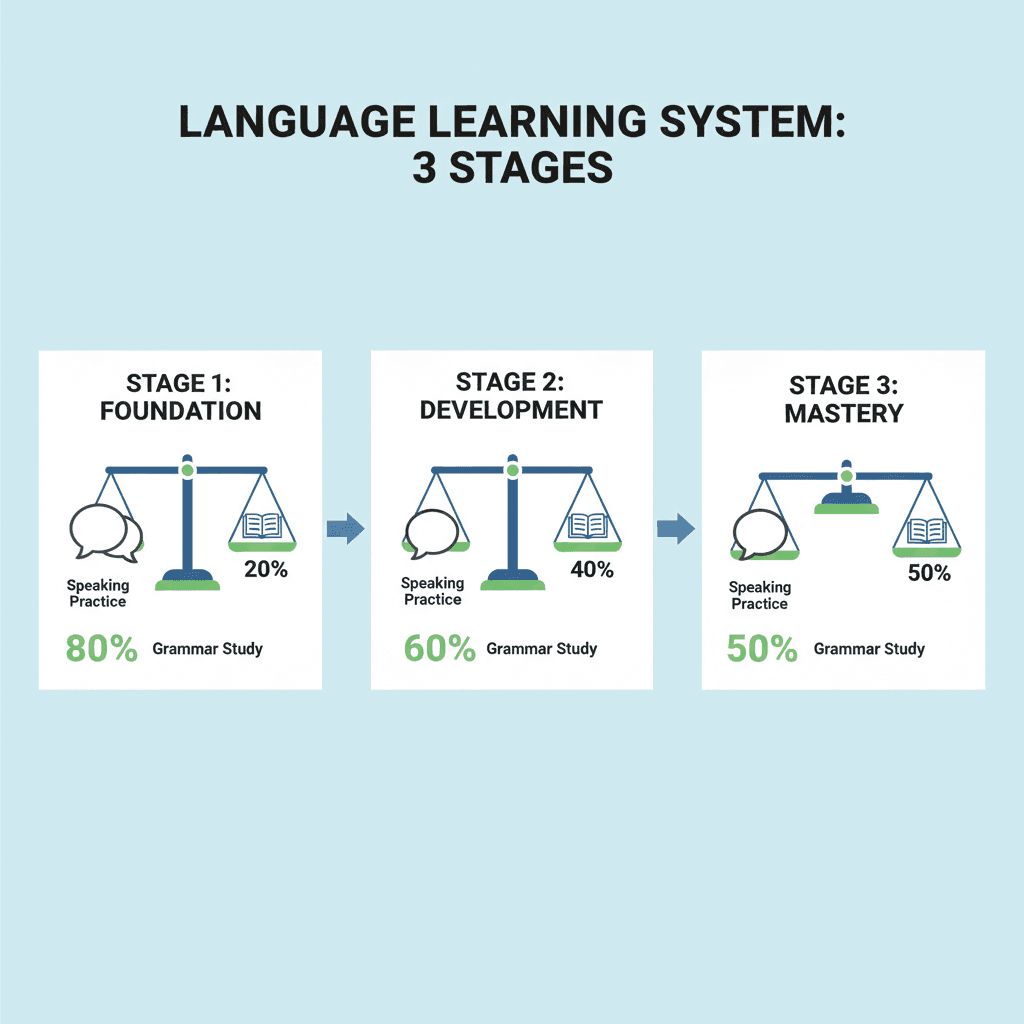
To take the guesswork out of the 'speak vs. study' dilemma, we've developed a simple 3-stage system. This framework gives you a clear roadmap for how to balance grammar and speaking based on your current level. Instead of feeling pulled in two directions, you'll know exactly where to focus your energy for maximum results, whether you're a complete beginner in India or an intermediate learner in the UK.
The logic is simple: you start with a heavy emphasis on speaking to build conversational habits and confidence. As you progress and your conversational needs become more complex, you gradually integrate more targeted grammar study to add clarity and precision. This approach, which blends both skills, is supported by a 2025 analysis suggesting this is the most effective path. It ensures you’re always learning grammar in the context of what you actually need to say.
Stage 1 (Beginner/A1): The 80/20 Conversation Focus
At the very beginning, your single most important goal is to build the habit of speaking. Your brain needs to accept that this new language is a tool for communication, not just a list of words to memorize. Therefore, your time should be heavily skewed toward active use.
- •Time Allocation: 80% Speaking & Listening / 20% Grammar Study.
- •Your Goal: To overcome the fear of speaking and build a small-win feedback loop that keeps you motivated.
- •Action Plan: Spend 15-20 minutes every day having simple conversations with an AI tutor or a patient partner. Focus on using your core vocabulary. For your grammar time, learn just one new, high-impact concept per week (e.g., how to make nouns plural). Don't worry about perfection; as a late 2025 article argues, 'doing more' (speaking often) is far more valuable than 'studying harder' at this stage.
This approach is powerful because it prioritizes what you actually want to do: speak. As a January 2026 guide states, A1 learners should focus on speaking because it's 'the hardest skill and what you actually want.' This 80/20 focus ensures you don't get bogged down in theory before you've even had a chance to enjoy talking to someone.
Stage 2 (Advanced Beginner/A2): The 60/40 Expansion
Once you're comfortable with basic introductions and present-tense conversations, you've reached the A2 level. Now, your goal is to expand the range of what you can talk about. This is the perfect time to start dedicating a bit more energy to structured grammar, as you now have a conversational context to apply it to.
- •Time Allocation: 60% Speaking & Listening / 40% Grammar Study.
- •Your Goal: To start telling simple stories and talking about your plans by learning past and future tenses.
- •Action Plan: Continue your daily speaking practice, but now try to describe your day yesterday or your plans for the weekend. During your grammar time, focus specifically on past and future verb forms. The key, according to a 2025 study on learning strategies, is to apply this knowledge immediately in real conversational interactions, not just memorize charts.
This is a critical period. Many learners quit here as the initial 'newbie' excitement wears off. By shifting your focus to storytelling, you make the language more personal and engaging, which is vital for staying motivated. As you build these skills, you'll be well on your way to the next level. For more detailed strategies, check out our guide on How to Go From A2 to B1 Speaking.
Stage 3 (Intermediate/B1): The 50/50 Refinement
At the B1 level, you can handle most everyday conversations and express your opinions. Congratulations! This is a huge milestone. However, this is also where many learners hit the 'intermediate plateau.' To break through, you need to shift from just communicating to communicating with more precision and nuance. This means an equal balance between practice and refinement.
- •Time Allocation: 50% Speaking & Listening / 50% Grammar Study.
- •Your Goal: To improve accuracy, fix recurring errors, and start discussing more complex or abstract topics.
- •Action Plan: Continue speaking daily, but push yourself into more challenging territory. Discuss movies, politics, or your dreams. Start a 'mistake journal' to note down errors you make repeatedly. Then, use your grammar time to specifically target and fix those weak spots. As a 2026 guide from Edlingo suggests, grammar is most effective at this stage when used to correct errors you actually make.
This 50/50 balance ensures you keep your speaking skills sharp while systematically improving your accuracy. AI conversation partners are particularly useful here, as they provide a space to practice speaking on complex topics without fear of judgment. This targeted approach is the key to moving past the common B1 stage. If you feel stuck, our article on how to Break the Intermediate Language Plateau can provide a detailed roadmap for your next steps.
Frequently Asked Questions
Frequently Asked Questions
Ready to Start Speaking with Confidence?
Get personalized feedback and practice anytime with SpeaksyAI, your AI language tutor.
Join the Waitlist