Why You Sound Robotic In A New Language (And How to Find Your Voice)
Ever feel like a machine when you speak a new language, even if you know the words? You're not alone. This guide explains why and gives you a system to sound natural.
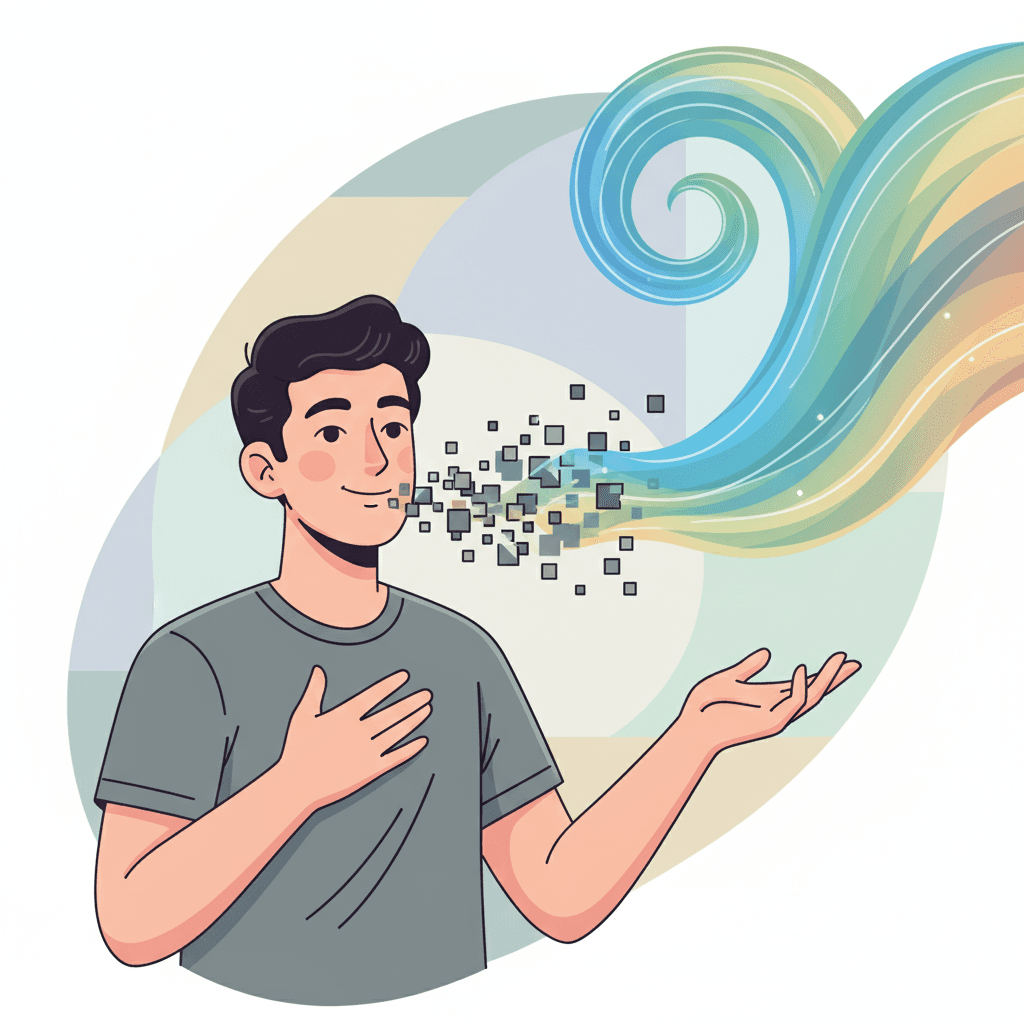
You Know the Words, But Why Do You Sound Robotic?
If you’ve ever found yourself wondering, “why do I sound robotic when speaking a foreign language?”, take a deep breath. You’re not alone. The most direct answer is that you're likely using the 'music' of your native language—its unique rhythm, stress, and intonation—which doesn't quite fit the new one you're learning. This phenomenon, called 'prosodic transfer,' is an incredibly common hurdle for intermediate learners. It has little to do with your accent or vocabulary size and everything to do with the underlying melody of your speech.
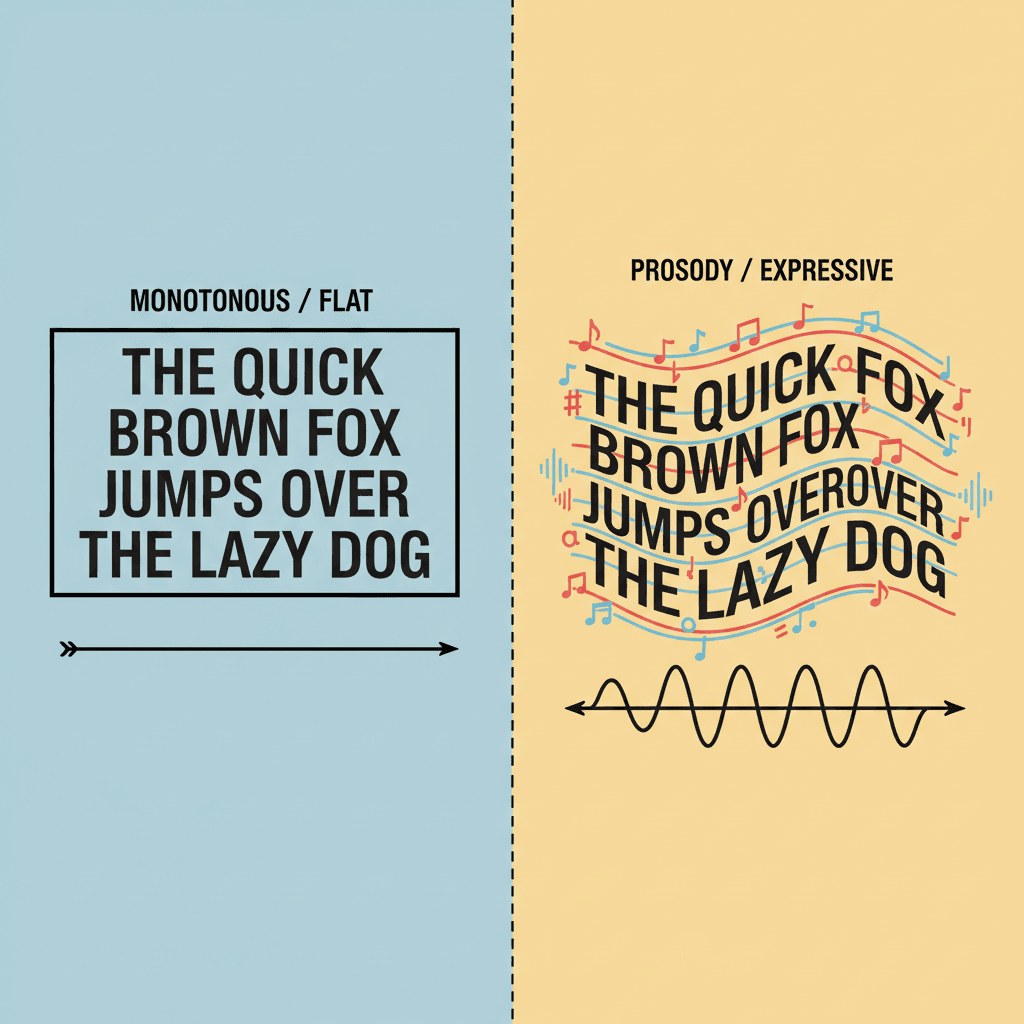
It's the classic intermediate plateau: you've memorized the grammar rules and have a solid bank of words, but when you speak, something feels... off. Your delivery might be flat, mechanical, or lack the emotional color that native speakers have. This isn't a sign of failure; it's a sign that you've moved beyond the basics and are ready to tackle a more advanced and rewarding aspect of fluency. Think of it not as a problem to be fixed, but as an exciting new level to unlock in your language journey—the level of sounding natural, expressive, and truly confident.
I remember this feeling vividly from my time learning Spanish. I could conjugate verbs in my sleep, but my practice partner once gently told me I sounded 'very serious,' even when trying to be friendly. It was a lightbulb moment. I was speaking Spanish words but with an English rhythm. The perfectionism of trying to get every word right was making me disconnect from the emotional flow of the conversation. Recognizing this shift from 'correctness' to 'naturalness' is the first, most important step.
The Real Culprit Isn't Your Accent, It's 'Prosody'
Let's clear up a common misconception. When you feel 'robotic', it’s tempting to blame your accent. But an accent is about how you pronounce individual sounds (like the difference between 'ship' and 'sheep'). The robotic quality, however, is almost always a problem of prosody.
Think of prosody as the 'music' of a language. It’s the combination of three key elements:
- •Rhythm: The pattern of stressed and unstressed syllables. (Is it bouncy or even?)
- •Stress: Which words or syllables get more emphasis in a sentence.
- •Intonation: The rise and fall of your voice—the melody that conveys questions, statements, and emotions.
Every language has its own unique prosody. The problem arises from what linguists call 'prosodic transfer.' Recent academic studies published by ResearchGate confirm this is a key reason learners sound robotic. It’s the unconscious process of applying your native language’s musical rules to the new language. For example, if your native language is 'syllable-timed' like Spanish or French (where each syllable gets roughly equal time), transferring that habit to a 'stress-timed' language like English (which emphasizes important words) will inevitably result in a flat, mechanical rhythm.
The 3 Main Causes of 'Robotic' Speech
Understanding why you sound robotic is the key to changing it. The issue stems from a mix of technical habits and psychological hurdles. Let's break down the three biggest contributors to that mechanical sound, which will pave the way for our system to help you find your natural flow.
Cause 1: First-Language Interference (Prosodic Transfer)
As we touched on, this is the number one technical reason. Your brain has spent years, even decades, mastering the rhythm and intonation of your first language. It's an automatic process. When you speak a new language, your brain's default setting is to apply those same well-worn musical patterns. It’s like trying to play improvisational jazz using a rigid classical music rhythm—the notes might be correct, but the feel is all wrong.
This interference is why many learners give every syllable equal weight and use a flat intonation. You might find yourself pronouncing words in careful isolation instead of connecting them, breaking the natural melodic contour that a native speaker would use. This isn't a mistake in pronunciation; it's a mismatch in musicality.
Cause 2: Perfectionism & Over-Monitoring Your Speech
Do you mentally rehearse sentences before you say them? Do you constantly scan your speech for grammatical errors? This intense focus on 'correctness' is a major psychological driver of robotic speech. Experts note that perfectionism and an over-reliance on grammatical structure cause a disconnection from the emotional aspect of speaking.
You become so focused on the structure of what you're saying that you forget the feeling you're trying to convey. This can lead to what some call 'regurgitation rather than genuine expression.'
This immense 'cognitive load'—simultaneously juggling grammar, vocabulary, pronunciation, and anxiety—forces you to over-monitor your output. The result is often a hesitant, carefully measured delivery where words come out as separate, evenly spaced blocks instead of a fluid stream of thought.
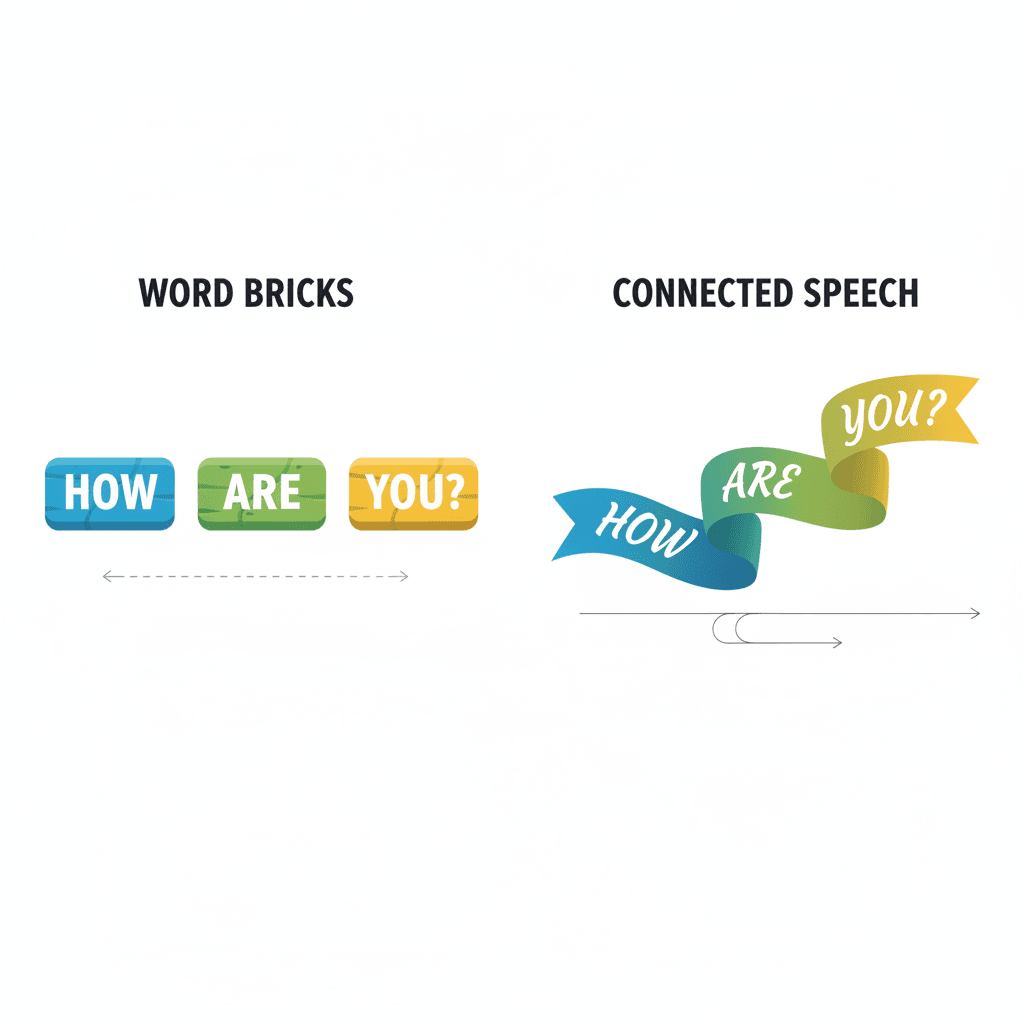
Cause 3: Speaking in 'Word Bricks' vs. Connected Speech
Imagine building a wall with bricks but leaving a small, perfect gap between each one. That’s how many learners speak: Word. By. Word. By. Word. This 'word bricks' approach is a primary cause of a robotic sound. In reality, native speakers don't talk like that. Their speech is a flowing river, not a neat row of bricks.
Natural speech is full of 'connected speech,' where sounds blend together, words link up, and unimportant syllables are reduced or even disappear. For example, 'what are you doing?' becomes 'whatcha doin'?'. Learners often pronounce every word fully and clearly because that’s how they learned them in isolation. Overcoming this requires a mental shift: realizing that sounding natural often means sounding less 'perfect' and embracing the messy, connected flow of real conversation.
A 3-Step System to Find Your Natural Flow
Feeling a little overwhelmed by prosody, perfectionism, and connected speech? Don't be. Now that you know the 'why,' you can focus on the 'how.' We've developed a simple, three-step system to help you move past the robotic stage and discover your own natural voice in your new language. This isn't about erasing your accent; it's about adding the music.
Step 1: Tune Your Ear to the Music (Active Listening Exercises)
Before you can produce the music, you have to hear it. Passive listening (like having a movie on in the background) isn't enough. You need to practice active listening with a focus on prosody. Research even shows a strong link between musical training and the ability to imitate foreign speech, because it trains your brain to notice pitch and rhythm. Here’s how you can start:
- 1.Listen for Emotion, Not Words: Pick a short audio clip of a native speaker. The first time, ignore the words and just listen to the melody. Is their voice going up or down? Is their tone happy, sad, or curious? You're listening for the intonation contour.
- 2.Tap Out the Rhythm: Listen to the same clip again, but this time, tap your finger on a desk to the beat of the sentence. You'll quickly notice that some taps are harder (stressed syllables) and some are softer. This helps you feel the rhythm in a physical way.
- 3.Hunt for Connected Speech: Now, listen with the transcript. Where do words blur together? Where are sounds dropped? Notice how 'for example' becomes 'frexample'. Identifying these connections is the first step to using them yourself.
Step 2: Practice Rhythm & Intonation (Beyond Shadowing)
Shadowing (repeating after a native speaker) is great, but you can go deeper with exercises that isolate the elements of prosody. These techniques help you build muscle memory for the new language's music without the pressure of getting words perfect.
- 1.The Humming Technique: Play a short sentence from a native speaker, then try to 'hum' the intonation contour. Don't say the words, just hum the melody. This removes the cognitive load of pronunciation and lets you focus purely on pitch.
- 2.The Rubber Band Technique: This is a fantastic physical tool. Hold a rubber band between your hands. As you say a sentence, stretch the band wider for the stressed syllables and let it relax for the unstressed ones. This kinesthetic feedback helps counter the habit of giving every syllable equal weight.
- 3.Mimic Emotional Phrases: Find short, emotional clips from TV shows or movies ('I can't believe it!', 'What are you talking about?'). Try to mimic the exact emotion and intonation. This directly links the 'music' of speech to a feeling, making your own speech more expressive and less robotic.
Step 3: Get Instant, Actionable Feedback with an AI Language Tutor
This is where technology becomes your superpower. Your human friends and language partners are invaluable, but when you ask for feedback on your robotic speech, they often struggle to give precise advice. They might say, 'It just sounds a bit flat,' but they can't easily explain why.
This is the gap that a specialized AI tutor can fill perfectly. Recent reviews confirm that AI tools significantly improve oral performance by providing automated, instant feedback. While generic AIs can sometimes be unhelpful, a dedicated language learning tool can analyze your speech on a granular level. For example, SpeaksyAI's instant pronunciation feedback can visualize your pitch, showing you exactly where your intonation rises and falls compared to a native speaker. It can highlight which syllables you need to stress and which to reduce, turning that vague 'flat' feeling into actionable data you can use to improve immediately.
Overcoming the Fear: Building Confidence to Speak Freely
Ultimately, sounding natural is as much about mindset as it is about mechanics. The fear of making mistakes, known as xenoglossophobia, can trigger a threat response in the brain that literally blocks your ability to recall words and speak fluently. That fear and perfectionism are what push you into that rigid, over-monitored, robotic speaking style.
The antidote is to embrace imperfection. Set small, achievable goals for your conversations. Instead of 'I will have a perfect 10-minute conversation,' try 'I will try to use three emotional intonation patterns' or 'I will focus on conveying a feeling, not perfect grammar.' Every time you speak, you are winning. Every mistake is a data point for learning. By shifting your goal from 'perfection' to 'connection,' you give yourself the freedom to play with the language, find its music, and let your true personality shine through. This confidence is essential to stop native speakers from switching to English and to feel comfortable enough to join group conversations.
FAQ: Sounding Robotic When Speaking a Foreign Language
Frequently Asked Questions
Ready to Find Your Natural Voice?
Get personalized feedback on your rhythm and intonation. SpeaksyAI's AI language tutor helps you speak confidently, not robotically.
Join the Waitlist