Shadowing vs. Mimicking vs. Parroting: Which is Right for You?
Struggling to find your voice in a new language? Learn the crucial differences between shadowing, mimicking, and parroting to choose the right technique for your level.

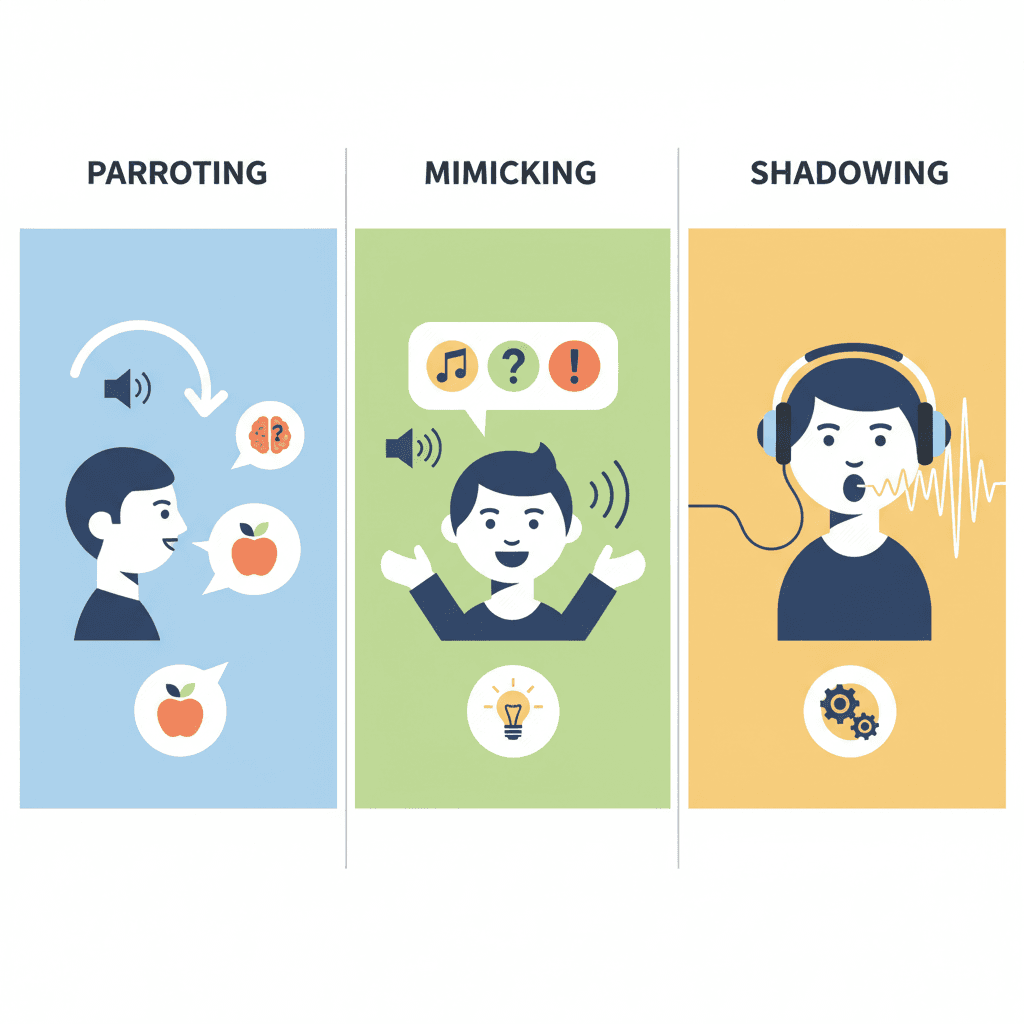
If you're looking for the best way to improve your speaking skills in a new language, you've likely come across a few powerful imitation techniques. But navigating the differences between shadowing vs mimicking vs parroting for language learning can be confusing. The simplest way to understand them is as a progressive, three-step system. You begin with parroting to master individual sounds and words. Next, you move to mimicking to capture the rhythm and emotion of whole phrases. Finally, you graduate to shadowing to develop a smooth, native-like flow. This system guides you from building foundational pronunciation to speaking with natural confidence.
Each stage in this language learning imitation system builds on the last, targeting a different aspect of spoken fluency. By understanding when and how to use each one, you can create a powerful practice routine that systematically improves your pronunciation and intonation. Let's break down what each technique involves and how you can use them to find your voice.
The Imitation Spectrum: A Quick Comparison Table
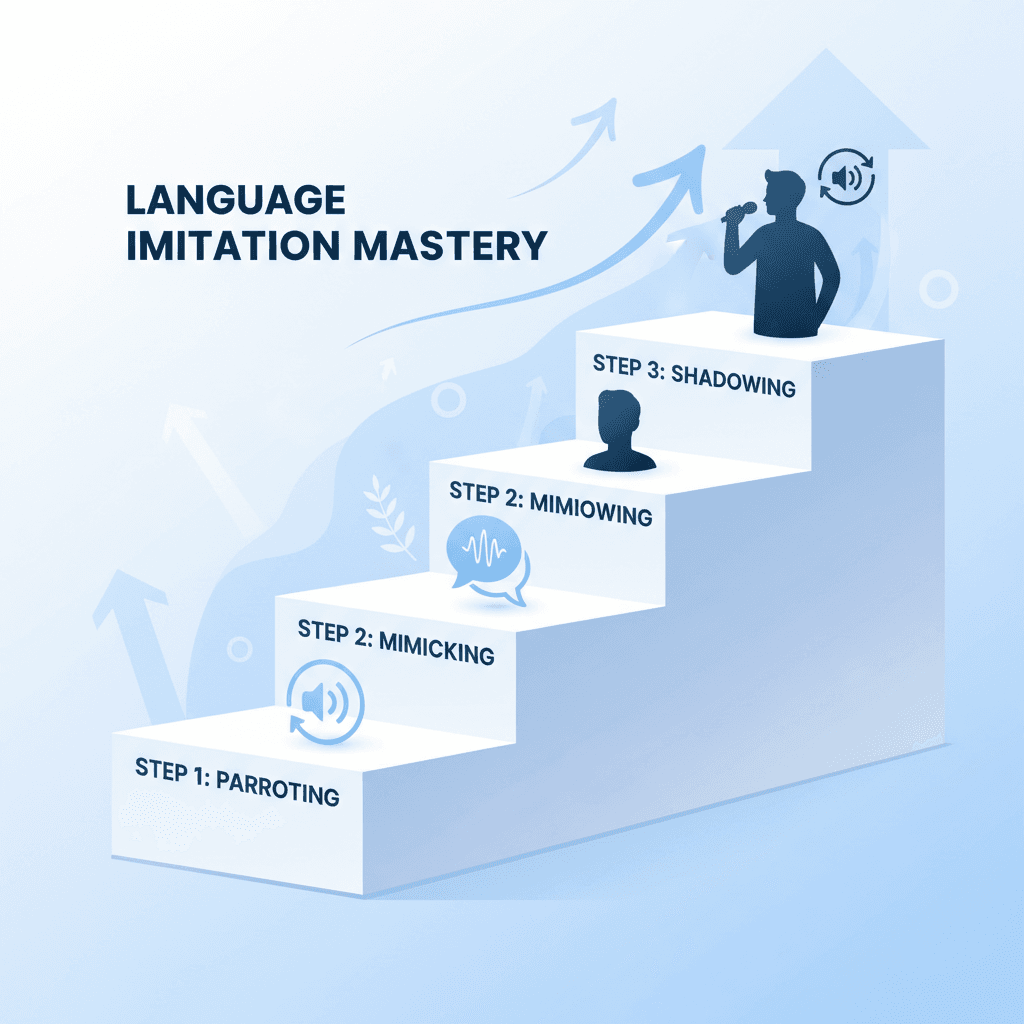
Before we dive deep, here’s a quick overview to help you distinguish between these three powerful techniques. Think of them as tools in your language learning toolkit, each designed for a specific job.
| **Technique** | **Primary Goal** | **Process** | **Difficulty** | **Best For** | |---|---|---|---|---| | **Parroting** | Sound & Word Repetition | Repeat individual words or short phrases immediately after hearing them, often without full context. | Beginner | Building muscle memory for new sounds and basic vocabulary recall. | | **Mimicking** | Rhythm & Intonation | Listen to a short chunk of audio, pause it, and then repeat it, trying to copy the emotion, stress, and pitch. | Intermediate | Internalizing prosody (the 'music' of the language) and connecting sounds to meaning. | | **Shadowing** | Fluency & Flow | Speak along with native audio in near real-time, aiming to match the speaker's cadence and rhythm with minimal delay. | Advanced | Developing native-like fluency, improving listening comprehension at speed, and mastering prosodic flow. |
Level 1: Parroting to Build Your Foundational Sounds
Parroting is the first and most fundamental step in your imitation journey. At its core, it’s about pure sound repetition. You hear a word, and you say it back immediately. The primary goal isn't deep comprehension but rather training the muscles in your mouth, lips, and tongue to produce unfamiliar sounds accurately. This is your training ground for the building blocks of the language.
While some dismiss this as 'mindless parroting,' it serves a crucial purpose. According to a 2026 guide, imitation without any understanding is the most basic form of repetition, but it's essential for forming a phonetic foundation. Think of it like a musician practicing scales. It might not be a song, but it's the foundation from which all music is made. Experts note that this technique is a targeted tool for building muscle memory, which is essential before you can tackle more complex phrases.
- •Pros: Excellent for isolating and practicing difficult sounds. It builds strong muscle memory and can help with memorizing new vocabulary through rote repetition.
- •Cons: Lacks context, which means you're not learning how to use the word in a sentence. It can feel robotic and doesn't improve conversational flow or intonation.
Your Action Step: Grab a list of 10-15 new vocabulary words. Use a dictionary app or online tool that provides audio for each word. Listen to the native pronunciation of the first word, then immediately say it out loud. Repeat this 5-10 times, focusing entirely on matching the sound. Don't worry about the meaning yet—just focus on the phonetics. This practice aligns with Second Language Acquisition (SLA) research, which shows that advanced fluency is built upon a 'foundation of scripted listening, phonics, and lexical patterning'—exactly what parroting helps you build.
Level 2: Mimicking to Capture Rhythm and Emotion
Once you're comfortable producing the basic sounds of the language, it's time to move to Level 2: mimicking. This is where you start to breathe life into your words. Unlike parroting, mimicking involves context, rhythm, and emotion. The process is often called 'delayed imitation' or 'listen-pause-repeat.' You listen to a complete phrase or short sentence, pause the audio, and then repeat it, trying to replicate not just the words but the entire delivery.
This is a crucial step because it moves you beyond individual words and into the realm of prosody—the music of a language. You'll focus on imitating the speaker's intonation (the rise and fall of their voice), stress (which words they emphasize), and emotional tone. This is incredibly important, as research consistently shows that prosody is one of the strongest indicators of how fluent a non-native speaker sounds. It’s the difference between saying 'I am happy' as a flat statement and 'I am happy!' with genuine excitement.
Mimicking is also where you truly start to connect sound to meaning. A landmark 2026 review of 70 years of research found that when imitators make errors, their mistakes are often grammatically and semantically consistent. This proves they are actively processing the meaning of what they're saying, not just repeating empty sounds. This active imitation strengthens the link between auditory perception and motor articulation in your brain, making recall and usage more automatic.
Your Action Step: Find a 30-60 second audio clip with a clear speaker, like a short segment from a podcast, a movie scene, or a news report. Listen to the first sentence or natural phrase. Pause the audio. Now, repeat it aloud, doing your best to copy the speaker's exact rhythm, pitch, and emotion. Record yourself and compare it to the original. Did you stress the same words? Did your pitch rise and fall in the same places? Repeat this until you feel you've captured the essence of the speaker's delivery.
Level 3: Shadowing to Master Native-Like Flow
Welcome to the final and most advanced level: shadowing. Popularized by polyglot and linguist Alexander Arguelles, this technique is your key to achieving a smooth, natural, and continuous flow in your target language. The process is simple to describe but challenging to execute: you speak simultaneously with a native audio source, trying to stay as close to the speaker's timing as possible. You are their 'shadow.'
This is a profound cognitive workout. It forces your brain to perform multiple tasks at once: listen intently to the incoming audio, comprehend its meaning, and articulate it all in near-real-time. This intense process engages your brain’s phonological loop and dorsal stream, accelerating the connection between hearing and speaking. The goal isn't 100% accuracy at first, but to relentlessly chase the speaker's rhythm and cadence. Research confirms that this is not just 'language parroting'; a comprehensive review found that shadowers process meaning deeply, as evidenced by their grammatically consistent errors when they do miss a word.
While shadowing is powerful, it's important to have realistic expectations. Research consistently shows it dramatically improves comprehensibility, fluency, rhythm, and prosody. However, its direct impact on reducing a foreign accent is less clear. As one major 2025 systematic review of 44 studies by Whitworth and Rose found, there is consistent positive evidence for shadowing improving speaking fluency, but weak or mixed evidence for it reducing accentedness. So, focus on shadowing as your tool for flow, not for perfecting individual sounds.
Your Action Step: Start with an audio clip you have already mimicked and are familiar with. Play the audio at a comfortable volume and start speaking along with it. Try to start speaking just a fraction of a second after the speaker begins. Don't stop if you make a mistake or fall behind—just jump back in and keep going. To learn more about the specifics of this powerful method, you can check out our detailed guide, How to Use the Shadowing Technique.
Putting It All Together: Your Weekly Imitation Practice System
Understanding each technique is one thing; implementing them is another. A structured routine is the best way to turn theory into tangible progress and overcome the fear of speaking, which is a major hurdle for many learners. Here is a sample weekly system that progresses you through the three levels, designed to build your skills systematically.
- 1.Days 1-2: Foundation (Parroting). Choose 10-15 new vocabulary words relevant to a topic you enjoy (e.g., cooking, technology, travel). Use an app or website to hear the native pronunciation. Spend 10-15 minutes each day parroting these words. Focus only on getting the sounds right. Repetition is key here.
- 2.Days 3-4: Context and Rhythm (Mimicking). Find a 1-2 minute audio clip (like a short YouTube video or podcast segment) that uses some of your new vocabulary. Spend 15-20 minutes practicing the listen-pause-repeat method. Work phrase by phrase. Record yourself and compare your intonation and stress to the original speaker's.
- 3.Days 5-6: Flow and Fluency (Shadowing). Now, use the same 1-2 minute audio clip you've been mimicking. Try to shadow it. Play the audio and speak along with it in real-time. It will be challenging! Don't worry about perfection. The goal is to keep up with the speaker's pace and rhythm. Do this for 10-15 minutes.
- 4.Day 7: Rest and Review. Give your brain and mouth a rest. Lightly review the vocabulary and listen passively to the audio clip one more time to reinforce what you've learned.
This structured cycle ensures you are not just randomly repeating sounds but are actively building from a solid phonetic base towards fluid, meaningful speech. This progression from simple repetition to deeper processing is supported by research showing that advanced shadowing involves understanding, making it a more significant cognitive step than basic parroting. By dedicating time each week, you'll see measurable gains in your overall comprehensibility, fluency, and prosody.
The Smart Way to Practice: Using the SpeaksyAI Language Tutor
One of the biggest obstacles for language learners, especially in places like the US, UK, or Australia, is the 'fear of speaking.' You know the techniques, but the thought of practicing them with a real person can be intimidating. This is where modern technology provides a perfect solution. An AI language tutor like SpeaksyAI creates a private, judgment-free space to master this 3-step imitation system.
Imagine this seamless workflow: First, you ask your AI tutor, "Can you give me a 30-second audio clip in French about ordering coffee?" Instantly, you have the perfect material for your practice. Then, you use the integrated recording tool to capture your attempt—whether you're parroting new words, mimicking a phrase, or shadowing the entire clip. Finally, and most importantly, SpeaksyAI's real-time pronunciation feedback analyzes your speech and gives you immediate, specific suggestions for improvement. It might highlight a vowel sound you're struggling with or show you where your intonation didn't match the native speaker's.
This isn't just about convenience; it's about effective learning. A 2025 randomized controlled trial found that an AI tutoring system was just as effective as human tutors in helping students identify and correct their mistakes. By having an on-demand conversation partner available 24/7, you can practice hundreds of repetitions in a single session, building muscle memory and confidence far faster than you could by waiting for a weekly class or language exchange. It's the perfect bridge between knowing the theory and feeling ready to speak confidently with real people.
Frequently Asked Questions about Imitation Techniques
Frequently Asked Questions
Ready to Perfect Your Pronunciation?
Get instant feedback on your imitation exercises and start speaking with confidence. Practice with your personal AI language tutor.
Join the Waitlist