How to Use Real Life Conversation Practice Online (A Guide)
Ready to move beyond flashcards? This guide shows you how to use real life conversation practice online to prepare for any situation, from ordering coffee to a job interview.
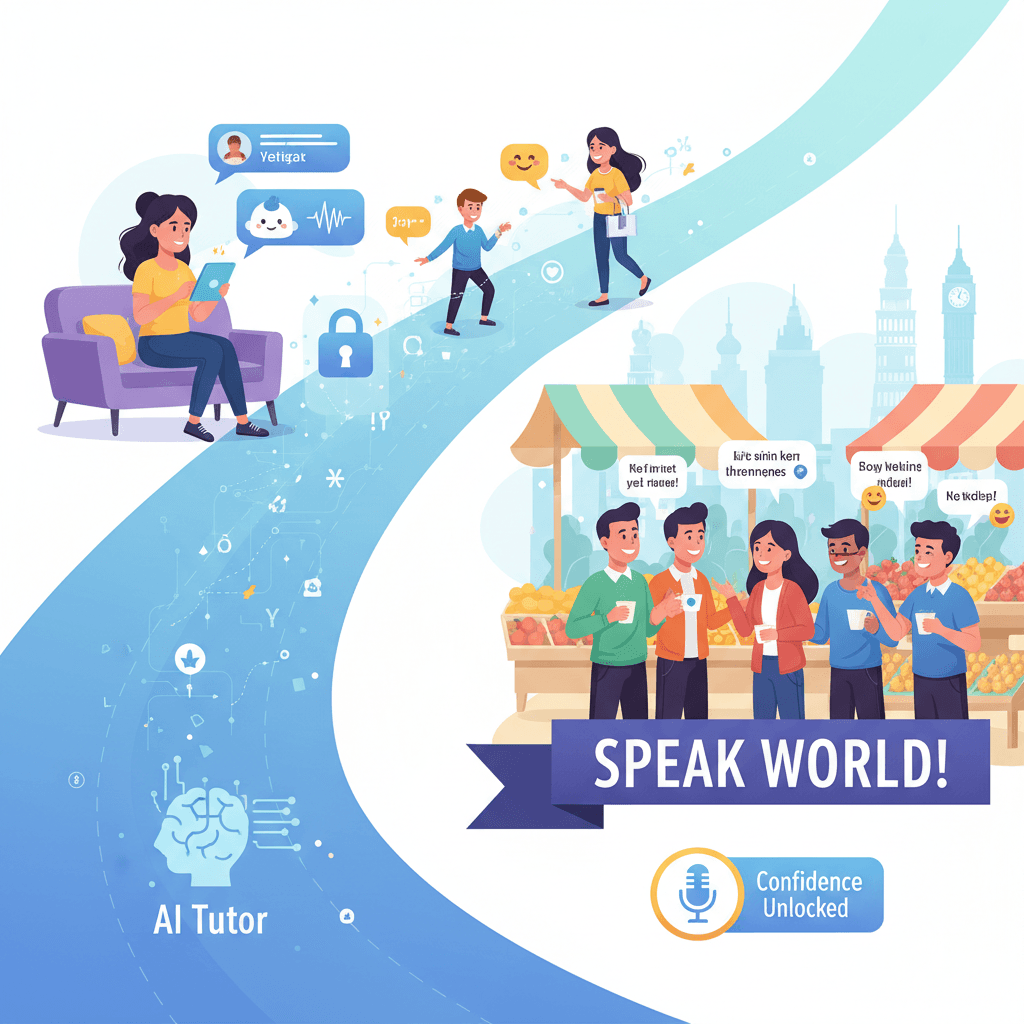
Does your heart race when you have to speak a new language in the real world? You’ve memorized the vocabulary and studied the grammar, but when it’s time to actually talk, your mind goes blank. If this sounds familiar, you’re not alone, and it’s certainly not your fault. For many learners, finding safe, effective real life conversation practice online feels like the biggest hurdle to fluency. The truth is, the gap between textbook exercises and the fast, messy reality of human conversation is wider than most courses admit. But what if you could build a bridge across that gap? What if you could train for any real-world scenario in a pressure-free zone, building unstoppable confidence before you even say “hello” to a native speaker? This guide will show you how.
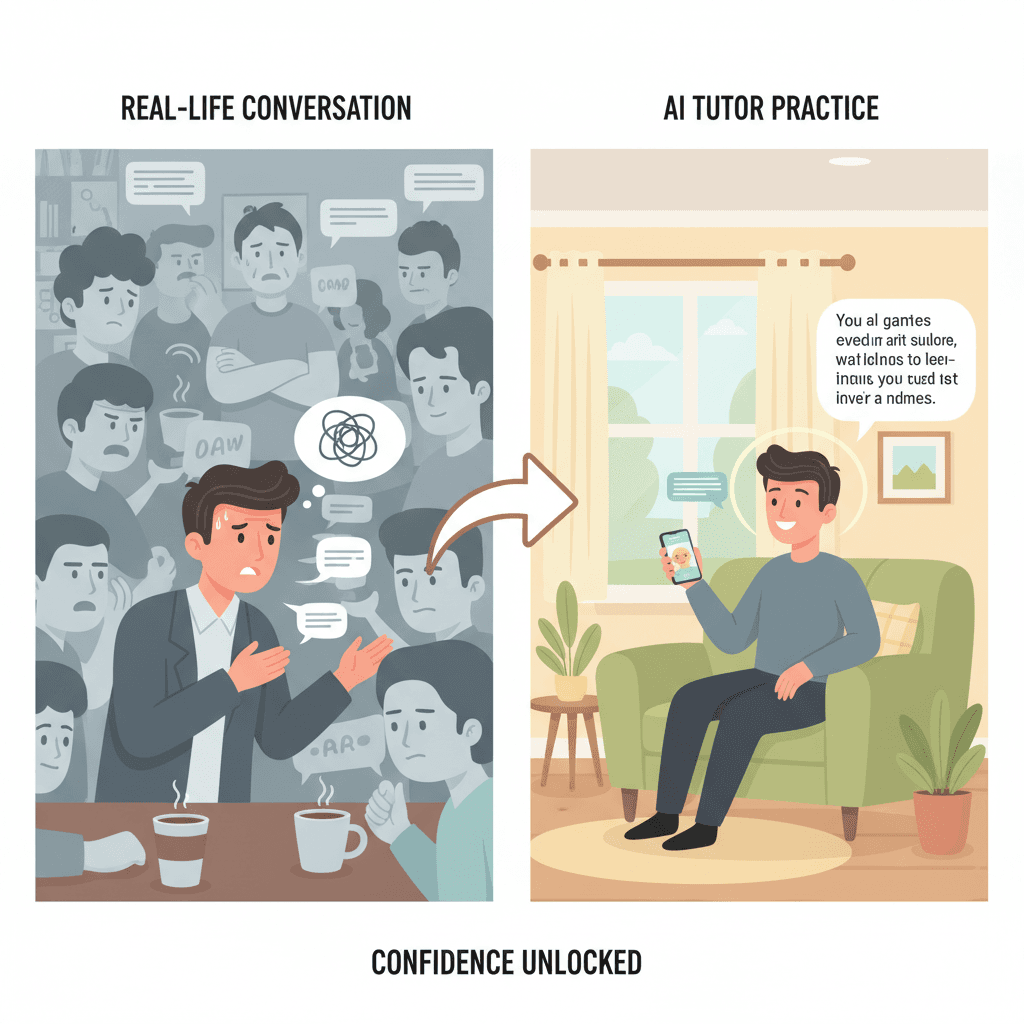
Why 'Real Life' Practice is So Hard (And It’s Not Your Fault)
The jump from structured lessons to spontaneous conversation can feel like jumping into the deep end of a pool. In a class, you have time to think. In real life, conversations are a rapid exchange of ideas, interruptions, slang, and non-verbal cues. Many learners find that their carefully constructed knowledge isn't enough to navigate these unpredictable waters, a sentiment echoed frequently in online communities like Reddit's r/languagelearning. This isn't a sign of failure; it's a sign that you're ready for the next stage of learning—one that requires a different kind of practice.
This feeling of being 'out of practice' is a recognized phenomenon called 'social deconditioning.' According to Psychology Today, it's a state where real-time human interaction feels difficult simply due to a lack of regular use, not a personal flaw. You don't lose your social skills; you just need to warm them up again.
The struggle is widespread. A recent study revealed that 63% of young adults admit to having difficulty with real-life interaction, despite being highly connected online. The complexity of genuine human dialogue is so profound that academics created REALTALK, a specialized 21-day corpus of authentic messages, just to establish a benchmark for how people actually talk. The problem isn't your ability; it's that traditional methods often fail to prepare you for the beautiful chaos of a real life english conversation.
The Power of a Safe Training Ground: Your AI Language Tutor
Imagine a conversation partner who is available 24/7, is infinitely patient, never judges you, and is 100% focused on helping you improve. This is the power of an AI language tutor. It provides a perfect, pressure-free environment for real life conversation practice online, allowing you to build skills and confidence at your own pace. You can stumble, make mistakes, and try again as many times as you need without the fear or embarrassment that can come with practicing with a human.
This isn't just about reciting phrases. Modern AI tutors are becoming incredibly sophisticated. To make the experience more authentic, developers are training their AI on massive datasets of human dialogue, like the REALTALK corpus, ensuring the conversations you have feel more natural and realistic. This shift from vocabulary drills to genuine speaking practice is why platforms like SpeaksyAI (speaksyai.com) are designed around interactive role-playing. They provide a safe space to simulate real-world interactions, helping you practice speaking confidently long before you face a high-stakes situation.
Major tech companies are also recognizing this need. Google, for instance, is rolling out AI-powered features for customized speaking and listening practice, a clear signal that the industry is moving towards more practical, communication-focused tools. Using an AI tutor is like having a dedicated sparring partner to prepare you for the main event.
A 4-Step Framework for Simulating Any Real-Life Scenario
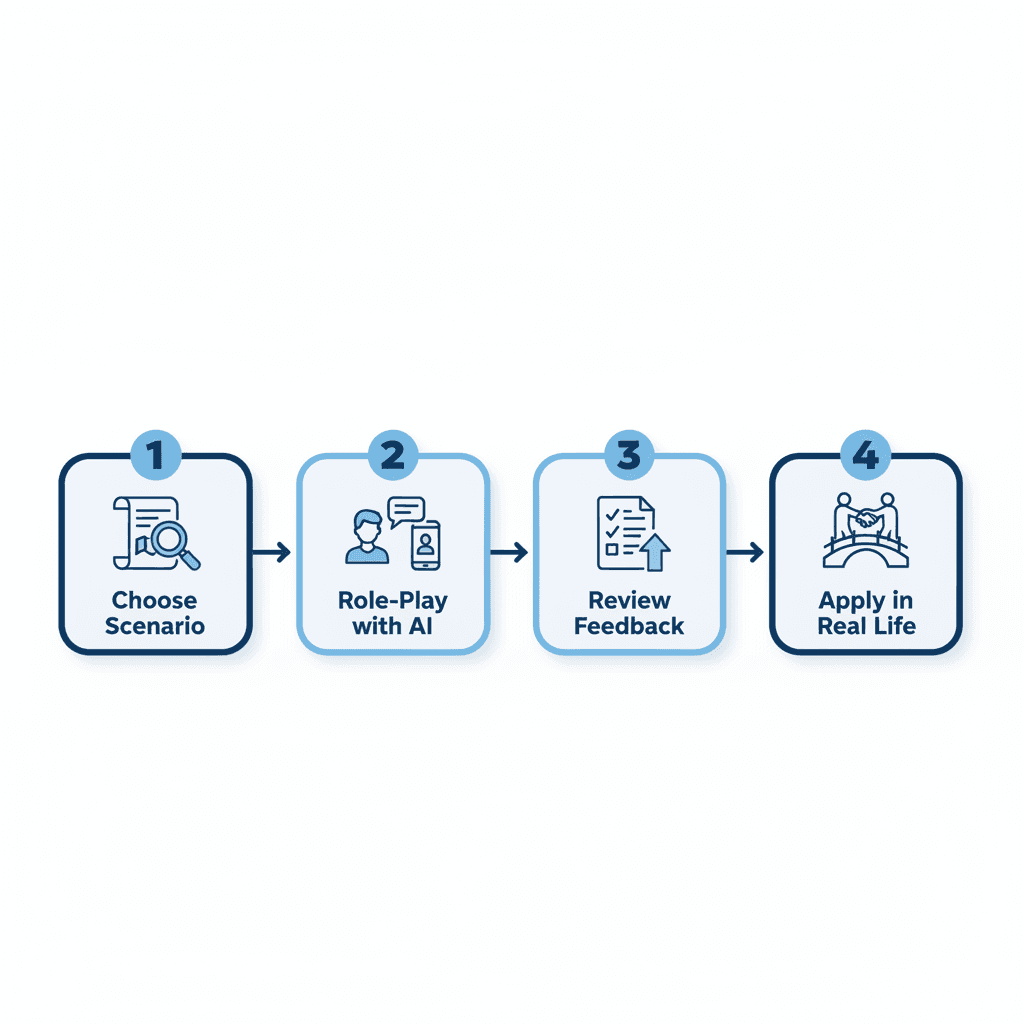
Okay, so where do you begin? The key to effective practice is structure. Instead of just having a random chat with an AI, you can follow a simple, repeatable framework to master specific situations. This turns your practice sessions from aimless chatter into targeted training. A 2024 paper published on ResearchGate outlines a process model for creating authentic digital conversation training, validating this structured approach. Let's walk through our four-step method for how to simulate conversations effectively.
- 1.Choose Your Scenario: Decide on a specific, real-world situation you want to master.
- 2.Role-Play with Your AI Tutor: Act out the scenario by giving your AI a clear role and objective.
- 3.Review and Refine: Use instant feedback on pronunciation and grammar to polish your performance.
- 4.Bridge to the Real World: Take the skills you've built and apply them in low-stakes, real-life interactions.
This isn't just theory. Web-based applications described in a 2024 arXiv paper are already using large language models to create interactive simulations for job interviews, providing feedback to support learning. By following this framework, you’re using a proven method to build practical, real-world fluency.
Step 1: Choose Your Scenario (Beginner to Advanced)
Don't try to boil the ocean. The first step is to pick one specific situation. This gives your practice session a clear goal and makes your progress measurable. Are you traveling to the UK soon? Practice buying a train ticket. Have a doctor's appointment in the US? Focus on describing symptoms. Start with what's most relevant or intimidating to you.
- •Beginner Scenarios: Ordering a coffee, buying a movie ticket, asking for directions, introducing yourself at a party.
- •Intermediate Scenarios: Making a doctor's appointment, returning an item to a store, asking a landlord about a maintenance issue, having a casual chat with a coworker.
- •Advanced Scenarios: Participating in a job interview, debating a topic with friends, negotiating a price, handling a customer complaint.
These conversation scenarios for language learners provide a ladder of difficulty, letting you build confidence step by step. A 2024 study found that even when virtual simulations aren't perfectly realistic, they are highly valuable for helping learners practice the topics and approaches for specific, challenging conversations. You are building a mental script that will serve you well when the real moment arrives.
Step 2: Role-Play with Your AI Tutor
Now it's time to act. This is where you bring your scenario to life. Don't just ask your AI tutor a question; give it a role and set the scene. This is the core of effective AI conversation practice. The goal is to create a dynamic exchange, not a simple Q&A. Be explicit with your instructions to get the most out of your session.
Why is the prompt so important? A 2024 analysis of millions of student interactions found that very few users consistently write high-quality prompts, which is key for unlocking effective AI tutoring. By being specific, you guide the AI to give you a more realistic and helpful experience. Try to go with the flow and respond to unexpected questions from the AI—this is fantastic practice for the unpredictability of real conversations.
Step 3: Review and Refine with Instant Feedback
Here’s where AI tutors truly shine: the instant feedback loop. After your role-play, you can review a transcript of the conversation. Many tools, including SpeaksyAI, also provide color-coded pronunciation feedback, showing you exactly which words or sounds you need to work on. You can listen to your own audio, compare it to the AI's, and identify areas for improvement.
Don't just do the scenario once. Run through it two or three times. On your second attempt, focus on correcting the grammar mistakes the AI pointed out. On the third, try to perfect your pronunciation on a key phrase. This repetition isn't boring; it's how you build muscle memory. With each pass, the words will feel more natural and flow more easily, embedding the language in your brain in a way that passive listening never could.
Step 4: Bridge to the Real World
Practice is only useful if it prepares you for reality. The final step is to take the confidence you've built in your safe AI environment and transfer it to the real world. The key is to start small. Don't jump from practicing a coffee order with an AI to negotiating a business deal. Your goal is to create a series of small, low-stakes wins to prove to yourself that you can do it.
- •The One-Phrase Mission: Go into a shop and use just one phrase you practiced. It could be as simple as, "Have a great day!"
- •The Question Quest: Ask for the price of an item, or ask a grocery store employee where to find something. The goal is a short, successful interaction.
- •The Compliment Challenge: Give a simple, genuine compliment to a barista or cashier. "I love the music in here!" is a great, low-pressure way to start a micro-conversation.
Each of these interactions is a mini-victory that rewires your brain to associate speaking with success, not fear. You're taking the script you perfected and performing the first line on a real stage. This is the crucial bridge from practice to performance.
How AI Is Getting More 'Real' Every Day
If you tried AI language tools a few years ago and felt they were robotic, it’s time to look again. The technology is evolving at an incredible pace, with a massive focus on making AI conversation feel less artificial and more authentic. This is great news for language learners in markets like the US, UK, Australia, India, and Canada who need to practice nuanced, regional-specific conversations.
A major reason for this improvement is the use of new, sophisticated datasets. To make AI more authentic, researchers are using massive, real-world datasets like REALTALK, a 21-day corpus of authentic messaging app dialogues, to benchmark AI conversation against genuine human interaction.
This trend is reflected in user behavior. An April 2023 study by the Pew Research Center shows that the public is increasingly interacting with conversational AI, making it a more common and 'real' experience. As big tech companies like Google and OpenAI continue to refine their models for 'smoother, more useful everyday conversations,' the tools you use for practice will only get better, closing the gap between simulation and reality.
From AI Practice to Real-World Confidence
Ultimately, the goal of AI conversation practice is to build the confidence you need to speak with actual people. The psychological benefit is just as important as the linguistic one. Using an AI tutor addresses the core barrier for so many learners: the fear of judgment. As academic literature from 2023 concludes, AI-driven tools can significantly reduce language anxiety and build speaking confidence, especially for learners who lack frequent opportunities for real-world practice.
This journey is about building momentum. You start in the completely safe environment of an AI role-play, where mistakes are just data points for improvement. Then, you move to low-stakes real-world interactions, like thanking a bus driver or ordering your lunch. Each successful interaction builds on the last, creating a positive feedback loop of confidence. Stanford-highlighted research from 2023 on AI agents that simulate human personalities shows a future where you can even practice navigating different social styles in a controlled environment before facing them in the wild.
Think of AI practice as your personal rehearsal studio. It's where you learn your lines, perfect your delivery, and get comfortable on stage. By the time the curtain rises on a real-life conversation, you'll be ready to perform with confidence and ease. It’s a tool not to replace human connection, but to make you feel more ready and excited to embrace it.
FAQ: Your Questions on Online Conversation Practice
Frequently Asked Questions
Ready to Practice for Real Life, Without the Pressure?
SpeaksyAI is your personal AI language tutor, ready 24/7 to practice any real-life scenario you want. Get instant pronunciation feedback and speak confidently.
Join the Waitlist