Mind Blank? How to Practice Speaking When You Have Nothing to Say
Ever sit down to practice speaking and your mind just... goes blank? It's a common feeling. This guide gives you a simple, powerful system for what to do when you have nothing to say.


It's a frustrating feeling: you set aside time for speaking practice, open your mouth, and... nothing. Your mind feels like a blank slate. If you’ve ever struggled with how to practice speaking when you have nothing to say, you’re in the right place, and you are not alone. This mental block isn't a sign that you're uninteresting or that your brain is empty. It's a common, temporary hurdle caused by pressure and anxiety. The fantastic news is that there’s a simple, repeatable system you can use to generate endless speaking material, even when you feel completely uninspired. Let's get you talking.
First, Know This: Your Mind Isn't 'Empty,' It's Overwhelmed
That deer-in-the-headlights feeling when you try to speak a new language is often a 'freeze' response. Your brain isn't empty; it's just experiencing a momentary traffic jam. This happens for a few key reasons: performance anxiety, the pressure to be 'perfect,' and cognitive overload. You're trying to retrieve vocabulary, construct grammatically correct sentences, nail the pronunciation, and come up with something engaging to say all at once. It’s no wonder your mind goes blank in conversation sometimes!
Think of it less as a lack of ideas and more as a temporary access issue. The content is all there, but anxiety has locked the door. The first step to finding your voice is to give yourself permission to lower the stakes. You don't need to deliver a groundbreaking speech. You just need to say one word, and then another. Every word you speak is a small victory, and we're going to celebrate those wins.
The 'Zero to Sixty' Framework: From One Word to a Monologue
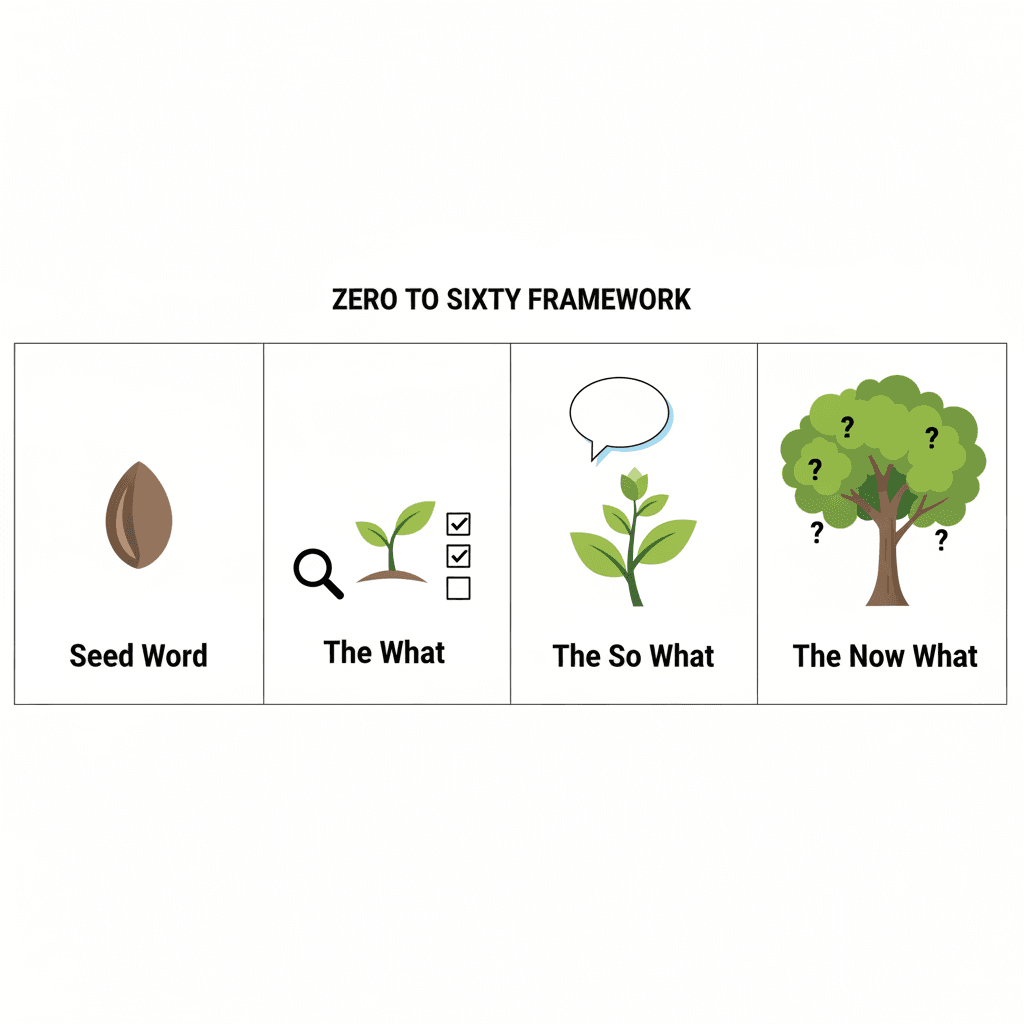
When your mind is blank, you need a system, not just motivation. Here is a simple, powerful framework called 'Zero to Sixty' that you can use anywhere, anytime. It helps you take a single, simple 'seed'—like an object in your room—and grow it into a short monologue. This is the core of effective solo speaking practice because it trains your brain to find words and form thoughts in your target language on demand.
Step 1: Pick a 'Seed' Word
Look around you right now. Pick one object. A lamp, a pen, a window, a sock. Don't overthink it. The more mundane, the better. This single noun is your 'seed.' Say the word out loud in your target language. Congratulations! You've just started. That's a genuine step forward.
Step 2: Describe the Facts (The 'What')
Now, describe the object as if you were explaining it to someone who can't see it. What is its color, size, shape, and material? Is it old or new? What is its function? Stick to simple, observable facts. For a pen, you might say: "This is a pen. It is blue. It is made of plastic and metal. It is long and thin. I use it to write."
Step 3: Add Your Story (The 'So What')
Next, connect the object to your own life. This is where you add opinions, memories, and feelings. Where did you get this pen? Is it your favorite? Did someone give it to you? Do you like the way it writes? You could continue: "I bought this pen last week at a store near my home. It is my favorite pen because the ink flows very smoothly. It reminds me of my university days when I took many notes."
Step 4: Ask 'What If?' (The 'Now What')
Finally, use your imagination. This pushes you beyond simple description into more complex and creative language. What if this pen could talk? What stories would it tell? What will happen to this pen in the future? Who made it, and what was their day like? "What if this pen could travel? Maybe it would go to another country, like Canada or Australia, and write a famous novel. I will probably lose this pen next month, but for now, it helps me practice my speaking."
In just four steps, you went from a single word to a short story. This repeatable process is your secret weapon for solo speaking practice. You can do it with any object, anywhere.
Start with Your Surroundings: How to Narrate Your World
The beauty of the 'Zero to Sixty' framework is that your practice material is literally all around you. This technique, often called 'self-talk language learning,' is one of the most effective ways to build fluency on your own. Instead of waiting for a conversation partner, you turn your own life into the conversation.
Let's take another example: a simple coffee mug. Start your monologue.
- •The 'What': "This is my coffee mug. It's white and ceramic. It can hold about 300ml of liquid. It has a small chip on the rim."
- •The 'So What': "My friend gave this to me for my birthday two years ago. It’s my favorite mug because it’s the perfect size. I use it every single morning for my first cup of coffee. Seeing it makes me happy and reminds me of my friend."
- •The 'Now What': "I wonder who designed this mug. Maybe they were also drinking coffee when they had the idea. If I broke it, I would be very sad. I should be more careful with it. Maybe I'll buy a similar one for my friend in the UK as a gift."
By actively narrating your world, you're not just practicing words; you're training your brain to think in the new language. You move from translating in your head to producing thoughts more spontaneously. This kind of self-talk language learning is incredibly powerful.
The simple act of describing your surroundings gets you used to the sound of your own voice producing the new language, building both confidence and automaticity.
Turn Media into Your Personal Prompt Generator
What about when you're tired of talking about your own furniture? You can turn the media you already consume into an endless source of conversation practice prompts. Instead of passively watching or reading, you become an active participant.
This approach grounds your practice in real-world, relevant content, making it feel less like a chore and more like a fun analysis. Try these ideas:
- •Summarize a News Headline: Read a headline from a source like the BBC or The New York Times. Give yourself 60 seconds to summarize the story out loud and then add your opinion.
- •Describe a Movie Scene: Pause a movie or TV show. Describe what the characters are wearing, the setting, and their body language. Predict what you think will happen next and why.
- •React to a Social Media Post: Find a photo or a short video on Instagram or TikTok. Describe what you see and voice your reaction to it. Do you find it funny, interesting, or strange?
- •Shadow a Podcast Clip: Listen to 30 seconds of a podcast. Pause it, and try to repeat what the speaker said, mimicking their intonation and rhythm. Then, explain their main point in your own words.
Your AI Tutor: The Perfect No-Pressure Brainstorming Partner
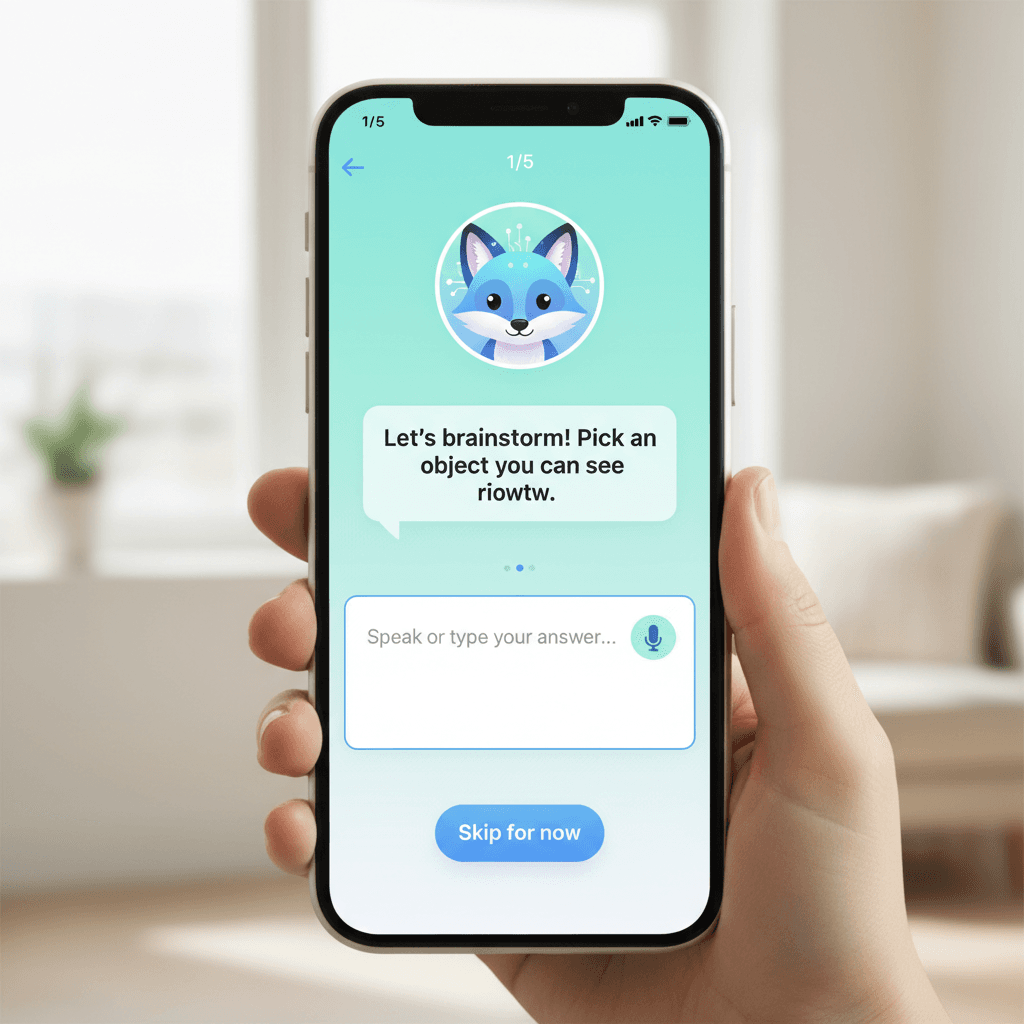
Even with these techniques, there will be days when you feel completely out of ideas. This is where an AI-powered tutor becomes an invaluable tool. It acts as your personal, on-demand brainstorming partner, removing the pressure of coming up with topics yourself.
Instead of staring at the wall, you can get an instant prompt. With the AI conversation partner from SpeaksyAI, you can simply say, "Give me a random object to describe," or "Give me a 'what if' scenario." The AI can generate millions of unique situations, questions, and ideas tailored to your level, ensuring you never run out of things to say.
This creates a judgment-free zone for speaking practice. You can talk about 'boring' topics, make mistakes, and build the crucial muscle memory for speaking without any of the social anxiety that might come with a human partner. It's the perfect environment for those days when your mind feels blank but your motivation to learn is still strong.
What About 'Boring' Topics? (A Surprising Advantage)
A common fear for language learners is, "What if I'm boring?" We put so much pressure on ourselves to have fascinating stories and witty opinions. But what if 'boring' was actually your secret weapon? Research has shown that conversations about seemingly mundane topics are often far more enjoyable than people anticipate.
A 2022 study published in the Journal of Personality and Social Psychology and highlighted in TIME Magazine found that people consistently underestimated how positive and connecting it would feel to have a substantive conversation with a stranger about an everyday topic. This is fantastic news for you!
Practicing with everyday objects and simple daily routines isn't just a last resort—it's a strategic advantage. When you master the art of describing a water bottle or narrating the act of making toast, you are building an incredible foundation of descriptive vocabulary and sentence structures. This is the heavy lifting of language learning. You're building fluency and automaticity, so when a more 'interesting' topic does come up, you'll have the linguistic tools ready to express yourself with confidence.
Every 'boring' sentence you practice is a building block for future, fascinating conversations. Celebrate the progress you make on the simple stuff—it matters more than you think.
From Solo Practice to Low-Stakes Conversation
All this solo speaking practice is designed to prepare you for the real world. But how do you make that leap? The key is to start small with low-stakes interactions. Your goal isn't to have a deep, philosophical debate; it's simply to use the language in a real context and see that you can do it.
Here’s a step-by-step path to apply your skills:
- 1.The Detailed Order: The next time you order coffee or food, don't just point or use the single menu item word. Use a full sentence and add a detail. "I would like a large black coffee, please. And could I also have one of those croissants?"
- 2.The Specific Compliment: Instead of a generic "I like your store," try to use the descriptive skills you've practiced. "This is a lovely shop! I especially like the blue vase in the window. The color is beautiful."
- 3.The Open-Ended Question: When a cashier or service person asks, "How are you?" answer honestly and then ask an open-ended question back. "I'm doing well, thank you. The weather is beautiful today. How has your day been so far?"
These tiny interactions are massive wins. They prove to your brain that you can communicate. As learners on forums like Reddit often discuss, these solo practice techniques are the bridge to building confidence for real-world interactions, especially when finding a consistent speaking partner is a challenge.
Frequently Asked Questions
Frequently Asked Questions
Never Run Out of Things to Say Again
SpeaksyAI is your personal AI language tutor that can generate infinite scenarios and questions, helping you speak confidently on any topic.
Join the Waitlist