How to Practice Speaking a Language as an Introvert (A System)
Practicing a new language can feel draining for an introvert. This guide reframes the challenge as energy management and gives you a step-by-step system to speak confidently.

Let’s be honest: hearing “you just need to practice speaking more” feels frustrating, doesn’t it? For many, this advice misses the point entirely. If you're an introvert, the challenge isn't a lack of desire to learn; it’s figuring out how to practice speaking a language as an introvert without feeling completely drained. The secret isn't forcing more uncomfortable conversations, but finding smarter, more energy-efficient ways to build your confidence and fluency.
Why "Just Practice More" Is Bad Advice for Introverts
First, let's clear up a common misconception: introversion is not the same as shyness. Shyness is a form of social anxiety, while introversion is about energy management. As an introvert, your social battery has a limited capacity, and certain activities—like small talk with strangers—can deplete it rapidly. Traditional language practice, which often involves group classes or spontaneous conversations with native speakers, can feel like running a social marathon you didn't train for.

This isn't just a feeling; it's backed by research. A study on language learners found that introverted students naturally favor memory, cognitive, and metacognitive strategies (like analysis and planning) but tend to avoid the very social and emotional strategies that most speaking advice relies on. Forcing yourself into these high-drain situations often backfires, increasing shyness and reducing self-confidence—two of the most common hurdles for introverted learners, according to studies published on ResearchGate.
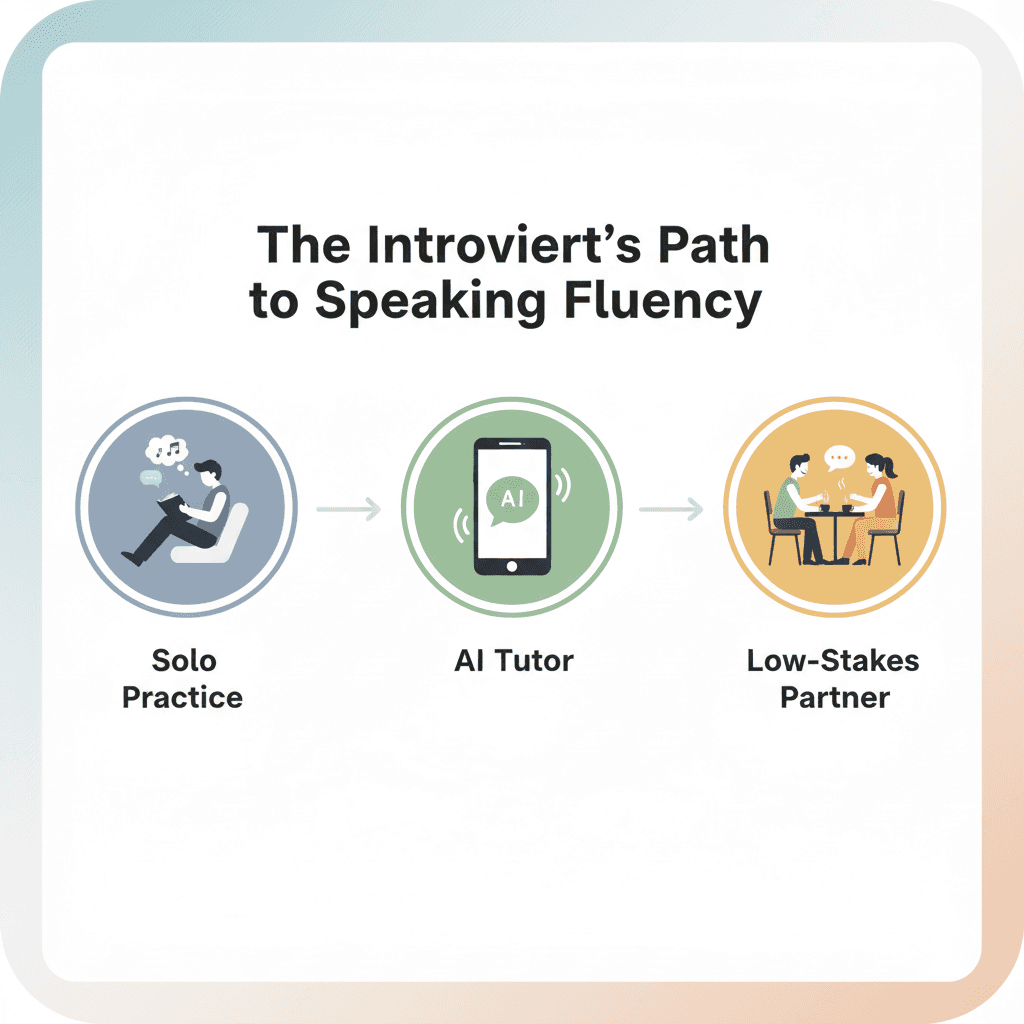
The challenge isn't a lack of desire; it's about managing your social energy budget.
Instead of fighting your natural tendencies, you can lean into them. The key is to reframe your approach from one of endurance to one of efficiency. It's about finding methods for solo speaking practice and low-stakes interaction that build your skills without burning you out. This way, when you do have real conversations, you'll feel prepared and confident, not exhausted.
Your Introvert Superpowers for Language Learning
What if your introverted traits weren't obstacles, but superpowers in disguise? By understanding your strengths, you can create a learning system that feels natural and effective. This is a core part of successful introvert language learning.
- •Deep Processing: You naturally think before you speak. Use this to your advantage by diving deep into grammar rules and sentence structures. While others rush to speak, you can build a more accurate foundation, which pays off in sounding more natural later on.
- •Keen Observation: Introverts are often excellent listeners and observers. You can absorb vocabulary, accents, and cultural nuances from movies and podcasts more effectively than many. You're not just passively listening; you're analyzing.
- •A Love for Solitude: Your comfort with being alone is your greatest asset. It allows you to spend hours with input-based learning (reading and listening) and solo practice without feeling bored or restless. This is where the real groundwork for fluency is laid.
Research supports this approach. One study identified that effective strategies for introverted learners include self-practice and listening to songs—activities that leverage your ability to focus deeply and learn independently. By dedicating time to intensive listening, you train your ear to the sounds and rhythms of the language, making pronunciation much easier when you do start speaking.
The Foundation: Low-Energy Solo Practice Techniques
Before you ever speak to another person, you can build a powerful foundation of speaking skills on your own. These energy-efficient methods let you practice without an audience, removing the fear of judgment and allowing you to focus purely on the mechanics of speaking.
- •Read Aloud: Grab a book, article, or podcast transcript in your target language and simply read it out loud for 5-10 minutes a day. This is a physical workout for your mouth, training your muscles to produce unfamiliar sounds and cadences.
- •Shadowing: This technique involves listening to a native speaker through headphones and repeating what they say in real-time, just a split-second behind them. As Pimsleur notes, it's incredibly effective for matching native-like intonation and rhythm.
- •Keep a Voice Journal: Once a day, record yourself speaking for 1-2 minutes. You can describe your day, talk about your opinions, or read a script. The goal isn't perfection; it's to get comfortable with the sound of your own voice in another language.
- •Narrate Your Life: As you go about your day, try to describe what you're doing in the target language, either out loud or as an internal monologue. "I am making coffee now. The coffee is hot. I need to add milk." This connects the language to your real life.
This kind of practice speaking without people is not just a warm-up; it's a legitimate and powerful learning strategy. It builds muscle memory, automates vocabulary retrieval, and gives you a safe space to make mistakes and correct them on your own terms.
The Bridge: Use an AI Tutor as Your Practice Partner
Once you're comfortable speaking on your own, the next step isn't necessarily a human. The rise of AI language practice has created the perfect bridge: an AI conversation partner. It offers a way to have realistic, interactive conversations without any of the social pressure or energy drain.
Think of it as a social simulator. An AI tutor has infinite patience, is available 24/7, and will never judge you for fumbling a word or asking it to repeat something ten times. This is invaluable for language learning for introverts, as it allows you to test your skills in a private, controlled environment. Advanced platforms like SpeaksyAI even offer instant pronunciation feedback and guided conversation modes that feel like you’re talking to a real person, but without the anxiety.
And this isn't just a gimmick—it's incredibly effective. A study from Google's LearnLM initiative found that a generative AI tutor was as effective as a human one for helping students learn. Practicing with these tools builds a crucial layer of confidence, making the eventual leap to human conversation feel like a small step rather than a giant leap.
A Step-by-Step Plan to Go from AI to Human Conversations
Transitioning from solo practice to real-life conversations can feel daunting. The key is to do it gradually, increasing the social stakes in small, manageable increments. This step-by-step plan is designed to keep you in control of your social energy budget.
- 1.Level 1: Master the AI Tutor. Make it a daily habit. Practice ordering coffee, asking for directions, or discussing a hobby. The goal is to make conversation feel automatic and low-effort in this zero-stakes environment.
- 2.Level 2: Start with Text-Based Chat. Join a language exchange app or an online community (like a Discord server for learners) and start chatting via text. This lets you think through your responses and use translation tools if you get stuck, all without the pressure of a live response.
- 3.Level 3: Exchange Voice Notes. Find a language partner who is open to exchanging short voice messages. This is the perfect middle ground between texting and live calls. You get to practice speaking and listening, but on your own time.
- 4.Level 4: Schedule Short, Structured Calls. Your first live conversations don't have to be long or spontaneous. Schedule a 10-15 minute call with a language partner or tutor. Agree on a topic beforehand so you can prepare some vocabulary and ideas. Check out our guide on finding the right language partner to get started.
Each level builds on the last, ensuring you never feel thrown into the deep end. You're slowly turning up the social volume, giving yourself time to adapt and build resilience.
How to Manage Your Social Energy in Real Conversations
Even with all this preparation, real-time conversations will use up some of your social battery. The goal is not to eliminate this energy cost, but to manage it effectively so you can have positive, rewarding interactions. This is where active speaking practice energy management comes in.
- •Set a Time Limit: Before the conversation starts, decide how long it will last. Politely say, "I've got about 15 minutes before I have to run, but I'd love to chat until then!" This gives you a clear end point and prevents the conversation from dragging on.
- •Prepare a Few Topics: Have 2-3 questions or short stories ready. This helps you avoid awkward silences and steer the conversation toward things you're comfortable discussing.
- •Use Your Listening Superpower: Ask open-ended questions and let your partner do more of the talking. This not only makes you a great conversation partner but also gives you time to think, process, and conserve energy.
- •Have a Graceful Exit Line: Know how you'll end the conversation. A simple "It was so great talking to you! I have to get going, but let's do this again soon," works perfectly.
- •Schedule Downtime: This is non-negotiable. After a conversation, plan for some quiet time alone to recharge. Read a book, listen to music, or just sit in silence. This allows your brain to recover and process the interaction.
Find the Perfect Low-Stakes Conversation Partner
When you're ready for one-on-one human practice, finding the right person is crucial. A patient, understanding tutor can create a safe space for you to grow. Platforms like Preply or italki are great for finding tutors, but you need to know what to look for.
When browsing tutor profiles, search for keywords that align with an introvert's needs, such as "patient," "speaking confidence," "customized lessons," or "relaxed environment." Many tutors specialize in helping anxious or quiet learners. Don't be afraid to be selective; the right fit will make all the difference. For more ideas, you can check out our guide to comparing AI tools and human tutors.
Frequently Asked Questions
Frequently Asked Questions
Practice Speaking Without the Social Drain
SpeaksyAI is the AI language tutor that lets you practice speaking anytime, with zero judgment and zero social energy cost. Get pronunciation feedback and build confidence at your own pace.
Join the Waitlist