Learning a Language Without Your Partner? Here's How to Thrive
Learning a new language is a personal journey, but it can feel lonely when your partner isn't on it with you. Here’s how to find balance and get the support you need.

Learning a new language is an exciting journey, but figuring out how to practice a language when your partner doesn't speak it can feel complicated and even a little lonely. You're motivated, you're putting in the hours, but you can't share your progress in the most natural way—by speaking. The great news is that you can absolutely make incredible progress and maintain harmony at home. The key is to blend dedicated solo language practice with clear, supportive communication with your partner, turning a potential point of friction into a new way to connect.
This guide is designed to help you navigate this common challenge. We'll validate those tricky feelings, give you a script for having a positive conversation with your partner, and provide a full toolkit for effective speaking practice at home that won't disrupt your relationship. You can do this, and your language goals are worth pursuing.
First, It's Okay to Feel Guilty (or Lonely)
Let's start by acknowledging the elephant in the room: it can feel strange. You might feel a pang of guilt for putting on headphones to do a lesson while your partner is sitting right there. You might feel a little lonely when you have a breakthrough and the one person you want to share it with can't understand. You might even feel frustrated when you wish you could just watch a movie in your target language together without subtitles.

These feelings are completely normal. In fact, research on relationships with language barriers often highlights the emotional complexities that arise. When one partner is more fluent, feelings of imbalance or dependency can surface. You're not alone in navigating this; you're part of a massive global community of learners, many of whom are figuring out how to fit their passion into their daily lives and relationships. Validating your own experience is the first step toward finding a sustainable solution.
How to Talk to Your Partner About Your Language Goals
The most powerful step you can take is to have an open, positive conversation with your partner. Often, any tension comes from unspoken assumptions. Your partner might worry you're creating a secret world they're not part of, or they might simply not know how to help. A proactive chat can replace those worries with a clear, shared understanding. It's not about asking for permission; it's about inviting them to be a part of your support system.
According to relationship experts at Michigan State University, creating a shared plan helps the learner feel supported and makes the partner feel included, even if they aren't learning. This conversation is your chance to build that plan together.
Frame It as Your Personal Goal
Start by sharing your ‘why.’ When your partner understands the deep-seated motivation behind your learning, it transforms from a potentially isolating hobby into an inspiring personal quest they can cheer you on. It stops being 'something that takes you away from us' and becomes 'something that is helping you grow.' I remember trying to learn Italian while my husband watched sports. I felt guilty until I finally sat down and explained, 'When I speak a little Italian with my grandmother on the phone, her whole face lights up. This isn't just a hobby; it's about connecting with her before it's too late.' That conversation changed everything.
- •For career growth: 'I'm learning this language because it could open up new job opportunities for us in the future.'
- •For family connection: 'It's really important for me to be able to speak with my relatives in their native language.'
- •For travel: 'I'm so excited for our future trip to [Country], and I want to be able to order us dinner and ask for directions.'
- •For brain health: 'I'm doing this as a personal challenge to keep my mind sharp, like a workout for my brain.'
Ask for Specific, Low-Effort Support
The word 'support' can feel vague and intimidating. Your partner might think it means they have to start learning, too! Make it easy for them to say 'yes' by asking for small, concrete, and low-effort things. This gives them a clear role as your cheerleader, not your teacher.
- 1.The 5-Minute Quizzer: 'Would you mind quizzing me with these 10 flashcards while the kettle boils? It would be a huge help.'
- 2.The Milestone Celebrator: 'I'm about to finish chapter 4 in my book. When I do, will you give me a high-five and do a happy dance with me?'
- 3.The Media Buddy: 'There's a comedy show from [Country] that looks hilarious. Could we watch one episode a week together with English subtitles?'
- 4.The Encourager: 'Sometimes I'm going to get frustrated. If you see me struggling, could you just remind me how far I've come?'
Creative Ways to Involve Your Partner (Without Pressure)
Beyond direct support, you can turn your language learning into a fun, shared cultural experience. This approach enriches your relationship by introducing new activities, foods, and media you can enjoy together. It's about inviting them into the world of the language, not forcing the language itself upon them.
- •Cook a meal together: Find a recipe from a country that speaks your target language. You can read the recipe in the original language while your partner helps with the cooking.
- •Listen to music: Create a playlist of music in your target language. You can listen to it during dinner or on a road trip. You don't need to understand every word to enjoy the rhythm and melody together.
- •Label your home: Get some sticky notes and label 10-15 items in your house (e.g., 'la puerta,' 'la fenêtre'). It becomes a fun, ambient learning tool that can lead to inside jokes.
- •Plan a 'theme night': Once a month, have a 'French Night' or 'Japanese Night' with food and a movie from that culture. It turns practice into a special occasion.
As language learners on platforms like Reddit often share, the goal is to make the language a positive presence in your home, not a source of division. These shared activities build positive associations for both of you.
Your Discreet, At-Home Speaking Practice Toolkit
Ultimately, the bulk of your speaking practice will happen solo. This is where you can make the most progress without disrupting your partner's life. Having a robust toolkit for solo language practice is essential for success. These methods are designed for you to do on your own, whether your partner is in the other room, wearing headphones, or out of the house.
Talk to an AI Language Tutor
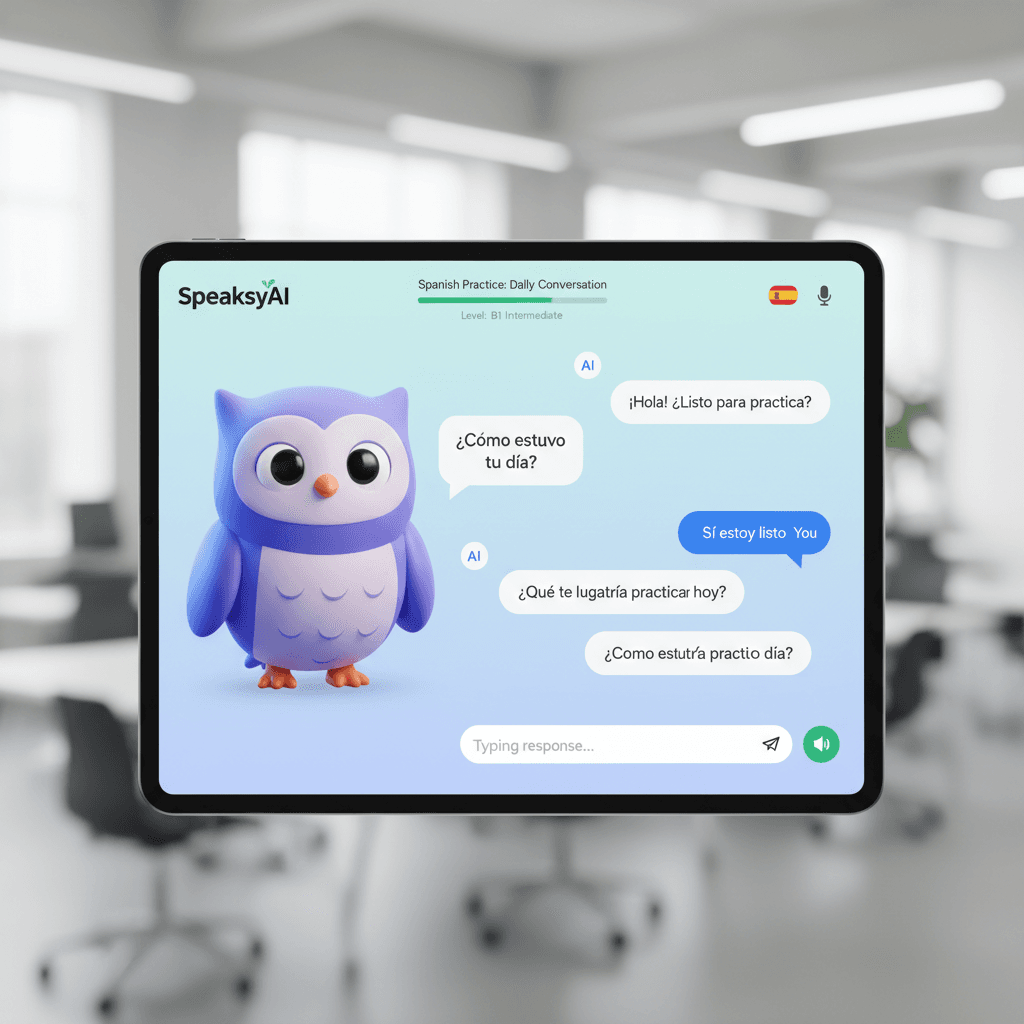
This is where technology becomes your best friend. In the past, getting speaking practice meant finding a human partner. Today, AI language tutors provide a private, non-judgmental space to practice speaking 24/7. This is the perfect solution for your situation. You can have a full, immersive conversation with an AI while sitting on the couch with headphones, feeling zero guilt about interrupting your partner.
Tools like the SpeaksyAI language tutor are designed for this exact purpose. You can talk about any topic you want, whenever you want. Crucially, you get instant, private feedback on your pronunciation and grammar, allowing you to make rapid improvements without the anxiety of being judged by a person. It's the most effective way to get high-volume speaking practice at home.
Narrate Your Daily Routine (Quietly)
This technique is simple, free, and incredibly powerful. As you go about your day, describe what you are doing, seeing, and thinking in your target language. You can do this out loud when you're alone or silently in your head if your partner is nearby.
As language experts at Pimsleur recommend, this trains your brain to think in the target language rather than constantly translating. Instead of thinking 'I am making coffee,' you practice thinking 'Preparo il caffè.' It connects the language directly to real-world objects and actions, helping you move from passive vocabulary (words you recognize) to active vocabulary (words you can use).
- •While cooking: 'Now I am chopping the onion. I need to find a bigger pan.'
- •While cleaning: 'I am putting the books on the shelf. This room is messy.'
- •While getting ready: 'Which shirt should I wear? I think I will wear the blue one.'
What is 'Crosstalk' and Should You Try It?
You may have heard about a trending technique called 'Crosstalk.' The concept is simple: you and your partner have a conversation where you each speak your own native language. You speak Spanish, they speak English. You rely on context, gestures, and drawings to understand each other.
This method, rooted in the 'Automatic Language Growth' approach, is designed to build comprehension skills in a low-pressure environment. It can be a fun experiment to see how much you can understand without the stress of having to produce perfect sentences. It's excellent for training your ear to the sounds and flow of the language.
The goal of Crosstalk is not perfect translation, but successful communication. Can you and your partner figure out what to have for dinner, with each of you speaking a different language? It's a fun, practical test of comprehension.
However, Crosstalk requires significant buy-in and patience from the non-learning partner. It's best to position it as a fun, optional game you can try for 15 minutes, not a mandatory new way of communicating. If it works, great! If not, there are plenty of other solo methods to fall back on.
How to Stay Motivated When Your Home Isn't an Immersion Zone
It's a well-known phenomenon in language learning: after a period of exciting initial progress, many learners hit a plateau. This 'wall of frustration' is where motivation can dip, and it's even harder when your home environment doesn't provide constant reinforcement. The key to pushing through is to build your own ecosystem of motivation.
- •Revisit Your 'Why': Write down your core motivation on a sticky note and put it on your bathroom mirror or computer monitor. Seeing it every day reinforces its importance.
- •Track Your Progress: Keep a journal where you write a few sentences each week. After two months, look back at your first entry. You'll be amazed at how far you've come.
- •Use Visuals: As some creative language bloggers suggest, get a jar and add a coin, marble, or even a dried chickpea for every 30 minutes of practice. This visual representation of your effort is incredibly satisfying.
- •Find a Community: Join an online forum, a Discord server, or a weekly virtual meetup for learners of your target language. Sharing struggles and wins with peers is a powerful motivator.
Remember, consistency beats intensity. A focused 20-minute session every day is more effective than a heroic but exhausting 3-hour cram session once a week. Celebrate your consistency, and you'll overcome any plateau.
FAQ: Practicing a Language With a Non-Speaking Partner
Frequently Asked Questions
Ready for Guilt-Free Speaking Practice?
Get a private, non-judgmental AI language tutor you can practice with 24/7, without disturbing your partner. Speak confidently on your own terms.
Join the Waitlist