The Post-Pimsleur Plan: How to Start Speaking Confidently
You've finished your Pimsleur course—congratulations! Now you have a great accent, but maybe feel stuck. Here’s how to activate what you've learned.
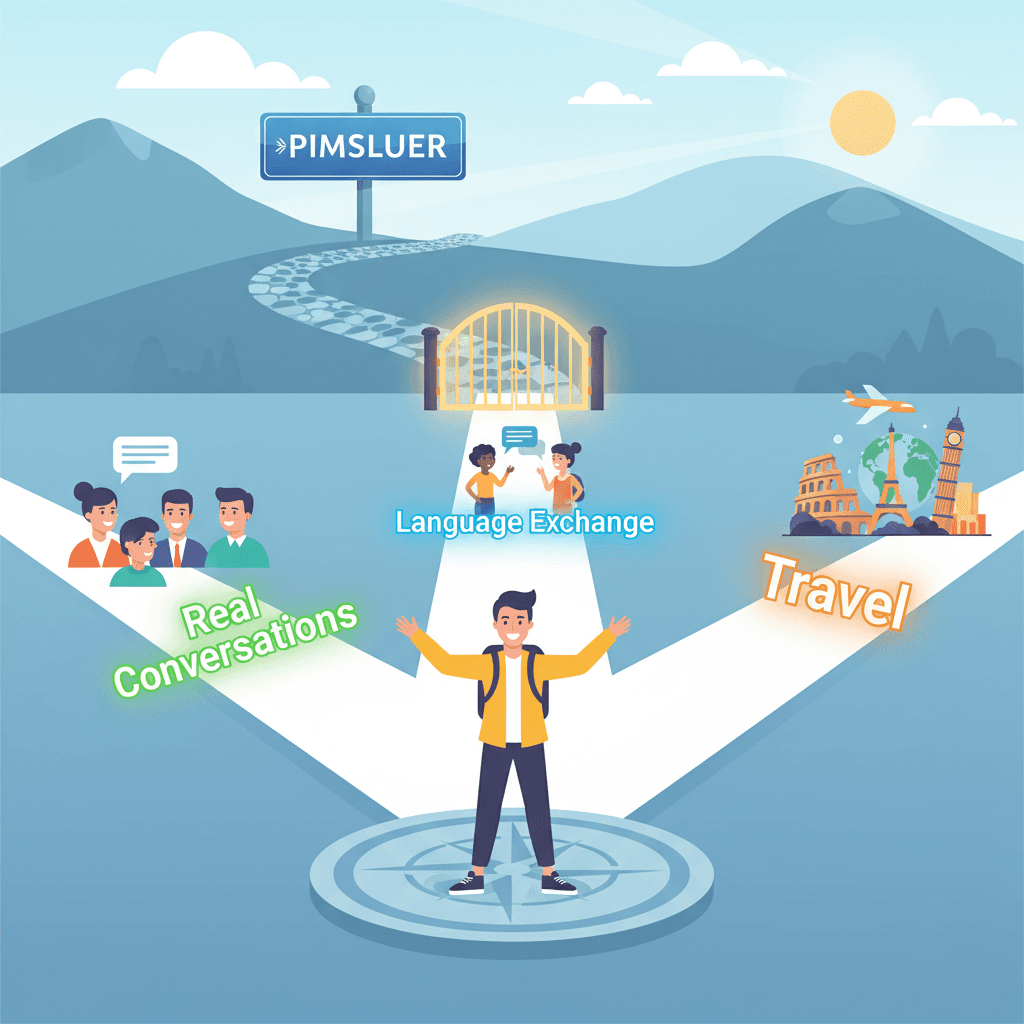
Finished Pimsleur and wondering how to start speaking after pimsleur with real confidence? You're in the right place. The short answer is: you need a simple 'Activation System' to turn the passive vocabulary you've learned into active, flexible speaking skills. Pimsleur has given you an incredible foundation in pronunciation, rhythm, and core phrases. You likely sound more natural than many other learners. Now, it's time to build on that foundation and unlock the spontaneous conversationalist inside you.
You Have a Great Foundation. What's Next?
First, let’s celebrate the win. Completing a Pimsleur course is a huge achievement! You’ve dedicated hours to listening, repeating, and absorbing the sounds of a new language. The Pimsleur method, built on 30-minute daily audio lessons and spaced repetition, is exceptionally good at what it does. According to an analysis by Lingtuitive, it's highly effective for building a strong foundational pronunciation and a base of useful, practical vocabulary. You’ve essentially tuned your ear to the language.
But you've probably noticed the paradox of the Pimsleur graduate: you can nail the accent on a prompted phrase, but you freeze when someone asks you an unexpected question. Many learners report this exact feeling; you have the ingredients, but not the recipe to cook up your own sentences. This is completely normal. Pimsleur is designed as a launchpad, not the final destination. As recent industry discourse from Upstream Research highlights, the focus is shifting from 'studying harder' to 'doing more'—moving from structured lessons to active, real-world application. This is your next adventure.
Even Pimsleur recognizes this need. The recent integration of features like Voice Coach scores and beta AI Conversation Coaches shows a clear response to user demand for more interactive practice. Your feeling isn't a sign of failure; it's a sign you're ready for the next stage of your journey toward Pimsleur fluency.
Step 1: Self-Assess Your Level (Where Are You *Really*?)
Before you can decide on your Pimsleur next steps, you need an honest snapshot of your current abilities. Pimsleur's audio lessons act as a continuous self-assessment—if you can’t respond to a prompt, you repeat the lesson. But this doesn't capture your ability to create new sentences. A case study on RiuNet found that while the method produces 'highly intelligible' speech for target phrases, it has limitations in spontaneous sentence creation. So, where do you stand?
- •Can you introduce yourself and others? (This is a core A1 skill that Pimsleur teaches well.)
- •Can you ask and answer basic personal questions about where you live, people you know, and things you have? (Another A1 checkpoint.)
- •Can you describe in simple terms your background, immediate environment, and needs? (This moves into A2 territory.)
- •Can you create a new, simple sentence you've never heard before? (This is the key test of moving beyond rote memorization.)
- •Can you understand sentences and frequently used expressions related to everyday life? (e.g., shopping, local geography, employment).
Use this checklist to identify your strengths (likely pronunciation and basic questions) and weaknesses (likely creating novel sentences and understanding fast replies). This isn't about getting a perfect score; it's about gaining clarity. Knowing you're strong in pronunciation but weak in spontaneous grammar helps you choose the right tools to move forward and practice speaking after Pimsleur.
Step 2: Activate Your Vocabulary and Grammar
The single biggest hurdle for post-Pimsleur learners is the gap between passive vocabulary (words you recognize when you hear them) and active vocabulary (words you can pull from memory and use in a sentence). Pimsleur is fantastic for building passive vocabulary. Our Activation System is designed to turn it into an active tool you can use spontaneously.
This involves two key components: systematically expanding your word bank with the most useful vocabulary and finally looking 'under the hood' to understand the basic grammar rules that Pimsleur taught you implicitly. A major challenge reported for language learners is maintaining consistency, often because they lack a clear plan to make this transition. This is your plan.
Find Your First 1000 Words
A recent review noted that while Pimsleur excels at basic communication, it can leave a 'vocabulary gap' for learners aiming for deeper conversations. The most efficient way to fill this gap is to focus on high-frequency words. Why? Because the top 1,000 most common words in any language account for a huge portion of everyday speech.
Linguistic research confirms that learning the top 1,000 most frequent words allows a learner to understand approximately 80% of everyday conversation. Instead of learning random words, you focus on the ones that give you the biggest return on your time. Collaborative platforms like Wiktionary offer free, publicly-available frequency lists for dozens of languages, often built from analyzing massive sources of text like movie subtitles. This isn't a shortcut; it's just smart strategy.
Choose a Beginner-Friendly Grammar Guide
Pimsleur teaches grammar implicitly, through patterns. You learned to say 'I want' and 'you want' by hearing and repeating them, not by studying a verb conjugation chart. This is a natural way to start, but to create your own sentences, you need to see the rules written down. This is where a dedicated grammar guide becomes your best friend and where you can start focusing on pimsleur reading and writing skills.
Look for a guide that is: Designed for beginners (A1/A2 level). Avoid dense academic tomes. Full of examples. You need to see the rules in action. Includes exercises. Actively applying the rules is what makes them stick.This step isn't about becoming a grammar expert. It's about understanding the basic structure of the language so you can start building sentences with confidence, moving beyond the phrases you memorized.
Step 3: Bridge the Gap with Low-Pressure Speaking
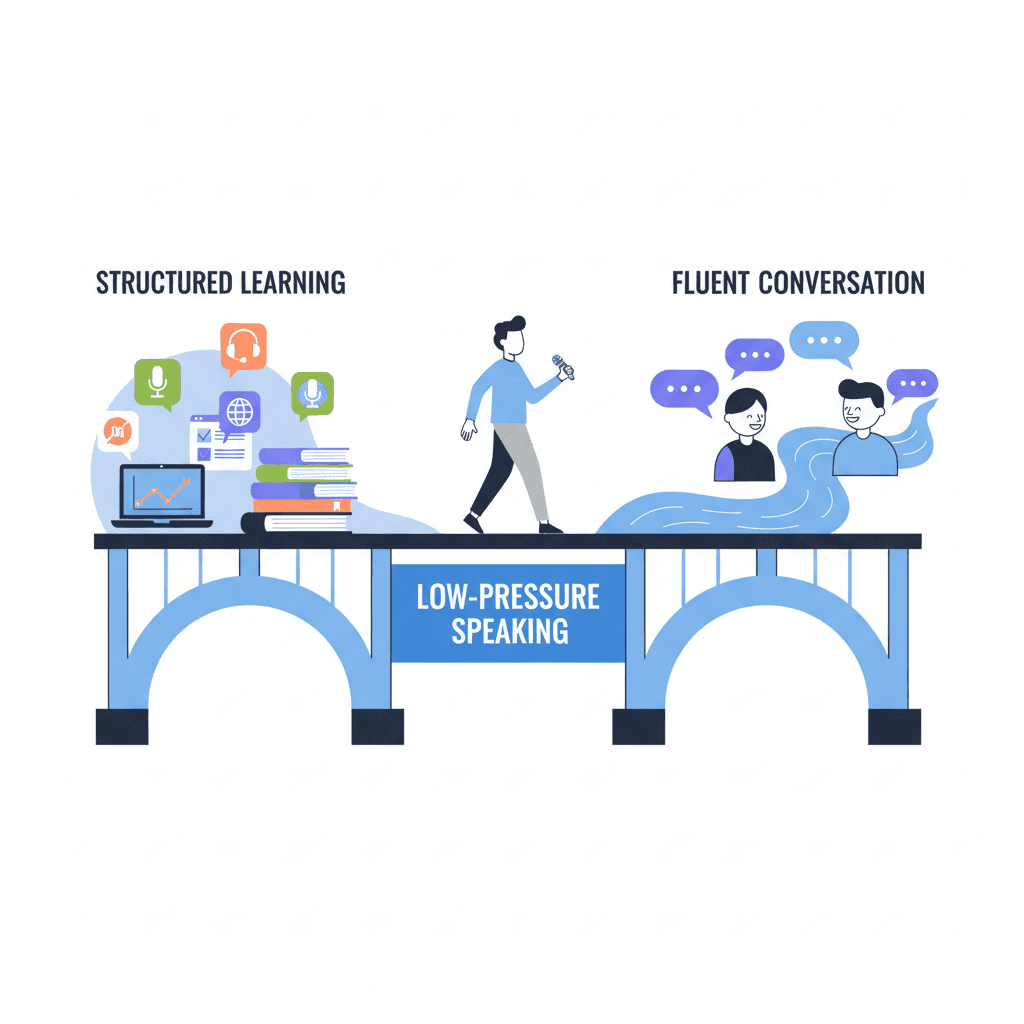
Here is the most critical step in figuring out how to start speaking after pimsleur. You have the vocabulary and the grammar basics, but the thought of talking to a native speaker is terrifying. What if you make a mistake? What if you don't understand? This fear is the biggest barrier to fluency. The solution is to find a low-pressure, non-judgmental environment to practice.
Finishing Pimsleur is like a driving instructor showing you the car, explaining the pedals, and letting you steer a few times. It's a vital first step. But you still need to spend time in an empty parking lot practicing turns and parking before you feel ready for the highway. An AI tutor is your empty parking lot.
The language learning industry has embraced this idea, with a major trend toward AI conversation partners that fill this exact need. Pimsleur's own recent AI conversation feature, designed to create a 'low-pressure speaking environment,' validates this approach. While it's great for practicing lesson vocabulary in a guided setting, a dedicated AI tutor lets you break free from the script. A tool like SpeaksyAI's AI conversation partner allows you to have truly open-ended, unscripted conversations about any topic, from ordering coffee to discussing your hobbies, all while getting instant feedback. It’s the perfect bridge between Pimsleur's structured audio and the unpredictability of real-world chat.
Step 4: Transition to Real-World Conversation
Once you've built confidence in the 'parking lot' with an AI tutor, you're ready for the highway: talking to real people. This is where your Pimsleur foundation truly shines. Your pronunciation will impress your partners, and the core phrases you learned will give you a solid starting point. This is the final and most important step in your activation system.
Platforms like iTalki and HelloTalk are designed for this. When considering pimsleur vs italki, it's not a competition; it's a sequence. Pimsleur gives you the foundation, and iTalki is where you build the house. Pimsleur's own blog recommends this kind of immersive learning, suggesting conversations with native speakers two to three times per week. Your first few sessions can still be nerve-wracking, so go in with a plan.
- 1.Prepare a few topics. Don't expect conversation to flow magically. Have 2-3 things you can talk about (your weekend, your job, your language learning journey).
- 2.Tell them your situation. Start by saying, "Hi, I'm a beginner. I just finished an audio course, so my accent might be okay, but I'm slow at forming my own sentences. Thanks for your patience!"
- 3.Ask questions. The easiest way to keep a conversation going is to ask your partner about themselves. It takes the pressure off you.
- 4.Embrace mistakes. You will make them. Every single one is a learning opportunity. The goal is communication, not perfection.
Your 30-Day 'Post-Pimsleur' Activation Plan
Feeling overwhelmed? Don't be. Consistency is more important than intensity. Here is a simple, actionable plan to maintain momentum and bridge the gap to conversational fluency. This structure is designed to combat the primary challenge many learners face: not having a clear plan after finishing a course.
- •Week 1: Assess & Gather. Take the self-assessment checklist seriously. Find and download a 1000 most common words list for your language. Choose and acquire your beginner's grammar guide. Your goal this week is preparation, not practice.
- •Week 2: Activate & Practice. Spend 15 minutes each day practicing your new vocabulary in unscripted dialogues with an AI tutor. Read and complete the first chapter of your grammar guide. Focus on applying one new grammar rule in your AI conversations.
- •Week 3: Expand & Reinforce. Continue your daily 15-minute AI speaking practice. Start reading a simple graded reader or children's story. Your goal is not to understand every word, but to see your vocabulary and grammar in a real-world context.
- •Week 4: Connect & Converse. Keep up your AI and reading practice. Now, take the leap: book one 30-minute introductory session on a language exchange platform like iTalki. Use your preparation tips and celebrate the fact that you're having a real conversation!
Frequently Asked Questions
Ready to Activate Your Speaking Skills?
Turn your Pimsleur foundation into confident conversation with a non-judgmental AI language tutor.
Join the Waitlist