Maintain a Language Without Daily Practice: A Simmering System
You've worked hard for your language skills, but now you don't use them daily. Here’s how to keep them sharp without the pressure of intense study using a simple 'simmering' system.

The best way to maintain a language without using it daily is to adopt a ‘Language Simmering System’. This low-stress approach involves keeping your skills warm with consistent, low-effort activities like listening to music or podcasts (simmering), combined with occasional, focused speaking practice to keep your active skills sharp (stirring). This method ensures you can stop forgetting a language by focusing on sustainable maintenance rather than the pressure of daily study. It’s about being smart with your time and energy, celebrating small wins, and keeping your hard-earned skills ready for when you need them.
Why 'Use It or Lose It' Is Only Half the Story
You’ve spent countless hours learning a new language. You’ve conquered grammar rules, built a solid vocabulary, and even had a few successful conversations. But now, life has gotten in the way. You’re no longer using the language every day, and a nagging fear begins to creep in: are you going to lose it all? This fear comes from the well-known phrase 'use it or lose it,' and it’s a major cause of anxiety for language learners. The phenomenon, known as language attrition, is real. Without regular use, your language skills can begin to fade.
But here’s the encouraging truth: that phrase is only half the story. Not all of your language skills fade at the same rate. Think of it less like a switch that flips off and more like different lights on a dimmer. Some fade faster than others, but the power is never completely cut.
The skills that require active production—speaking and writing—are typically the first to feel rusty. You might find yourself searching for words that used to come easily or hesitating to form complex sentences. However, your passive skills—listening and reading comprehension—are much more resilient. This is great news! It means that even if you haven't spoken the language in months, you likely still have a strong foundation of understanding to build upon. Your brain hasn't deleted the information; it has just moved it to a less accessible folder.
Even better, research from Fluency Corp suggests that relearning is significantly faster and easier than learning from scratch. This is because the original learning process created dormant neural pathways in your brain. When you begin to practice again, you aren't starting over; you're simply reactivating those pathways. This is a crucial mindset shift. You aren't fighting a losing battle against forgetting; you are simply maintaining and, when necessary, reactivating a skill you already possess. This makes language skill maintenance a far more manageable and less intimidating goal.
Introducing the 'Language Simmering System'
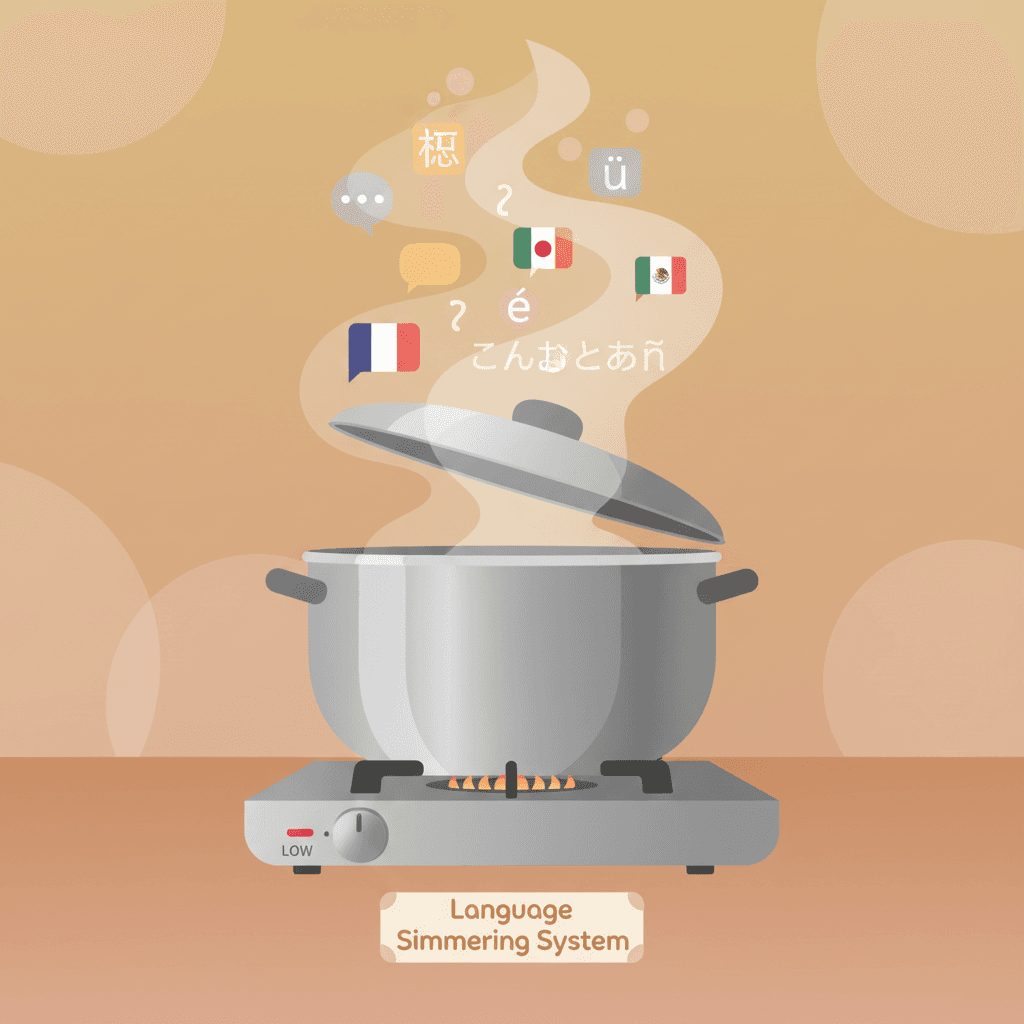
So, if you don't need to 'use it' daily to avoid 'losing it,' what's the alternative? We call it the 'Language Simmering System.' It’s a flexible, guilt-free approach designed for busy people who want to keep their language skills sharp without the pressure of a full-boil study routine. Imagine your language ability is a pot of soup on the stove. You don’t need to have it at a rolling boil every single day—that would be exhausting and would eventually boil over or burn out. A study cited by Noun Town found that many learners quit due to unrealistic expectations and life crowding out the habit, which is exactly what a high-pressure approach creates.
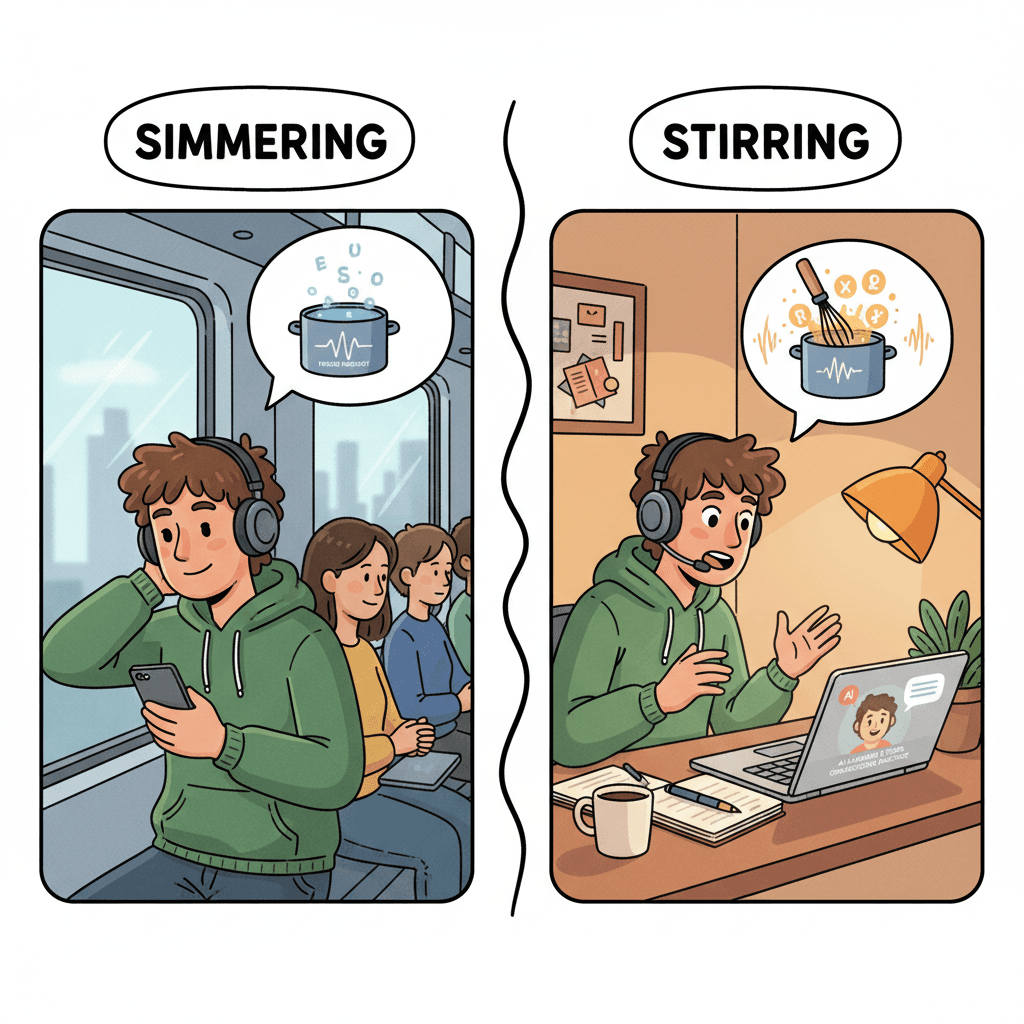
Instead, the goal is to keep the soup simmering. This means maintaining a low level of heat with consistent, low-effort exposure to the language. This is the 'simmering' phase, where you integrate the language into your life in easy, passive ways. It keeps everything warm, fragrant, and ready.
Then, every so often, you need to 'stir the pot.' This is the active part of the system. Stirring involves focused, high-impact activities that engage your active skills, especially speaking. This prevents the ingredients from settling at the bottom and ensures everything is well-mixed and flavorful. This occasional 'stir' is what keeps your speaking skills from declining and ensures you can access your knowledge when an opportunity arises. This system acknowledges that your time and energy are finite, focusing on maximum retention for minimum-but-consistent effort.
Simmering: Low-Effort Ways to Keep the Language Warm
The 'simmering' phase is the foundation of your language skill maintenance plan. It’s all about creating a low-pressure, 'home immersion' environment that weaves the language into the fabric of your daily life. The goal isn't to add more tasks to your to-do list, but to cleverly replace existing activities with their target-language equivalents. This strategy works because, as a report from Travelmag notes, passive skills decline much more slowly, so keeping them active requires less intensive effort. You're simply feeding your brain a steady diet of input.
Think about the media you already consume. Are you on your phone during your commute? Do you listen to music while you work or do chores? Do you unwind with a TV show in the evening? All of these are perfect opportunities for simmering. The key is to make it easy and enjoyable. Don't force yourself to read a dense academic article; find a popular blog or a fun YouTuber. Don't switch your entire Netflix profile; just commit to watching one movie or series in your target language each week. Small, consistent actions are the secret here.
- •Media Swaps: Listen to podcasts, news radio, or an audiobook in your target language during your commute or workout. Create a playlist of music in that language for a mood boost.
- •Screen Time: Change the language settings on your smartphone, tablet, or social media apps. This exposes you to practical, everyday vocabulary.
- •Entertainment Hour: Dedicate one evening a week to watching a movie or TV show in the original language. Start with subtitles in your native language, then switch to target-language subtitles, and eventually try watching without any.
- •Reading for Pleasure: Follow news sites, magazines, or bloggers from countries where the language is spoken (e.g., the US, UK, India, Australia, or Canada for English learners). Read about topics you're already interested in, like sports, fashion, or cooking.
- •Social Feed Immersion: Follow creators, celebrities, or meme accounts on social media that post in your target language. It’s a fun, bite-sized way to see modern, colloquial language in action.
Stirring: High-Impact Practice to Speak Confidently
While simmering keeps your comprehension strong, 'stirring the pot' is what ensures you can actually use the language when the moment comes. This is the active, output-focused part of the system, and it's non-negotiable for maintaining speaking skills. Language attrition hits active skills like speaking the hardest. Without practice, your brain’s ability to quickly recall vocabulary and construct sentences on the fly weakens. Stirring is the antidote.
This doesn't mean you need a two-hour conversation every day. High-impact practice is about quality, not just quantity. It’s about forcing your brain to move from passive recognition to active recall. This is the process of retrieving information, rather than just being presented with it. Methods like journaling or simply narrating your actions force your brain to do this heavy lifting, which is far more powerful for retention than just listening. The goal is to make this 'stirring' a regular, but not necessarily daily, habit.
Active recall is the difference between knowing a word when you see it and being able to produce it in a conversation. It's the muscle you need to train to keep your language skills sharp.
The Challenge of Solo Speaking Practice
Here’s the biggest hurdle for most learners: how do you practice speaking when you don't have anyone to talk to? Finding a reliable conversation partner who matches your schedule, proficiency level, and goals can be incredibly difficult. Studies confirm that 'limited practice opportunities' and a 'lack of confidence' are two of the most significant challenges learners face. This is especially true when you're trying to maintain a language, not learn it from zero. The pressure to perform can feel high, and the fear of making mistakes can lead to avoidance, creating a vicious cycle where lack of practice erodes confidence further.
Your Asynchronous Speaking Partner: The AI Language Tutor
This is where modern technology provides a brilliant solution. An AI language tutor is the perfect tool for the 'stirring' part of your maintenance system. It solves the problem of solo practice by giving you a sophisticated conversation partner on demand, 24/7. You no longer have to worry about scheduling, time zones, or feeling judged.
Tools like SpeaksyAI allow you to engage in real-time voice conversations on a vast range of topics. Want to rehearse ordering coffee, discussing a news article, or preparing for a job interview? You can do it instantly. The AI provides a low-pressure, judgment-free zone where you can practice speaking freely, make mistakes, and build the confidence you need to speak confidently in the real world. With features like instant pronunciation feedback and tailored suggestions, SpeaksyAI’s AI conversation partner acts as your personal speaking coach, helping you keep your active skills sharp and ready whenever you need them. It's the ultimate way to practice language alone without sacrificing the quality of interactive practice.
Finding Your 'Minimum Effective Dose': Sample Schedules
The beauty of the Simmering System is its flexibility. You can tailor it to your life, your goals, and the amount of time you can realistically commit. The key is finding your 'Minimum Effective Dose'—the smallest amount of consistent effort that yields the biggest result in retention. As noted by Preply, consistency is far more effective than cramming. A sustainable weekly rhythm is the goal. Forget trying to study for an hour every day if your schedule doesn't allow it. Instead, choose a plan that you can stick to without feeling overwhelmed.
Here are a few sample schedules. Think of them as templates that you can adapt. Remember to mix 'simmering' (input) and 'stirring' (output) activities. Many polyglots report using a tiered approach, rotating their focus to ensure each of their languages gets some attention without requiring daily practice for all of them.
- 1.The 15-Minute Daily Dip: Perfect for busy professionals. Five days a week, spend 10 minutes on a 'simmering' activity (e.g., listening to a podcast) and 5 minutes on a 'stirring' activity (e.g., talking to yourself about your day or using an AI tutor to describe a picture). Total: ~75 minutes/week.
- 2.The 3-2-1 Weekly Plan: Ideal for those who prefer slightly longer, less frequent sessions. Three times a week, do 30 minutes of listening (simmering), 20 minutes of reading (simmering), and 10 minutes of active speaking with an AI tutor (stirring). Total: ~3 hours/week.
- 3.The Weekend Power Session: Best for people with hectic weekdays. Keep your simmering light during the week (e.g., music, changing phone language). On Saturday or Sunday, schedule a 60-90 minute 'power session' that includes reading an article, watching a video, and then having a 20-30 minute conversation about it with an AI partner. Total: ~2-3 hours/week.
Shift Your Mindset: From 'Forgetting' to 'Reactivating'
Perhaps the most important part of long-term language maintenance is psychological. You must shift your mindset away from a fear of 'forgetting' and towards a confidence in 'reactivating.' Every time you feel rusty or struggle for a word, it’s easy to think, 'I’m losing it.' This negative self-talk is discouraging and can become a self-fulfilling prophecy, making you want to practice even less.
Instead, reframe the experience. When a word is on the tip of your tongue, don't see it as a failure. See it as your brain working to find the path to that dormant information. Remember the research from Fluency Corp: the knowledge isn't gone, it's just temporarily offline. Your practice sessions are the process of bringing it back online. This 'growth mindset,' as described by The Glossika Blog, is crucial for long-term retention. Celebrate the small victories—the word you remembered, the phrase you understood, the sentence you managed to speak.
This perspective is liberating. It removes the pressure of perfection and replaces it with the gentle, consistent effort of maintenance. Your language skills aren't a fragile vase that will shatter if you don't look at it; they are a muscle that can be re-strengthened. And if you feel like your skills have gone from simmering to completely cold, don't worry. There are specific strategies for that, too. An approach focused on reactivating dormant skills, which some call a 'Relearning System,' can help you efficiently bring your language back to life.
Frequently Asked Questions About Language Maintenance
Frequently Asked Questions
Ready to Keep Your Speaking Skills Sharp?
Get on-demand, low-pressure speaking practice with an AI tutor that's always available. Join the SpeaksyAI waitlist today.
Join the Waitlist