Learning a Language at 40: Your Strategic Advantage
The idea that language learning is only for the young is a persistent myth. This guide isn't just to tell you it's possible—it's to show you how to use your life experience as a 40+ learner to learn smarter.

Thinking about learning a new language in your 40s, 50s, or beyond? You might be asking yourself, is it too late to learn a language at 40? Let's clear this up right away: not only is it not too late, but your age can be a strategic advantage. While the way you learn may be different from a teenager, you bring powerful tools to the table that younger learners simply don't have: deeper focus, clearer motivation, and a lifetime of experience that gives new words meaning. Forget the myth that your brain is 'too old' to learn. With the right system, you can achieve your language goals, whether it's for travel, career, or connecting with family.

Let's Be Honest: Why Learning at 40 Feels Different
It's easy to feel intimidated when you start your language learning journey as an adult. You have a demanding career, family responsibilities, and a schedule that's already packed. It’s completely normal to feel that your brain isn’t the same ‘sponge’ it was in high school French class. These feelings are valid, and they’re rooted in a combination of psychology, biology, and the simple realities of adult life.
That 'spongy brain' feeling has some scientific basis. A large-scale 2018 study by researchers Hartshorne, Tenenbaum, and Pinker, published in the journal Cognition, found that our natural ability to absorb grammar is at its peak until about age 17 or 18. After that, it begins a gradual, slow decline. But here's the key: it's a decline, not a full stop. It just means you'll learn differently, using more explicit, strategy-driven methods rather than pure intuition.
The real challenges of adult language learning often have less to do with brain chemistry and more to do with these common hurdles:
- •Self-Consciousness: The fear of making mistakes or 'sounding stupid' is far more pronounced in adults. We're used to being competent, and being a beginner again can feel uncomfortable.
- •Perfectionism: You have a sophisticated understanding of your native language, which can lead to frustration when you can't express yourself with the same nuance in a new one.
- •Time Constraints: Juggling language practice with work, family, and personal commitments is one of the biggest obstacles for learners over 40.
The 'Adult Advantage': Turning Age Into Your Superpower
While it's easy to focus on the challenges, doing so overlooks the incredible advantages you possess as a mature learner. Children learn implicitly, absorbing a language through massive exposure over many years. You, on the other hand, can learn strategically. This is the core of the 'adult advantage'—turning your life experience and developed cognitive skills into your greatest assets.
For starters, you understand how to learn. This skill, known as metacognition, is something you've honed over decades. You know which study methods work for you, how to manage your time, and how to set realistic goals. You're not just learning a language; you're applying a lifetime of learning expertise to a new skill. Research on adult learning shows that adults can selectively outperform children in certain learning tasks, demonstrating a superior ability to manage their own learning process.
- •You Have a Clear 'Why': Unlike a student learning for a grade, your motivation is likely tied to a deep personal goal—a dream trip, connecting with your heritage, or a career change. This powerful purpose is the fuel that will carry you through challenges.
- •You're a Vocabulary Master: That landmark 2018 study of nearly 670,000 people also found that adults often excel in vocabulary acquisition. Why? Because you have a vast web of existing knowledge—concepts, emotions, and experiences—to which you can connect new words, making them stick.
- •You Understand Grammar Concepts: You already know what a verb, noun, or preposition is. You can grasp abstract grammatical rules much faster than a child who has never thought about sentence structure before.
Contrary to popular belief, adults are often faster language learners than children in the early stages, especially when it comes to grasping the explicit rules of grammar and sentence structure.
Debunking the 'Critical Period' Myth with Modern Science
One of the most persistent myths in language learning is the 'Critical Period Hypothesis'—the idea that there's a fixed window in early childhood to become fluent. If you miss it, you're out of luck. Fortunately, modern science has shown this is a huge oversimplification. The goal for most adult learners isn't to be mistaken for a native speaker; it's to communicate effectively and confidently. And for that, there is no age limit.
The critical period primarily affects the ability to acquire a perfect, native-like accent. While children are brilliant mimics, achieving a flawless accent is an incredibly high bar and is not necessary for fluency. You can be completely fluent—able to discuss complex topics, understand movies, and build deep relationships—with a noticeable accent. Fluency is about communication, not perfection.
Your brain's ability to adapt, known as neuroplasticity, continues throughout your life. Every time you practice vocabulary or try to form a new sentence, you are physically building and strengthening neural pathways. You're not just learning a language; you're giving your brain a fantastic workout.
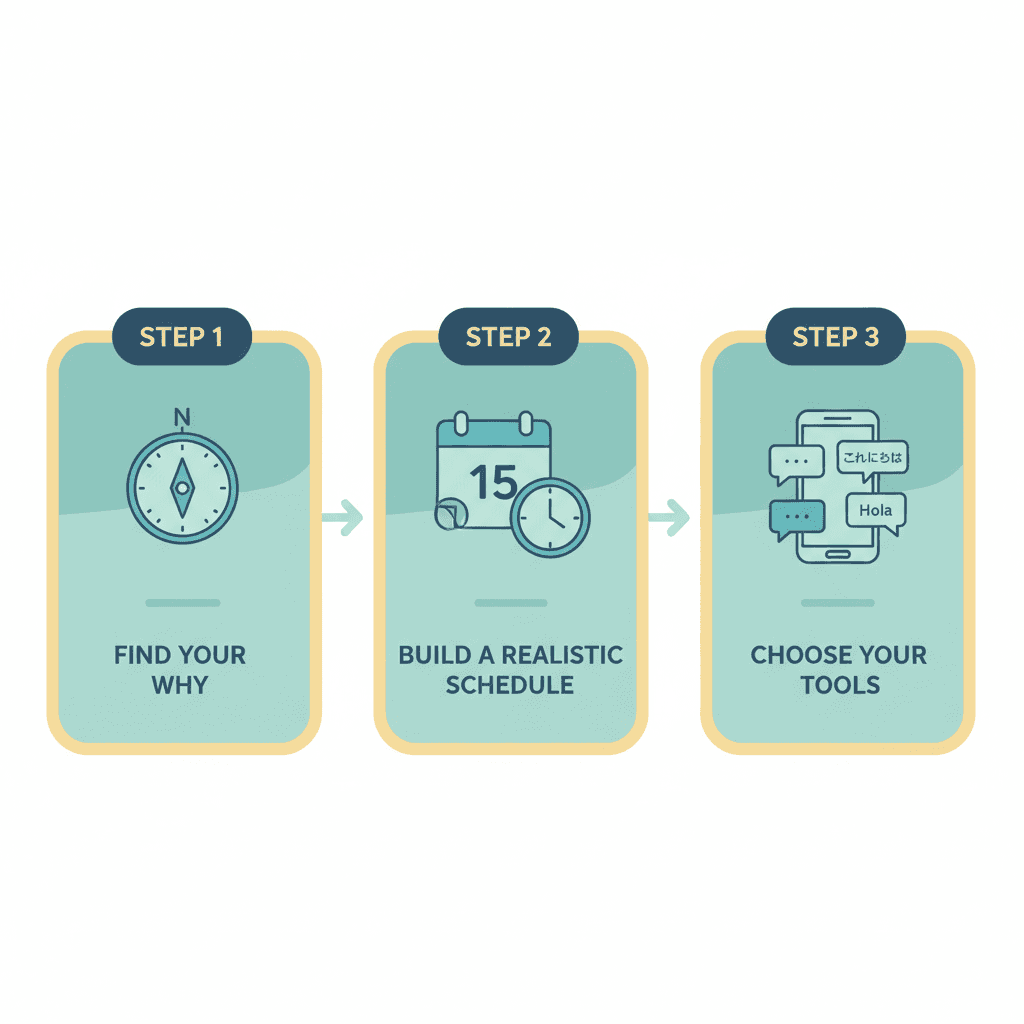
The 40+ Learner's System: A 3-Part Action Plan
So, we've established that you can absolutely succeed. But how do you do it? The best way to learn a language at 40 is not to try and learn like a teenager. It's to embrace your adult advantages with a system designed for your life. This 3-part plan helps you build a sustainable, effective, and even joyful learning routine.
Step 1: Find Your 'Why' (Beyond Brain Health)
The cognitive benefits of language learning are amazing—a study in the journal Nature Aging found that speaking multiple languages can protect against brain aging. But on a tough day when you're tired and feeling discouraged, 'brain health' might not be enough to get you to open your textbook. You need a powerful, personal, and emotional reason to learn.
This is your core motivation. It's the vision that will pull you through the inevitable plateaus. Before you download a single app, take some time to define it. What specific, exciting outcome will learning this language create in your life? Industry analysis shows that most learners quit within the first 100 hours, not because of difficulty, but because their motivation wanes. A strong 'why' is your defense against quitting.
- •Meaningful Travel: Imagine not just visiting Italy, but having a real conversation with a shop owner in a small village.
- •Family Connection: What would it feel like to speak to your in-laws in their native tongue or pass on a heritage language to your kids?
- •Career Advancement: Could speaking Spanish, Mandarin, or German open up a promotion or an international assignment you've been dreaming of?
- •Personal Passion: Maybe you just want to understand your favorite foreign films, read a beloved author in the original text, or connect with a new hobby.
Step 2: Build a Realistic Schedule for a Busy Life
The 'all or nothing' approach is a recipe for burnout. The key for busy adults is consistency over intensity. A focused 15-20 minutes every day is far more effective than a heroic but exhausting 3-hour session once a week. The goal is to build a habit that feels so natural it's almost automatic.
The secret weapon for this is 'habit stacking.' Don't try to find new time in your day; instead, anchor your language practice to an existing daily routine. This simple technique removes the guesswork and decision fatigue, making your practice a seamless part of your day. This is a crucial strategy for language learning for busy adults.
- •While your morning coffee brews, review 10 vocabulary flashcards.
- •During your commute, listen to a language learning podcast instead of the news.
- •While you're walking the dog, describe what you see in your target language (even if it's just in your head).
- •Before bed, write one sentence in a journal about your day.
Step 3: Choose Your Tools to Overcome Self-Consciousness
For many adults, the single biggest hurdle is the fear of speaking. The thought of making a mistake in front of a teacher or a native speaker can be paralyzing. The good news is that modern technology has created the perfect solution to build confidence in private.
While group classes and private tutors are valuable, they can be intimidating at the start. This is where AI-driven tools provide a game-changing advantage. They create a safe, judgment-free space to make mistakes, which is where real learning happens. You can practice pronunciation, test out sentence structures, and build conversational flow without any pressure.
For example, using SpeaksyAI's AI conversation partner allows you to have open-ended conversations on any topic, whenever you want. You get instant, private feedback on your grammar and pronunciation, helping you build a solid foundation of speaking confidence before you ever have to talk to a person. Think of it as your private gym for language fitness, preparing you for real-world interactions.
What Does Success Look Like? Setting Realistic Milestones
One of the main reasons learners quit around the 100-hour mark is because their definition of 'success' is a vague, distant goal called 'fluency.' This sets you up for disappointment. To stay motivated, you need to redefine success with small, tangible, and frequent wins.
Celebrating these small victories is not just a nice idea; it's a neurological one. Each small success gives you a little dopamine hit, which reinforces the habit and builds momentum. Instead of aiming for 'fluency by Christmas,' focus on a ladder of achievable milestones.
- 1.This week's goal: Learn the 10 most common greetings and farewells.
- 2.This month's goal: Be able to introduce yourself and ask someone their name and where they're from.
- 3.This quarter's goal: Successfully order a meal at a restaurant, including asking for the bill.
- 4.In six months: Hold a 5-minute, simple conversation about your hobbies or your job.
Every time you successfully use a new word or understand a sentence, take a moment to acknowledge it. That's not just practice; that's progress. That's fluency in the making.
FAQ: Your Questions About Learning a Language at 40
Frequently Asked Questions
Ready to Start Speaking with Confidence?
SpeaksyAI is your personal AI language tutor. Get unlimited, non-judgmental speaking practice anytime, anywhere. It's the perfect partner for your language journey.
Join the Waitlist