Job Interview in a Foreign Language? Here’s Your Action Plan
Preparing for a job interview in a foreign language is more than just translating your resume. It’s about building the confidence to communicate your value clearly. Let's get you ready.

Feeling nervous about an upcoming job interview in another language? You're not alone. The key to success is knowing how to prepare for a job interview in a foreign language by focusing on clear communication, not perfect fluency. This guide, The SpeaksyAI Job Interview System, will walk you through a step-by-step process to build your confidence, structure your answers, and show the hiring manager you’re the right person for the role. Let's get you ready to speak confidently in your interview.
Reframe Your Goal: Aim for Clarity, Not Perfection
Before you even start memorizing vocabulary, let's address the biggest fear most learners face: the fear of making a mistake. It’s natural to feel that you need to be perfectly fluent to impress a hiring manager. But what if the goal wasn't perfection? What if the goal was simply clear communication? Shifting your mindset from 'I must not make any grammar errors' to 'I must clearly communicate my value' is the single most important step you can take.
This isn't just wishful thinking; it's backed by data. According to the 2025 LinkedIn Global Talent Trends Report, an incredible 72% of international hiring managers prioritize a candidate's communication effort and cultural adaptability over perfect fluency. They are listening for the content of what you say, not just the packaging. Research from the Journal of Applied Linguistics also found that interviewers care more about the clarity of your message than your accent. Hiring managers in competitive markets like the US, UK, Australia, and Canada want candidates who can provide structured answers with concrete examples. Your mission is not to sound like a native speaker; it's to be an understood, compelling candidate.
Think of it this way: a grammatically flawless but vague answer is far less valuable than a clear, detailed answer with a few minor mistakes. This mindset shift frees you up to focus on what truly matters: preparing your content, structuring your stories, and practicing how you'll deliver them. Success in a job interview in another language depends on preparation and having recovery strategies for when you stumble, not on achieving an impossible standard of perfection.
Step 1: Deconstruct the Job & Build Your "Phrase Bank"
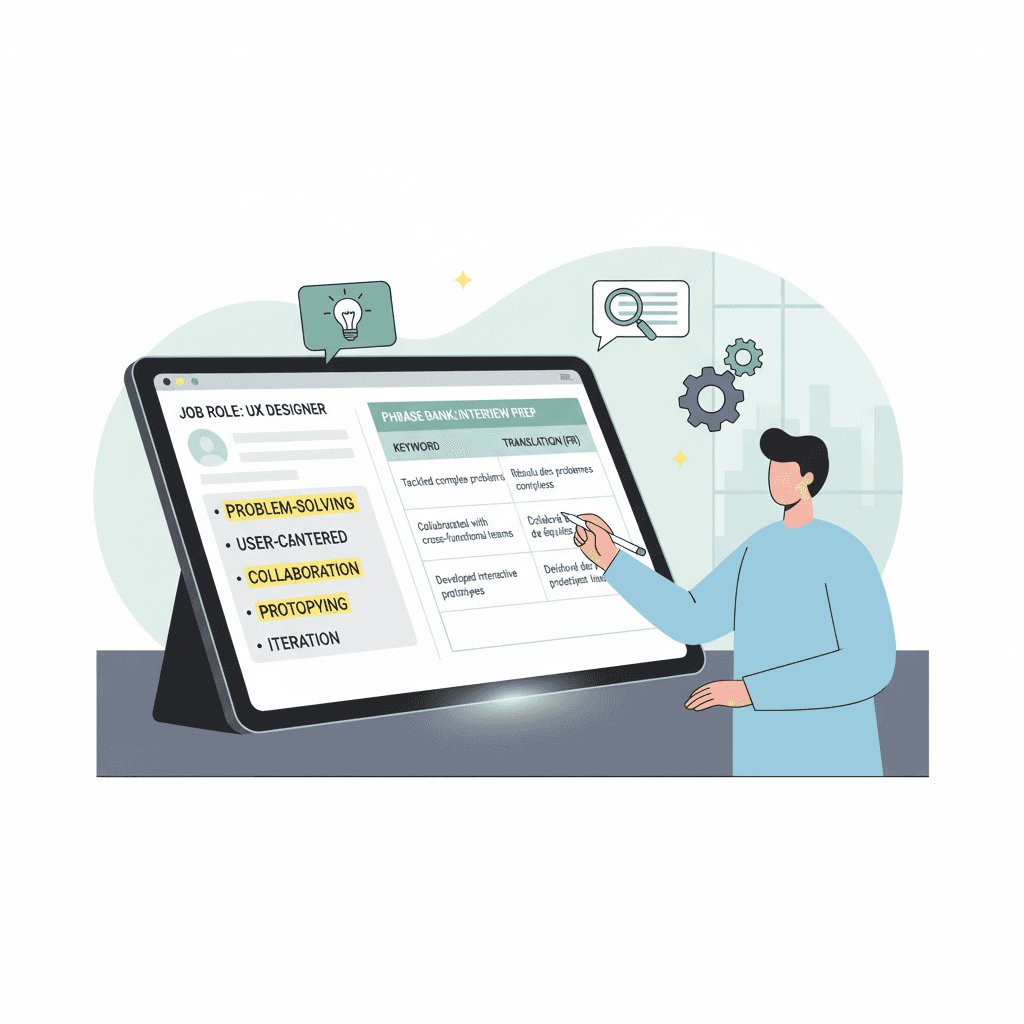
Once you've embraced the goal of clarity, it's time to build your toolkit. Forget generic vocabulary lists. To succeed, you need a targeted, job-specific "Phrase Bank." This is your personal collection of terms, phrases, and sentence starters that are directly relevant to the role you want. It’s a systematic approach that ensures you have the right words ready when you need them most.
Start by becoming a detective. Scour the job description and highlight key responsibilities, required skills, and company values. Then, visit the company's website, blog, and LinkedIn page—making sure to view them in the target language. Look for patterns. How do they describe their products, their culture, and their industry? This is where you'll find the authentic language you need. Experts recommend creating 40-60 reusable 'chunks' or phrases that you can adapt to different questions, rather than trying to memorize entire scripts.
- •Action Verbs: Collect verbs that describe your accomplishments (e.g., I developed, I implemented, I optimized, I led) in the target language.
- •Industry Nouns: List the specific technical terms, software names, and jargon used in your field.
- •Core Skill Descriptors: Prepare phrases to talk about your key strengths (e.g., "I have extensive experience in project management," "I am skilled at data analysis").
- •Result-Oriented Language: Find words to quantify your impact (e.g., "which resulted in a 15% increase in…," "helping to reduce costs by…").
The goal is to build a list of 50-80 highly relevant terms and practice using them in full sentences. This is a crucial part of your language interview preparation because employers are increasingly assessing job-related language skills, not just general proficiency. Having your Phrase Bank ready means you won't have to search for critical words under pressure.
Step 2: Prepare Your Stories with the STAR Method
Behavioral questions—like "Tell me about a time you faced a challenge" or "Describe a successful project"—are standard in modern interviews. The best way to answer them is with a story, and the best way to structure that story is with the STAR method. This framework is a gift for non-native speakers because it provides a simple, logical path for your answer, preventing you from rambling and helping the interviewer follow along easily.
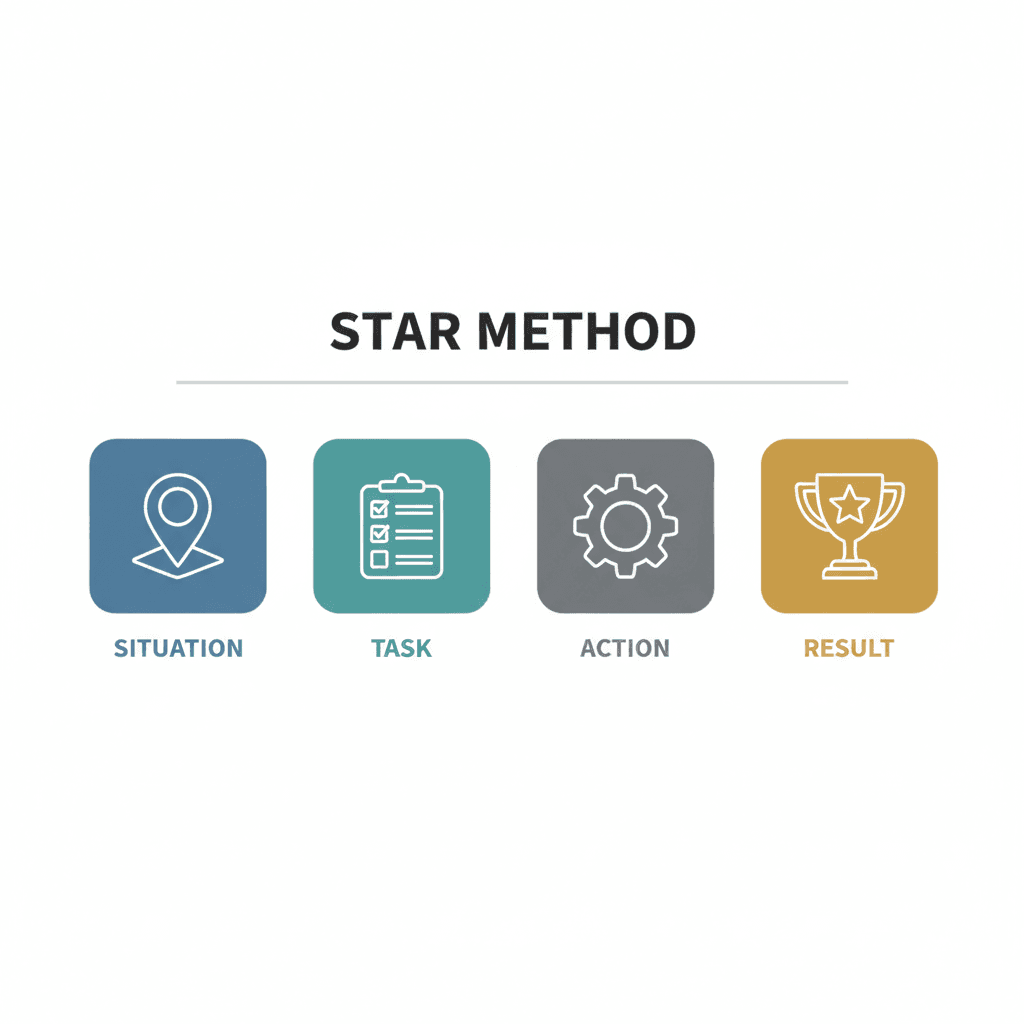
STAR stands for Situation, Task, Action, and Result. It's a strategic framework endorsed by publications like the Harvard Business Review because it turns your job history into a compelling narrative. Let's break down how you can use it.
- 1.Situation: Briefly set the scene. What was the context? Where and when did this happen? Keep this to one or two simple sentences.
- 2.Task: What was your specific responsibility or goal? What problem were you trying to solve? State it clearly.
- 3.Action: This is the most important part. Describe the specific actions you took. Use strong 'I' statements and pull verbs from your Phrase Bank. What did you do?
- 4.Result: What was the outcome of your actions? Quantify it whenever possible. Did you save money, increase efficiency, or improve customer satisfaction? This is how you prove your value.
Data shows that hiring panels increasingly rely on structured behavioral interviews, and using the STAR method in a foreign language provides a clear window into your thought process and problem-solving abilities. A 2025 guide found that this approach can help non-native speakers stand out by 40% in competency-based interviews simply because it makes their experience more memorable and easier to digest. It reduces the ambiguity that can sometimes come with language barriers, allowing your qualifications to shine through.
Step 3: Simulate the Interview with an AI Language Tutor
You have your Phrase Bank and your STAR stories. Now comes the most critical part of your preparation: practice. Reading your notes is passive. To truly speak confidently in an interview, you need to build speaking muscle memory through active practice. You must simulate the pressure and unpredictability of a real conversation.
This is where an AI language tutor becomes your secret weapon—a personal interview simulator available 24/7. Instead of just hoping you'll remember what to say, you can pressure-test your answers in a safe environment. This active practice is what closes the gap between knowing what to say and being able to say it clearly when it matters most.
With a tool like SpeaksyAI's AI conversation partner, you can transform your preparation. You can simply instruct the AI: "Act as a hiring manager from a tech company in Germany. I am interviewing for a Project Manager role. Ask me common behavioral questions." The AI will then role-play with you, allowing you to practice your STAR stories out loud and get comfortable responding on the spot.
- •Run full interview simulations to build the mental stamina to speak and think in another language for an extended period.
- •Get instant feedback on your pronunciation of key industry terms from your Phrase Bank.
- •Practice responding to unexpected questions to improve your flexibility and conversational skills.
- •Record yourself and listen back to identify areas where you can improve your clarity, tone, and pacing.
- •Reduce interview anxiety by making the real interview feel like just another practice session you've already aced.
This kind of AI interview practice is the key to activating your vocabulary and moving beyond theory. It’s what allows you to walk into that interview room—virtual or physical—feeling prepared, not just studied.
Step 4: Master the 'Small Talk' and Cultural Nuances
A job interview is a professional conversation, not an exam. The moments of small talk at the beginning and end are critical for building rapport and making a human connection. Don't neglect them! Prepare a concise, positive, 60-second answer to the classic "Tell me about yourself" opener. This isn't a detailed life story; it's your professional elevator pitch connecting your past experience to this future opportunity.
Equally important is having a plan for when you don't understand something. It will happen, and it's okay! How you handle it shows confidence and problem-solving skills. Instead of panicking or saying "What?", have a few polite 'recovery phrases' ready in your Phrase Bank.
- •"Could you please repeat that? I want to make sure I understand correctly."
- •"That's an interesting term. Could you explain what you mean by [the term]?"
- •"If I understand correctly, you're asking about... Is that right?"
Finally, remember that cultural awareness is a huge part of communication. Studies show that a candidate's accent has minimal impact on hiring decisions when they demonstrate cultural understanding. Norms around formality, eye contact, gestures, and even punctuality can vary widely between countries like India and the United States. Do a little research on professional etiquette in the company's home country. This effort shows respect and adaptability—qualities that, as we know, hiring managers value highly.
The Post-Interview Follow-Up: Your Thank-You Email
Your effort to communicate effectively shouldn't end when the interview does. Sending a post-interview thank-you email is one of the easiest and most effective ways to stand out. A 2024 TopResume study found that 68% of hiring managers say a thank-you note influences their decision, yet shockingly, another study found only 24% of candidates actually send one. This simple act places you in the top quarter of applicants.
For a candidate interviewing in a foreign language, this email serves an extra purpose: it's one last chance to demonstrate your professionalism, written communication skills, and genuine interest in the role. It reinforces the positive impression you made and shows your dedication.
Subject: Thank You - Interview for [Job Title] Dear [Interviewer Name], Thank you very much for your time today. I truly enjoyed our conversation and learning more about the [Job Title] position and the team at [Company Name]. I was particularly interested in [mention something specific you discussed, e.g., the upcoming project you talked about]. My experience in [mention a relevant skill, e.g., agile development] seems to align well with the goals you described. I am very enthusiastic about the opportunity to contribute to your team. Please let me know if there is any other information I can provide. Thank you again for this opportunity. Best regards, [Your Name]
Keep your email brief, specific, and professional. Mention a specific point from your conversation to make it memorable. Most importantly, proofread it carefully or use a grammar-checking tool before hitting send. This small gesture can make a big difference.
Frequently Asked Questions
Frequently Asked Questions
Ready to Speak Confidently?
Get the practice you need for your interview. Join the SpeaksyAI waitlist and get access to your personal AI language tutor.
Join the Waitlist