Is Duolingo Good for Speaking Practice? A Realistic Guide
Duolingo is a powerful starting point for vocabulary and grammar. But when it's time to actually speak, you need a different strategy. Let's explore how to use it effectively and what comes next.
So, is Duolingo good for speaking practice? The short answer is: yes, it’s a great place to start, but it won’t get you to fluency on its own. Duolingo is a phenomenal tool for building a vocabulary foundation and a daily learning habit. However, to truly develop conversational skills, you need to bridge the gap between knowing words and using them spontaneously. This guide will give you a clear system for using Duolingo effectively while incorporating the practice you need to become a confident speaker.
What Duolingo Is Genuinely Good For
Let's start by celebrating what Duolingo does exceptionally well. If you're using the app, you've made a great choice for kicking off your language learning journey. Its biggest strength is its gamified design, which is incredibly effective at helping you build a consistent, daily learning habit. Turning language learning into a game with streaks, leaderboards, and achievements keeps you motivated and coming back every day. This consistency is the bedrock of any successful learning plan.
The proof is in the numbers. Duolingo's engaging format has led to massive user adoption. According to its Q2 2026 Investor Report, the company saw a 23% year-over-year growth in Daily Active Users. This isn't just a business metric; it’s a testament to how well the app works at keeping learners engaged, a crucial first step that many people struggle with, whether they're in the US, UK, or India.
Beyond habit-building, Duolingo is a powerhouse for establishing foundational vocabulary and understanding basic grammar. The repetitive, bite-sized exercises are perfect for drilling new words into your memory. For beginners, this structured approach can be as effective as formal education. In fact, a peer-reviewed 2026 study from Duolingo Efficacy Studies found that after one semester, the communication skills of French learners on Duolingo were comparable to those of students in a traditional university classroom.
This well-rounded start gives you the raw materials you'll need for conversation. Another study in 2024 confirmed that after just three months of using the app, learners showed measurable improvements in all four key areas: reading, writing, listening, and speaking. Think of Duolingo as your personal vocabulary and grammar coach, preparing you for the next stage of your journey.
Why Duolingo Alone Isn't Enough for Speaking
While Duolingo gives you a fantastic starting toolkit, you'll eventually notice a gap between what you can do in the app and what you can do in a real conversation. This isn't a failure of the app; it's a limitation of its format. Most Duolingo exercises are based on recognition and translation—matching words, filling in blanks, or choosing the right translation. This is a different cognitive skill from spontaneous speech production, which is what you need when talking to another person.
In a real conversation, there are no multiple-choice options. You have to recall words, form sentences, and respond to unpredictable questions in real time. Duolingo's own research suggests that completing a full course generally brings a user to the A2 level on the Common European Framework of Reference (CEFR) scale. An A2 level represents a basic ability to handle simple, routine exchanges—a great milestone, but still a long way from conversational fluency.
- •Focus on Vocabulary, Not Conversation: A 2026 analysis noted that the app's core design is built more for learning words and maintaining streaks than for practicing actual back-and-forth conversation.
- •Limited Speaking Feedback: While some speaking exercises exist, they primarily check for pronunciation on a pre-written sentence. Features like the AI-powered Roleplay in Duolingo Max are a step in the right direction but are limited to a few languages and offer minimal corrective feedback on grammar or word choice.
- •Lack of Spontaneity: The app cannot replicate the dynamic, unscripted nature of real-world interactions. You're always following a prompt rather than generating your own thoughts.
Even the language testing industry is acknowledging this gap. The official Duolingo English Test, used by universities worldwide, was updated in 2025 to replace its simple 'Listen, Then Speak' prompt with a more complex 'Interactive Speaking' section. This new format simulates a real conversation, signaling a clear industry shift toward valuing spontaneous speaking skills over simple repetition.
A Practical Guide to Maximizing Duolingo’s Speaking Features
So, how can you use Duolingo for speaking practice more effectively? With a few adjustments, you can turn its passive exercises into more active practice. The goal is to force yourself to produce language, not just recognize it. Here’s a practical, step-by-step guide to get more speaking value out of every lesson.
- 1.Speak Every Answer Aloud: Before you tap or type anything, say the full answer out loud. This simple habit transforms every exercise into a mini-speaking prompt. A 2024 study by Smith, Jiang, and Peters found that Duolingo participants showed noticeable improvement in speaking skills after about 27 hours of practice—making this active effort is key to seeing those results.
- 2.Use the Microphone Icon Religiously: Whenever you see the little microphone icon, use it. Opting to speak your answer instead of typing forces you to practice pronunciation and sentence construction under a little bit of pressure, which is great training.
- 3.Enable Speaking-Only Exercises: Go into your Duolingo settings and ensure that both speaking and listening exercises are enabled. You can often focus on these specifically for a more intensive workout.
- 4.Leverage Duolingo Max Roleplay: If you're a subscriber to Duolingo Max, make the AI-powered 'Roleplay' feature a core part of your routine. Research from 2025 showed that learners who engaged with these specific AI features demonstrated significantly higher self-efficacy and felt more prepared for real-life conversations.
By adopting these habits, you actively work to close the gap between passive knowledge and active skill. You’re not just learning the words; you’re training your brain and your mouth to use them together. This prepares you perfectly for the next step: true conversational practice.
The Bridge from Duolingo to Confident Conversation
You’ve built your vocabulary and grammar foundation with Duolingo. Now what? The next logical step is to find a bridge that takes you from the structured world of the app to the dynamic world of real conversation. This is where you need a tool designed specifically for spontaneous speaking practice.
Duolingo gives you the words; an AI language tutor gives you the conversation.
This is the core of the 'Yes, and...' approach to language learning. Yes, Duolingo is an essential tool. And, you need to supplement it with a platform that allows for open-ended, judgment-free practice. A 2026 review highlighted that speaking ability improves minimally with Duolingo-only use precisely because its format can't replicate the 'spontaneous language production in response to another person' required for true conversational practice. This is the gap an AI tutor is built to fill.
Think of Duolingo as the textbook and an AI conversation partner as the language lab. This combination is incredibly powerful. A 2026 study in the Journal of English Language and Education demonstrated this perfectly. When Duolingo was used as a supplementary tool in a higher education setting, it significantly improved students' average speaking performance scores from 63.96 to 82.92. The app provided the knowledge, and another method allowed students to activate it.
This is the judgment-free practice gap that an AI language tutor from speaksyai.com is designed to fill. By providing a platform for open-ended conversation on any topic, it allows you to activate the vocabulary and grammar you've learned on Duolingo in realistic, unscripted scenarios. You can talk for minutes at a time, get instant feedback on pronunciation, and build the confidence you need without the pressure of speaking with a human partner just yet.
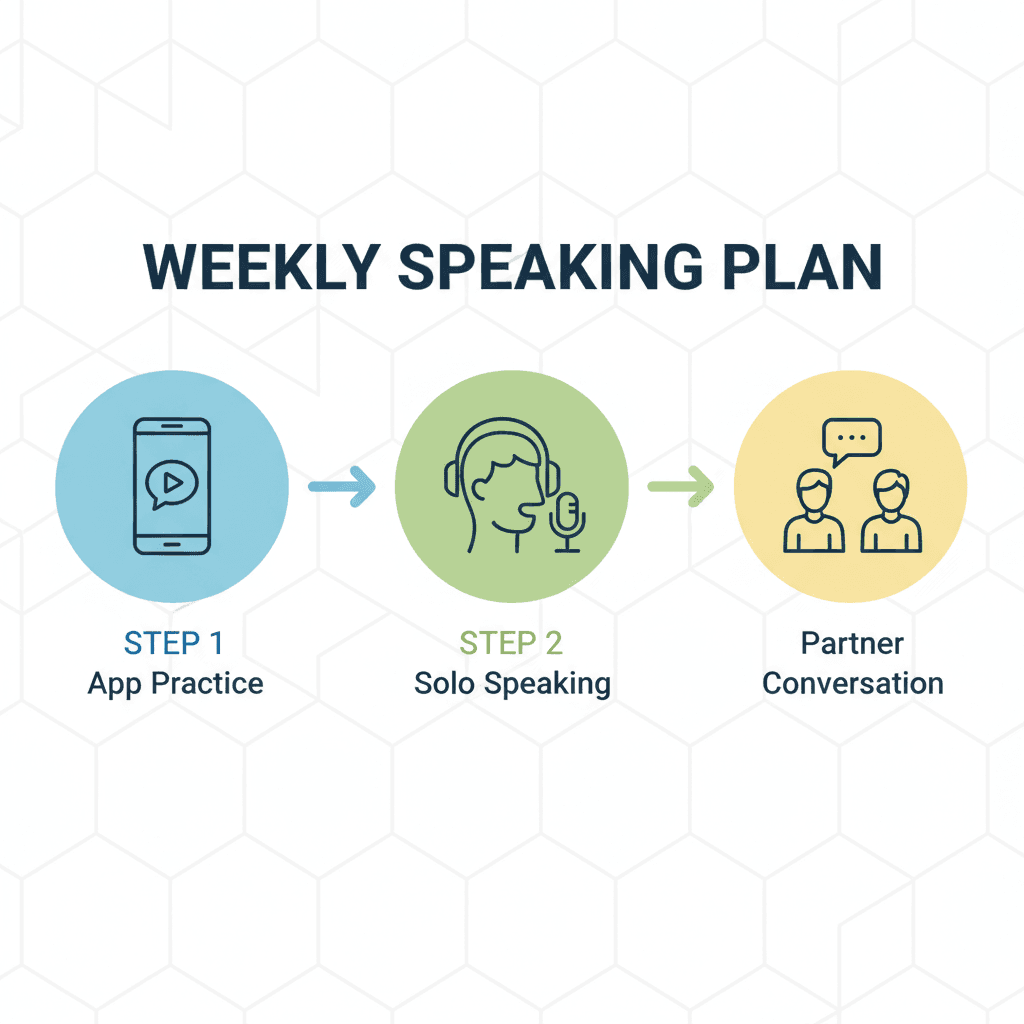
The Duolingo-to-Speaking System: A 3-Step Weekly Plan
Feeling motivated but need a clear plan? Here is the Duolingo-to-Speaking System, a simple, actionable weekly routine that combines Duolingo's strengths with the power of AI conversation practice. This system ensures you’re not just collecting words but actively using them to build fluency.
- 1.Step 1: Build Your Foundation Daily (15 mins/day). Continue using Duolingo every day to learn new vocabulary and grammar. A 2024 study showed that this consistent use leads to improvement across all language skills. This is your 'ingredient gathering' phase.
- 2.Step 2: Activate Your Knowledge Weekly (2-3 times/week). Schedule 2-3 sessions of 20-30 minutes with an AI language tutor. Your goal in these sessions is to use the new words and sentence structures you learned in Duolingo that week. You can start by simply describing your day or talking about a topic from a recent Duolingo lesson.
- 3.Step 3: Refine Your Flow (10 mins/session). After your speaking sessions, use the 'shadowing' technique. Listen to a sentence from a Duolingo Story or a response from your AI tutor, and repeat it immediately, trying to match the intonation and rhythm. A 2025 study noted that Duolingo's gamified environment helps reduce speaking anxiety, making it a perfect low-stakes setting for practicing techniques like shadowing.
This three-step system creates a powerful feedback loop. Duolingo provides the new material. Your AI tutor provides the practice arena. And shadowing refines your pronunciation and flow. Together, they form a complete learning ecosystem that takes you from beginner to confident speaker.
The Future of Speaking Practice: AI and Industry Shifts
The need for better speaking practice isn't just a feeling among learners; it's a major trend shaping the entire language learning industry. The most telling sign is the 2025 update to the Duolingo English Test, which is moving to an 'Interactive Speaking' section. This shift shows that high-stakes assessments are evolving to measure real conversational ability, not just rote memorization.
Duolingo itself is leaning into this trend. Its VP of Learning discussed in February 2026 how the company is now using generative AI characters to provide 'low-stakes' conversational practice to help learners overcome speaking anxiety. This internal focus validates the need for tools that simulate conversation. A peer-reviewed 2025 study further supports this, finding that learners' self-efficacy—their belief in their own ability to succeed—significantly increases after using mobile apps that incorporate generative AI.
Ultimately, the goal is to increase your 'willingness to communicate.' A quasi-experimental study confirmed that AI-integrated tools like Duolingo significantly boosted this willingness among English learners in online classes. By providing safe, accessible, and effective practice, AI tutors are becoming an indispensable part of the modern language learner's toolkit, whether they're in Canada, Australia, or anywhere else in the world.
So, What's the Verdict on Duolingo for Speaking?
So, let's return to our original question: is Duolingo good for speaking practice? The verdict is clear: Duolingo is a valuable and highly effective supplement for speaking, but it should not be your only tool. While a majority of users in one study felt their speaking skills improved with the app, it’s crucial to understand its role.
Think of it this way: Duolingo is your personal trainer for vocabulary and grammar. It gets you in shape by building your linguistic muscles. However, you still need to get on the field and play the game. That 'game' is real conversation. Expert reviews from 2026 consistently identify speaking as Duolingo's weakest area for serious learners, noting that its 'read-this-sentence' prompts don't train you for the spontaneity of real-world speech.
The most effective language learners use a stacked approach. They use Duolingo for what it’s best at—building a daily habit and a strong vocabulary foundation. Then, they plug that knowledge into a tool designed specifically for conversation, like an AI language tutor, to practice using those words in unlimited, unscripted contexts. Duolingo builds your inventory; a speaking tool teaches you how to use it.
Frequently Asked Questions About Duolingo for Speaking
Frequently Asked Questions
Ready to Turn Your Duolingo Vocabulary into Conversation?
Use the words you've learned on Duolingo in unlimited, judgment-free conversations with a personal AI language tutor. Start speaking confidently today.
Join the Waitlist