How to Use Shadowing for Language Learning: The SpeaksyAI System
Heard about shadowing but not sure where to start? This guide breaks down the powerful language learning technique into a simple, step-by-step system you can use today.

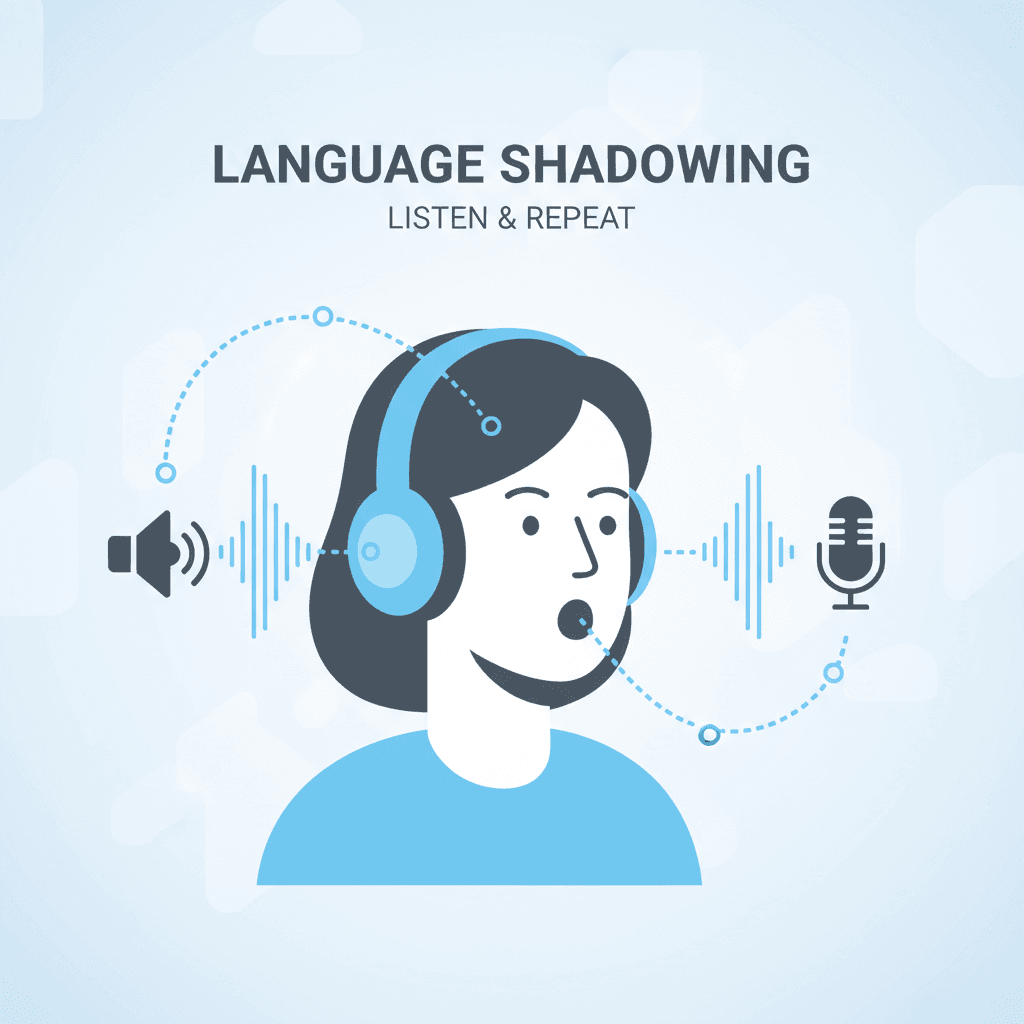
What if you could install the rhythm, flow, and music of a new language directly into your brain? It sounds like science fiction, but it’s the core promise of a powerful learning method that top polyglots swear by. If you’ve ever felt like you know plenty of words but can’t quite make them sound natural when you speak, you’re in the right place. This guide will walk you through exactly how to use shadowing for language learning, a technique that bridges the gap between passive listening and confident speaking. It might feel intimidating at first, but we've broken it down into a simple, actionable system to help you start speaking with more confidence, starting today.
What is Shadowing? (And the Science of Why It Works)
At its heart, the shadowing technique is beautifully simple: you listen to a native speaker and repeat what they say in real-time, like an echo or a shadow. You aim to mimic everything—their pronunciation, their rhythm, the rise and fall of their voice (intonation), and even their pauses. The technique was famously popularized by the American linguist and polyglot Professor Alexander Arguelles, who demonstrated it as a way to move beyond textbook learning and internalize the physical, spoken reality of a language.
But why is this mimicry so effective? The answer lies in how your brain processes language. Shadowing intensely engages your brain's 'phonological loop,' a crucial neural circuit for holding and processing speech sounds. When you passively listen, this loop is only partially engaged. But when you force yourself to listen and speak simultaneously, you're giving it a full workout. This strengthens the connection between hearing the sounds and producing them yourself, effectively rewiring your brain for better pronunciation and more natural speech patterns.
Further brain imaging studies support this, showing that learners who regularly practice shadowing exhibit efficiency gains in the left cerebellum—a part of the brain linked to the complex motor control required for speech. You aren't just learning words; you're training your brain and mouth to execute the physical act of speaking a new language fluently.
Is Shadowing the Right Technique for You Right Now?
Before you dive in, it’s helpful to do a quick 'readiness check.' While shadowing is incredibly powerful, it’s most effective when used at the right stage of your journey. Think of it as a specialized tool. If you're an absolute beginner (A1 level) just learning your first 100 words, shadowing might feel overwhelming. Your primary focus should be on building a foundational vocabulary and understanding basic grammar.
However, if you're a high-beginner to intermediate learner (roughly A2-B2 on the CEFR scale), shadowing is your secret weapon. This is the stage where you likely have a decent vocabulary but find your speech is slow, choppy, or heavily accented. You understand a lot, but you don't sound the way you want to. Research by Hamada (2016) confirmed this, showing that lower-intermediate learners saw significant improvement in their pronunciation with short, frequent shadowing sessions.
A landmark study at National Taiwan University reinforces this, finding that learners who practiced shadowing consistently saw significant gains not just in individual sounds, but in their overall intonation and fluency. If you're trying to close the gap between sounding like a learner and sounding more natural, the shadowing technique is precisely the tool you need. It trains the physical aspects of fluency, from your mouth's muscle memory to the natural rhythm and intonation (prosody) of native speech.
The 5-Step SpeaksyAI Shadowing System
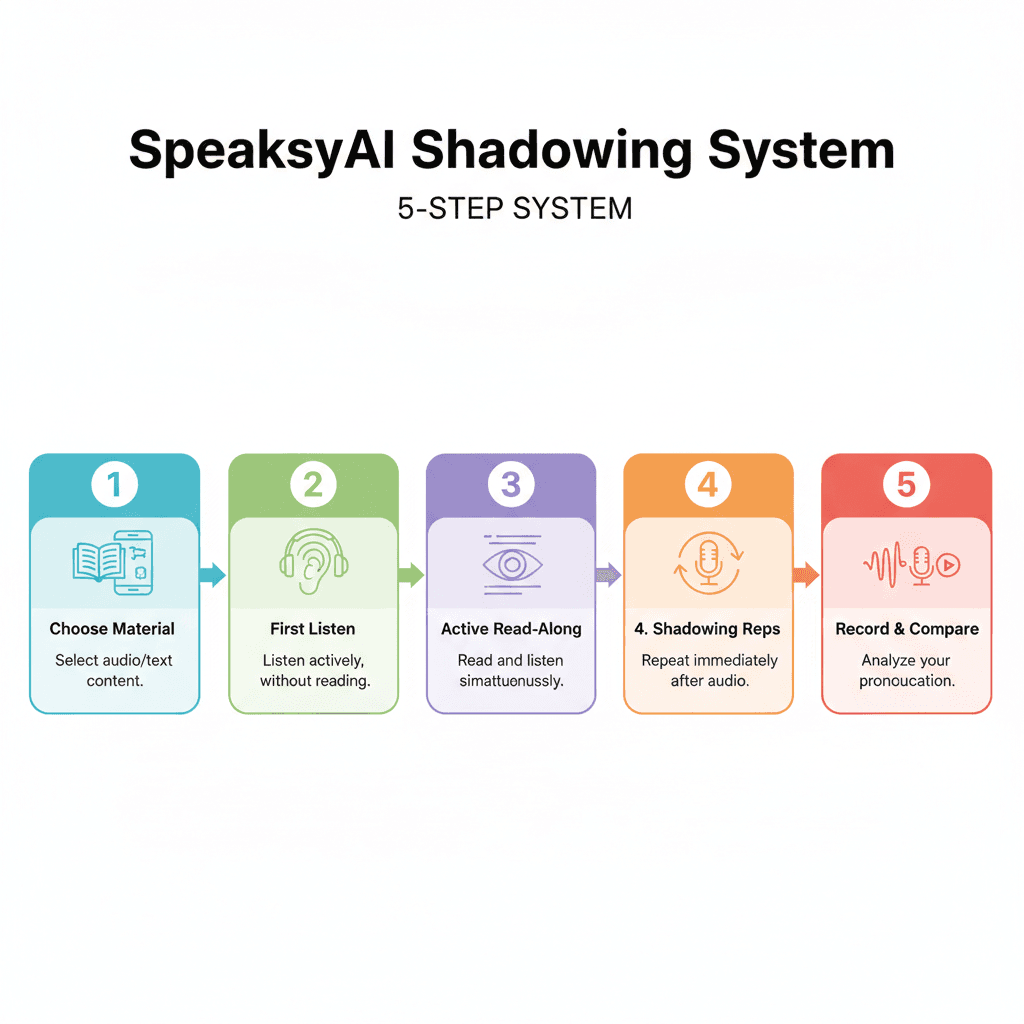
Ready to get started? We’ve distilled the best practices into a clear, five-step process. Forget the pressure to be perfect. Think of this as a workout for your mouth and your brain, not a performance. The first few times will feel messy, and that's not just okay—it's a sign you're pushing your limits and making progress. The goal is consistency, not perfection. A massive 2025 systematic review of 44 different studies confirmed that this kind of consistent practice provides positive evidence for improving speaking fluency and comprehensibility.
The key is breaking it down into manageable chunks. Research confirms that short, frequent sessions are far more effective than long, draining ones. So, grab your headphones, find a quiet spot for 15 minutes, and let's begin your first session.
Step 1: Choose Your Perfect Shadowing Material
This is the most critical step. The right material sets you up for success, while the wrong material can lead to frustration. Your ideal shadowing audio should meet a few key criteria: it should be short (30-90 seconds is perfect), spoken clearly by a native speaker, and come with a transcript. Most importantly, it should be just slightly above your comfort level—challenging enough to learn from, but not so difficult that you get lost. Research by Hamada (2016) validates this approach, showing significant improvement from short, frequent sessions with appropriate material.
- •Podcasts for learners: Shows like 'Duolingo Podcasts' or 'News in Slow Spanish' are designed for this, with clear audio and transcripts.
- •Audiobooks: Find a book you enjoy with a clear, single narrator. The pacing is often steady and easy to follow.
- •YouTube Channels: Look for channels with high-quality audio and accurate captions. TED Talks or educational creators are excellent sources.
- •Netflix shows: Advanced learners can use clips from shows, using extensions that provide dual-language subtitles.
Step 2: The First Listen (Comprehension)
Before you try to speak, you need to understand the context. Play your chosen 30-90 second audio clip once or twice without looking at the transcript. Don't stress about catching every single word. The goal here is simple: get the gist. What is the speaker talking about? What is the overall mood or feeling? This initial listen primes your brain for the content.
Some guides suggest aiming for about 80% comprehension at this stage before moving on. This ensures the material is at the right level for you. This step is crucial because it separates listening for meaning from listening for sounds. A 2025 study in 'Language Learning & Technology' found that learners who combined comprehension-focused listening with output activities like shadowing improved their fluency three times faster than those who only listened passively. You're building a foundation of meaning before you start building the sounds on top of it.
Step 3: The Active Read-Along
Now it's time to connect the sounds you heard with the words on the page. Play the audio again, but this time, read along with the transcript. This is your chance to fill in the gaps. Pause the audio to look up any key words or phrases you don't understand. Pay close attention to how the written words compress or link together in natural speech. You might see 'going to' written, but hear 'gonna'.
This 'read-along' is a recognized scaffolding technique that prepares you for true shadowing. It builds the critical bridge between your reading vocabulary and your listening vocabulary. Academic research supports this kind of preparatory step, with a September 2025 paper examining different 'flavors' of the shadowing technique, validating this as a crucial part of the process. You are actively training your brain to map sounds to text, which is essential for both listening and speaking.
Step 4: The Shadowing Reps (Practice)
This is the main event. Put the transcript away (or just don't look at it). Play the audio clip and, after a second or two, start speaking along with the narrator. Your goal is to stay as close to the speaker's timing as possible, like a shadow. Try to match their rhythm, their pitch, and their pronunciation. It will feel chaotic and messy at first. You'll stumble, you'll miss words, and you'll mumble. Celebrate this! It's the feeling of your brain and mouth being pushed to build new neural pathways.
Don't just do it once. Aim for 3-5 repetitions of the same audio clip. This isn't just a random number; research by Shiki et al. (2010) suggests that a learner's accuracy in repeating audio tends to plateau after four to five reps, making this an incredibly efficient way to practice. With each repetition, you’ll notice yourself getting a little closer, a little smoother, and a little more confident. You're actively keeping your brain's phonological loop engaged, which boosts the process of turning what you hear into a mental blueprint you can use later.
Step 5: The Cool-Down (Record & Compare)
On your final repetition, take out your phone and record yourself shadowing the audio. This step might feel uncomfortable, but it is arguably the most valuable. Most of us have no idea what we actually sound like in a foreign language. Recording provides objective, undeniable feedback. As one 2026 guide states, making a recording at week one and another at week four is 'the single clearest way to hear progress.'
Now, listen back to your recording and compare it to the original native speaker audio. Don't judge yourself harshly. Instead, listen like a detective. What did you nail? Maybe you got the rhythm of a particular phrase just right. Acknowledge that win! Then, identify one or two specific things to focus on next time. Perhaps you notice you're not pronouncing a vowel sound correctly, or your intonation is flat on questions. This targeted feedback, confirmed as effective by a study at National Taiwan University, is what turns mindless repetition into mindful, targeted practice and leads to significant gains in fluency and pronunciation.
Your Shadowing Toolkit: Recommended Materials by Level
Finding the right content is half the battle. To make it easier, here are some specific recommendations to get you started. Remember, the key is to choose level-appropriate materials. As research from Hamada (2016) shows, this is especially crucial for lower-intermediate learners to see significant improvement.
- •High-Beginner (A2): Focus on materials created for learners. The audio is often slower, clearer, and comes with full support. Examples include 'News in Slow Spanish' for Spanish, 'Coffee Break' language podcasts, and the Duolingo Podcasts, which cleverly mix English narration with target-language interviews.
- •Intermediate (B1/B2): You can start moving to content made for native speakers, but choose wisely. Look for clear, single-speaker audio. TED Talks are fantastic because they are scripted, well-articulated, and have interactive transcripts. Audiobooks with a good narrator or monologue-style YouTube videos are also excellent choices.
- •Advanced (C1+): At this level, you can challenge yourself with more complex, natural conversations. Try shadowing clips from TV shows and movies on Netflix (for example, 'Lupin' for French or 'Dark' for German). You can also use news broadcasts from sources like the BBC or NPR, or even fast-paced panel discussion podcasts.
The availability of great intermediate resources is growing every year. For instance, Duolingo, whose podcasts are a favorite for shadowing, reported a massive 23% year-over-year increase in daily active users in its Q2 2026 results, showing just how many learners are using these kinds of tools. There has never been a better time to find perfect shadowing material online.
Troubleshooting: How to Overcome Common Shadowing Hurdles
Even with a clear system, you're bound to hit a few bumps. That’s a normal part of the process! Here’s how to troubleshoot the most common challenges with an empathetic, problem-solving approach.
The speaker is too fast! I can't keep up.
This is the most common hurdle. The solution is simple: slow them down! Most platforms, including YouTube and many podcast players, allow you to adjust the playback speed to 0.75x. This small change can make a huge difference, allowing your brain the extra processing time it needs. Alternatively, it might be a sign that the material is too advanced. There's no shame in choosing a simpler audio clip; the goal is successful repetition, not frustration.
I feel so awkward and silly doing this.
Welcome to the club! Nearly everyone feels this way at first. The key is to start small. Commit to just one minute of shadowing. Do it in private—in your room, in your car, or while walking the dog. Remember the research by Hamada (2016): even short, frequent sessions produce significant results. By starting small, you prove to yourself that it's manageable, and the feeling of awkwardness quickly fades as you start to notice improvement.
I'm in a situation where I can't practice out loud.
You can still practice! Try 'silent shadowing,' where you mouth the words silently along with the speaker. You'll still be engaging the muscle memory in your mouth and jaw without making a sound. You can also try just humming the intonation and rhythm of the speech. A 2025 paper on different shadowing types supports these variations, showing that they still help internalize the prosody and flow of the language, making them a great option for when you need to be quiet.
From Shadowing to Speaking: Bridge the Gap with AI
Shadowing is an incredible tool, but it's not the final destination. Its purpose is to build the phonological awareness and muscle memory you need for the ultimate goal: confident, spontaneous conversation. A 2025 systematic review of 44 studies confirmed that shadowing is highly effective for building this foundation. Once you've practiced the rhythm and patterns of a phrase in a shadowing session, the next logical step is to use it yourself.
This is where you bridge the gap from mimicry to real communication. How do you take the words and structures you just practiced and make them your own? You need a safe, judgment-free space to experiment. You need to activate what you've learned.
This is where an AI language tutor like SpeaksyAI (at speaksyai.com) becomes your perfect practice partner. After a shadowing session where you’ve worked on, say, ordering food in French, you can immediately jump into a conversation with an AI tutor and role-play being in a French café. You can try using the exact phrases you just shadowed in a real, interactive context. This combination of isolated practice (shadowing) followed immediately by integrated practice (conversation) is what locks in learning and builds true fluency.
Industry analysis from 2026 highlights how AI conversation partners are transforming language learning by offering this kind of unlimited, on-demand practice. Some analyses even show that combining shadowing with AI-powered feedback is 'dramatically more effective' because the technology can provide instant, targeted guidance in a way that self-practice alone cannot. It's the perfect way to take what you've shadowed and make it part of your active, confident speaking ability.
Frequently Asked Questions about Shadowing
Frequently Asked Questions
Ready to Turn Shadowing into Real Conversation?
Shadowing builds the foundation. SpeaksyAI gives you the safe space to use it. Practice what you've learned in realistic conversations with our AI language tutor.
Join the Waitlist