How to Use Role-Playing for Language Learning (A 5-Step Guide)
Tired of knowing words but freezing in real conversations? Role-playing is the bridge to confident speaking. Discover how to use this powerful method, especially with an AI tutor, to practice real-world scenarios.

Why Your Brain Loves Role-Playing for Language Learning
You’ve studied the vocabulary lists. You’ve memorized the grammar rules. But when you try to speak, there’s a frustrating gap between what you know and what you can say. This is the single most common challenge for language learners, but there's a powerful and proven way to bridge that gap. Learning how to use role-playing for language learning is the key to turning passive knowledge into active, confident speech. Think of it as a flight simulator for conversation. It gives you a safe, controlled environment to practice, make mistakes, and build real-world experience before you 'fly' in a conversation with a native speaker.

Role-playing works because it taps directly into how our brains are wired to learn. Research on pretend play shows that participants often use higher and more complex forms of language than they would in other situations, actively stimulating language development. It’s not just about reciting lines; it’s about creating authentic communicative experiences. A 2023 conference paper highlighted that activities from basic dialogues to complex problem-solving scenarios promote learner autonomy, pushing you to think on your feet and use the language creatively.
Data-Backed Results: A systematic review scheduled for publication in 2025 demonstrated that role-playing techniques are exceptionally effective at improving the speaking skills and engagement of English as a Foreign Language (EFL) students. (Systematic Review, 2025)
This method does more than just sharpen your linguistic skills; it builds the confidence you need to use them. A 2025 study found that role-playing games (RPGs) foster crucial social-emotional competencies that are directly linked to speaking confidence. By practicing in a low-stakes environment, you learn to manage the fear of making mistakes, which is often the biggest barrier to fluency. This allows you to effectively practice communication skills and start speaking with assurance, celebrating those small wins along the way.
Furthermore, role-playing makes learning engaging. A pilot study from September 2025 discovered that students using RPG-based English teaching games showed significant vocabulary gains and a major boost in engagement. When you’re immersed in a scenario—whether you're negotiating a business deal or just ordering a pizza—you’re not just studying; you’re playing. This playful immersion makes practice feel less like a chore and more like an adventure, helping you stay motivated on your path to fluency.
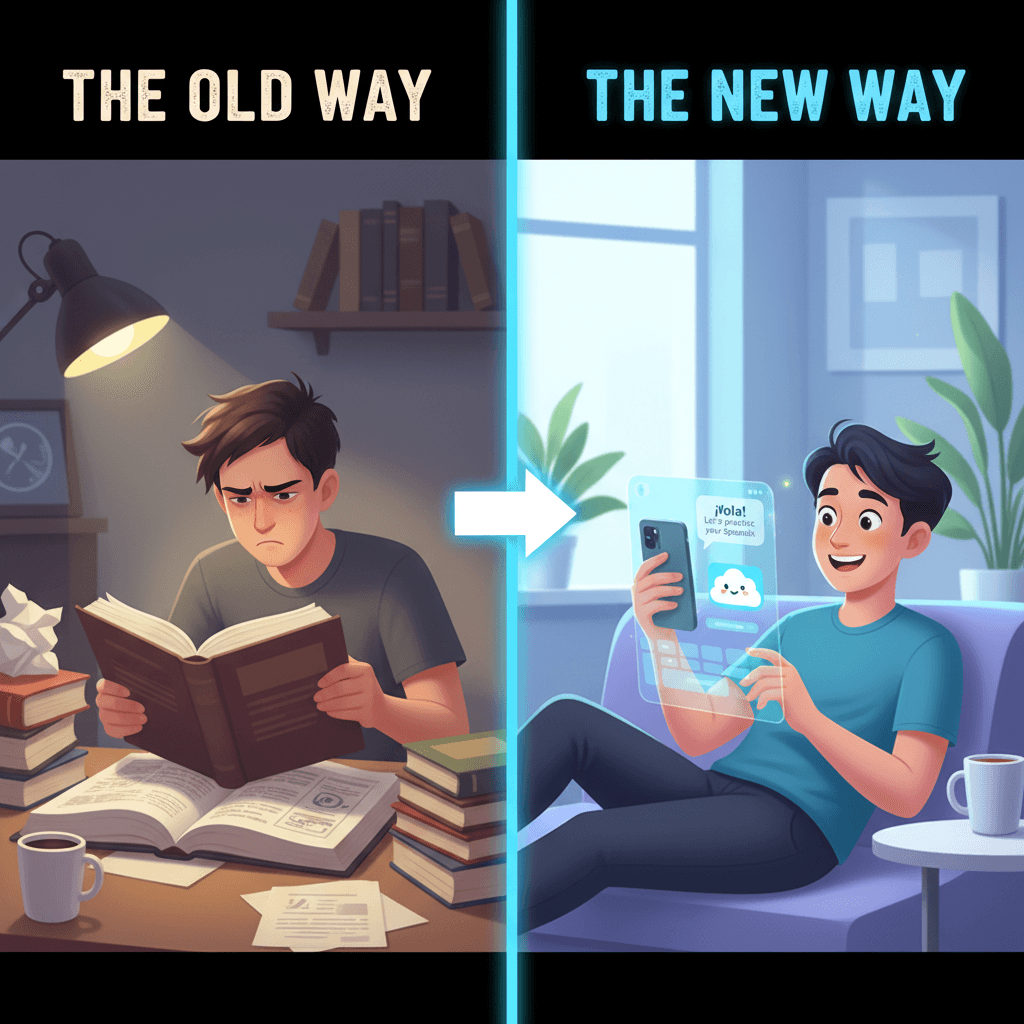
The Old Way vs. The New Way: Role-Playing with an AI Tutor
Traditionally, role-playing required finding a willing and patient partner. This came with a host of challenges: coordinating schedules, finding someone at the right skill level, and overcoming the natural performance anxiety that comes from practicing in front of another person. For many learners in the US, UK, India, or Australia, these logistical hurdles can make consistent practice feel nearly impossible.
Enter the new way: an AI language tutor role-play. Modern technology has revolutionized this practice, removing the friction and anxiety from the equation. An AI partner is available 24/7, possesses infinite patience, and offers a completely non-judgmental space to practice. You can try a scenario ten times in a row, stumble over your words, and ask for corrections without ever feeling like you're being a burden. This 'safe space' for practice is a core focus for leading platforms, as it's proven to reduce the performance anxiety that holds so many learners back.
This evolution is driven by what researchers call Role-Playing Language Agents (RPLAs). Powered by advanced Large Language Models (LLMs), these aren't just simple chatbots. They are sophisticated cognitive simulations designed with personality models and memory, making interactions feel incredibly realistic and adaptive. A 2024 paper investigating the effect of a GenAI agent on students' speaking performance confirmed the positive impact of this modern approach, validating the shift toward AI-powered practice.
The AI Advantage: The results speak for themselves. A 2025 study found that students who used AI conversation tools for role-playing showed a staggering 75% improvement in their overall speaking scores over an eight-week period. This demonstrates how scalable and effective AI-driven practice can be.
The 5-Step Framework for Your First AI Role-Play Session
Getting started with an AI role-play is easier than you think. This simple, 5-step framework will guide you through your first session, helping you build a powerful new practice habit from day one.
Step 1: Choose Your Scene (Start Simple)
Don't try to negotiate a complex business contract on your first attempt. Start with a simple, high-frequency scenario you are likely to encounter in real life. Think about ordering a coffee, buying a train ticket, or asking for directions. These low-stakes situations help you build momentum and gain confidence right away. The goal is to make your first experience a success.
Step 2: Set the Stage (Prompting Your AI)
Your AI tutor is a powerful tool, and a good prompt is how you aim it. Be specific about the context. A 2024 guide to using AI recommends crafting detailed prompts that define the AI's persona and interaction style. Instead of saying 'Let's practice ordering food,' try this: 'You are a friendly waiter at a restaurant in Rome. I am a tourist. I will ask you for a table and order a meal. Please ask me what I'd like to drink and recommend a dessert.' This level of detail creates a much more dynamic and realistic scenario.
Step 3: Play Your Part (Embrace Imperfection)
Now, just dive in. The most important part of this step is to let go of the fear of making mistakes. This is a private practice session, not a performance. A 2025 systematic review found that role-playing is effective precisely because it helps learners overcome their fear of grammar errors, which in turn improves fluency and pronunciation. So, embrace the imperfection and focus on communicating your message.
Step 4: Get Instant Feedback (The AI Advantage)
Here's where an AI tutor truly shines. After your conversation, you can get immediate, detailed feedback. Unlike practicing with a human partner who might not want to interrupt or correct you, an AI can provide a full breakdown of your performance. Platforms like SpeaksyAI are designed to pinpoint errors in grammar, suggest better vocabulary choices, and even analyze your pronunciation, giving you a clear roadmap for what to improve.
Step 5: Replay & Refine (Building Muscle Memory)
Don't just do a scenario once. Take the feedback from Step 4 and immediately replay the scene. Try to incorporate the corrections and suggestions. This act of repetition is what builds conversational muscle memory. It’s how phrases and grammar structures move from being conscious, clunky calculations in your head to smooth, automatic responses. A 2025 study noted that RPG elements boost engagement and vocabulary—this is the same effect you create by replaying and refining your performance.
15 Ready-to-Use Role-Play Scenarios (Beginner to Advanced)
One of the biggest hurdles to starting is thinking of what to practice. These ready-to-use language learning scenarios are designed to get you speaking immediately. Remember, empirical evidence from 2025 links role-playing to improved speaking fluency and reduced anxiety. A 2026 study even found it can improve speaking achievement by 11.8% compared to traditional methods. Pick a scenario below and prompt your AI tutor.
A1-A2: Everyday Essentials
- •Ordering coffee and a pastry at a cafe.
- •Buying a ticket for a train or bus.
- •Introducing yourself to a new person at a casual gathering.
- •Asking a stranger for directions to the nearest subway station.
- •Checking into a hotel and confirming your reservation.
B1-B2: Complex Conversations
- •Returning a faulty electronic item to a store and asking for a refund.
- •Explaining a problem to a landlord (e.g., a leaky faucet or broken appliance).
- •Participating in a casual job interview for a part-time position.
- •Making a doctor's appointment and describing your symptoms clearly.
- •Disagreeing politely with a friend's opinion on a movie or book.
C1-C2: Nuanced Negotiations
- •Debating a nuanced current event, like climate policy or economic trends.
- •Negotiating a salary and benefits package for a new job.
- •Handling a complaint from an angry customer with empathy and professionalism.
- •Persuading a team of colleagues to adopt your idea for a new project.
- •Participating in a formal business meeting and making a strategic recommendation.
Beyond Scenarios: Targeting Grammar and Tone with Role-Play
Role-playing is more than just a tool for practicing situations; it's a precision instrument for targeting your specific weaknesses. You can move beyond general scenarios and design practice sessions that focus on mastering difficult grammar points or understanding social tone.
To work on grammar, set a specific rule for your AI tutor. For instance, you could prompt it with: 'Let's role-play a conversation about our weekend plans. For this entire conversation, I want you to correct every single mistake I make with past-tense verbs.' As a 2026 study on young learners found, role-play games provide an effective way to practice and reinforce specific English grammar structures. This transforms a general conversation into a targeted, high-impact grammar drill.
You can also use role-playing to master tone and formality, a common challenge for advanced learners. Try this prompt: 'We are going to role-play asking for a favor. First, you will be my close friend. Then, we will do it again, but you will be my boss. I need to practice using polite, formal language.' This type of exercise builds an intuitive understanding of how to use grammar and vocabulary correctly in different social contexts, a benefit highlighted by the European Journal of English Language Teaching.
The role-play technique helps English as a Foreign Language (EFL) students improve their speaking skills, including specific aspects like fluency, pronunciation, and grammar.
Overcoming the 'Cringe Factor': How to Feel Less Awkward
Let’s be honest: talking to yourself or a computer can feel a bit strange at first. This 'cringe factor' is a real emotional barrier, but it’s one you can easily overcome with the right mindset and strategy. Remember, the proven benefits are worth pushing through a few moments of initial awkwardness.
- 1.Start with an AI, Not a Person: The number one way to reduce awkwardness is to remove the social pressure. An AI tutor is a tool, not an audience. It has no ego, no judgment, and no impatience. As industry analysis from 2026 notes, this non-judgmental environment is a key reason why AI-powered role-playing is becoming so popular.
- 2.Keep It Short and Sweet: You don't need to perform an epic drama. Start with focused, 5-minute sessions. The goal is building a consistent habit, not winning an Oscar. Short, frequent practice is far more effective than long, infrequent sessions.
- 3.Prepare a 'Cheat Sheet': Before you start, jot down 5-10 key words or phrases you want to use. This isn't cheating; it's preparation. It gives you a safety net and helps you focus on specific learning goals for the session.
- 4.Reframe It as a Private Workout: Think of role-playing as a private gym for your mouth and brain. You're there to do reps, build muscle, and improve your form. No one is watching. Research from 2025 confirms that the perceived safety of a learning environment is critical to a student's willingness to communicate.
- 5.Make It a Game: Turn practice into play. Challenge yourself to use three new idioms in a conversation. See if you can complete a scenario without looking at your notes. A 2025 pilot study showed that game-like elements significantly boost engagement, proving that fun is a powerful learning tool.
The Science of Success: Why This Method Works
This isn't just a fun new approach; it's a method grounded in solid educational science. For anyone wondering how to use role-playing for language learning effectively, the answer lies in its proven ability to engage multiple aspects of cognition, memory, and social-emotional learning. The data consistently shows that it delivers real, measurable results for learners committed to achieving fluency.
Quantifiable Improvement: A comprehensive 2025 systematic review confirmed that role-play techniques measurably improve the speaking skills of EFL students. Backing this up, a separate 2025 study in Ghana quantified the benefits, showing remarkable improvements including a 32% increase in vocabulary and a 27% increase in grammar accuracy among students using the method.
A key reason for its success is engagement. A September 2025 pilot study on RPG-based teaching games found they led to significant vocabulary gains and had overwhelmingly positive effects on student engagement. This mirrors the experience of using an AI for solo language learning scenarios. By transforming practice from a passive chore into an active, immersive game, you stimulate the brain's reward centers, making the learning process more enjoyable and sustainable.
Ultimately, the method works because it creates a direct path from theory to practice. It provides a space where you can freely express yourself, experiment with language, and learn to manage real-world situations with appropriate and effective communication. As a 2025 review noted, this enjoyment and freedom are critical components of successful language acquisition, helping you build not just a bigger vocabulary, but lasting confidence.
Frequently Asked Questions About Role-Playing
Frequently Asked Questions
Ready to Be Your Own Role-Play Partner?
SpeaksyAI is the 24/7 AI language tutor that lets you practice infinite scenarios without judgment. Get instant feedback and finally speak confidently.
Join the Waitlist