How to Use Movies to Practice Speaking a Language: A System
Turn movie night into your most effective speaking workout. This guide shows you how to use movies to practice speaking a language with a system that goes beyond watching.
Have you ever binged a foreign film, hoping to absorb the language through osmosis, only to find you still can't form a sentence when it counts? You're not alone. Many learners believe that passive watching will magically improve their speaking, but it rarely does. The secret isn't just watching more movies—it’s knowing how to use movies to practice speaking a language in an active, focused way. It’s time to stop being a passive viewer and start treating movie time as an energizing workout for your speaking muscles. This guide will show you exactly how to do it.
Why Just Watching Movies Isn't Enough for Speaking Practice
Let's be clear: watching movies in your target language is fantastic for your listening skills. But listening is only half the battle. Speaking is an active skill that requires muscle memory in your mouth, tongue, and brain. Just like you can't learn to swim by watching videos of swimmers, you can't learn to speak by only listening. You need to engage, repeat, and produce the language yourself.
The difference between passive viewing and active practice is what separates stalled learners from fluent speakers. Research confirms this. A 2025 study highlighted that watching English movies has a significant positive impact on speaking skills, but only when learners use them to actively improve pronunciation, intonation, and vocabulary. The key is engagement. For your speaking to improve, you must use films to listen for and capture specific language elements like stress, accent, and rhythm—not just to follow the plot.
Think of it this way: passive watching is like sitting on the sidelines. Active practice is getting on the field and running the plays. A 2026 study found that using same-language subtitles (intralingual) produces the strongest results for learning vocabulary, reinforcing the need for active engagement. By turning a movie into an interactive tool, you transform a leisure activity into a powerful language learning session.
Step 1: Choose Your Practice Scene Like a Pro
The first mistake many learners make is trying to practice with an entire movie. This is overwhelming and inefficient. The goal isn't to memorize a two-hour film; it's to master a small, manageable chunk of dialogue. A great practice scene acts as a focused, high-intensity workout.
- •Keep it Short: To maintain focus and avoid frustration, experts recommend choosing a movie excerpt that is no longer than one to three minutes. This is short enough to repeat multiple times without getting bored.
- •Pick a Familiar Film: For beginners, using a scene from a movie you already know is a great strategy. Since you understand the context, you can focus all your energy on the language itself.
- •Consider the Genre: If your goal is to learn practical, everyday language, choose scenes from sitcoms or dramas over fantasy or sci-fi films. The dialogue in a show like Friends will be far more useful for daily conversation than dialogue from The Lord of the Rings.
- •Find a Role Model: Choose a scene that features a character whose accent and speaking style you admire. This makes the process of imitation—a core part of the movie language learning method—much easier and more motivating.
The Dialogue Density Check
Not all scenes are created equal. Avoid long monologues, action sequences with little talking, or scenes with complex, poetic language. You're looking for scenes with high 'dialogue density'—quick, natural, back-and-forth conversations between two or more characters. This gives you more short, repeatable lines to practice. A 2025 study confirmed that mimicking the natural rhythm of conversations is key to improving pronunciation and intonation. These short exchanges are the building blocks of real-world fluency.
The 'Goal-Relevance' Filter
Why are you learning this language? To travel, for business, to connect with family? Let your goals guide your scene selection. Movies are an 'endless resource' for real language in context, so find scenes that match your needs. If you want to get better at small talk, find a party scene. If you have a business trip to the US or UK, find a scene set in an office. A 2026 analysis showed that clearly defined goals improve performance, so focus your practice on scenarios you'll actually face. This makes your learning incredibly efficient and relevant.
Step 2: The 'SpeaksyAI Movie Method' for Active Practice
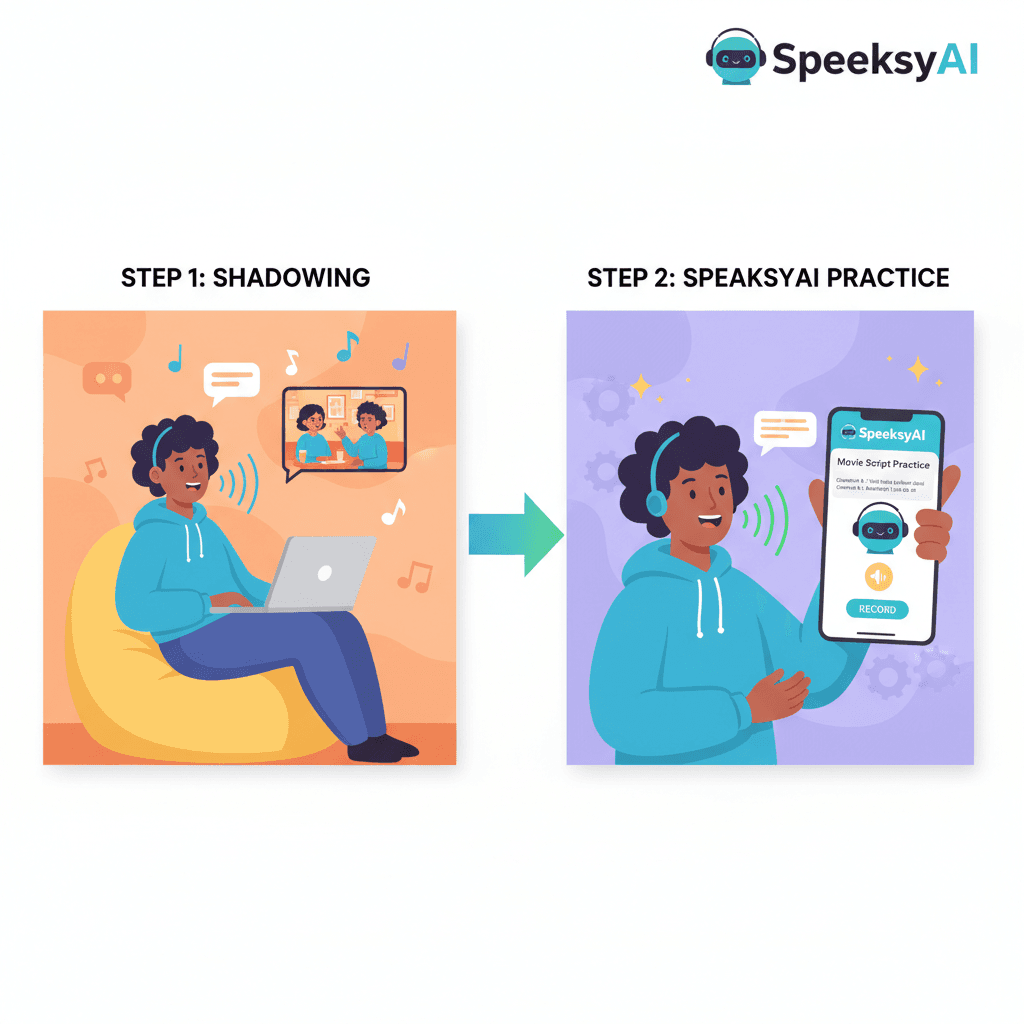
Once you have your perfect scene, it's time to put it to work. This is where you move from passive watching to active role-play. We call this the SpeaksyAI Movie Method, a three-phase system designed to take you from mimicking lines to speaking with confidence. It’s built on the idea that active, structured practice yields the best results.
This isn't just theory; it's backed by research. A 2025 study found that active techniques like shadowing—which we'll cover next—are essential for turning a scene into an effective speaking workout. Furthermore, a 2025 study showed that learners using AI-powered tools for speaking practice achieved 'substantial improvements' in proficiency. This method combines both to give you a powerful framework for progress.
Phase 1: Shadowing for Rhythm and Pronunciation
Shadowing is a powerful technique where you repeat a character's lines immediately after you hear them. The goal is not just to say the words, but to copy everything—the intonation, the stress on certain syllables, the rhythm, and the emotion. A systematic review of research confirmed that shadowing is highly effective for improving pronunciation, fluency, and the natural melody of speech.
- 1.Play one line of dialogue from your chosen scene.
- 2.Pause the video immediately.
- 3.Repeat the line out loud, trying to match the actor's delivery exactly.
- 4.Focus on how words connect together for a smoother flow.
- 5.Repeat this process for the entire 1-3 minute scene.
Don't worry about being perfect on the first try. This is a workout! As a 2025 study concluded, this kind of practice directly helps students improve pronunciation and intonation. For targeted feedback, modern AI language tutors can analyze your speech as you repeat lines, helping you pinpoint and correct mistakes.
Phase 2: Role-Play the Scene with an AI Language Tutor
After you’ve shadowed the lines and feel comfortable with the pronunciation, it’s time to truly perform. This is where you can use an AI conversation partner to role-play the scene. This step is crucial because it moves you from pure mimicry to interactive dialogue. A February 2025 study found that an AI-supported learning model significantly improved students' role-play performance and speaking skills.
With a tool like SpeaksyAI (at speaksyai.com), you get a safe, judgment-free environment to practice. You can give the AI a simple prompt: “Let’s role-play a scene from a movie. You are Character A, and I am Character B. You say the first line.” Then, you act out your part. This on-demand practice fills the 'speaking gap' that many apps leave open, building your confidence for real-life conversations.
Step 3: Go Beyond the Script to Build Real Fluency
Memorizing a script is a great start, but true fluency means being able to speak spontaneously. The final step of the movie language learning method is to use the scene as a launchpad for genuine, creative conversation. This is how you bridge the gap between repetition and real-world interaction. It's about taking the vocabulary and sentence structures you've learned and making them your own.
A 2025 action research study found that when students had opportunities to 'comment on observations' from a movie, their confidence in oral production soared. Using movies for language practice helps decrease learner anxiety by providing exposure to authentic conversations, which encourages the risk-taking needed for spontaneous speech.
Summarize and Discuss the Scene
After you’ve practiced the scene, challenge yourself to activate your passive vocabulary. Turn to your AI tutor and summarize the scene in your own words. Explain what happened, describe the characters' motivations, and share your opinion on their actions. This forces you to recall and use words you might recognize but don't typically say. A 2026 study showed learners using films saw a 22.2% vocabulary increase, and this effect is amplified when you actively discuss the material to move words from passive to active memory.
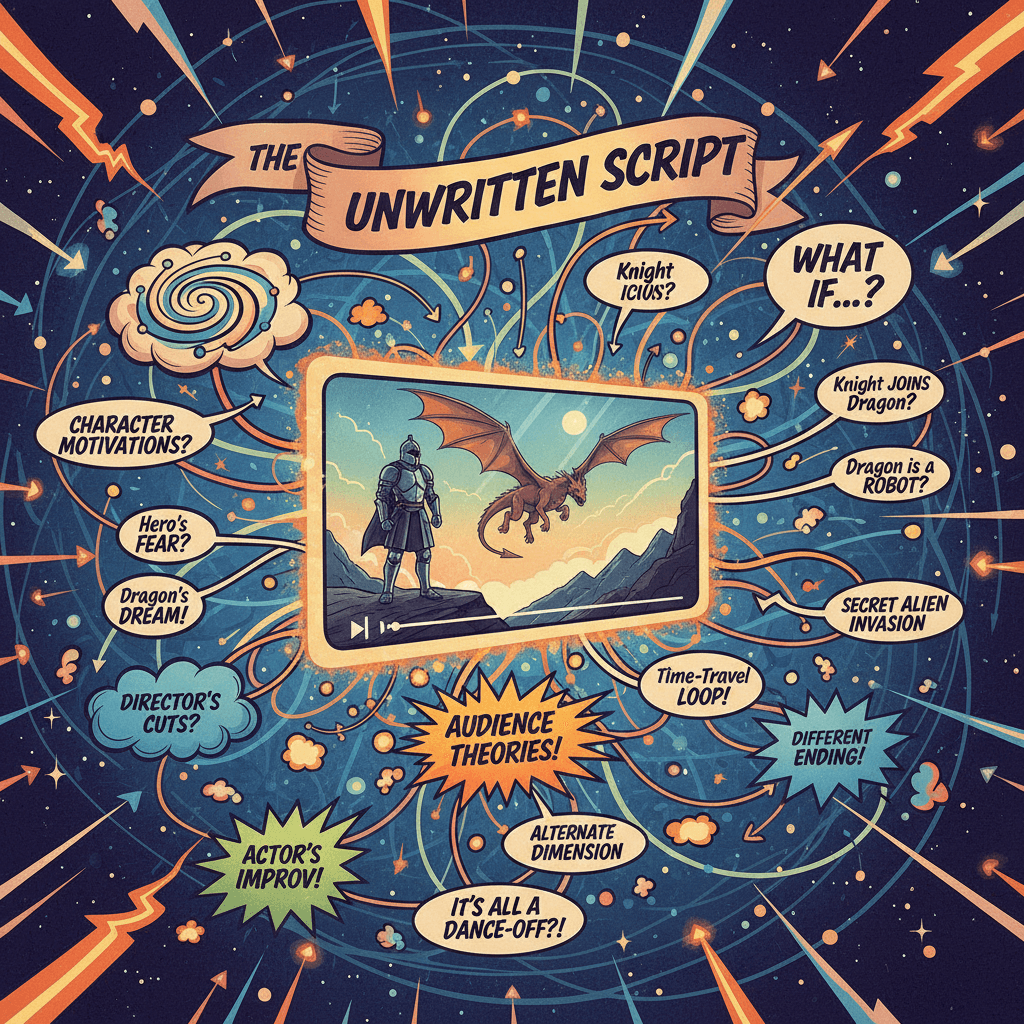
Create 'What If' Scenarios
This is where you build true conversational agility. Go back to your AI tutor and create 'what if' scenarios, also known as counterfactuals. For example, prompt the AI: “Let’s continue the scene, but what if my character said ‘no’ to your offer instead?” This simple twist forces you to think on your feet and produce novel sentences, moving beyond the script. This practice is a core part of the SpeaksyAI Movie Method because it shifts you from repeating lines to the creative, spontaneous language generation required for real-world flexibility.
FAQ: Using Movies for Language Speaking Practice
Frequently Asked Questions
Ready to Turn Movies into Speaking Practice?
SpeaksyAI is the AI language tutor that lets you role-play scenes and get instant feedback. Stop watching and start speaking confidently.
Join the Waitlist