How to Use Humor in a Foreign Language: A 4-Step System
Mastering humor in a new language feels like the final test of fluency. This step-by-step system will help you understand cultural jokes and tell your own to speak confidently.
Have you ever been in a conversation in a new language, following along perfectly, only for everyone to burst out laughing at a joke that went completely over your head? It’s a common feeling, and it highlights a crucial truth: understanding humor is often the final frontier of language learning. But what if you had a clear roadmap to navigate this tricky terrain? This guide provides exactly that. We’ll show you how to understand and use humor in a foreign language not just to get a laugh, but to build deeper connections and finally speak with the confidence you’ve been working toward. This isn’t about memorizing jokes; it’s about grasping the culture behind the comedy.
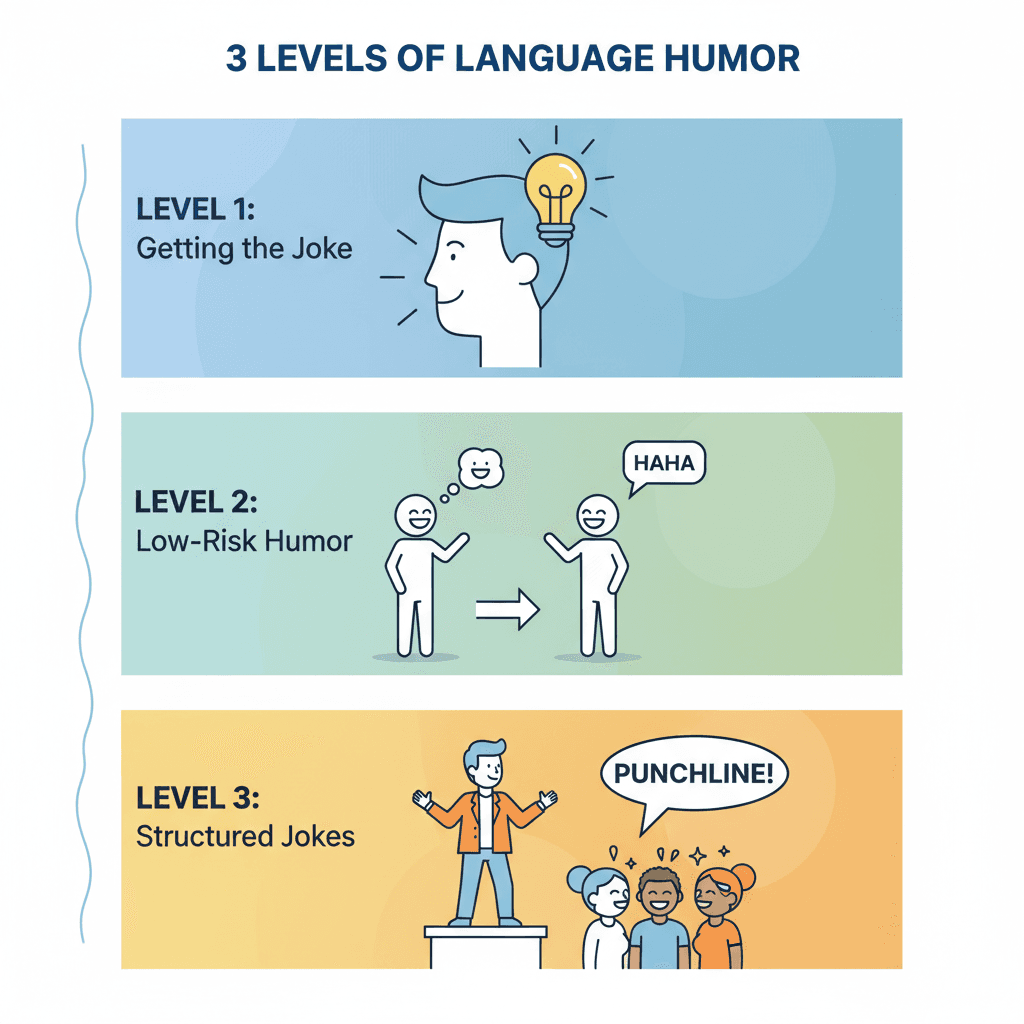
Why Humor is the Final Boss of Language Learning
If learning a language is like a video game, then grasping humor is the final boss battle. It requires you to use every skill you’ve acquired—vocabulary, grammar, pronunciation—and combine them with a whole new set of abilities: cultural awareness, timing, and an understanding of shared social cues. It’s the ultimate sign that you’re moving beyond textbook knowledge and into the realm of true, native-like fluency. Why? Because humor is deeply woven into the fabric of a culture.
Achieving ‘humor competence’ is considered a final challenge even for advanced language learners because it requires a complex combination of both linguistic and deep cultural knowledge.
A joke that’s hilarious in the US might be confusing in the UK or completely miss the mark in India. A study from April 2024 confirmed this, identifying that the difficulty in understanding cross-cultural humor stems from fundamental differences in social systems, norms, cognition, and core values. Humor isn't just about the words. Researchers describe it as a 'multi-modal and context-sensitive' resource. This means you have to interpret non-verbal cues, tone of voice, and the social situation to truly get the joke. It's the difference between translating a sentence and truly understanding its meaning and intent.
The 3 Levels of Language Humor: A Learner's Roadmap
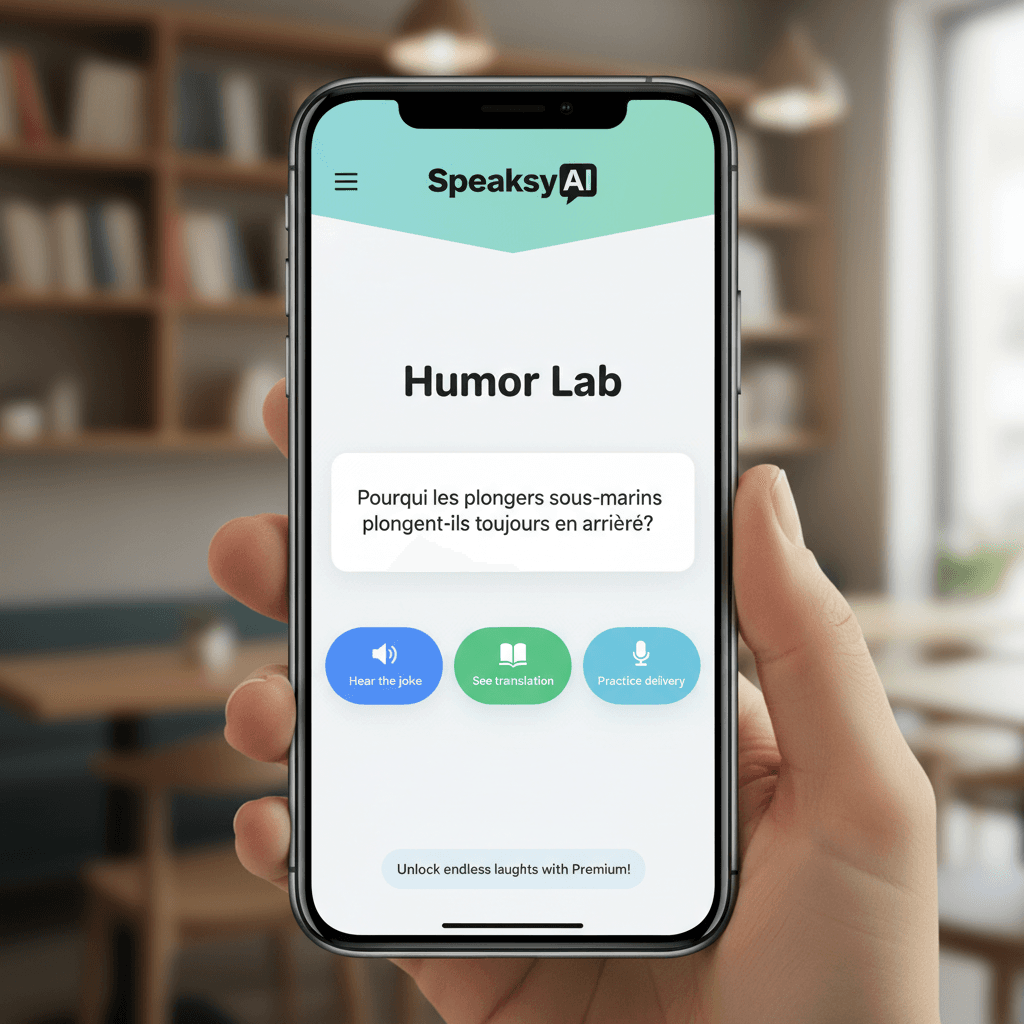
Trying to go from zero to telling complex, witty stories can feel overwhelming. That’s why we’ve created The SpeaksyAI System for Understanding Humor—a clear, three-level roadmap to guide you. This framework breaks down the process into manageable stages, helping you build your skills progressively. You’ll move from simply understanding what’s funny (passive use) to making others laugh yourself (active use), all while building confidence and making language learning fun.
This journey isn’t just for fun; it’s a strategic way to accelerate your learning. A March 2024 study in AMERICAN JOURNALS found that humor can lower the affective barriers to learning, creating a safer environment where you feel more comfortable experimenting with new words and phrases. The goal is to gradually expand your comfort zone, one small win at a time.
Level 1: Passive Understanding (Getting the Joke)
Your first goal isn’t to be a comedian; it’s to be a good audience member. This level is all about exposure and observation. You’re training your brain to recognize the patterns, rhythms, and cultural references that make something funny in your target language. Think of yourself as a detective, gathering clues from the world around you. This is a crucial first step toward bridging the gap between basic vocabulary and deep cultural understanding.
- •Watch sitcoms and comedies: Start with subtitles in your own language, then switch to subtitles in the target language. Pay attention to when the laugh track plays. What just happened? What was the cultural reference?
- •Follow meme accounts: Memes and cartoons are powerful learning tools. They often combine simple text with a visual, providing instant context. Find popular meme accounts from your target country (e.g., from Australia or Canada) and see if you can figure out the joke.
- •Listen to comedy podcasts: This is great for tuning your ear to the rhythm and timing of conversational humor. Don't worry if you don't understand everything; just soak it in.
As you consume more humorous content, you’ll start to notice patterns. According to one study, this process helps you build 'humor convergence,' allowing you to understand different types of humor like irony or sarcasm and build stronger social bonds with native speakers. You're not just learning words; you're learning a new way of seeing the world.
Level 2: Active Use with Low-Risk Humor
Once you start ‘getting’ about 50% of the jokes you hear, it’s time to dip your toes into active use. But you don’t have to start by trying to tell a complicated joke. The key at this stage is to use ‘low-risk’ humor that is safe, simple, and often builds connection rather than aiming for a huge laugh. This is where you can turn your own learning journey into a source of gentle comedy.
Some of the safest and most effective types of humor for learners include self-deprecation about your language skills ('My Spanish is strong, but my accent is a mystery!') or making simple observational jokes about a shared experience, like the weather or a delicious meal. This type of humor lowers your ‘affective filter’—the emotional barrier to learning—and signals to others that you’re friendly and don’t take yourself too seriously. It’s also a fantastic way to develop your ‘pragmatic competence,’ or the ability to use language appropriately in real social situations.
Level 3: Active Use with Structured Jokes & Sarcasm
Welcome to the advanced level. Here, you’ll move from spontaneous observations to more structured forms of humor. This includes learning how to tell a joke in a foreign language using common formulas. Many cultures have them, like the ‘An Englishman, an Irishman, and a Scotsman…’ format in the UK. Learning these structures gives you a template to work with. However, be aware that these often rely on stereotypes and can be a minefield if you don’t understand the specific cultural context in humor.
This level also includes the art of sarcasm. Sarcasm is notoriously difficult because its meaning is often the opposite of the words being said. Its effectiveness depends entirely on tone, context, and the relationship between the speakers. What might be perceived as playful teasing in one culture could be seen as rude or aggressive in another. As research from 2017 highlights, sarcasm is a double-edged sword: it can be used to build solidarity with a group or to create distance and cause offense. Proceed with caution!
The SpeaksyAI System for Practicing Humor (Safely)
The biggest barrier to practicing humor is often the fear of failure. What if no one laughs? What if you offend someone? This is where technology can be your secret weapon. Using an AI language tutor as a ‘humor practice partner’ gives you a private, pressure-free space to experiment. With a tool like SpeaksyAI, you can analyze jokes in another language and role-play conversations without any social risk.
- 1.Deconstruct a Joke: Find a joke or meme online and bring it to your AI tutor. Use a prompt like: 'Explain this joke in Spanish to me. What cultural knowledge am I missing?' This helps you see the hidden layers of meaning.
- 2.Role-Play a Scenario: Set up a low-stakes situation to practice your delivery. Try this prompt: 'Let's role-play. We are at a cafe in Paris, and I want to try telling a simple observational joke. You be the barista.'
- 3.Get Delivery Feedback: The best joke can fall flat with poor delivery. Record yourself telling a short joke and ask your AI tutor: 'Listen to this and give me feedback on my pronunciation, pacing, and tone. Do I sound natural?'
This systematic approach removes the guesswork and anxiety from the process. Research on AI safety in 2024 even explored a 'Humor Evaluation Harness' to ensure AI-generated jokes are appropriate, highlighting how technology can create a safe practice environment for learners. It’s the perfect way to build the confidence you need before trying out your new skills with native speakers.
The Graceful Recovery: What to Do When a Joke Fails
Let's be honest: it’s going to happen. You’ll tell a joke, and it will be met with silence or confused looks. Every single native speaker has experienced this, so as a learner, you are in good company! The key isn’t to avoid failure, but to have a plan for how to recover gracefully. Having a few phrases in your back pocket can turn an awkward moment into a charming one.
- •"Oops, that must have lost something in translation!" (A classic that immediately explains the situation.)
- •"Well, that worked much better in my head!" (A self-deprecating and relatable recovery.)
- •"And that's the end of my career in comedy." (Shows you don't take yourself too seriously.)
Remember, a joke failing in a cross-cultural setting is rarely a reflection on you. A 2024 study confirmed that these misfires are often due to deep-seated differences in social norms and values. In fact, failed humor is such a normal part of communication that researchers have created a formal 'typology' to categorize the different ways a joke can go wrong. So when it happens, just smile, use one of your recovery phrases, and move on. You're not failing; you're learning.
Frequently Asked Questions
Ready to Practice Your Humor Skills?
Get feedback on your joke delivery and practice conversations with SpeaksyAI, your personal AI language tutor.
Join the Waitlist