How to Tell a Story in a Foreign Language: A 4-Step System
Telling a story is the ultimate test of speaking confidently. This guide gives you a simple, step-by-step system to craft and share your first story, no matter your level.

Why Storytelling is Your Ultimate Speaking Test
What if the single best way to prove you can speak a new language wasn't acing a grammar test, but simply telling a good story? For many learners, this feels like the final boss of language learning. But learning how to tell a story in a foreign language is more than just an advanced skill—it’s the ultimate test of your confidence and ability to truly connect with others. It’s where vocabulary, grammar, and cultural understanding all come together in a meaningful, memorable way.
This isn't just a feeling; it's backed by solid research. A landmark 2025 study confirmed that storytelling-based instruction leads to significant improvements in speaking skills, learner engagement, and the retention of new vocabulary and grammar. When you tell a story, you’re not just reciting words; you’re organizing your thoughts, expressing emotions, and making your ideas come alive for someone else. This active process solidifies language in your brain far more effectively than passive memorization.
Our brains are fundamentally wired for narrative. Think about it: you're far more likely to remember a friend's anecdote than a dry list of facts. In fact, research updated in 2025 found that people are 22 times more likely to remember facts when they are delivered as part of a story. This is because stories engage us emotionally and cognitively, creating stronger neural connections. The language learning industry is taking note, with a clear trend toward emphasizing productive skills like speaking and writing. The goal is authentic communication, and storytelling is the most authentic form there is.
The SpeaksyAI Storytelling System: Your 4-Step Framework
Feeling intimidated? That's completely normal. The idea of weaving a narrative in a new tongue can feel like a mountain to climb, especially when you're still mastering basic sentences. That’s why we developed the SpeaksyAI Storytelling System—a clear, step-by-step framework designed to take you from single words to your first simple story with confidence.
This system isn't about becoming a master novelist overnight. It's about taking small, consistent, and encouraging steps. This approach is supported by a 2026 study from MeloLingua, which found that effective story-based practice for A1-B2 learners can involve daily sessions of just 10–20 minutes with content you can mostly understand (about 80-95%). Our system is built on this principle of manageable micro-practice.
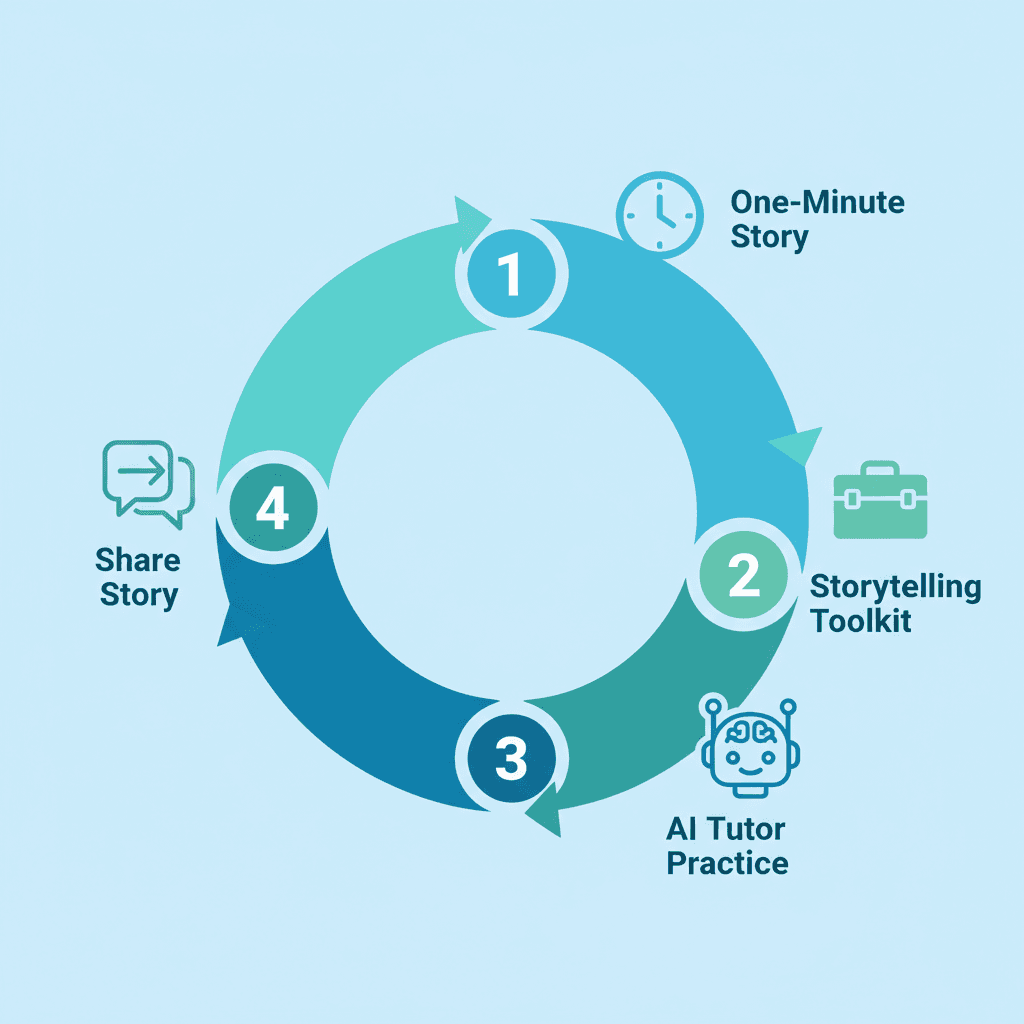
We'll break down this seemingly huge task into four achievable parts: creating a simple story framework, building a practical toolkit of phrases, practicing with targeted feedback, and sharing your story in a low-pressure way. Let's begin.
Step 1: The 'One-Minute Story' Framework
Forget complex plots, surprising twists, or deep character development. Your first goal is to master the 'One-Minute Story.' This is a tiny narrative that you can create, practice, and perfect in a short amount of time. It's the perfect way to fill those 10-20 minute daily practice sessions and build a powerful habit without feeling overwhelmed.
The secret to the One-Minute Story is a structure you already know: a Beginning, a Middle, and an End. By focusing on this foundational template, you simplify the task of speaking and give your narrative a clear, logical flow. It’s a simple story in a foreign language, designed to be achievable.
- •Beginning: Introduce a character and a setting. (Example: 'Yesterday, a woman was in the park.')
- •Middle: Describe a single, simple action or event. (Example: 'She saw a dog playing with a ball.')
- •End: State the outcome or the character's feeling. (Example: 'It made her smile.')
That’s it! It might feel incredibly basic, but you’ve just told a complete story. You've introduced a character, described an event, and provided a resolution. This is the bedrock of all storytelling and a direct way to build the productive speaking skills that modern language learning celebrates. You've taken your first step.
Step 2: Build Your Storytelling Toolkit
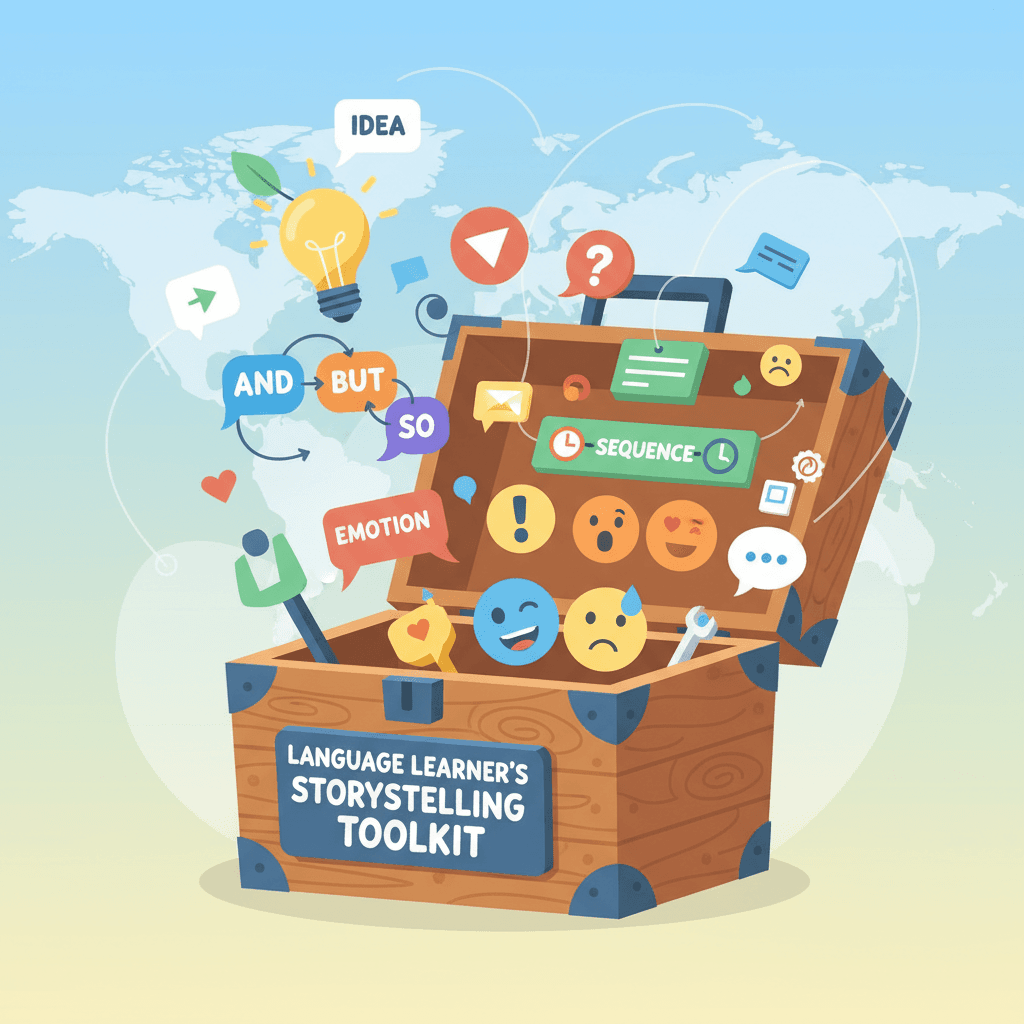
Now that you have a structure, you need the right tools to assemble it. Your 'Storytelling Toolkit' is a collection of essential phrases that act as the glue for your narrative. They help you connect ideas smoothly and signal to your listener where you are in the story. Mastering these will make your storytelling for language learners feel much more natural.
Start by learning a few key transition words. These are your signposts:
- •To start: First..., In the beginning..., It all started when...
- •To continue: Then..., After that..., Next..., A moment later...
- •For a surprise: Suddenly..., Unexpectedly..., All of a sudden...
- •To end: Finally..., In the end..., At last...
Next, add phrases to open and close your story with confidence:
- •Introductory Phrases: 'This is a story about...', 'I want to tell you about a time when...', 'Let me tell you what happened yesterday...'
- •Concluding Phrases: 'And that's what happened.', 'The moral of the story is...', 'And they all lived happily ever after.'
Why does this work so well? A 2025 study confirmed that a storytelling approach directly improves speaking skills by engaging learners emotionally and cognitively. Because you're learning these phrases in a meaningful context—to tell your own story—they are much more likely to stick in your long-term memory.
Step 3: Practice & Refine with an AI Language Tutor
You have your framework and your toolkit. Now comes the most important part: practice. This is where modern technology becomes your most valuable partner, providing a safe and effective space to practice storytelling in a second language without fear of judgment. This is key for building narrative skills in language learning.
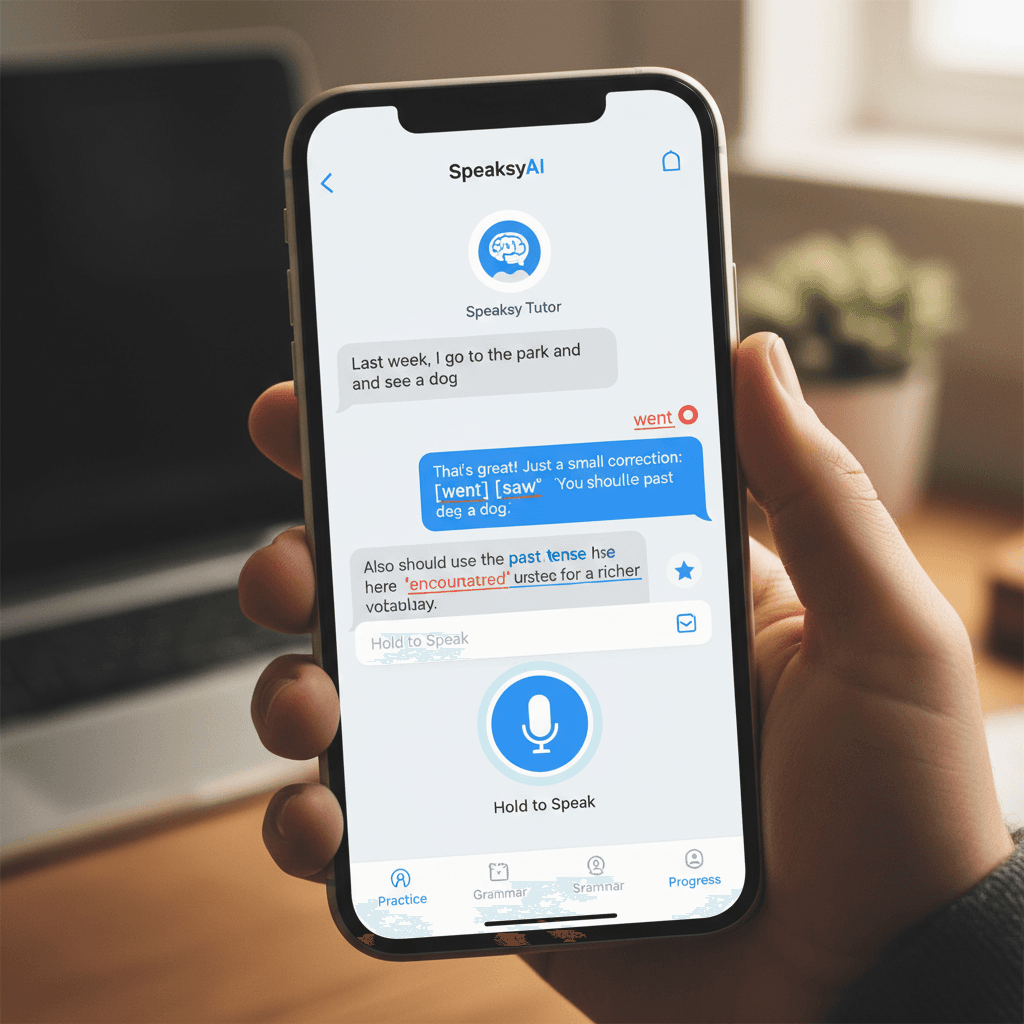
AI-powered platforms are designed for exactly this kind of targeted practice. A 2026 meta-analysis of 46 studies found that AI has a significant positive effect on language learning. With a tool like SpeaksyAI (at speaksyai.com), you can turn theory into practice by having a realistic conversation. The key is to guide the AI to help you.
Instead of just starting a random chat, be specific with your goals. Try using prompts like these:
- •“Let's practice storytelling. I'm going to tell you a one-minute story about my morning.”
- •“Can you ask me questions to help me tell a story about my last vacation?”
- •“I wrote a short story. Can I tell it to you and get feedback on my grammar and pronunciation?”
The AI tutor offers instant, neutral feedback. It can gently correct your verb tenses, suggest more natural-sounding vocabulary, and help you refine your pronunciation. This is how you practice storytelling with AI: you use it as a patient, always-on-call coach to refine your simple story until you feel confident enough to share it.
Step 4: Share Your Story (Low-Stakes Practice)
True confidence comes from application. The final, crucial step is to take your practiced story and share it in a low-stakes environment. The goal isn't to perform for an audience; it's to prove to yourself that you can communicate an idea from beginning to end. According to a July 2026 article, AI provides 'structured, low-stakes opportunities to practice conversations without fear of mistakes or judgment,' which is the perfect stepping stone.
Here are a few practical, low-pressure ways to take that next step and apply your skills:
- 1.Record Yourself. Use your phone's voice memo app to record yourself telling your one-minute story. Listen back and notice where you felt smooth and where you hesitated. It’s a private and powerful way to be your own coach.
- 2.Tell Your AI Tutor. Use a role-play scenario within an app like SpeaksyAI. For example, pretend you're 'catching up with a friend' and use your story as an anecdote in the conversation. This puts your skill into a realistic context.
- 3.Share with a Language Partner. During your next chat with a language exchange partner, tell them your story. It’s a perfect, bite-sized topic for conversation and opens the door for them to ask questions and for you to elaborate.
- 4.Write It Down. Post your short story in a language learning forum or social media group. Seeing it in writing can help you spot mistakes, and you might get helpful feedback from native speakers.
Each time you share your story, you strengthen the neural pathways for those words and grammatical structures, making them easier to access the next time. You are building real, functional communication skills one small win at a time.
Beyond Words: Understanding Cultural Story Structures
As you become more comfortable with storytelling, you'll discover one of its most fascinating aspects: the 'rules' aren't the same everywhere. Learning about cultural nuances in storytelling can elevate your language skills and provide a much deeper connection to the culture you're studying. A narrative isn't just a sequence of events; it's a reflection of a culture's values and way of thinking.
For example, many stories in Western cultures (like in the US, UK, and AU) follow a linear, conflict-driven plot. There's a problem, rising action, a climax, and a resolution. However, this isn't a universal structure. The traditional East Asian 'Kishōtenketsu' structure, common in Japan, China, and Korea, builds a narrative through four acts: Introduction (ki), Development (shō), Twist (ten), and Conclusion (ketsu), often without a central conflict to drive the plot forward.
A culture's unique idea of what constitutes a 'good story' is shaped by its core beliefs, traditions, values, and even the language itself.
The best way to learn this is through immersion and observation. As you listen to native speakers, watch films, or read fiction in your target language, pay attention to more than just the words. Notice the rhythm and the flow. What does the story focus on? What is left unsaid? This is a key part of multimodal literacy—combining listening, reading, and cultural understanding to become a truly effective communicator.
Frequently Asked Questions
Frequently Asked Questions
Ready to Practice Your Storytelling?
Use SpeaksyAI's advanced AI language tutor to get instant feedback on your pronunciation, grammar, and narrative flow.
Join the Waitlist