How to Self-Correct When Speaking a Language: A 4-Step System
Tired of making the same mistakes? Learning how to self-correct when speaking a foreign language is a superpower. This guide gives you an actionable system to do it.

Ever finish a conversation in a new language and immediately cringe, replaying a clumsy mistake in your head? It’s a feeling every learner knows. But what if those moments of error weren't failures, but fuel? The most successful language learners share a specific skill: they know how to self-correct when speaking a foreign language. This isn’t about being perfect; it’s about building a system for improvement that turns mistakes into milestones, boosting your confidence and accelerating your journey to fluency.
Why Self-Correction Is Your Language Learning Superpower
Let's reframe how you see mistakes. The ability to spot and fix your own errors isn't a sign of weakness—it's an advanced skill that shows you're taking control of your learning. This process is a core part of what researchers call 'metacognition,' or 'thinking about your thinking.' You're not just speaking; you're actively listening to yourself, evaluating your performance, and making adjustments. It’s this active engagement that separates passive learners from proactive, confident speakers.
Training in metacognitive strategies has a strong positive effect on students' foreign language learning.
This isn't just theory; it has a measurable impact. A November 2024 study of ESL students found that those who consistently practiced self-correction showed significant gains in both language proficiency and motivation, including a remarkable 30% improvement in writing accuracy. Rather than waiting for a teacher's red pen, they built the internal mechanism for progress. By embracing error correction, you foster a sense of autonomy and ownership—key traits of advanced, independent learners. You begin to see yourself not as someone who makes mistakes, but as someone skilled enough to fix them.
The fear of making mistakes in front of others is a major barrier to practice. This is where modern technology provides a powerful advantage. A key industry trend noted in early 2026 is the rise of AI language tutors that offer a 'judgment-free' environment. In this private space, you can experiment, make errors, and practice your speaking error correction techniques without an ounce of social anxiety, building your competence and confidence in a safe, supportive setting.
The AI Feedback Loop: A 4-Step System for Self-Correction
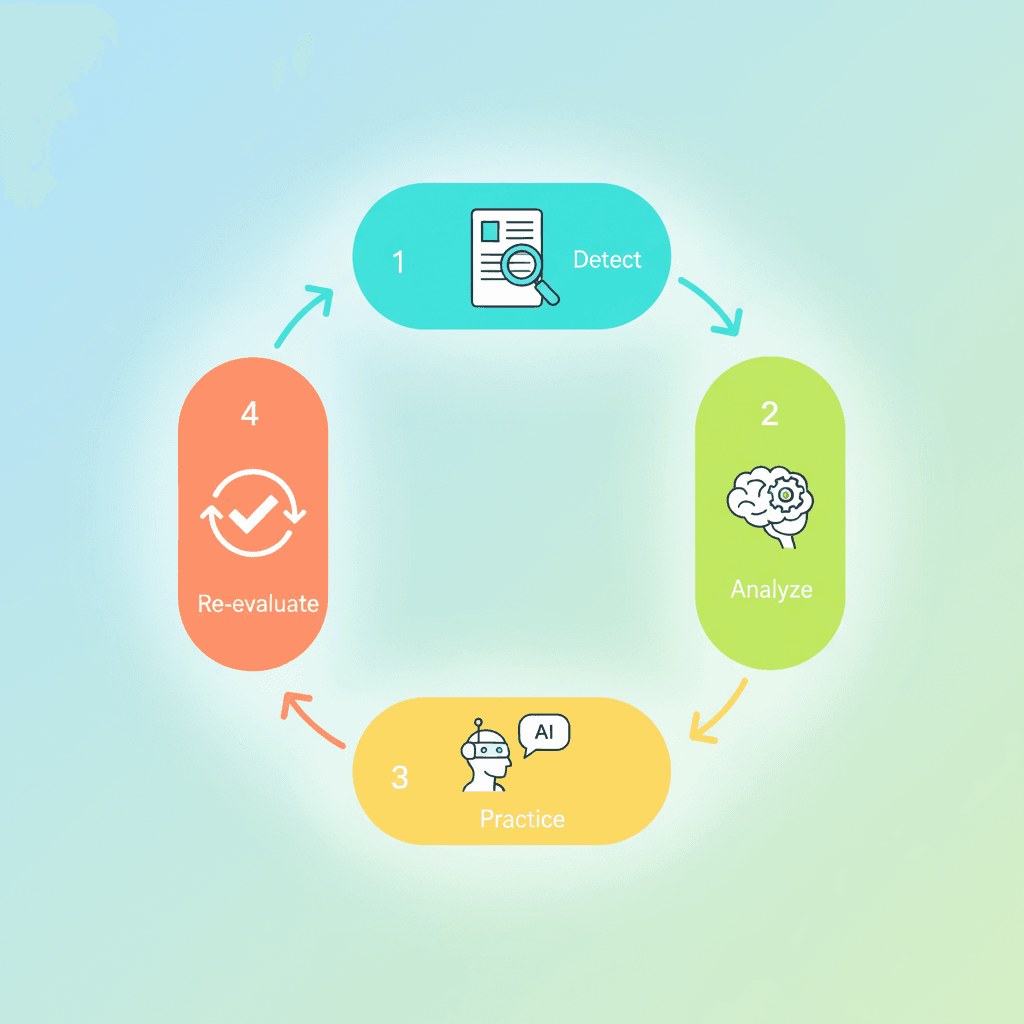
So, how do you turn the idea of self-correction into a practical habit? You build a system. We call it the 'AI Feedback Loop'—a repeatable, four-step cycle that helps you systematically detect, understand, and fix your speaking errors. This transforms random practice into a targeted strategy to improve speaking accuracy. By leveraging AI, this powerful language learning feedback loop becomes more efficient and accessible than ever before.
A 2025 study on AI speech recognition highlighted that these systems provide the instant, granular feedback on pronunciation and intonation that is crucial for making real-time self-corrections. An AI tutor doesn't get tired or impatient; it provides a consistent, low-pressure environment that helps reduce the anxiety tied to making mistakes. This allows you to focus purely on the mechanics of your speech and build muscle memory for the correct forms.
- 1.Detect: You learn to hear your own mistakes by shifting your perspective from an active speaker to an objective listener.
- 2.Analyze: You categorize the error to understand what went wrong, whether it was grammar, pronunciation, or vocabulary.
- 3.Practice: You use targeted exercises, often with an AI tutor, to drill the corrected form until it becomes natural.
- 4.Re-evaluate: You test yourself later to ensure the correction has been integrated into your long-term speech patterns.
Step 1: Detect — How to Hear Your Own Mistakes
The first challenge in self-correction is simply noticing the error as it happens. When you're in the flow of speaking, your brain is juggling vocabulary, grammar, and pronunciation all at once, leaving little bandwidth for quality control. The most effective way to overcome this is to create distance between your 'speaker self' and your 'listener self.' The gold-standard technique for this is simple: record yourself speaking.
This popular technique to practice speaking a language alone is powerful because, as one March 2025 article notes, it shifts your perspective from a participant to an objective listener. Grab your phone, open a voice memo app, and respond to a prompt for 1-2 minutes. You could describe your day, talk about a hobby, or explain your opinion on a topic. When you play it back, you're no longer under pressure to produce language. You can simply listen, and you'll be amazed at what you notice.
As you listen, focus on identifying common error patterns. A December 2025 study identified several frequent issues for language learners you can look for:
- •Improper speech flow: Are you using too many filler words (um, uh) or pausing in unnatural places?
- •Grammatical mistakes: Did you use the wrong verb tense, article, or preposition?
- •Pronunciation issues: Are there specific sounds or words you consistently mispronounce?
- •Semantic deviations: Did you use a word that was technically correct but sounded unnatural or awkward in context?
Step 2: Analyze — Understanding the Type of Error
Once you've detected an error, the impulse might be to just feel frustrated. Resist it! The next step is to get curious and analyze the mistake. By understanding the *type* of error you made, you can turn a vague feeling of 'that sounded wrong' into a specific, fixable problem. This process of categorization is another powerful metacognitive strategy that makes the task feel less overwhelming.
A 2025 guide on self-correction recommends sorting your mistakes into a few key areas. Try keeping a 'mistake journal' and categorizing each error you find in your recordings:
- •Pronunciation: A specific vowel or consonant sound, word stress, or intonation pattern.
- •Grammar: Verb conjugation, noun gender, word order, or tense usage.
- •Vocabulary: Using the wrong word (e.g., 'sensible' instead of 'sensitive'), a false friend, or an unnatural phrase.
- •Fluency: Awkward phrasing or unnatural pauses that disrupt the rhythm of your speech.
It's also helpful to distinguish between a 'slip' and a 'gap.' As linguistics research points out, a 'performance mistake' is a slip of the tongue—an error you know is wrong and can often correct yourself once you notice it. A 'gap,' on the other hand, points to a rule or word you haven't fully learned yet. Identifying which is which helps you decide whether you need a quick reminder or a deeper dive into a grammar lesson.
Step 3: Practice — Correcting the Error with an AI Tutor
Knowing what you did wrong is only half the battle. The crucial next step is targeted practice to overwrite the old habit with the correct form. This is where repetition in a safe environment is key, and where modern AI language feedback tools shine. Instead of just noting the error, you actively work on fixing it until the new version feels automatic.
AI tutors provide a 'judgment-free' environment for this crucial work. According to a March 2026 report by Migaku, this removes the social anxiety of making the same mistake over and over in front of a person. With AI tutors like SpeaksyAI (speaksyai.com), you can practice a difficult phrase, a tricky verb conjugation, or a single vowel sound dozens of times, getting instant feedback on your pronunciation and grammar until you get it right. This focused drilling builds the muscle memory needed for lasting improvement.
This targeted practice pays off. A November 2025 study found that students showed significant skill improvements after using AI-generated exercises for revision. Because modern AI is highly adaptive, it can personalize your practice by focusing on your specific weaknesses, as noted by Hello Nabu in April 2026. This ensures your practice time is spent as efficiently as possible, drilling what you actually need to improve.
Step 4: Re-evaluate — Closing the Feedback Loop
You've detected an error, analyzed it, and practiced the correct version. Are you done? Not quite. The final step is to close the language learning feedback loop by re-evaluating. You need to check if the correction has actually 'stuck' in your long-term memory. This act of self-assessment is what solidifies your learning and ensures you don't keep making the same mistake weeks later.
How do you re-evaluate? A few days after your practice session, try recording yourself again. Give yourself a similar prompt that would require you to use the grammar point or vocabulary you worked on. When you listen back, pay special attention. Did you use the correct form automatically? Or did the old error creep back in? If it's still there, that's okay! It's valuable data. It just means you need another round of focused practice.
This cycle of testing and re-testing is crucial for building what the American Council on the Teaching of Foreign Languages (ACTFL) calls 'learner ownership.' A 2024 study at Leiden University confirmed this, showing that a structured self-evaluation procedure helped students better diagnose their own speaking errors and reduced their reliance on teachers. You become your own coach. And thanks to the massive scale of AI platforms, you have a nearly infinite playground for this re-evaluation. With major platforms offering over 20,500 AI-driven course units by Q1 2026, you'll never run out of new scenarios to test your skills.
The 'Intelligent Correction' Method: Which Mistakes Should You Fix First?
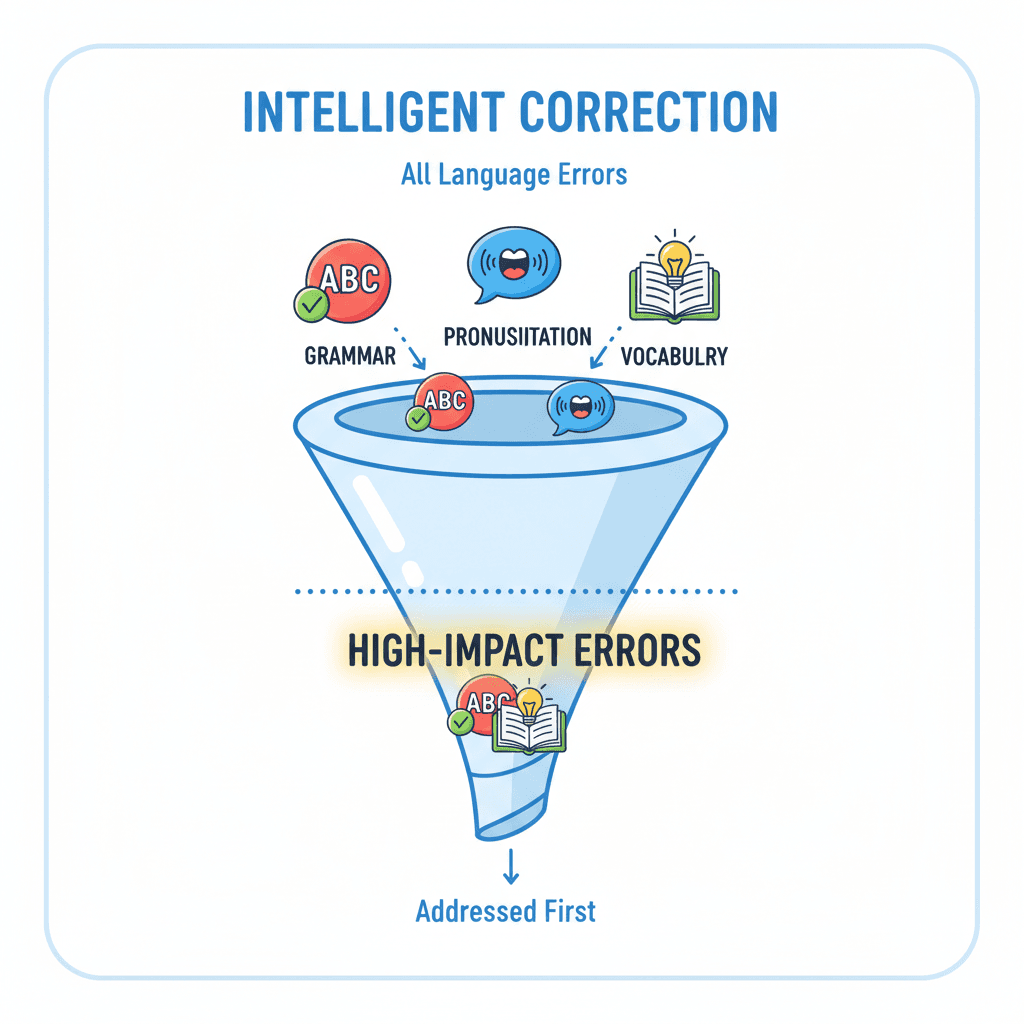
After recording yourself, you might have a list of ten or more errors. The feeling can be overwhelming, and trying to fix everything at once is a recipe for burnout. The smart approach is to prioritize. The 'Intelligent Correction' method is a simple triage system to help you decide what to work on now, what to focus on next, and what to ignore for the time being. This is another metacognitive strategy that keeps you motivated and focused on what matters most.
Here’s how to triage your errors. Divide them into three levels of priority:
- 1.High-Impact Errors (Fix Now): These are mistakes that block communication or cause serious misunderstanding. Think incorrect verb tenses that change the meaning of a story, or mispronouncing a word so badly it becomes unrecognizable. Your primary goal is to be understood, so these are your top priority.
- 2.Pattern Errors (Fix Next): These are recurring mistakes you make over and over, like always forgetting the third-person 's' in English or mixing up noun genders in Spanish. Experts warn these can 'fossilize' if not addressed, becoming permanent habits. Fixing these patterns has a big impact on your overall accuracy.
- 3.Minor Slips (Fix Later): These are small, occasional errors that don't get in the way of communication—using 'in' instead of 'at,' or a slight mispronunciation that doesn't cause confusion. It's okay to let these go for now. Chasing perfection will slow you down and hurt your confidence.
For pattern errors, a great strategy is to consciously practice sentences using the structure you frequently misuse. For example, if you struggle with the past tense, spend five minutes deliberately telling a short story about what you did yesterday. This kind of focused practice, especially in the 'judgment-free' zone of an AI tutor, is incredibly effective for breaking bad habits.
How to Self-Correct in Live vs. Practice Scenarios
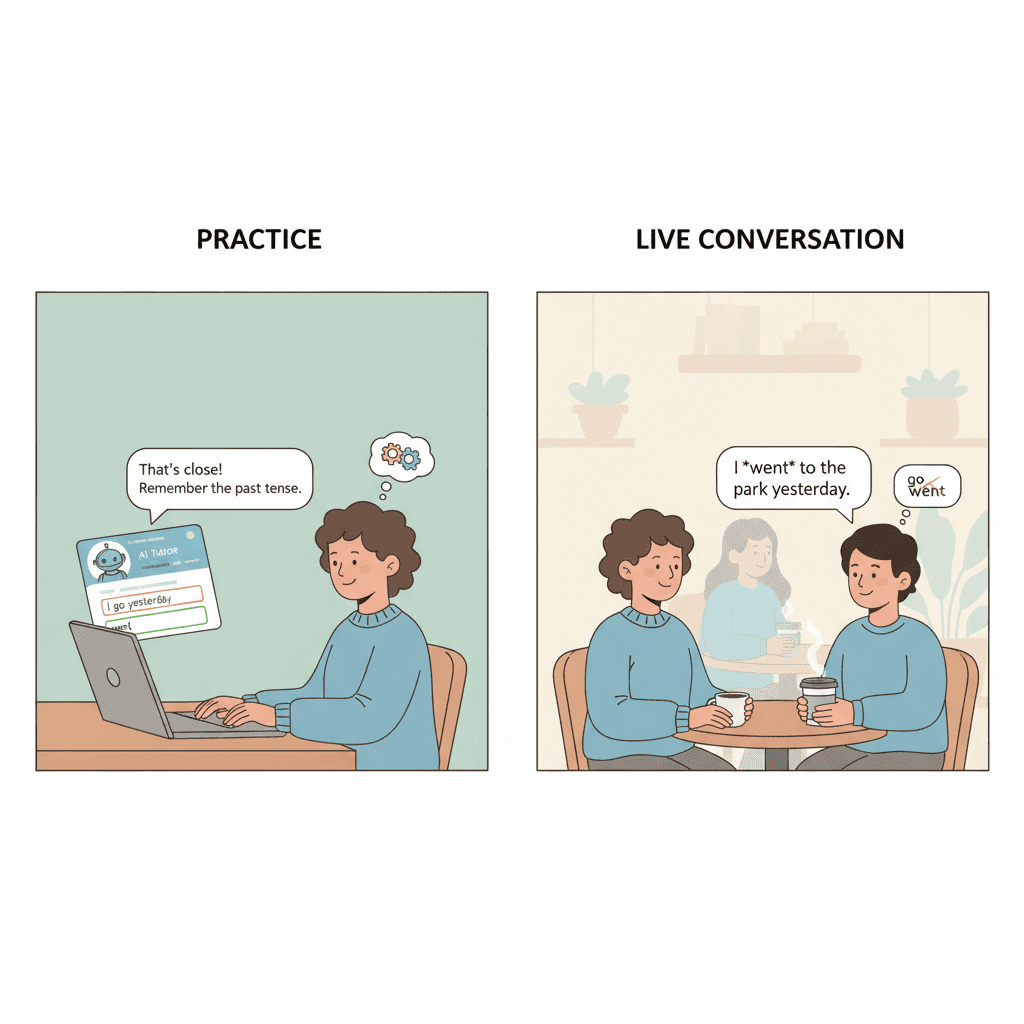
Knowing *what* to fix is one thing; knowing *when* and *how* is another. Your approach to speaking error correction should change dramatically depending on the context. A quick correction in a live chat with a friend is very different from a detailed analysis session during solo practice. Mastering this distinction is an advanced skill that balances accuracy with conversational flow.
In a Live Conversation: The Quick Fix & Move On. When you're talking to another person, the primary goal is communication, not perfection. If you notice a mistake, the best strategy is a quick 'during-production correction,' a term from a 2022 TESL-EJ study. It looks like this: 'Yesterday, I goed... sorry, I went... to the store.' You acknowledge the error, fix it, and immediately move on. This shows you're aware of the mistake without derailing the entire conversation. Don't stop to analyze it; save that for later.
In a Practice Session: The Deep Dive. When you are practicing speaking a language alone, your goal is the opposite: accuracy and analysis. This is the time for what the same study calls 'post-performance correction notes.' After you've recorded yourself, you can take your time to pinpoint errors, categorize them, and practice the correct forms. This is where AI tutors like SpeaksyAI excel, providing the space for these detailed conversation correction techniques without pressure. Knowing you can dissect your speech later frees you up to be more spontaneous and fluent during live interactions.
Switching between these two modes—the quick fix in public, the deep dive in private—is a sophisticated metacognitive skill. It allows you to build confidence in real-world conversations while systematically improving your technical skills behind the scenes. With the infrastructure for solo practice rapidly expanding, this hybrid approach has never been more accessible for learners in the US, UK, Australia, or anywhere else.
Frequently Asked Questions
Frequently Asked Questions
Ready to Master Self-Correction?
Get instant feedback on your speaking and build confidence in a judgment-free environment with SpeaksyAI's AI language tutor.
Join the Waitlist