The Relearning System: How to Relearn a Language You Forgot
Feeling frustrated that you've forgotten a language? You're not alone. The good news is it's much faster to relearn it. This system shows you how to reactivate your knowledge.

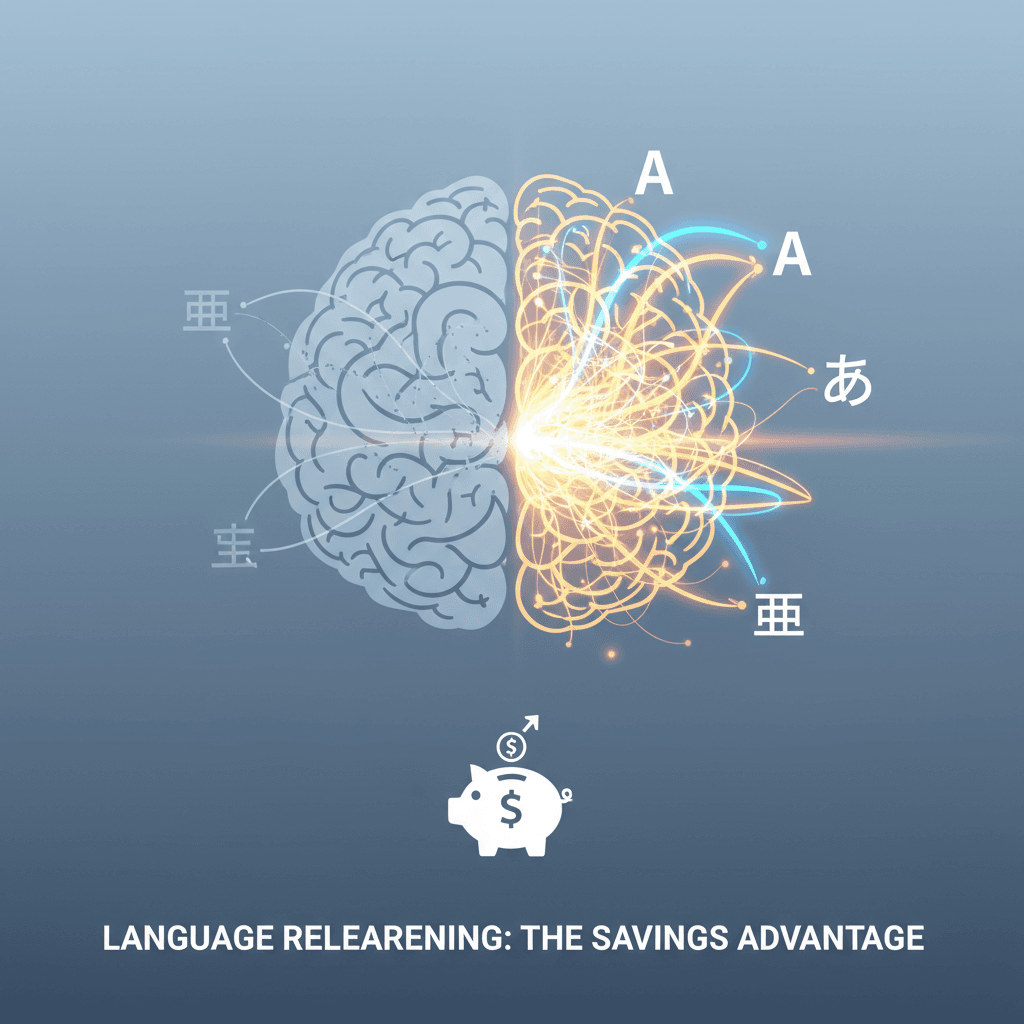
It’s a frustrating feeling, isn't it? That moment you try to recall a word in a language you once knew, and all you find is a blank space. But what if we told you that forgotten language isn't gone, it's just dormant? And that there's a proven method for how to relearn a language you forgot that's up to four times faster than learning it the first time? This isn't just wishful thinking; it's backed by science. Welcome to The Relearning System, your clear, encouraging, and actionable path to reactivating your skills and speaking confidently again, faster than you think.
Why Relearning Is Your Secret Superpower (The 'Savings' Advantage)
The first thing to understand is that all your past effort is not lost. Linguists and psychologists refer to this phenomenon as the 'language savings paradigm.' Your brain doesn't just delete the language; it archives it. The neural pathways you built are still there, waiting to be reactivated. Think of it less like a daunting restart from zero and more like an exciting recovery mission to awaken a skill you already possess.
This 'savings' gives you a massive head start. A 2026 study from the LangTrack Blog found that relearning a forgotten language is two to four times faster than learning it from scratch. The research showed that relearners could recover approximately 80% of their receptive vocabulary (what you understand when reading or listening). Your previous experience created a mental framework for the language's grammar, sounds, and structure, which makes new (or old) information stick much more easily.
Beyond just getting your skills back, language reactivation offers profound cognitive benefits. Research presented at the 2026 Federation of European Neuroscience Societies Forum suggests that speaking two or more languages can make a person's brain appear up to six years younger than their chronological age. This mental workout builds cognitive reserve, which multiple studies have linked to healthier aging and a more resilient brain, helping to protect against cognitive decline. You're not just refreshing a language; you're investing in your long-term brain health.
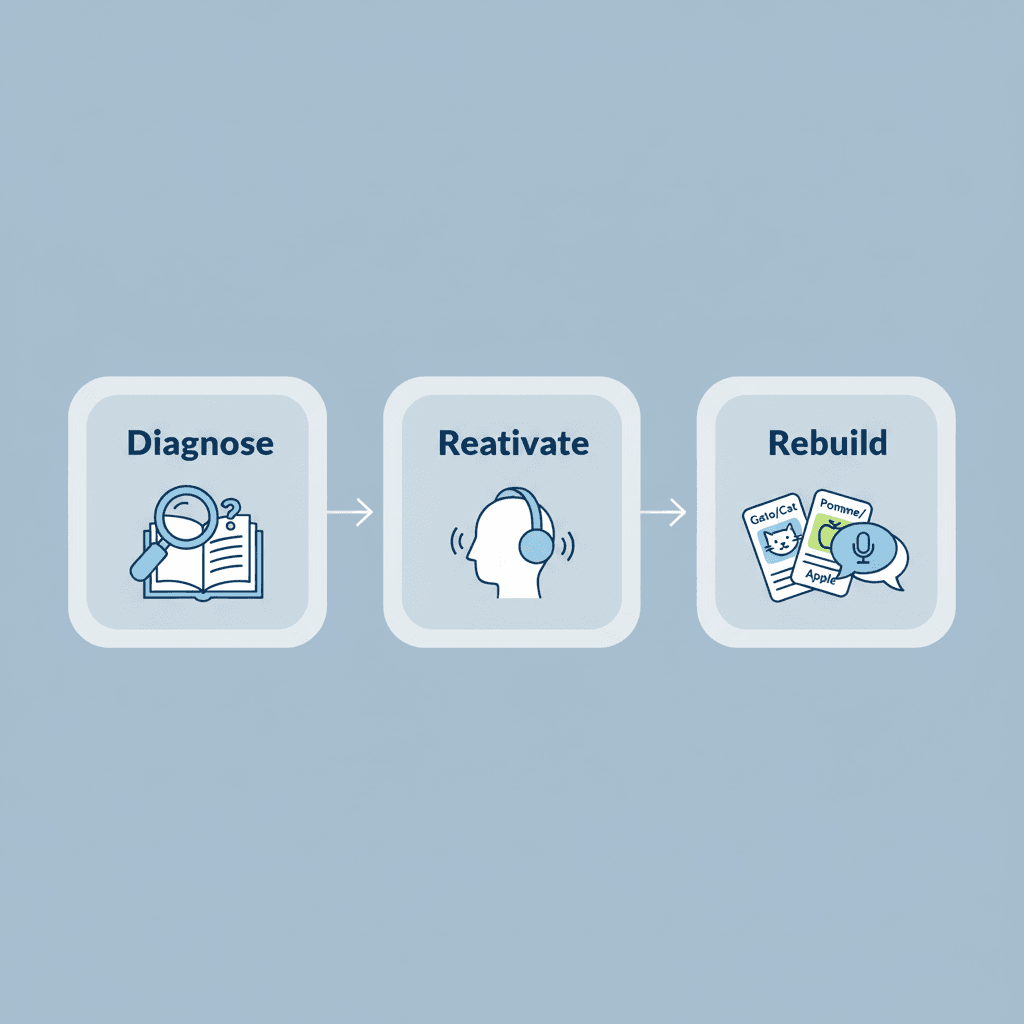
Step 1: Diagnose Your 'Forgotten' Areas
Before you can create an effective forgotten language study plan, you need to know where you stand. Your language skills aren't one single block; they're a collection of different abilities that fade at different rates. A self-diagnosis helps you pinpoint your exact knowledge gaps, so you can focus your energy where it matters most instead of randomly reviewing things you already know.
- •Receptive Vocabulary: How many words do you recognize when you read or hear them? This is usually the strongest remaining skill.
- •Active Vocabulary: How many words can you actively recall and use when speaking or writing?
- •Grammar Intuition: Do sentence structures and verb conjugations 'feel' right or wrong, even if you can't explain the rule?
- •Speaking Confidence: How comfortable do you feel trying to form sentences and speak out loud?
To get a baseline, try some practical tests. Watch a familiar movie in the target language without subtitles. Can you follow the plot? Try to write a short paragraph about your day. Where do you get stuck? This initial assessment isn't a test you can fail; it's simply data collection. For a more precise measure, an AI language tutor can act as your personal diagnostician. A short, five-minute conversation can give you an immediate baseline of your grammar, vocabulary, and fluency, helping you build a truly custom plan from day one.
Don't be discouraged if your speaking ability feels miles behind your listening comprehension. This is completely normal. The same 2026 LangTrack Blog study noted that while receptive vocabulary is about 80% recoverable, speaking confidence can start as low as 30% recoverable. This gap is your roadmap. It tells you to start with input before pushing yourself too hard on output.
Step 2: Reactivate with Comprehensible Input
Once you know your starting point, the next step is to gently awaken your passive knowledge. The most effective way to do this is through 'comprehensible input,' a concept championed by linguist Dr. Stephen Krashen. The theory is simple: we acquire language by understanding messages. Instead of drilling flashcards of words you don't remember, you'll re-expose your brain to the language in a low-pressure, enjoyable way.
Your goal here is not to understand every single word. It's to get the gist of what's being said. This process of hearing and seeing words in context is what reactivates those dormant neural pathways. As a 2026 article in Bubblic explains, this knowledge is a 'dormant skill' just waiting for the right prompt. Here are some activities to get you started:
- •Watch TV shows and movies: Start with a show you know well. Turn on the audio in your target language and use target language subtitles, not English ones. This connects the spoken sounds to the written words.
- •Listen to podcasts: Search for podcasts specifically designed for language learners or relearners in your target language. They often speak slower and use slightly simpler vocabulary.
- •Read graded readers: These are books adapted for different learning levels. Find one that feels challenging but not impossible. If you're looking up more than 5-7 words per page, try an easier level.
- •Change your phone's language: A simple, passive way to re-familiarize yourself with everyday vocabulary.
This input-focused stage is powerful because your receptive skills are the most intact. As the LangTrack Blog found, with around 80% of your receptive vocabulary recoverable, you have a strong foundation to build upon. This phase is all about reminding your brain of what it already knows and rebuilding its comfort with the sounds and flow of the language.
Step 3: Rebuild with Targeted, Active Practice
After a week or two of soaking in comprehensible input, it's time to shift from passive listening to active rebuilding. This is where you use the data from your Step 1 diagnosis to surgically repair the specific gaps in your knowledge. The key is targeted practice—focusing on the words and grammar structures you personally struggle with.
For vocabulary, start with a frequency list (the 1,000-2,000 most common words in a language) and create your own flashcard deck using a Spaced Repetition System (SRS) like Anki or Quizlet. An SRS algorithm shows you cards right before you're about to forget them, making memorization incredibly efficient. For grammar, instead of reading a whole textbook, pick one—and only one—confusing concept per week. Maybe it's the subjunctive mood in Spanish or noun cases in German. Your goal is to practice that single point in real conversations until it becomes second nature.
This is where modern AI tools shine. An AI language tutor can create a conversation that specifically drills your target grammar point. Want to practice the past tense? The AI can ask you questions about your weekend. Need to work on conditionals? It can propose hypothetical scenarios. This provides the personalized, adaptive learning experience that experts at the Center on Inclusive Digital and Distance Learning (CIDDL) noted as critical for effective skill-building in 2023.
Step 4: Regain Confidence Through Consistent Conversation
You can learn all the words and grammar rules in the world, but language only truly comes alive when you use it to communicate. For most people working on how to get a language back, speaking is the biggest hurdle. That initial 30% speaking confidence figure from the LangTrack Blog study can feel intimidating, but it is not a permanent state. Confidence is a skill you build through practice, just like vocabulary.
The most important factor in rebuilding confidence is creating a 'safe space' for practice. You need an environment where you can make mistakes without fear of judgment. While human tutors in places like the US, UK, and India are fantastic, scheduling and cost can be a barrier. This is why many learners are turning to AI. An AI tutor is available 24/7, is infinitely patient, and provides a zero-judgment zone to stumble, self-correct, and grow. Platforms like SpeaksyAI (at speaksyai.com) are designed specifically for this, helping you accumulate the speaking hours needed to feel comfortable and fluid again.
To overcome initial speaking anxiety, experts suggest starting with manageable 15-minute daily conversations in a 'safe space' to methodically break down psychological barriers and rebuild the habit of speaking.
The goal is consistency, not intensity. A 2026 report from HelloTalk found that the strongest predictor of regaining conversational ability was total time spent in 'spaced, spoken, and corrected practice hours.' A short, daily conversation is far more effective than a long, draining session once a week. This consistent habit transforms speaking from a stressful performance into a natural mode of expression.
Your 30-Day Language Reactivation Plan
Ready to put it all together? Here is a sample forgotten language study plan that combines all four steps into a clear, week-by-week schedule. Remember, this is a template—adjust the intensity based on your personal schedule and starting level. The key is consistent, focused effort.
Week 1: Diagnosis & Low-Pressure Input
- •Day 1: Perform your self-diagnosis. Watch a show, write a paragraph, and note where you feel strong and where you struggle.
- •Daily Goal: Spend 30 minutes with comprehensible input. This could be one episode of a TV show or a 30-minute podcast for learners.
- •Focus: Don't try to produce anything. Just listen and absorb. Let your brain reacclimate to the sounds and rhythm of the language.
Week 2: Active Vocabulary Rebuild
- •Daily Goal: Continue your 30 minutes of daily input. Find a frequency list of the top 1,000 words and add 10-15 new words to your SRS flashcard deck each day.
- •Speaking Practice: Start with 5-10 minute conversations with an AI tutor. Focus on simply using the new vocabulary words you're learning.
- •Focus: Connect your passive and active knowledge. Aim to recognize your new vocabulary 'in the wild' during your listening practice.
Weeks 3-4: Grammar Focus & Conversational Fluency
- •Weekly Goal: Choose one specific grammar point to focus on for the entire week.
- •Daily Goal: Continue your input and SRS reviews. Increase your speaking practice to 15-20 minutes per day.
- •Speaking Practice: Ask your AI tutor to create conversations that force you to use your target grammar point. Tell stories, explain concepts, and debate topics.
- •Focus: Shift from just recalling words to building correct, complex sentences. Embrace making mistakes as part of the learning process.
Overcoming the Psychological Hurdles of Relearning
Relearning a language is as much a mental game as it is an academic one. One of the biggest frustrations is the 'tip-of-the-tongue' feeling—that sensation of knowing you know a word but being unable to access it. Neuroscience tells us this is normal. The memory isn't gone; its neural pathway has just become 'de-activated' from disuse. Every time you successfully recall a word or understand a sentence, you are strengthening that pathway.
It's crucial to manage your expectations. Avoid the trap of comparing your current self to your 'past peak' self. That comparison is a recipe for frustration. Instead, focus on the 'relearning advantage' discovered by Hermann Ebbinghaus: the 'savings paradigm' proves that you are relearning this information far faster than you learned it the first time. Celebrate every small win—every forgotten word that suddenly pops into your head is a victory.
- •Celebrate small wins: Did you understand a joke in a movie? Did you form a complex sentence correctly? Acknowledge it!
- •Track your progress: Keep a simple journal. Write down one new thing you learned or felt more comfortable with each day. Looking back after a week will reveal incredible progress.
- •Focus on the present: Don't worry about the level you used to be at. Focus on being slightly better today than you were yesterday.
FAQ: Relearning a Forgotten Language
Frequently Asked Questions
Ready to Speak Confidently Again?
Get early access to the AI tutor designed to reactivate your language skills and help you find your voice, faster than you ever thought possible.
Join the Waitlist