How to Practice Speaking a Language for Travel: A 4-Week Plan
Don't just learn phrases, learn to speak confidently on your next trip. This guide provides a step-by-step, 4-week plan to practice speaking for travel.

Planning a trip is exciting, but for many, one question looms large: how to practice speaking a language for travel without feeling overwhelmed? If the idea of fumbling through a conversation in a new country fills you with dread, you're not alone. The good news is that you don't need to be fluent to have meaningful, confident interactions abroad. The secret is to shift your goal from perfection to connection. This guide provides a step-by-step system for building real-world speaking confidence, transforming your pre-trip practice from a chore into an exciting part of your adventure.
Why 'Travel Fluency' is Different (and More Achievable)
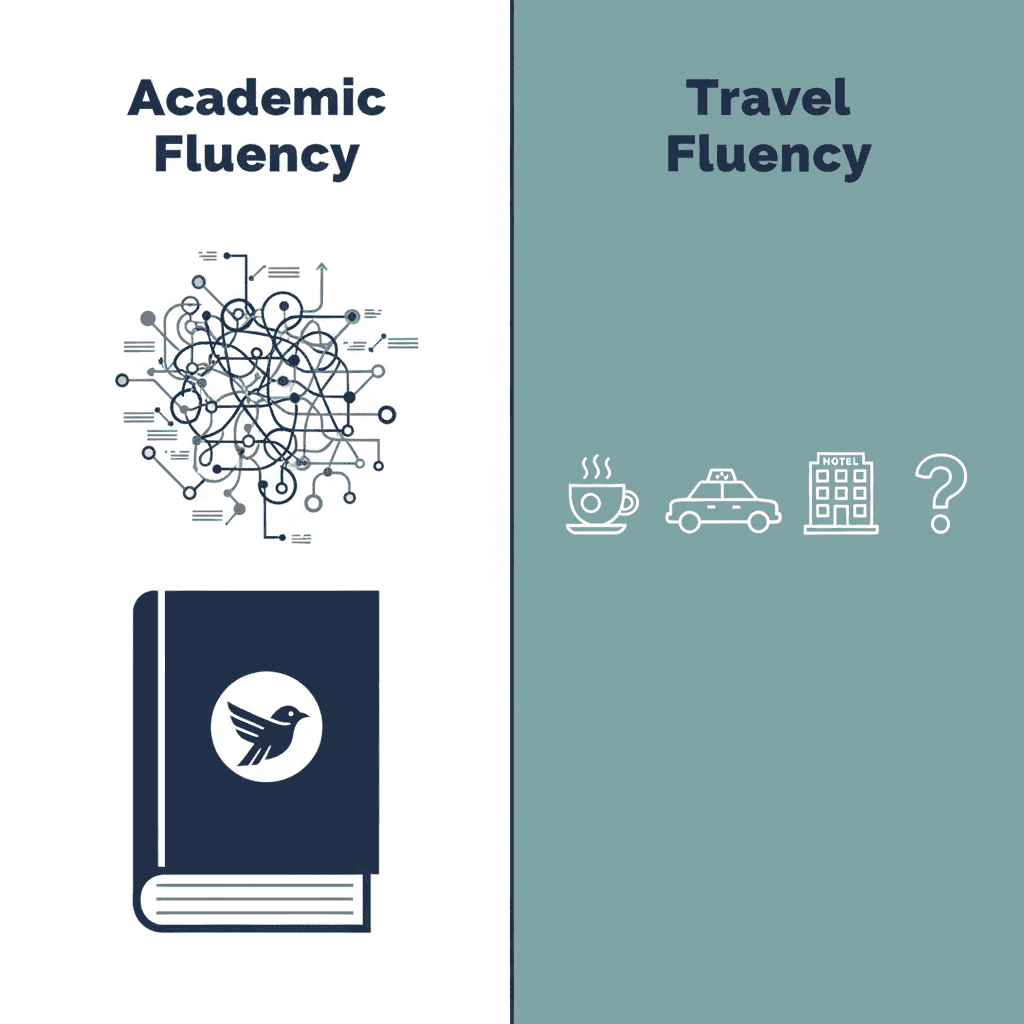
Let's reframe the goal. Traditional fluency—the kind that takes years to develop—isn't necessary for a one or two-week vacation. Instead, aim for what we call 'travel fluency' or 'minimum viable fluency.' This is the 20% of language skill that delivers 80% of the value on your trip. It’s about practicality, not perfection. Knowing just enough to navigate daily situations, show respect to locals, and handle basic interactions will fundamentally change your travel experience for the better.
Linguistics experts and polyglots often note that learning just 50 to 100 of the most common words and a handful of key phrases can unlock a surprisingly high level of comprehension and functional communication, making your trip smoother and more immersive.
This practical approach helps bridge the common gap between aspiration and action. While most travelers in the US, UK, and Australia agree it's important to learn a few local words, many don't, often due to a lack of confidence. The key is realizing that the goal is attainable. Modern technology, especially the rise of conversational AI and adaptive learning apps, has made this targeted, use-driven practice more accessible than ever, allowing you to prepare for specific travel scenarios before you even pack your bags.
A recent survey by Preply found that while 80% of U.S. adults believe it's important to learn some of the local language before traveling, only 58% actually make the effort. This highlights a common confidence hurdle that a structured practice plan can help you overcome.
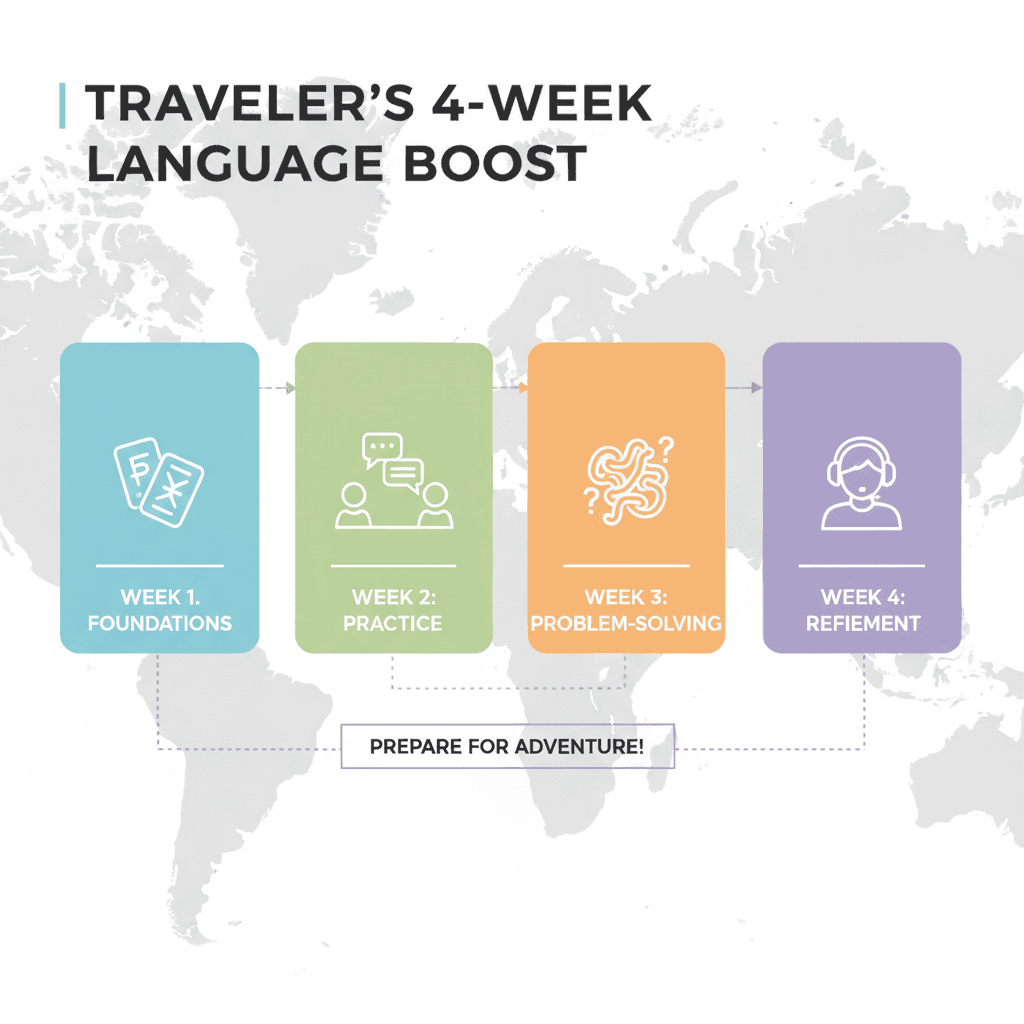
Your 4-Week Pre-Trip Speaking Sprint: A Week-by-Week Plan
Consistency is your greatest ally. Rather than cramming at the last minute, you can build a travel-specific speaking routine with just 15-20 minutes of focused practice each day. This four-week sprint is designed to build your skills progressively, moving from foundational phrases to spontaneous conversation so you arrive at your destination feeling prepared and confident. The goal isn't to be perfect; it's to build the courage to try. Create a checklist for each week to track your progress and celebrate your wins along the way!
Week 1: Core Scenarios & Foundational Phrases
Your first week is all about building the foundation. The goal is functional communication, not complex grammar. Start by identifying the 5-7 most likely situations you'll encounter on your holiday. This isn't just about 'survival phrases'; it's about building scripts for real interactions.
- •Greetings and basic courtesies (please, thank you, excuse me, sorry)
- •Checking into your hotel or Airbnb
- •Ordering food and drinks (including dietary needs, e.g., 'I am vegetarian')
- •Asking for directions ('Where is the train station?')
- •Making a simple purchase at a shop or market
- •Buying tickets for transport or a museum
- •Asking for help or clarification ('Can you repeat that, please?')
Once you have your scenarios, use a tool like ChatGPT to generate a list of essential phrases for each. Then, load these phrases into a flashcard app like Anki or Quizlet for daily review. Focus on high-frequency words and sentence structures. For pronunciation, use an online dictionary like Forvo to hear how native speakers say each word. Getting the sounds right from the start will build a strong base for the weeks ahead.
Week 2: Role-Playing and Pronunciation Feedback
Now that you have your core phrases, it's time to move from memorizing to internalizing. The most effective way to do this is through role-playing. Practice the scenarios you identified in Week 1 out loud. This active recall is crucial for moving language from your short-term to your long-term memory. You can start by simply talking to yourself, but to truly prepare for conversational language for travel, you need interaction and feedback.
This is where AI-powered platforms like SpeaksyAI truly shine. Instead of just reading a script, you can engage in a simulated conversation. For example, you can tell the AI, 'Let's role-play me ordering a coffee in a café in Rome.' The AI will act as the barista, responding to you in real-time. This interactive practice is essential for building the muscle memory needed for real-world conversations.
The key to improvement is a rapid 'feedback-retry loop.' An AI tutor provides instant, judgment-free notes on your pronunciation and grammar, allowing you to immediately try again and correct your mistakes. This process, as noted in educational research, dramatically accelerates learning by creating a safe environment to experiment and build confidence without the fear of embarrassment that often holds learners back.
Week 3: Simulating Spontaneity and Handling Problems
Real conversations are rarely perfect. What happens when the hotel can't find your reservation, or the item you want at the market is out of stock? This week is about preparing for the unexpected. Your language practice before your trip should include rehearsing how to handle these small challenges gracefully.
Use your practice time to simulate problems. An AI tutor like SpeaksyAI is perfect for this, as it can introduce unexpected turns into your role-plays, forcing you to think on your feet. Practice phrases for:
- •Apologizing and explaining a misunderstanding ('I'm sorry, I don't understand.')
- •Asking for an alternative ('Do you have another one?')
- •Confirming details ('So, the train leaves at 3 PM?')
- •Politely pointing out an error ('I think there is a mistake on the bill.')
This type of practice moves you beyond passively learning *about* a language and into actively *using* it for authentic tasks. As industry reports on AI in education highlight, this ability to simulate real-world problem-solving is what makes modern tools so effective for travelers. By rehearsing these tricky situations in a low-stakes environment, you build the resilience and confidence to handle them calmly if they arise on your trip.
Week 4: Listening, Cultural Nuances, and Speed
In your final week, the focus shifts to polish and reception. Speaking is only half of the conversation; you also need to understand the replies you get. The best way to improve your listening comprehension is to get more input. Dedicate 15-20 minutes a day to listening to the language spoken at a natural pace. Watch TV shows or movies in the target language (with subtitles in that language, not English!), listen to podcasts for learners, or find music with clear lyrics.
This is also the time to research basic cultural etiquette. How do people greet each other? What are the customs around tipping in restaurants or haggling in markets? Understanding these non-verbal cues and cultural norms is just as important as knowing the right words. A quick search for 'cultural etiquette in [your destination]' will provide valuable insights.
Finally, use this week to consolidate everything you've learned. Run through your role-play scenarios one more time, focusing on speaking a little more smoothly and naturally. Remember, the goal is not speed but clarity and confidence. A few well-spoken phrases will always be more effective than many poorly pronounced ones.
Practicing 'Just-in-Time' While You Actually Travel
Your language practice doesn't stop when you board the plane. One of the most powerful advantages of modern learning tools is the ability to do 'just-in-time' rehearsals. Think of your language app as a digital rehearsal room you can carry in your pocket. This is a game-changer for anyone wondering how to speak a language on vacation with confidence.
Here’s how it works: before you leave your hotel to visit the Louvre, spend five minutes on your phone practicing the specific interaction. Role-play asking for 'deux billets pour le musée, s'il vous plaît' and understanding the response about the price. Before heading to a restaurant, rehearse how to ask for a table and order your favorite dish. This immediate practice primes your brain, reduces in-the-moment anxiety, and makes the real interaction feel like the second time you're doing it, not the first.
This use-driven approach is a major trend in language learning, as it directly connects practice to real-world application. It transforms dead time—like waiting for a bus or sitting in your hotel room—into powerful moments of preparation that build lasting confidence.
How to Practice When Your Travel Partner Doesn't Speak the Language
Traveling with a partner, friend, or family member who isn't learning the language is a common scenario. It can be challenging to practice when your default is to speak English with your companion. But don't let this stop you! Here are a few simple strategies to keep your skills sharp:
- 1.Narrate Your Day: As you walk around, silently (or quietly) narrate what you're seeing and doing in the target language. 'We are walking to the café. I see a blue car. I am hungry.' It's a simple but effective way to keep the language active in your mind.
- 2.Schedule 'Practice Pockets': Carve out 10-15 minute 'practice pockets' for yourself. While your partner is resting, showering, or checking emails, you can run through a quick role-play scenario on your phone with an AI tutor. It's a small investment of time for a big confidence boost.
- 3.Teach Them the Fun Stuff: Get your partner involved by teaching them 3-5 essential phrases like 'hello,' 'thank you,' and 'cheers!' This makes the experience more inclusive and gives you a chance to practice by teaching.
Remember, the desire to connect through language is growing worldwide. By making a small effort, you're tapping into a powerful global trend of travelers seeking more authentic and meaningful interactions.
The global language travel market was valued at over $26 billion in 2023 and is projected to nearly double by 2034, according to a report by Future Market Insights. This shows a massive and growing desire among travelers from the US, UK, Canada, and beyond to engage more deeply with local cultures.
Frequently Asked Questions About Speaking for Travel
Frequently Asked Questions
Ready to Speak Confidently on Your Next Trip?
SpeaksyAI is your personal AI language tutor. Practice real-world travel conversations anytime, anywhere. Get instant feedback and build confidence before you go.
Join the Waitlist