Join Group Conversations in a Foreign Language: A 5-Step System
Struggling to find your voice in fast-paced group chats? This guide provides a simple system to help you confidently participate in any group conversation.

Jumping into a group chat in your native language can be tricky. But in a foreign language? It can feel like trying to board a moving train. If you’ve ever felt your heart race or your mind go blank, you’re not alone. This guide is your complete playbook on how to participate in group conversations in a foreign language with confidence. It’s not about finding a magic shortcut; it’s about a proven system that breaks this intimidating skill into small, achievable wins. We’ll show you how to move from a silent observer to an active, confident speaker, one step at a time.

Why Group Conversations Are So Intimidating (It's Not You!)
Feeling anxious about group conversations is incredibly common. In fact, research shows that many people feel anxious communicating even in their native language. When you add the complexity of a new language, that feeling is amplified. Your brain is suddenly juggling multiple tasks: deciphering fast speech and different accents, tracking a rapidly changing topic, translating in your head, and trying to formulate a response. This intense mental workload is known as 'cognitive load,' and it’s the primary reason why group chats feel so much harder than a calm, one-on-one conversation.
If you find yourself falling silent, don't mistake it for failure. It’s not a sign of disengagement. Instead, neuroscience suggests you’re likely processing the conversation at a profound level—a thoughtful, deep-listening approach that is often overlooked in fast-paced group settings. The very structure of the conversation can be the problem, not your ability.
Some research argues that the environment of a group conversation itself can be emotionally distressing and create a 'dysfunctional human-environment cognitive ecology,' making it difficult to follow along and contribute.
Even native speakers struggle, especially in digital formats. A 2023 survey revealed that 68% of Americans have a 'love/hate' relationship with group chats, and nearly 80% wish for more direct, in-person interactions. So, let’s reframe this. The challenge isn't a flaw in your language skills; it's a design flaw in the situation itself. And the good news is, you can learn to navigate it with the right system.
The 5-Step System for Confident Group Participation
You wouldn't try to climb a mountain without a map, so why jump into a complex social situation without a strategy? This 5-step system is your map. It’s designed to help you prepare, engage, and grow from every group conversation you have. Instead of relying on luck or sudden inspiration, you’ll have a clear process that builds confidence and skill over time. The goal is to turn chaos into a predictable pattern you can master.
Step 1: Prepare with a Micro-Goal
The pressure to be a brilliant, witty conversationalist is paralyzing. So, let's get rid of it. Before you join any group conversation—whether it's at a language exchange meetup in Sydney or an online session with learners from India—give yourself one tiny, achievable mission. This is called 'pre-task planning,' a strategy proven to reduce anxiety. Your goal isn't to dominate the conversation; it's just to check one small box.
This approach, often called setting 'micro-goals,' shifts your focus from a vague, stressful target ('be fluent') to a concrete action you can control. Celebrating this small win builds positive momentum and makes the next conversation feel a little less daunting. What could your micro-goal be?
- •Ask one follow-up question using 'why' or 'how'.
- •Use one new vocabulary word you learned this week.
- •Give a compliment to another speaker (e.g., 'That's a great point!').
- •Share a brief, one-sentence opinion.
- •Simply say 'hello' and introduce yourself.
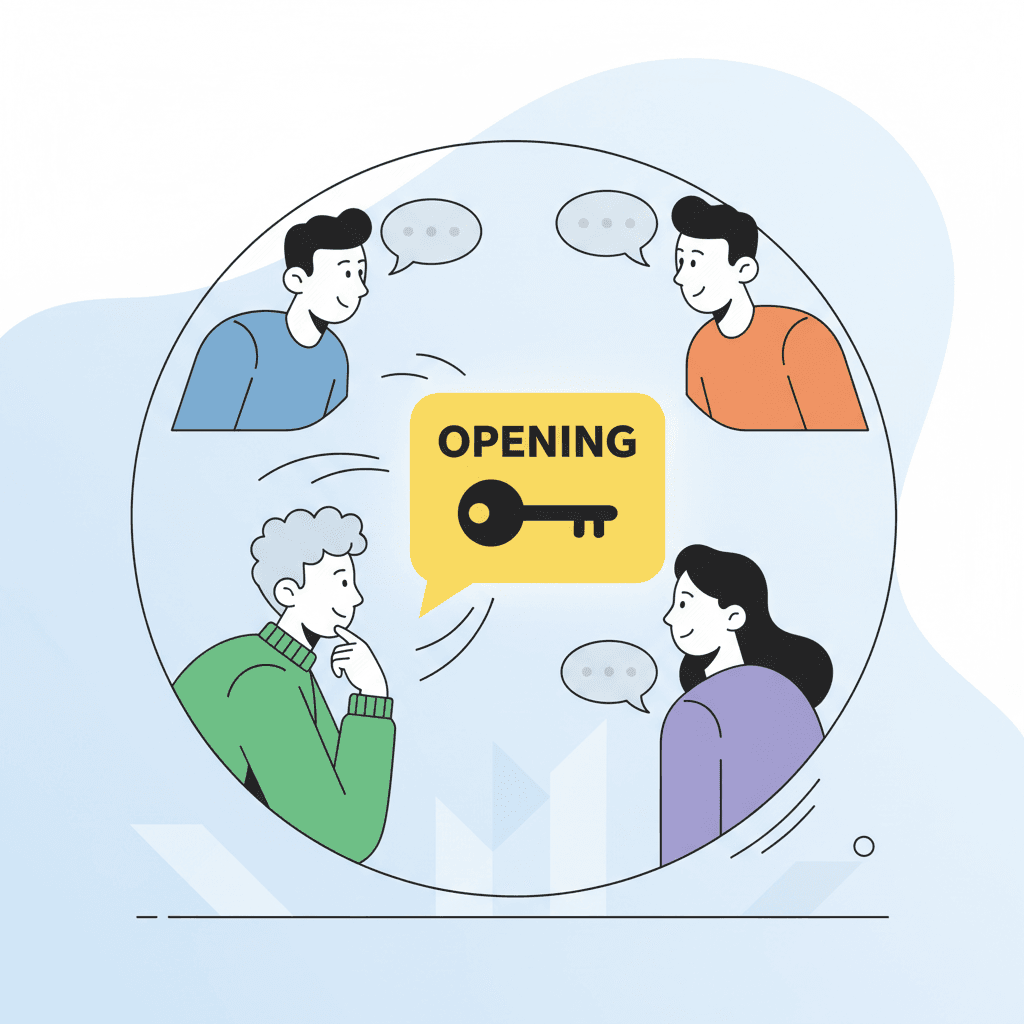
Step 2: Find Your Opening with Active Listening
For language learners, listening isn't a passive activity; it's a strategic tool. Instead of anxiously waiting for your turn to speak, shift your focus to active listening in the foreign language. Your new goal is to understand the rhythm and flow of the conversation. Who is speaking? Who are they looking at? Where do the natural pauses occur? By becoming an observer, you'll feel more engaged and less pressured.
Show you're engaged even when you’re not speaking. Use non-verbal cues and 'backchanneling'—nodding, smiling, and making affirming sounds like 'uh-huh,' 'I see,' or their equivalent in your target language. This does more than just show you're paying attention; it signals to the group that you are an active participant, making it easier for them to include you. It also helps you stay focused and better understand fast speech by concentrating on the overall gist rather than every single word.
- •Listen for the Gist: Don't try to understand every word. Focus on the main idea of what's being said.
- •Watch for Pauses: Conversations have a natural ebb and flow. Identify the moments when one topic ends and another might begin.
- •Identify the 'Question-Asker': In every group, there's often someone who helps guide the conversation. Listening to their questions can give you ideas for your own.
- •Paraphrase in Your Head: Silently try to summarize what a speaker just said in one sentence. This sharpens your listening and prepares you to contribute.
Step 3: Enter the Conversation with Key Phrases
Once you've set a micro-goal and used active listening to find a potential opening, it's time to speak. Having a few 'pocket phrases' ready removes the pressure of inventing the perfect sentence on the spot. These are simple, versatile phrases for interjecting politely in English or any other language. A 2014 study highlighted that mastering common expressions (formulaic language) can make you sound more fluent than knowing rare, complex vocabulary.
Phrases for politely interjecting:
- •"Sorry to interrupt, but I just wanted to add..."
- •"If I could just jump in for a moment..."
- •"That reminds me of..."
- •"Speaking of [topic], I heard that..."
Phrases for agreeing with someone and adding your point:
- •"I agree with [Name]. And I would also add..."
- •"That's a great point. It makes me think about..."
- •"Exactly! In fact, I was just reading that..."
- •"You're so right. Another thing to consider is..."
Phrases for when you don't understand (which is a great way to participate!):
- •"I'm sorry, I didn't catch that. Could you say it again?"
- •"What does [word/phrase] mean?"
- •"So, if I understand correctly, you're saying that...?"
- •"Could you explain that in a different way?"
Step 4: Navigate Online Group Conversations (Discord & Zoom)
The rules change slightly in the digital world. Platforms like Discord and Zoom have become incredible hubs for online group conversations, connecting learners from the US, UK, Canada, and beyond. However, a 2023 study described these platforms as a digital 'third place' where linguistic nuances can be lost without physical cues. Audio delays, people speaking over each other, and the inability to make eye contact can make it even harder to find an opening.
Fortunately, virtual platforms also offer unique tools you can use to your advantage. Mastering these is a key skill for modern language learning.
- 1.Use the 'Raise Hand' Feature: This is the clearest, most universally understood signal that you want to speak. It takes the guesswork out of interjecting and lets the group moderator bring you in.
- 2.Type in the Chat: If you have a thought but can't find a pause to say it, type a short version in the chat box. For example: "Great point! I have a thought on that when there's a moment." This signals your intention without interrupting.
- 3.Turn Your Camera On: Being a visible, engaged face makes a huge difference. It allows others to see you nodding and reacting, making you a more present part of the conversation.
- 4.Unmute with Intention: The act of unmuting your microphone can be a subtle but effective signal that you are preparing to contribute. Do it just before you see a pause coming.
- 5.Start in Smaller Groups: Use Zoom's breakout rooms or find smaller, focused channels on Discord. Research consistently shows that small group discussions significantly improve fluency and confidence.
Step 5: Practice with an AI Tutor to Reduce Anxiety
How do you practice for a high-pressure situation without the pressure? This is where AI-powered learning tools have become a game-changer. To build real confidence for group conversations, you need to practice the skills of listening to different voices, understanding fast speech, and responding quickly. This is where AI tutors shine.
A landmark 2022 study in Indonesia found that Small Group Discussion (SGD) significantly improves students' speaking fluency and confidence. AI tutors, like the one offered by SpeaksyAI, are designed to simulate this exact dynamic. You can practice responding to different 'speakers' who change topics, speak at different speeds, and ask you unexpected questions—all in a private, non-judgmental environment. It's like having on-demand SGD practice to help you manage speaking anxiety.
The benefits are clear. A 2023 study confirmed that practicing with conversational AI led to a statistically significant reduction in foreign language speaking anxiety among university students. Why? Because the fear of making a mistake or being judged disappears. You can try out your new interjection phrases, ask for clarification as many times as you need, and build muscle memory for real-world conversations. This safe, repeatable practice is the bridge between knowing the theory and feeling confident enough to apply it.
Frequently Asked Questions
Frequently Asked Questions
Ready to Speak Confidently in Any Group?
SpeaksyAI's AI tutor is being built to help you practice the exact skills you learned here. Join the waitlist for early access and build your fluency.
Join the Waitlist