How to Make a Phone Call in a Foreign Language (A System)
The thought of making a phone call in a foreign language can be terrifying. This guide provides a simple, step-by-step system to beat phone anxiety and speak confidently.

Does your heart race when you even think about how to make a phone call in a foreign language? You’re not alone. Phone call anxiety is incredibly common—a 2024 BankMyCell survey found that 81% of millennials feel apprehension before dialing. When you add a language barrier, that anxiety can feel insurmountable. It’s the ultimate communication challenge: no body language, no lip-reading, just you, your vocabulary, and the pressure to respond instantly. But what if you could stop seeing it as a threat and start treating it as a trainable skill? This is your system to conquer the phone, build confidence, and speak clearly in any language.

Why Phone Calls Are Uniquely Terrifying (And How to Reframe It)
The specific fear of talking on the phone has a name: telephobia. And it’s a growing phenomenon, with some Australian research from EchoLynk indicating it affects as many as 90% of Gen Z individuals. The primary stressor is the pressure for an immediate response. A 2025 study by AXA Insurance Belgium found that 49% of Gen Z actively avoid calls, preferring the control and editing capabilities of texting. When you can’t see the other person, you lose a massive part of communication.
According to a 2026 report by iTourtranslator, phone calls in a second language are uniquely challenging because they force your brain to process listening, understanding, translating, and speaking simultaneously—all without visual aids. This intense cognitive load is what triggers the classic 'freeze' response. Your mind goes blank, and the words you just practiced evaporate.
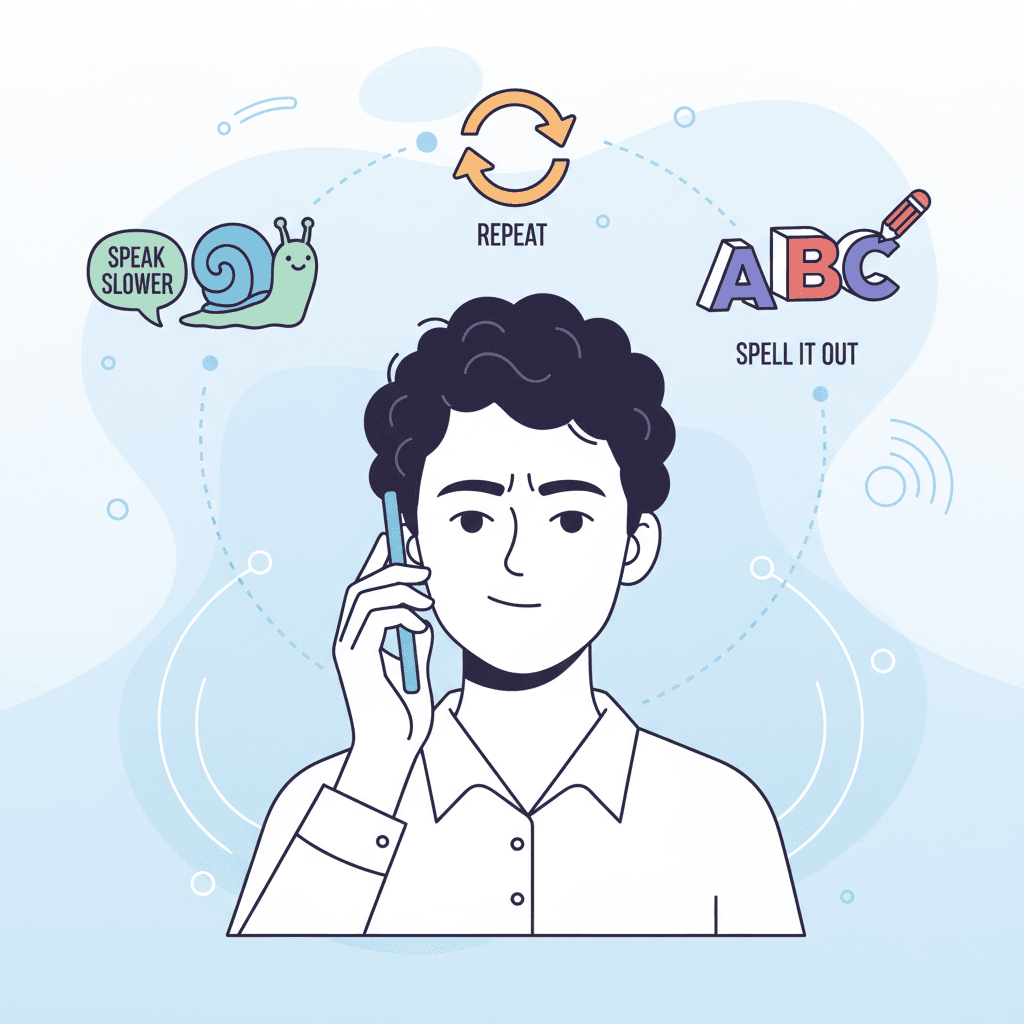
But here’s the reframe: an audio-only conversation is a powerful opportunity to train your listening skills in a focused way. By removing visual distractions, you force your brain to tune into intonation, rhythm, and word choice more carefully. Instead of a source of fear, you can see it as an intense but effective workout for your language brain. The key is having a system to manage the challenge.
Step 1: The Pre-Call Preparation System
Confidence comes from preparation. Walking into a phone call unprepared is like walking onto a stage without knowing your lines. To avoid that deer-in-the-headlights moment, you need a repeatable pre-call system. This isn’t about scripting every single word, but about creating a roadmap that keeps you on track, even if you get nervous. A good phone call script in a foreign language is your safety net.
The need for clear communication is more than just a personal goal; it has real-world implications. A 2026 report from AInora revealed that businesses can lose up to 29% of potential international customers simply due to an inability to communicate in their preferred language. Your preparation is a step toward bridging that gap. Here’s your checklist:
- 1.Define Your Goal: What is the single most important outcome of this call? Write it down. (e.g., 'Book a dinner reservation for two people at 8 PM on Saturday.')
- 2.Create Your Mini-Script: Outline the key points. This should include your opening line, your main question or statement, and a polite closing. Don't write a novel, just bullet points.
- 3.Gather Your Information: Have any necessary names, dates, numbers, or reference codes written down in front of you. This prevents panicked searching during the call.
- 4.Look Up Key Vocabulary: Based on your goal, what are the 5-10 words you absolutely need? Look them up and write down their pronunciation phonetically.
- 5.Prepare Your 'Escape' Phrases: What will you say if you don't understand? Have 2-3 'survival phrases' ready, like 'Could you please speak more slowly?' or 'I'm sorry, could you repeat that?'
Step 2: Practice Your Script in a Safe Environment
A script is just a piece of paper until you bring it to life. The biggest mistake learners make is spending all their time preparing and no time practicing. You need a space where you can make mistakes, sound silly, and build muscle memory without the fear of judgment. This is crucial to overcoming phone call anxiety in a foreign language.
This is where AI language tutors become your secret weapon. You can practice phone calls in another language without the pressure of a real person on the line. Modern platforms like the one offered by SpeaksyAI (speaksyai.com) are designed for this exact purpose. You can tell the AI, 'Let's role-play a phone call where I need to book a hotel room,' and it will engage in a natural, fluid conversation with you, simulating the audio-only environment and forcing you to rely solely on your listening and speaking skills.
The technology has advanced far beyond clunky, turn-based exercises. As industry development shows, modern AI voice tools now support simultaneous listening and speaking, which is perfect for simulating the flow of a real call. This kind of practice trains you to handle interruptions and think on your feet, allowing you to speak confidently on the phone when it really matters. Given that approximately 96% of global conversations feature at least one non-native English speaker, according to Kent State University, this practice is preparing you for a very common, real-world scenario.
The use of AI-powered multilingual communication tools grew 89% year-over-year in 2025, showing how rapidly AI is being adopted to overcome language barriers and build conversational fluency.
Step 3: Execution and In-Call Troubleshooting
It's showtime. You've prepared and you've practiced. Now it's time to make the call. Before you dial, find a quiet place where you won't be interrupted. Take a few deep breaths. It may sound silly, but smiling before you speak can actually make your voice sound warmer and more friendly. When you're ready, dial the number.
Start the call by speaking slowly and clearly. State your name and the reason for your call, just as you practiced. Don't rush. Giving yourself space to think is perfectly fine. Remember, the person on the other end is likely accustomed to speaking with non-native speakers—Kent State University research (2026) reminds us this is the case in about 96% of global conversations. But what happens when things go wrong?
Your 'What If...' Survival Guide
- •...I don't understand what they said? Use one of your prepared phrases: 'I'm sorry, I didn't understand. Could you please repeat that?'
- •...I forget a critical word? Don't panic. Describe it. 'I need the thing you use to open a door...' (a key). Most people are happy to help you find the word.
- •...the connection is bad? It's not your fault! Say: 'The connection is not very good. I'm having trouble hearing you.'
- •...I just get totally flustered? It's okay. Take a breath and say, 'One moment, please.' or 'I'm sorry, my [language] is not perfect.' A little honesty goes a long way.
Essential Phrases for Every Stage of the Call
Having a mental toolbox of essential phone call phrases is like having a map in an unfamiliar city. A 2024 guide from Unlock Learning Hub confirms that breaking a call down into stages is a systematic way to manage the conversation. Here are the key phrases you'll need, organized by when you'll use them.
1. Introductions & Greetings
- •Hello, this is [Your Name] calling.
- •Hi, my name is [Your Name] and I'm calling from [Company/Place].
- •May I speak with [Person's Name], please?
- •Is this a good time to talk for a moment?
2. Stating Your Purpose
- •I'm calling to ask about...
- •The reason for my call is regarding...
- •I would like to make an appointment/reservation.
- •I'm returning your call.
3. Asking for Clarification & Repetition
- •I'm sorry, could you please repeat that?
- •Could you speak a little more slowly, please?
- •I'm sorry, I didn't catch that last part. Could you say it again?
- •How do you spell that, please?
4. Handling Numbers & Spellings
- •Let me read that back to you to make sure it's correct.
- •So that's [number/spelling]?
- •Was that B as in 'Bravo' or V as in 'Victor'?
- •Just to confirm, the number is...
5. Taking/Leaving a Message
- •Could I leave a message for [Person's Name]?
- •Could you please ask them to call me back?
- •My phone number is [Your Number].
- •When is a good time to call back?
6. Ending the Call
- •Thank you so much for your help.
- •That's everything I needed, thank you.
- •Have a great day.
- •Goodbye.
Tackling High-Stakes Scenarios (Doctor, Landlord, Emergencies)
Some phone calls carry more weight than others. Calling a doctor, reporting a leak to your landlord, or handling an emergency requires a special level of clarity and confidence. The pressure is higher, and so are the stakes. A 2025 study by Pocketalk found that nearly one in five UK emergency workers (17%) face language barriers daily. Furthermore, 47% struggle to understand a caller's symptoms. This highlights why being prepared for these specific calls is so important.
A 2026 study on situational teaching proved that scenario-based training is highly effective for improving communication in high-stakes conversations. By practicing specific situations, you can significantly improve your ability to communicate critical information. Here are a few mini-scripts to get you started.
Mini-Script: Calling a Doctor's Office
- •Goal: Make an appointment.
- •Key Phrases: 'I'd like to make an appointment to see a doctor.', 'I am a new patient.', 'My symptoms are...'
- •Key Vocabulary: fever, headache, stomach ache, insurance card, date of birth, prescription.
Mini-Script: Calling Your Landlord
- •Goal: Report a maintenance issue.
- •Key Phrases: 'I'm calling to report a problem in my apartment.', 'The [item] is broken/leaking/not working.', 'My address is [address] and my apartment number is [number].'
- •Key Vocabulary: leak, electricity, heating, urgent, water, repair.
Mini-Script: Calling Emergency Services
- •Goal: Clearly state the emergency and your location.
- •Key Phrases: 'I need help.', 'There is a fire/medical emergency/crime.', 'My location is...'
- •Key Vocabulary: emergency, police, fire department, ambulance, address, help.
In these situations, you can't assume help will be available. A 2025 study found that 46% of emergency workers admit to lacking adequate translation resources. Practice saying your address and a simple description of the problem out loud until it becomes automatic.
The Rise of AI Phone Call Translators
What if you could have a live interpreter in your pocket for every call? That's the promise of a new wave of technology: the AI phone call translator. Driven by the explosive growth in AI communication, these tools represent a major shift from turn-based translation to fluid, simultaneous conversation.
Apps like AI Call and iTourTranslator allow you to dial a real phone number directly from the app. You speak in your native language, and the app translates your words for the person on the other end in near real-time. When they respond, the app translates their speech back to you. This technology can be a game-changer for complex or urgent calls where clarity is non-negotiable.
While these translator apps are a fantastic safety net for comprehension, they don't build your personal speaking skill. Think of them as a helpful tool, not a replacement for practice. As an Upstream Research report notes, fluid, real-time dialogue practice with AI conversation tools is what ultimately builds a learner's own speaking ability and confidence. Using a translator helps you get through one call; consistent practice prepares you for a lifetime of them.
Frequently Asked Questions
Frequently Asked Questions
Ready to Practice Your Next Phone Call?
Stop feeling anxious. Start practicing phone call scenarios in a low-pressure environment with your personal AI language tutor.
Join the Waitlist