How to Improve Listening Skills for Conversation: A 3-Step Plan
Tired of getting lost in conversations? This guide shows you how to improve your listening skills not just by hearing, but by actively understanding and responding.

It's a frustrating feeling we all know: you’re in a conversation, trying your best to keep up, but your mind starts to drift. Suddenly, you realize you've missed a key point and have no idea what to say next. If this sounds familiar, you're not alone. The journey of learning how to improve listening skills for conversation can feel intimidating, but the truth is, it's a completely solvable challenge. While studies show that a staggering 70% of effective communication hinges on active listening, only about 2% of people have actually mastered it. This isn't a personal failing; it's a sign that most of us were never taught how to listen effectively. This guide will change that.
Why You Really Get Lost in Conversations (It’s Not Your Fault)
The feeling of struggling to listen is incredibly common. When you’re learning a new language or just trying to connect better with colleagues, the pressure to understand everything perfectly can cause 'listening anxiety.' This is the brain freeze that happens when you miss one word and spend the next thirty seconds worrying about it, missing everything else in the process. It’s a form of cognitive overload, and it happens to the best of us.
Research from the Philadelphia College of Osteopathic Medicine highlights a major gap between perception and reality: while 96% of professionals believe they are good listeners, many cannot accurately recall a 10-minute presentation just moments after it ends. The primary barrier isn't external noise, but 'internal chatter'—the constant stream of thoughts, judgments, and replies forming in our own minds. This inner monologue prevents us from being fully present with the speaker.
But here’s the good news: listening isn't a fixed trait. As experts at UC Berkeley's Greater Good Science Center point out, it's a trainable, habit-based behavior. You can overcome challenges like 'brain freeze' by consciously building better listening habits. The first step is to give yourself permission to be a learner and embrace a system for improvement.
The Listen-Process-Respond (L-P-R) System for Active Listening

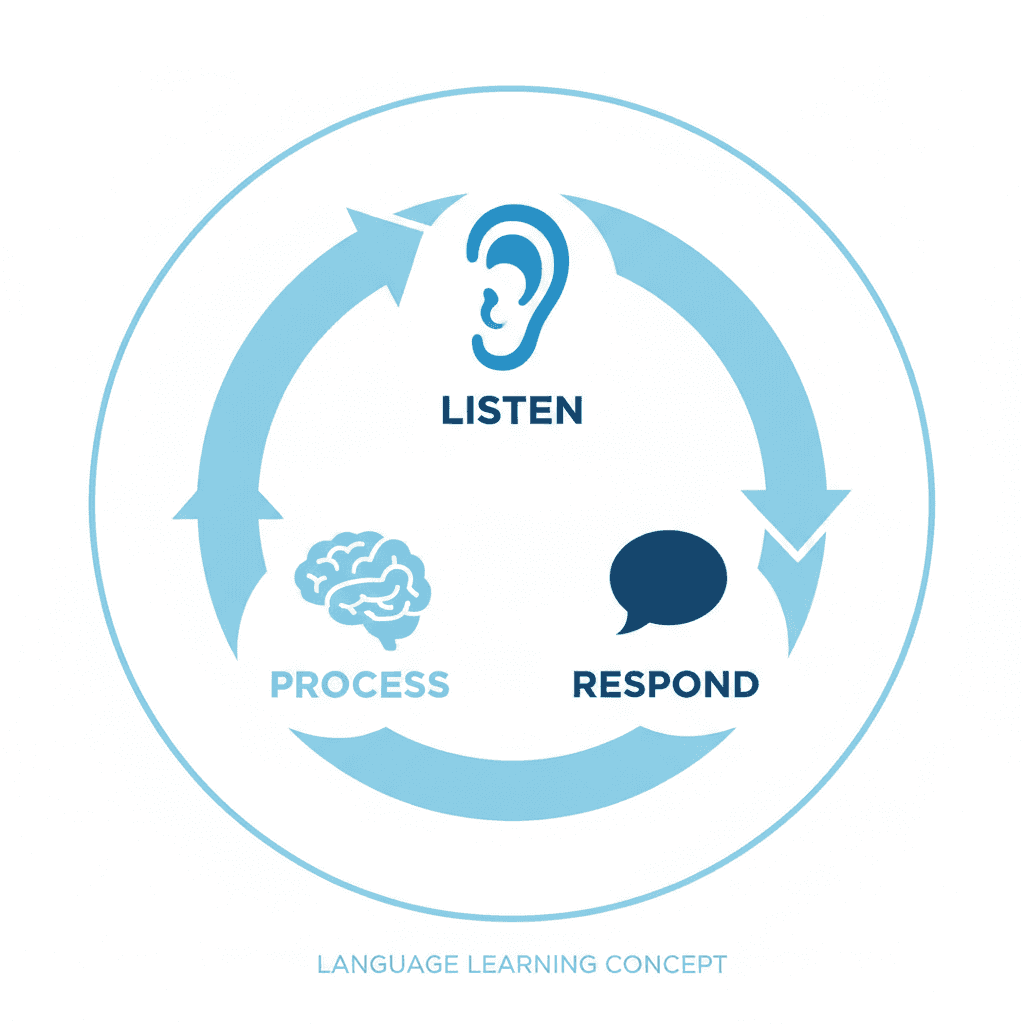
Instead of just 'trying harder' to listen, you need a structured approach. We call it the Listen-Process-Respond (L-P-R) System. This framework transforms listening from a passive activity (letting sound wash over you) into an active, three-step skill. It’s designed to quiet your internal chatter and give you a clear role at every moment in the conversation, helping you build the foundation to speak confidently.
This system isn't just theory; it's backed by science. A 2021 study published in PMC validated an active listening training model built on three core levels: sensing (Listen), processing (Process), and responding (Respond). Similarly, guidance from Stanford's Graduate School of Business reinforces this model by breaking active listening into distinct actions like paying full attention (Listen), pausing to reflect (Process), and summarizing to confirm understanding (Respond).
Step 1: Listen to Capture
The first step is the most radical: your only job is to listen. You are not planning your reply. You are not judging the speaker's ideas. You are simply capturing the full message. This means listening for more than just words. Pay attention to the speaker's tone of voice, their emotions, and their body language. What is the intent behind their words? Are they excited, concerned, or uncertain?
The moment you start crafting your reply, you stop listening.
This requires silencing your 'internal chatter.' When you notice your mind drifting to what you’ll say next, gently bring your focus back to the speaker. Think of yourself as a detective gathering clues. The goal is 100% focus on the other person. This single habit is the foundation of all active listening skills and is key to bridging the gap between the 98% of people who struggle with listening and the 2% who have mastered it.
Step 2: Process to Understand
This is the crucial middle step that most people skip. After the speaker has made a point (and before you jump in to respond), take a brief, silent moment to process what you just heard. This isn't an awkward silence; it's a thoughtful pause. During this step, your brain works to connect the dots.
- •Summarize their main point in your head. What is the single most important thing they just said?
- •Connect it to what they said earlier. How does this new information fit into the larger conversation?
- •Identify any emotions. Are they expressing frustration, enthusiasm, or something else?
- •Note any questions you have. What part of their message is unclear?
This 'process' step is where true comprehension happens. It’s the difference between hearing and understanding. By taking this small pause, you give your brain the space it needs to move from passively receiving information to actively making sense of it. The impact is significant: according to a 2023 Salesforce report, 74% of people feel more effective and valued when they feel their voice is truly heard and understood.
Step 3: Respond to Connect
Finally, you respond. But after following the first two steps, your response will be fundamentally different. Instead of just stating your own opinion, your goal is to formulate a reply that proves you were listening and connects back to their points. This is how you build rapport and trust.
- •Paraphrase for confirmation: Start with phrases like, "So, if I'm understanding you correctly..." or "It sounds like you're saying..." This confirms you got the message right.
- •Ask thoughtful, clarifying questions: Use the questions you noted during the 'Process' step. For example, "You mentioned [a specific point]. Could you tell me more about that?"
- •Acknowledge their feelings: Say things like, "I can see why that would be frustrating," or "That sounds like an exciting opportunity." This validates their emotional experience.
- •Link your response directly to their comments: When you share your thoughts, start by connecting them. "That's an interesting point about X. It makes me think about Y..."
Responding this way shows respect for the speaker and dramatically reduces misunderstandings. Research from 2022 in the Proceedings of the National Academy of Sciences even found that people feel more connected to conversational partners who respond thoughtfully, as it signals genuine interest and engagement.
How to Practice Your Listening System with AI
Knowing the L-P-R system is one thing; mastering it requires practice. While passive listening to podcasts or news from the US, UK, or Australia can help with accents and vocabulary, it doesn't train you for real-time interaction. This is where AI-powered language apps are changing the game, providing a space for dedicated conversational listening practice.
An AI language tutor provides a safe, low-pressure environment to apply the Listen-Process-Respond system without the fear of real-time judgment. You can have spontaneous conversations where your only goal is to practice. Can you listen to the AI's full response without interrupting? Can you pause to process its meaning? Can you respond by paraphrasing what it said?
Unlike scripted chat bots, advanced tools like SpeaksyAI are designed to provide truly dynamic conversations that prepare you for the real world. This type of interactive practice is the bridge between knowing the theory of active listening and having the confidence to use it. By getting instant feedback on your responses, you can refine your ability to reply effectively and build true conversational fluency.
How to Measure Your Listening Improvement
One of the best ways to stay motivated is to track your progress. But how do you measure something as intangible as listening? Instead of focusing on a final score, look for changes in your conversational habits. Here are a few self-assessment questions to ask yourself regularly:
- •Can I summarize the last 3-5 minutes of this conversation? The ability to restate key points is a core sign of comprehension.
- •Am I asking more clarifying questions? Shifting from making statements to asking questions shows a deeper level of engagement.
- •Am I interrupting less? Consciously waiting for the other person to finish their thought is a measurable improvement.
- •How often is my mind wandering? Notice if you're able to stay present for longer periods during conversations.
You can also measure your impact on others. Are colleagues or friends seeking out your opinion more often? Are you resolving disagreements more smoothly? These are signs that your improved listening is making others feel heard and understood—a powerful indicator of progress.
Frequently Asked Questions
Frequently Asked Questions
Ready to Practice Your Listening Skills?
Turn theory into practice. Get unlimited conversational practice with an AI language tutor that gives you instant feedback.
Join the Waitlist