How to Improve Grammar When Speaking: A 5-Step Action Plan
Struggle to use correct grammar when you speak? Go from knowing the rules to using them confidently. Our actionable plan helps you build spoken grammar 'muscle memory' for real-world conversations.

Do you know hundreds of grammar rules, but they all vanish the moment you open your mouth to speak? If you've ever wondered how to improve grammar when speaking, you're not alone. It’s one of the most common frustrations for language learners. You can read a sentence and spot an error instantly, but when you're in a conversation, the correct words just don't come out. This isn't a sign of failure; it's a normal part of the learning process. The good news is that there’s a clear, manageable path from knowing the rules to using them confidently in real life.
Why Your Grammar Knowledge Disappears When You Speak
The gap between what you know (passive knowledge) and what you can use in real-time (active use) is caused by something called 'cognitive load.' Reading and listening are input activities; your brain has time to process the information. Speaking is an output activity that happens in milliseconds. You’re simultaneously trying to formulate your thoughts, choose the right vocabulary, pronounce words correctly, listen to the other person, and, on top of all that, apply complex grammar rules.
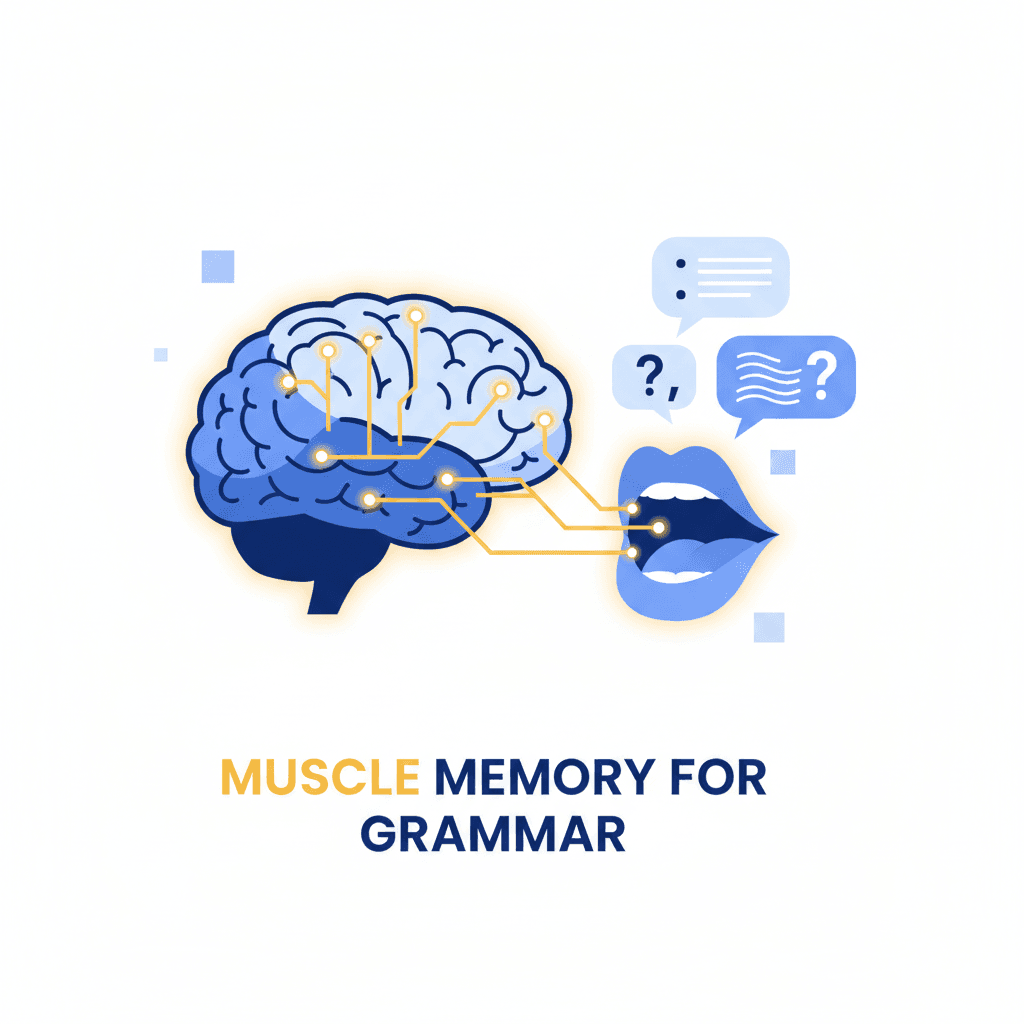
It’s like juggling. Trying to consciously apply grammar rules while speaking is like adding three more balls to your juggling act—it’s no wonder things start to fall apart. Research highlights that focusing too intensely on grammatical correctness during a conversation can increase this cognitive load, leading to more hesitation and disrupting the natural flow of speech. The key isn't to think harder, but to make the process more automatic.

This is where a concept called 'proceduralization' comes in. To move a grammar rule from passive knowledge to active skill, it needs to become an automatic procedure. Think of it like learning to drive a car. At first, you consciously think about every single step. But with enough practice, it becomes second nature. The same principle applies to spoken grammar. You need to practice using the rules until they become a reflex, not a calculation.
A key study published in The International TESOL Journal confirmed that the most effective approach is one that integrates explicit grammar teaching with real-life communication practice. This combination bridges the gap between passive knowledge and active use, improving both accuracy and fluency. The following steps will show you exactly how to do this.
Step 1: Find Your Pattern (What Are Your Common Spoken Grammar Errors?)
You can't fix a problem you don't know you have. Before you can improve, you need to identify your specific, recurring mistakes. Trying to fix everything at once is overwhelming and ineffective. Instead, become a detective and investigate your own speech. The best way to start is to record yourself.
Take your phone and record yourself speaking for 2-3 minutes. Talk about a simple topic you're comfortable with, like your day, your hobbies, or a recent movie you watched. Then, listen back. Don't cringe—listen with curiosity! What patterns do you hear? You can also use a transcription tool and read the text to spot errors more easily. This self-correction method is often more effective for long-term improvement than relying only on automated checkers. Your goal is to find your personal list of common spoken grammar errors.
Look for patterns in these key areas:
- •Subject-Verb Agreement: Do you say "she go" instead of "she goes"?
- •Verb Tenses: Are you mixing up past, present, and future tenses? (e.g., "Yesterday, I go to the store.")
- •Prepositions: Do you struggle with using words like in, on, at, and for correctly?
- •Articles: Are you forgetting to use a, an, and the, or using them incorrectly?
- •Plurals: Do you sometimes forget the '-s' on plural nouns?
Write down the top 2-3 mistakes you notice yourself making repeatedly. This isn't about judging yourself; it's about collecting data for your improvement plan. To help with this kind of analysis on a larger scale, researchers are even developing resources like the Speak & Improve Corpus, a massive collection of learner speech data designed to improve feedback on grammatical errors.
Step 2: Pick One Target, Master It
From the list of errors you created in Step 1, choose just one. This is the most important part of this step. Not two, not three. Just one. Let's say you noticed you often forget the '-s' in third-person singular verbs (e.g., "he walk" instead of "he walks"). For the next week, that is your only grammar mission.
This one-at-a-time method prevents you from feeling overwhelmed. It turns the giant, intimidating goal of "speak with correct grammar" into a small, achievable mission: "This week, I will focus on adding '-s' to my verbs." This approach is supported by research techniques like 'Focus on Form,' which highlight how concentrating on a single grammatical form makes it more noticeable and easier to produce correctly.
As language learning experts advise, breaking down grammar into manageable steps is key. The goal isn't to be perfect overnight, but to build a sustainable system for progress. Celebrate the small win of mastering one rule at a time.
Once you have your target, quickly review the rule. You probably already know it. The goal isn't to study the rule for hours, but to refresh it in your mind before you move on to the most crucial part: targeted practice.
Step 3: Build Muscle Memory with Targeted AI Practice
Now it's time to practice your single target grammar point until it becomes automatic. This is where AI-powered language tutors become your most valuable partner, offering a bridge between studying a rule and using it in a real conversation. With an AI tutor, you can have hundreds of targeted mini-conversations without the pressure of a human listener.
For example, if your target is the third-person '-s,' you can start a conversation with an AI tutor and say, "Let's talk about my friend. He is a doctor." Then, you can consciously practice using that structure over and over in a conversational context. Tell the AI about what he does, where he works, and what he likes. Platforms like SpeaksyAI are designed for this kind of spoken grammar practice, providing a safe space to make mistakes and receive immediate, non-judgmental feedback.
This process builds 'muscle memory' for grammar. Each time you correctly use your target structure, you strengthen the neural pathway, making it easier and faster to access the next time. The AI provides the perfect environment for this repetition, reducing the mental effort required to speak correctly in future, real-world situations. You’re not just learning a rule; you’re training your brain to use it on command.
It's a powerful method backed by data: research shows that learners who practice regularly with AI tutors that provide tailored feedback can improve their speaking confidence and accuracy significantly faster than those in traditional classroom settings alone.
Step 4: Bridge Your AI Practice to Real Conversations
Practicing with an AI is like using training wheels. It builds your confidence and skills in a safe, controlled environment. But eventually, you have to take the training wheels off and ride on your own. The next step is to take the grammar point you've mastered with your AI tutor and intentionally use it in real conversations.
Don't jump straight into a high-stakes job interview. Start small. Here's a simple plan to transition from AI practice to real-world application:
- 1.Find a low-stakes partner: Start with a trusted language exchange partner, a patient friend, or a tutor.
- 2.State your intention: Tell them, "I'm practicing my past tense today, so please let me know if you hear any mistakes."
- 3.Use your target grammar point: During the conversation, actively look for opportunities to use the structure you practiced. If you worked on past tense, tell a story about your weekend.
- 4.Focus on clarity, not perfection: Remember the goal is 'communicative clarity.' It's better to communicate your message with a small mistake than to be silent for fear of being wrong.
This blended approach is proven to be effective. A meta-analysis of dozens of studies found that the positive effects of AI on language learning are most significant when combined with human interaction. The AI builds the foundation and the muscle memory, and real conversation solidifies it.
Step 5: Rinse and Repeat for Continuous Improvement
Once you feel more confident with your first target grammar point in real conversations, what's next? You go back to Step 1. This five-step process isn't a one-time fix; it's a continuous cycle for improvement.
Listen to a new recording of yourself. Have you eliminated your first target error? Great! That's a huge win—celebrate it! Now, what is the *next* most common mistake on your list? Pick that as your new target and repeat the cycle: focus on that single point, build muscle memory with an AI grammar checker for speaking, and then bridge it to real conversations.
This cyclical approach turns the daunting goal of "perfect grammar" into a manageable, empowering system for lifelong progress. Recent studies confirm the power of this 'rinse and repeat' method, showing that learners who engage in repeated speaking tasks with AI support show significant improvements in grammatical accuracy and fluency. You are building your ability to speak English with correct grammar one small, manageable piece at a time.
Overcoming the Fear of Making Grammar Mistakes
For many learners, the biggest barrier to spoken grammar isn't knowledge—it's fear. The fear of making grammar mistakes can be paralyzing. Psychologically, this fear can activate the brain's threat response, which hinders learning and memory. It can lead to a 'silence spiral,' where you speak less to avoid errors, which means you get less practice, and your progress stalls.
The key is to reframe your mindset. A mistake is not a failure; it's a data point. It's a sign that you're pushing your boundaries and a clue about what to focus on next. Native speakers make mistakes in their speech all the time! The goal of language is to connect and be understood, not to pass a grammar test.
True fluency requires more than mastering grammar rules; it's about using the language as a tool for real-world interaction and communication.
Embrace 'communicative clarity' over 'grammatical perfection.' Did the other person understand your meaning? If so, you succeeded. Every conversation is a victory. This shift in perspective, combined with the confidence you build by practicing in a safe AI environment, is the most powerful way to finally correct grammar in conversation without the fear.
FAQs: Your Spoken Grammar Questions Answered
Frequently Asked Questions
Ready to Build Your Speaking Confidence?
Stop letting grammar rules hold you back. Start practicing in a supportive, judgment-free space with an AI tutor that's always available.
Join the Waitlist