How to Go From A2 to B1 Speaking: A 3-Month Activation Plan
Stuck at the A2 level? This guide provides a clear system to go from A2 to B1 speaking. Learn to activate your passive knowledge and start having real conversations.

The A2 Plateau is Real (But You Can Break It)
If you're stuck at the A2 level, you know the frustration. You can understand a good amount, you’ve memorized vocabulary, but when you try to speak, the words just won't come together. This guide provides your answer to how to go from A2 to B1 speaking. Forget random tips; this is The A2 to B1 Speaking System, a structured program designed to turn your passive knowledge into active, confident conversation. We'll give you a clear, actionable plan to break through the language learning plateau and start speaking with the fluency you've been working toward.
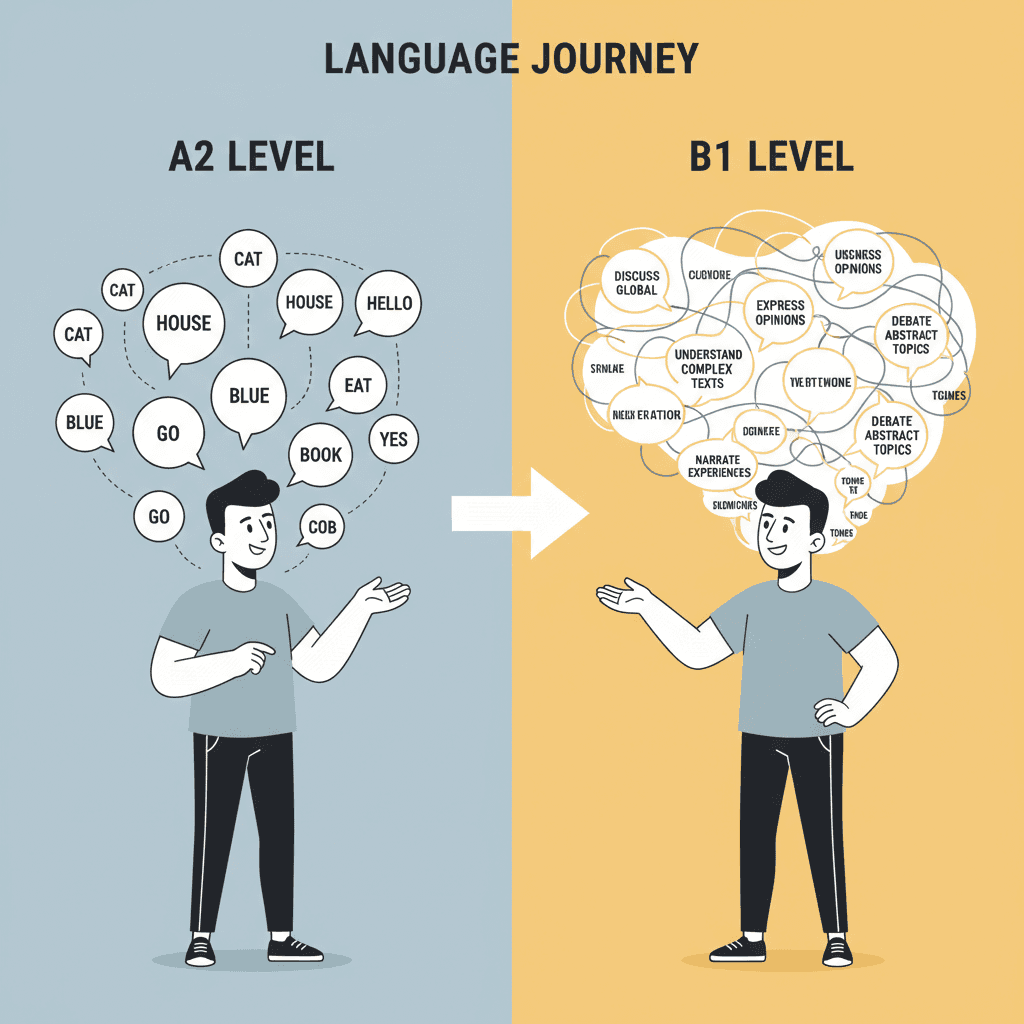
The feeling of being stuck is a well-documented phenomenon. Research from Pearson shows the A2 to B1 transition can take twice as long as A1 to A2. Why? Because it requires a fundamental shift. It’s no longer about just learning words; it’s about activating them. Many learners hesitate, waiting for perfect grammar, but B1 proficiency is about maintaining the flow of conversation, even with a few mistakes. This system is designed to help you overcome that fear and activate the language you already know, which, according to guides, can take between two to four months with consistent practice.
Twenty laser-focused minutes of daily practice are considered more effective than longer, infrequent study sessions for building conversational fluency.
The journey requires commitment—the A2 to B1 transition takes roughly 180 to 250 guided study hours for most adults. That’s why having a structured 'system' like this one is so crucial. It ensures your effort is focused, efficient, and directly targeted at developing the skills you need to finally feel like a confident speaker.
Step 1: Diagnose Your A2 Speaking Gaps (A 2-Minute Checklist)
Before you can build your path forward, you need to know exactly where you're starting from. The jump from an A2 speaking level to B1 is significant, requiring a focused effort. Use this quick checklist, based on the core competencies of a B1 speaker, to pinpoint your specific areas for improvement. Be honest with yourself—this is the first step toward targeted, effective practice.
- •Can you enter unprepared into a conversation on a familiar topic (like your job or hobbies)?
- •Can you narrate a story or describe an event using past, present, and future tenses?
- •Do you use connecting words like 'because,' 'so,' 'actually,' and 'although' to link your ideas, or do you speak in short, simple sentences?
- •Can you express your dreams, hopes, and ambitions, even if you have to search for words sometimes?
- •Can you handle most situations that might arise while traveling in a country where the language is spoken?
If you answered 'no' or 'not really' to several of these, don't worry! That's completely normal for an A2 learner. This checklist simply gives you your personal roadmap. It shows you the exact skills this system will help you build. The goal isn't perfection; it's progress. Now let's work on the mindset you need to tackle these gaps.
Step 2: Master the B1 Mindset: From Words to Ideas
The single biggest obstacle for A2 learners is the mental habit of translating everything word-for-word from their native language. To reach B1, you need a cognitive shift. You must move from thinking in individual words to thinking in 'chunks' and connecting whole ideas. This is the secret to sounding more natural and less robotic.
A B1 speaker doesn't just state facts; they explain, connect, and elaborate. They use conjunctions and discourse markers (like 'actually', 'so', 'you see') to weave sentences together into a coherent story or opinion. For example, instead of saying, "I went to the store. I bought bread. The store was busy," a B1 speaker might say, "I went to the store to buy some bread, but it was really busy, so I had to wait in line for a while."
Building this new mental habit takes time. Reaching a B1 conversational level requires approximately 350 to 400 hours of total structured learning. However, you can accelerate this process with focused daily practice. Just twenty minutes a day spent consciously trying to connect your thoughts with linking words is more powerful than hours of passive listening. This consistent effort is what builds the neural pathways for fluent, idea-driven speech.
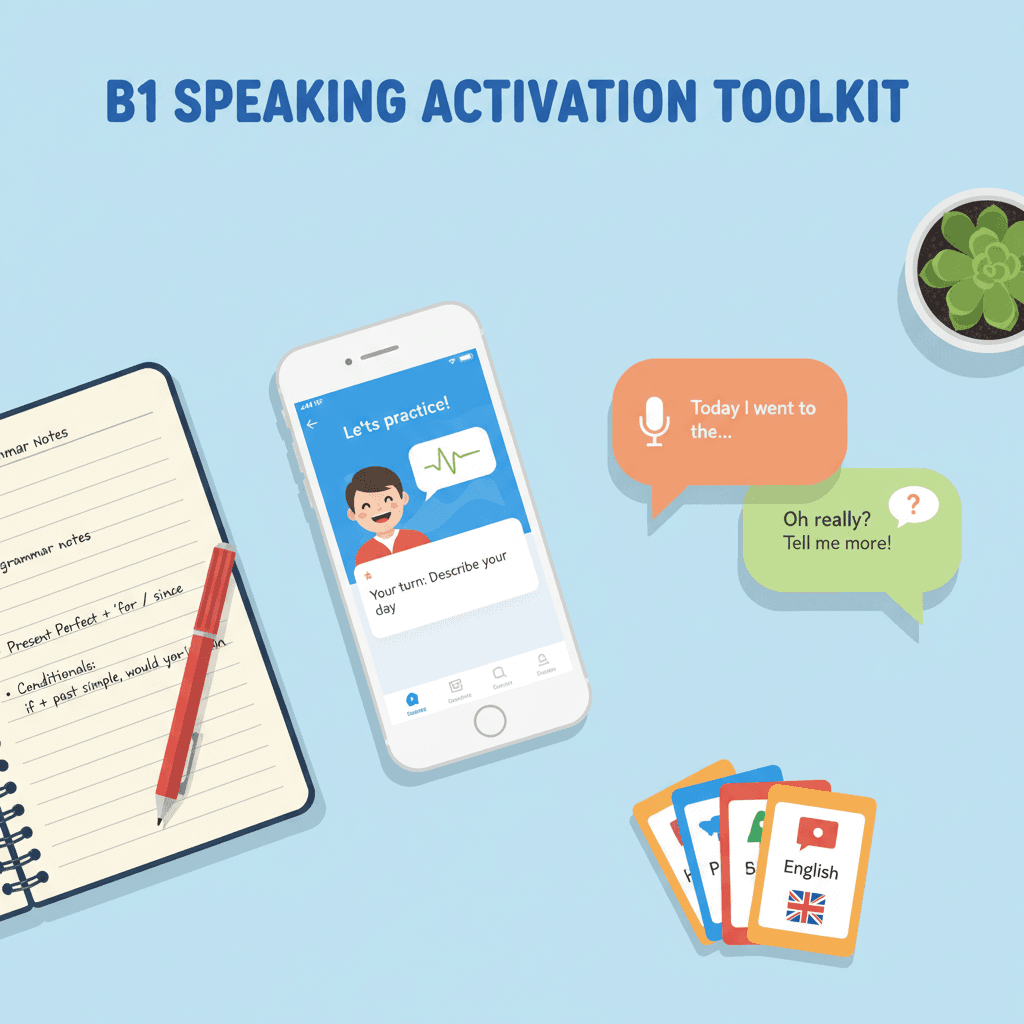
Step 3: Build Your B1 Speaking Activation Toolkit
With the right mindset, you now need the right tools and techniques to put it into practice. Activating your vocabulary means pulling it out of your memory and using it in real-time conversation. This section outlines the most effective methods to make that happen consistently. The goal is to create a daily routine that makes speaking a habit, not a special event.
One powerful technique is creating mental maps before you practice. If you plan to talk about your last holiday, spend two minutes brainstorming related words: 'beach,' 'flew,' 'hotel,' 'delicious food,' 'relaxing,' 'because it was sunny.' This primes your brain and makes the vocabulary accessible when you need it. Remember, consistency is key. A 2026 guide found that 20 laser-focused minutes of daily, conversation-first practice are more effective than sporadic, long study sessions.
AI-Powered Practice with SpeaksyAI
To build confidence, you need a safe space to make mistakes without judgment. This is where modern technology becomes your greatest ally. An AI language tutor gives you the ability to practice B1-level scenarios—like describing your experiences, giving opinions, or handling unexpected questions—on your own terms. Practicing daily with AI tools can improve fluency two to three times faster than passive methods alone.
Platforms like SpeaksyAI are specifically designed for this. You can have open-ended conversations and receive instant, private feedback on your pronunciation, grammar, and how naturally you speak. This 'conversation, correction, confidence' loop is crucial. It helps you identify and fix errors like direct word-for-word translation and build the muscle memory you need to speak confidently with real people in the US, UK, or anywhere else.
Targeted Practice with a Language Partner
Once you've built some initial confidence with an AI tutor, practicing with a language exchange partner is the next step. However, to truly accelerate your progress from A2 to B1, your sessions need structure. Unstructured chatting is often inefficient. Instead, agree on a specific goal for each session. For example, dedicate one conversation to only using past tenses to tell a story, and the next to describing your future plans and hopes.
Don't be intimidated if your partner is more advanced. Research shows that learners with lower competence levels benefit the most from virtual language exchange. Use your partner for real-time feedback. Ask them for more natural ways to phrase things. This exposure to authentic language and direct correction is invaluable for bridging the gap between textbook knowledge and real-world conversation.
Step 4: Your 12-Week A2 to B1 Speaking Plan
Knowing what to do is one thing; having a plan to do it is another. This 12-week roadmap breaks down the journey of how to go from A2 to B1 speaking into manageable, month-by-month goals. This structure turns an intimidating 180-250 hour mountain into a series of small, achievable hills. For learners in Australia, Canada, or India aiming for B1/B2 in 3-6 months, a daily commitment of 1-2 hours is often recommended, but even 20 focused minutes a day will yield significant results.
Month 1: Building Foundational Sentences
Focus: From simple sentences to connected thoughts. Goal: Confidently narrate your daily routine and simple past events using conjunctions (and, but, so, because) without long pauses.
Your mission this month is to build 'survival confidence'. This means moving from just answering questions to proactively explaining yourself. Dedicate your daily 20-minute practice sessions to this. Use a journal or an AI tutor like SpeaksyAI to describe what you did yesterday or what your typical workday looks like. Record yourself and listen back. Are you linking your ideas? The focus here isn't on complex grammar, but on flow and connection, the critical first skill separating B1 from A2.
Months 2-3: Expanding to Spontaneous Conversation
Focus: Expressing yourself and handling unpredictability. Goal: Comfortably enter an unprepared conversation on familiar topics, expressing opinions, hopes, and dreams.
Now you'll enter the 'EXPAND' phase. You have the foundation; it's time to build on it. Your practice should now shift toward more abstract topics. Talk about a movie you liked and why you liked it. Discuss your career ambitions or your dream vacation. The key is to practice handling unexpected questions. This trains you for real-world spontaneity, helping you move beyond 'robotic phrasing' and toward authentic communication. This is when you truly start to feel like a B1 speaker.
According to a 2026 guide, just 15-20 focused minutes of daily speaking practice can lead to B1-level performance in as little as 10-14 weeks. Consistency beats intensity. Find a time that works for you every day and stick to it.
Step 5: How to Measure Your Progress to B1
To stay motivated, you need to see your progress. But how can you measure something as fluid as speaking ability? The key is to move beyond just 'feeling' better and use objective metrics. A simple and powerful method is to record yourself once a week performing the same task, such as introducing yourself and your hobbies for one minute.
When you review your recordings, don't just listen for mistakes. Listen for tangible signs of improvement, which researchers have identified as key markers of progress from A2 to B1:
- •Fluency: Is your speaking tempo faster? Are you pausing less often to search for words?
- •Range: Are you using more words and a greater variety of vocabulary than you did last month?
- •Coherence: Are you speaking in longer, uninterrupted chunks of speech? Are you connecting your ideas with linking words?
- •Accuracy: While not the primary focus, are you starting to self-correct certain grammatical errors?
Tracking these small wins is incredibly empowering. It provides concrete proof that your hard work is paying off and helps you identify exactly what to focus on in your next practice session. Compare your performance to the official CEFR B1 descriptors to see how close you're getting to your goal.
Frequently Asked Questions
Frequently Asked Questions
Ready to Reach B1 and Speak Confidently?
Get personalized speaking practice and instant feedback with our AI language tutor. Sign up to be the first to know when SpeaksyAI is available.
Join the Waitlist