How to Give a Presentation in a Foreign Language: A System
Giving a presentation in a foreign language is daunting. This guide provides a step-by-step system to help you prepare, practice, and deliver your message with clarity and confidence.


Standing in front of an audience, ready to share your ideas, is a big moment. Doing it in a language that isn’t your first? That’s a monumental achievement. But for many, the fear of making mistakes can be overwhelming. If you've ever worried about how to give a presentation in a foreign language, you’re not alone. The good news is that with the right system, you can move past the anxiety and learn to speak confidently, focusing on what truly matters: connecting with your audience.
This guide provides a step-by-step action plan designed for non-native speakers. We'll shift your focus from impossible perfection to achievable clarity, script your talk for maximum impact, and show you how to use powerful tools to rehearse until you feel ready. Let's get started.
The Mindset Shift: Aim for Connection, Not Perfection
The single biggest hurdle in public speaking in a second language isn't grammar or vocabulary—it's fear. The pressure to sound like a native speaker is immense, but it's also a trap. It places the focus on avoiding errors rather than on sharing your message. The first and most crucial step is to redefine your goal. You're not aiming for a flawless performance; you're aiming for a genuine connection.
When you let go of the need for perfection, something amazing happens. Your delivery becomes more natural, your personality shines through, and your audience is more likely to engage with your ideas, not your accent. This isn't just a feel-good idea; it's backed by research into the psychology of language learning. Anxiety is often tied directly to how we perceive our own abilities.
The key is to shift your goal from perfection to connection. Your audience wants to understand your ideas, not score your grammar.
Embracing this mindset empowers you to view your accent as a part of your identity, not a flaw. It allows you to focus your energy on speaking clearly and passionately. Remember, your unique perspective as a non-native speaker is a strength. You've worked hard to master this language, and that dedication is something to be proud of.
Step 1: Script Your Talk for Clarity and Impact
Once you've embraced the right mindset, it's time to build the foundation of your confidence: a clear, powerful script. For a non-native speaker presentation, scripting isn't about creating something to be read word-for-word. It's about structuring your thoughts, simplifying your language, and giving yourself a reliable roadmap to follow.
Structuring Your Narrative
Forget trying to translate your presentation directly from your native tongue. That often leads to unnatural phrasing. Instead, build your talk in the new language from the ground up, using a simple story structure. A compelling narrative is far more engaging than a list of facts. Start with a problem or a question, guide the audience through your discovery process, and end with a clear solution or conclusion. This makes your content memorable and easier to follow, regardless of language.
Simplifying Complex Ideas
This is your chance to shine through clarity. Resist the temptation to use complex vocabulary or convoluted sentences to sound more 'academic' or 'professional.' The most impactful speakers use simple, direct language. Use short sentences. Stick to core vocabulary you are comfortable with. If you have to explain a complex topic, use analogies and strong visual aids to do the heavy lifting. Your goal is to be understood, not to impress with your lexicon.
Finding Your Key Phrases
Signposting is your best friend when presenting in a foreign language. These are the phrases that guide your audience through the talk, telling them what's coming next. They act as anchors for both you and your listeners. Memorize a handful of these phrases so you can deliver them smoothly, which builds momentum and confidence.
- •To introduce a topic: "Let's start by looking at..." or "The first point I'd like to make is..."
- •To move to a new section: "Now that we've covered X, let's turn to Y."
- •To give an example: "For instance..." or "A great example of this is..."
- •To summarize: "So, to recap..." or "In conclusion..."
Step 2: Rehearse with Your AI Presentation Simulator
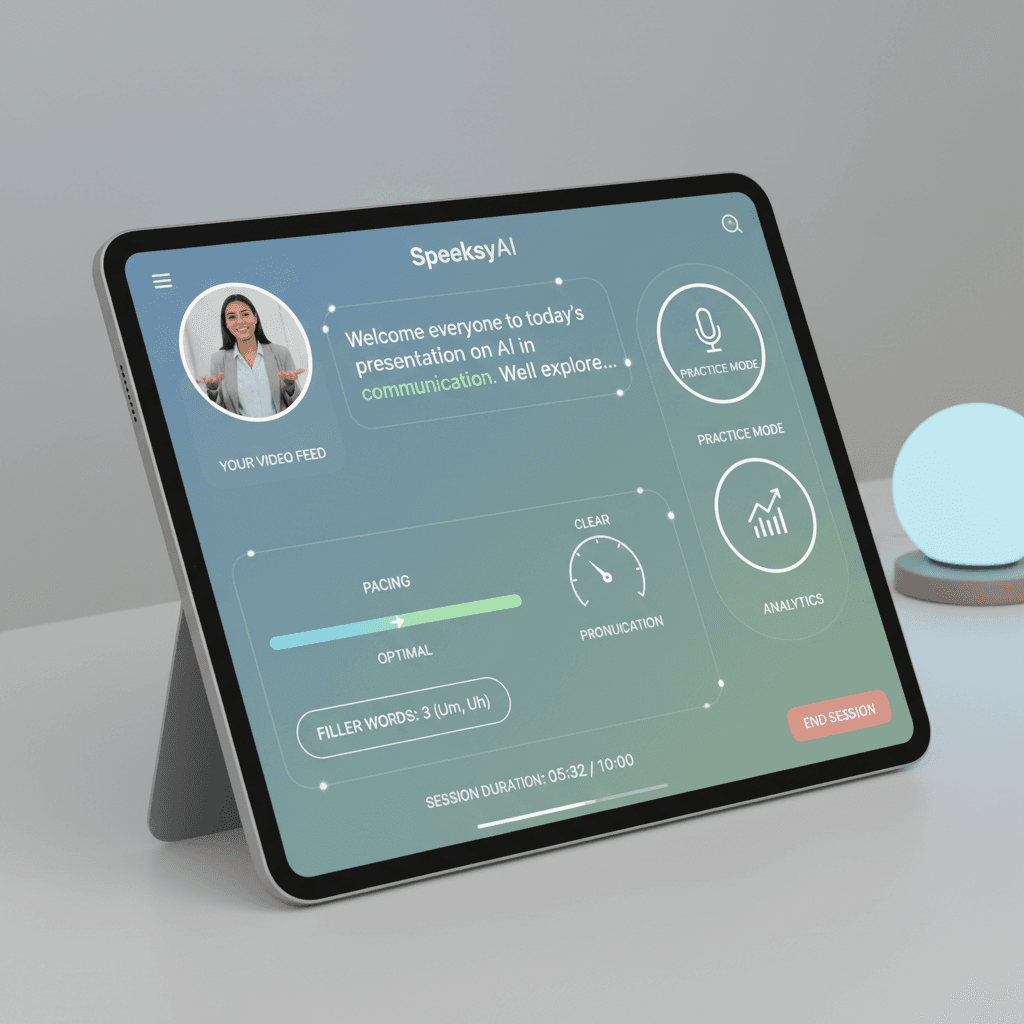
With your script ready, the next step is practice. But not just any practice. To build true fluency and confidence, you need to rehearse in a way that provides feedback without adding pressure. This is where technology becomes your personal coach. Think of it as a 'Presentation Simulator'—a space where you can run through your talk an unlimited number of times without fear of judgment.
Modern AI language tutors are designed for exactly this. Using a dedicated presentation practice app, you can paste in your script and deliver it section by section. The AI will listen and provide instant, private feedback on your pacing, clarity, and pronunciation. Are you speaking too quickly? Are certain words unclear? The AI can pinpoint these issues, allowing you to make targeted improvements.
This process of systematic, AI-driven practice directly tackles the root of public speaking anxiety. The more you rehearse and refine your delivery in this low-pressure environment, the more competent you will feel. This builds a powerful sense of self-efficacy that will stay with you when you step in front of a live audience. You'll know you can do it because you've already done it—many times.
Step 3: Master Delivery, Pacing, and Cultural Nuances
Communication goes far beyond words. Your body language, the pace of your speech, and your awareness of cultural norms all play a massive role in how your message is received. Now that you're confident with the content, it's time to perfect the delivery.
Record yourself practicing. Do you look confident? Are your gestures open and purposeful? Pay close attention to your pacing. Non-native speakers often rush when nervous, which makes them harder to understand. Use deliberate pauses to let key points sink in and to give yourself a moment to breathe and gather your thoughts. Use your slides as a teleprompter for your ideas, not your full script. They should support your words, not replace them.
Finally, be mindful of cultural presentation nuances. Humor that works well in the US might not land in Japan. The level of formality expected in Germany differs from the more casual style common in Australia. If you're presenting to an international audience, aim for a clear, professional, and universally respectful tone. Avoid slang, complex idioms, and culturally specific jokes.
Step 4: Master the Q&A in a Foreign Language
For many, the most intimidating part of a presentation is the question-and-answer session. The scripted part is over, and now you have to think on your feet. This is where fear of misunderstanding or not having the right words can spike. But you can prepare for this, too. The key is to anticipate, practice, and have a few 'survival phrases' ready.
First, brainstorm potential questions your audience might ask. Think about any areas of your presentation that might be confusing or controversial. Then, practice answering them—out loud. You can even use your AI tutor to role-play the presentation Q&A in a foreign language, asking it to pose questions about your topic. This helps you get comfortable with spontaneous speech in a controlled setting.
- •To ask for clarification: "I'm sorry, could you please repeat the question?" or "If I understand correctly, you're asking about... Is that right?"
- •To buy time to think: "That's an excellent question. Let me take a moment to think about that."
- •To rephrase in your own words: "So, you're asking why we chose method A over method B."
- •To politely defer: "That's a very detailed question. I can follow up with you by email with more specific information after the presentation."
Having these phrases memorized provides a safety net. They give you control over the conversation, ensure you understand what's being asked, and project confidence even when you're searching for the right words.
Step 5: Your Delivery Day Action Plan
The day of your presentation has arrived. You've done the hard work of scripting, rehearsing, and preparing. Now, it's all about managing your energy and mindset to ensure you can deliver your best performance. A solid day-of routine can make all the difference.
- 1.Do a final, light run-through. Don't try to cram. Just review your key points and opening/closing statements one last time to get them fresh in your mind.
- 2.Perform vocal warm-ups. Spend 5-10 minutes doing simple vocal exercises in the target language. Tongue twisters or simply reading a paragraph aloud can help get your mouth muscles ready.
- 3.Use deep breathing techniques. Research shows that physiological factors greatly influence presentation anxiety. Before you go on, take several slow, deep breaths to calm your nervous system.
- 4.Arrive early and test your tech. Eliminate any potential for last-minute technical stress. Make sure your slides, microphone, and any other equipment are working perfectly.
- 5.Connect with the audience beforehand. If possible, mingle with a few audience members before you start. Turning anonymous faces into friendly ones makes the experience feel more like a conversation.
- 6.Have your notes, not your script. Keep a simple list of bullet points or key phrases on a notecard or on the presenter view of your slides. This will keep you on track without tempting you to read.
When you step up to speak, remember your primary goal: connection. Smile, make eye contact, and speak from the confidence you've built through diligent preparation. You've earned this moment.
FAQ: Giving a Presentation in a Foreign Language
Frequently Asked Questions
Ready to Speak Confidently?
Knowing how to give a presentation in a foreign language is a skill, and like any skill, it's built through smart practice. By shifting your mindset to connection, scripting for clarity, and rehearsing systematically, you can overcome anxiety and deliver your message effectively. Your ideas are too important not to be heard.
Take the next step in your public speaking journey. Start using the SpeaksyAI tutor as your personal presentation simulator today and deliver your next talk with the confidence it deserves. Try it now.
Ready to Practice Your Presentation?
Get unlimited, judgment-free practice and instant feedback with your personal AI language tutor. Build the confidence to deliver your talk flawlessly.
Join the Waitlist