How to Disagree Politely in a Foreign Language: A System
Worried you'll sound rude when you disagree in another language? You're not alone. This guide provides a simple system to help you speak your mind respectfully and confidently.

Does your stomach clench at the thought of disagreeing with someone in your native language? Now imagine doing it in a foreign one. The fear of sounding rude, aggressive, or just plain wrong can be paralyzing. But what if you had a system for how to disagree politely in a foreign language—a clear, step-by-step method that builds confidence and turns potential conflict into constructive conversation? The truth is, mastering polite disagreement isn't just about avoiding offense; it’s a powerful communication skill that can lead to better outcomes. In fact, a 2026 study found that while negotiators felt less confident using a foreign language, they actually achieved better results because it forced more careful, analytical thinking. This guide will introduce you to the SpeaksyAI System for Polite Disagreement, a method designed to help you navigate these tricky conversations with grace and skill.
Why Disagreeing in Another Language Feels So Hard (and How to Fix It)
If you feel intimidated, you’re not alone. Disagreeing requires a high level of linguistic and cultural nuance. You're not just translating words; you're navigating complex social rules about hierarchy, directness, and respect. It’s a delicate dance, and the fear of stepping on someone’s toes is completely normal. In many cultures, like those in East Asia, directly saying 'no' can be seen as disruptive to group harmony, so people rely on indirect phrases to show respect (Cross-Cultural Communication in 2025, July 2025). This cultural layer adds a significant challenge for language learners.
The problem is often magnified by the medium. A study from UC Berkeley's Haas School of Business found that disagreements are perceived more reasonably and positively when they are spoken rather than written. Without the benefit of tone of voice and non-verbal cues, a written disagreement in an email or chat can feel much harsher than intended. This is why simply memorizing phrases isn't enough; you need to practice saying them.
But here's the encouraging part: the ability to disagree politely is a learnable skill. Research on Japanese learners of English showed they were able to acquire and successfully use different disagreement strategies over a ten-week period (Learning Politeness: Disagreement in a Second Language). You can too. The key is to move beyond random phrases and adopt a system. By breaking it down into assessing the context, choosing a strategy, and practicing in a safe environment, you can remove the guesswork and build the confidence to handle any conversation.
Step 1: Assess the Context (Formal, Informal, Cultural)
Before you say a word, you need to 'read the room.' The right way to disagree in a casual chat with a friend in Sydney is very different from a formal business meeting in Mumbai. Is the setting formal or informal? Are you speaking to a superior, a peer, or a subordinate? Your approach must adapt. Speakers must constantly 'read the room' and adjust their directness to the specific situation (Softening or intensifying your language in oppositional talk).
Cross-cultural communication styles exist on a spectrum. Some cultures, like German or Dutch, often value direct, 'involvement politeness,' where open debate is a sign of engagement. In contrast, other cultures, such as British or Japanese, often prefer indirect, 'deferent politeness,' where softening language and maintaining a degree of distance shows respect (Sheffield Hallam Working Papers). What is considered polite for maintaining social harmony in one culture might be seen as evasive or even insincere in another (The Pragmatics of Politeness in Cross-Cultural Communication, June 2024).
Interestingly, context can sometimes outweigh status. A fascinating July 2024 study published by MDPI on American speakers of Arabic found that the topic of conversation was the main driver of their disagreement strategy—often mattering more than the social status of the person they were speaking to. This shows that while cultural norms provide a baseline, the immediate situation and the sensitivity of the topic are just as crucial. Are you disagreeing about a project deadline or a deeply held personal belief? The former allows for more directness than the latter.
Step 2: Choose Your Strategy (Acknowledge, Soften, Pivot)
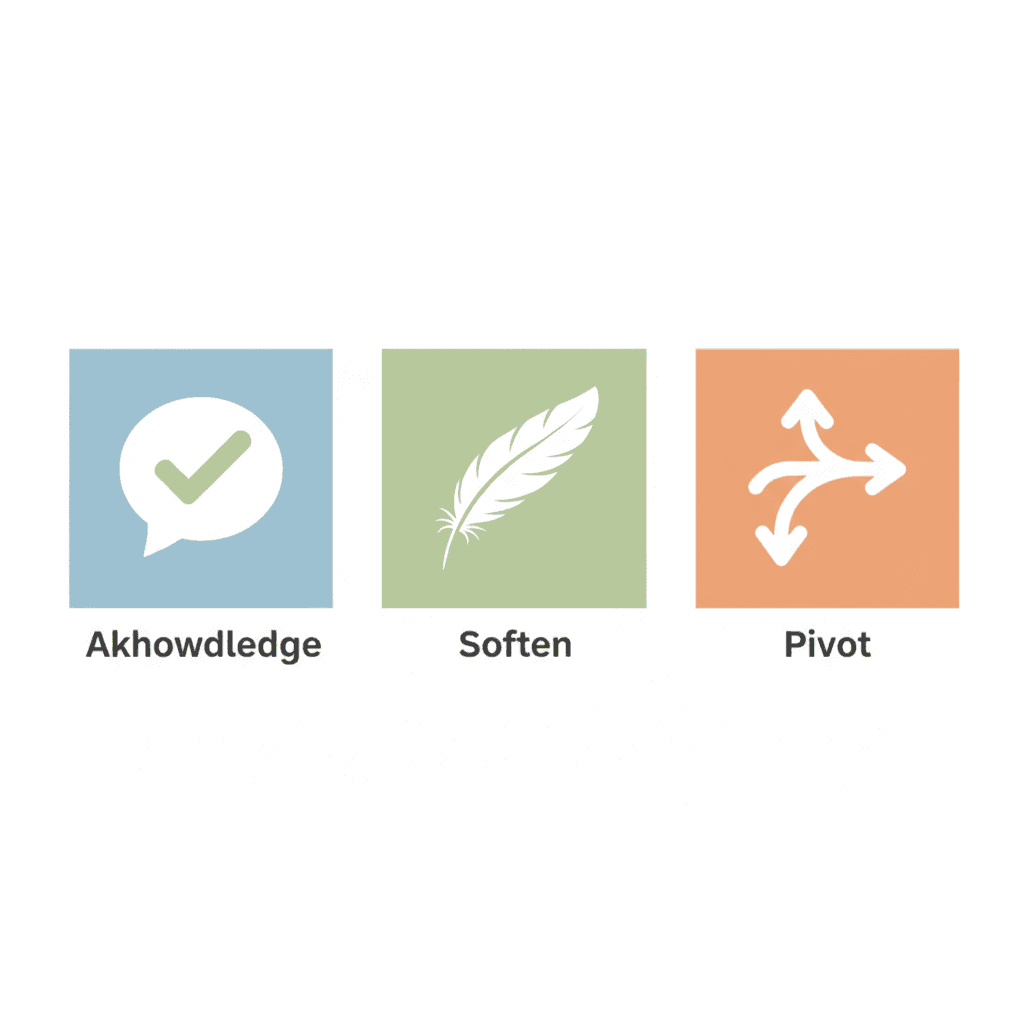
Once you've assessed the context, you can choose your strategy. Instead of blurting out 'I disagree,' you can follow a simple, three-part approach that preserves the relationship while making your point clear. This is the core of the SpeaksyAI system.
- •Acknowledge: Start by showing you've heard and understood their point. This validates the other person and makes them more receptive to your view. Phrases like 'I see what you mean' or 'That's a valid point' work well.
- •Soften: Use 'hedging' or 'softening' language to cushion your disagreement. These are words and phrases that make your statement less direct and absolute. Examples include 'I'm not so sure,' 'It seems to me,' or 'I could be wrong, but...'
- •Pivot: After acknowledging and softening, you can pivot to your alternative idea or opinion. Frame it as another perspective or a question, like 'Have we considered...?' or 'From my perspective...'
In many English-speaking professional environments, especially in the US and UK, this kind of softening language is essential. A direct 'I disagree' can be perceived as overly confrontational, especially in a cross-cultural communication context (Agreeing and Disagreeing Politely in English Across Cultures, 2026). This is one of the most important skills for anyone working in international teams.
A key strategy for softening disagreement is to first acknowledge the other person's idea positively before presenting your own, demonstrating that you have listened and value their input.
This isn't just about being 'nice'—it's about being effective. Teams that practice constructive conflict, which is built on this very skill of diplomatic disagreement, have been shown to financially outperform their peers, according to research cited by McKinsey (High Bridge Academy, 2026). The ability to express disagreement politely is a key ingredient for innovation and better decision-making.
Step 3: Master Key Phrases for Different Languages
With your strategy in mind, you can now plug in the right phrases. Below are examples for English, Spanish, and French, organized by the Acknowledge-Soften-Pivot method. Remember, your tone of voice is critical—a UC Berkeley Haas study found disagreements are perceived more positively when spoken, so practice saying these aloud.
English Disagree Politely Phrases:
- •Acknowledge: I see your point. / I understand where you're coming from. / That's a fair point.
- •Soften & Pivot: ...but I have a slightly different perspective.
- •Soften & Pivot: ...however, have you thought about...?
- •Soften & Pivot: ...on the other hand, it could be that...
- •Combined example: 'I see your point about the deadline, but I'm concerned we might need more time for quality assurance.'
Spanish Disagree Politely Phrases:
- •Acknowledge: Entiendo tu punto. / Comprendo lo que dices. / Es un buen argumento.
- •Soften & Pivot: ...sin embargo, yo lo veo de otra manera. (however, I see it differently.)
- •Soften & Pivot: ...no estoy del todo seguro/a de eso. (I'm not entirely sure about that.)
- •Soften & Pivot: ...con todo respeto, creo que... (with all due respect, I think that...)
- •Combined example: 'Entiendo tu punto sobre el presupuesto, sin embargo, yo lo veo de otra manera.'
French Disagree Politely Phrases:
- •Acknowledge: Je vois ce que tu veux dire. / Je comprends ton point de vue.
- •Soften & Pivot: ...cependant, je ne suis pas tout à fait d'accord. (however, I don't quite agree.)
- •Soften & Pivot: ...n'est-il pas possible que...? (isn't it possible that...?)
- •Soften & Pivot: ...de mon côté, je pense que... (for my part, I think that...)
- •Combined example: 'Je comprends ton point de vue, cependant, je ne suis pas tout à fait d'accord sur la stratégie marketing.'
Remember that politeness strategies are not universal; what works in one culture might not in another (ResearchGate). Always be observant. Notice how native speakers in your target language handle disagreements and adapt your own approach accordingly. Using softeners like 'I see your point, but...' is a great starting point for English, as it signals respect before presenting an alternative (FluentMinds, 2025).
Step 4: Practice Disagreeing in a Low-Stakes Environment
Reading about how to express disagreement is one thing; doing it under pressure is another. The final, most crucial step in this system is practice. You need to build muscle memory so that when a real-life situation arises, you can respond confidently instead of freezing up.
This is where modern technology becomes your best friend. AI language tutors provide the perfect low-stakes environment to practice these difficult conversations. On a platform like SpeaksyAI (at speaksyai.com), you can role-play challenging scenarios with an AI that gives you instant feedback on your grammar and phrasing, all without the social pressure or fear of offending a real person. As the UC Berkeley Haas study showed, spoken disagreements are perceived more reasonably, so verbal practice is essential for mastering the right tone and delivery.
To get started, try these role-play prompts with an AI tutor. The goal is to apply the Acknowledge-Soften-Pivot strategy out loud.
- 1.Your colleague in a US-based company presents a marketing slogan you think is ineffective. Politely offer a different perspective during your team meeting.
- 2.You're in a business meeting with your manager in the UK. They suggest a project timeline you believe is unrealistic. How do you express your concern while showing respect?
- 3.You're having a casual chat with a new friend in Canada. They state a strong opinion about a movie you love, saying they found it boring. How do you disagree without making it awkward?
- 4.An associate from your Indian office suggests a process change that you believe will create more work. Explain your reservations during a video call.
Practicing these scenarios does more than just build fluency; it builds a competitive advantage. With miscommunication in international business costing organizations trillions of dollars annually (FluentCap Blog, 2026), your ability to navigate cross-cultural disagreements with poise is an incredibly valuable asset.
Beyond Words: Non-Verbal Cues for Disagreement
Your words are just one piece of the puzzle. Nonverbal communication can account for as much as 55% of a message's meaning (Harnessing the Power of Body Language in Cross-Cultural Communication, March 2025). Your tone of voice, eye contact, and gestures can either reinforce your polite words or completely undermine them.
As we've seen, vocal tone is particularly powerful. The same phrase, 'I'm not so sure about that,' can sound curious and collaborative or dismissive and aggressive depending entirely on your intonation. This is another reason spoken practice is so vital—it trains you to match your tone to your polite intentions, a key finding supported by the UC Berkeley Haas study.
Gestures and facial expressions also vary wildly. A thumbs-up is positive in the US and Australia, but offensive in parts of the Middle East. A simple nod might mean 'I agree' in one culture, but just 'I am listening' in another. Misinterpreting these non-verbal cues is a significant challenge for global teams (Cross-cultural communication in global teams, April 2025). When you're unsure, the best strategy is to be observant. Pay attention to how locals use their hands, head, and expressions during discussions, and when in doubt, adopt a more neutral, still posture.
Frequently Asked Questions About Polite Disagreement
Frequently Asked Questions
Ready to Practice Speaking Confidently?
Get personalized feedback and practice tough conversations with your AI language tutor.
Join the Waitlist